 a formal, competitive debate format featuring
a sharply framed motion that is proposed by
one side and opposed by another. A winner
is declared in an Oxford-Style debate either
by the majority or by which team has swayed
more audience members between the two
votes.
Three Speakers from each side
First Affirmative - Constructive Speech
First Negative - Interpellation of the first affirmative Speaker
First Negative - Constructive Speech
First Affirmative - Interpellation of the first negative speaker
Second Affirmative - Constructive Speech
Second Negative - Interpellation of the second affirmative
Second Negative - Constructive
Second Affirmative - Interpellation of the second negative
Third Affirmative - Constructive Speech
Third Negative - Interpellation of the third affirmative
Third Negative - Constructive Speech
Third Affirmative - Interpellation of the third negative
Rebuttal of the Team Captain of the Negative Side
Rebuttal of the Team Captain of the Affirmative Side
 Constructive Speech: Minimum of five (5)
and maximum of seven (7) minutes
 Interpellation: Five (5) minutes
 Rebuttal Speech: Three (3) minutes
 A. Whether or not it is Necessary?
(Necessity)
 B. Whether or not it is Beneficial?
(Beneficiality)
 C. Whether or not it is practical?
(Practicability)
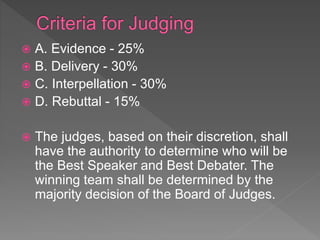
 A. Evidence - 25%
 B. Delivery - 30%
 C. Interpellation - 30%
 D. Rebuttal - 15%
 The judges, based on their discretion, shall
have the authority to determine who will be
the Best Speaker and Best Debater. The
winning team shall be determined by the
majority decision of the Board of Judges.
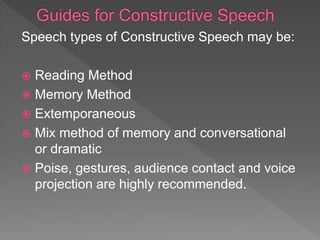
Speech types of Constructive Speech may be:
 Reading Method
 Memory Method
 Extemporaneous
 Mix method of memory and conversational
or dramatic
 Poise, gestures, audience contact and voice
projection are highly recommended.
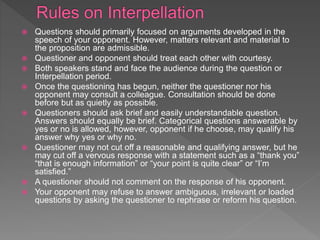
 Questions should primarily focused on arguments developed in the
speech of your opponent. However, matters relevant and material to
the proposition are admissible.
 Questioner and opponent should treat each other with courtesy.
 Both speakers stand and face the audience during the question or
Interpellation period.
 Once the questioning has begun, neither the questioner nor his
opponent may consult a colleague. Consultation should be done
before but as quietly as possible.
 Questioners should ask brief and easily understandable question.
Answers should equally be brief. Categorical questions answerable by
yes or no is allowed, however, opponent if he choose, may qualify his
answer why yes or why no.
 Questioner may not cut off a reasonable and qualifying answer, but he
may cut off a vervous response with a statement such as a “thank you”
“that is enough information” or “your point is quite clear” or “I’m
satisfied.”
 A questioner should not comment on the response of his opponent.
 Your opponent may refuse to answer ambiguous, irrelevant or loaded
questions by asking the questioner to rephrase or reform his question.
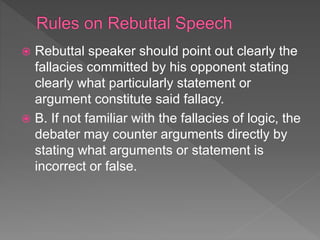
 Rebuttal speaker should point out clearly the
fallacies committed by his opponent stating
clearly what particularly statement or
argument constitute said fallacy.
 B. If not familiar with the fallacies of logic, the
debater may counter arguments directly by
stating what arguments or statement is
incorrect or false.
The moderator of the debate has the following
duties:
 To reveal the issue involve the debate;
 To rule on points of clarification about the
issues or questions and answers made
during the Interpellation; and
 To see to it that the debate is orderly and
follows the rules of parliamentary
procedures.
 To time the speakers and debaters
accurately;
 To give the speakers a one-minute warning
with the ringing of the bell once before
his/her time is up.
 To prevent the debaters from exceeding the
time allotted to them by ringing the bell twice.
CROSS EXAMINATION
The cross-examination period of a debate is a
time when the person who is not going to speak
next in the constructive questions the person
who has just finished speaking. Consider cross
examination an information exchange period - it
is not the time to role play lawyer.
Cross examination may serve six objectives:
› To clarify points
› To expose errors
› To obtain admissions to setup arguments
› To save prep time
› To show the judge how cool you are so they WANT to
vote for you
 Most debaters tend to ignore the value of good cross-
examination. Remember, 30% of the entire debate is spent
in cross-examination -- it should be a meaningful and
essential part of the debate. If nothing else, debaters tend
to underestimate the importance that cross-examination
may have on the judge. Cross-examination will indicate to
the judge just how sharp and spontaneous the debaters
are. Invisible bias will always occur in a debate round and
judges would always like the sharpest team to win. Good,
effective cross-examination of the opponents can play an
important psychological role in winning the ballot of the
judge.
 Be dynamic. Have questions and be ready to go, answer
questions actively and with confidence whenever you can.
The image you project will be very important to the
audience/judge. This is the one opportunity the
audience/judge has to compare you with opponents side-
by-side.
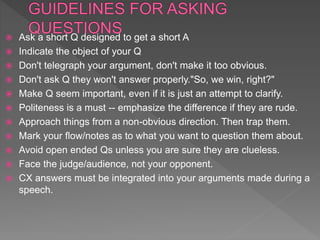
 Ask a short Q designed to get a short A
 Indicate the object of your Q
 Don't telegraph your argument, don't make it too obvious.
 Don't ask Q they won't answer properly."So, we win, right?"
 Make Q seem important, even if it is just an attempt to clarify.
 Politeness is a must -- emphasize the difference if they are rude.
 Approach things from a non-obvious direction. Then trap them.
 Mark your flow/notes as to what you want to question them about.
 Avoid open ended Qs unless you are sure they are clueless.
 Face the judge/audience, not your opponent.
 CX answers must be integrated into your arguments made during a
speech.
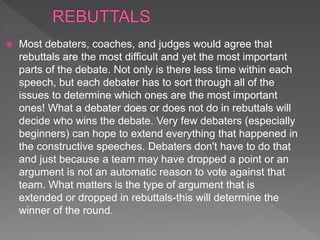
 Most debaters, coaches, and judges would agree that
rebuttals are the most difficult and yet the most important
parts of the debate. Not only is there less time within each
speech, but each debater has to sort through all of the
issues to determine which ones are the most important
ones! What a debater does or does not do in rebuttals will
decide who wins the debate. Very few debaters (especially
beginners) can hope to extend everything that happened in
the constructive speeches. Debaters don't have to do that
and just because a team may have dropped a point or an
argument is not an automatic reason to vote against that
team. What matters is the type of argument that is
extended or dropped in rebuttals-this will determine the
winner of the round.
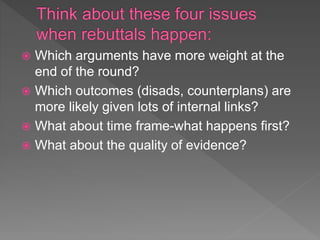
 Which arguments have more weight at the
end of the round?
 Which outcomes (disads, counterplans) are
more likely given lots of internal links?
 What about time frame-what happens first?
 What about the quality of evidence?
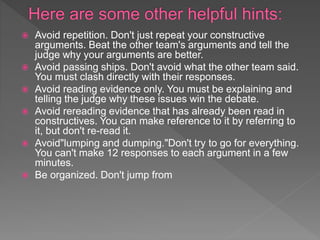
 Avoid repetition. Don't just repeat your constructive
arguments. Beat the other team's arguments and tell the
judge why your arguments are better.
 Avoid passing ships. Don't avoid what the other team said.
You must clash directly with their responses.
 Avoid reading evidence only. You must be explaining and
telling the judge why these issues win the debate.
 Avoid rereading evidence that has already been read in
constructives. You can make reference to it by referring to
it, but don't re-read it.
 Avoid"lumping and dumping."Don't try to go for everything.
You can't make 12 responses to each argument in a few
minutes.
 Be organized. Don't jump from
 Don't be a blabbering motormouth. Speak quickly but not
beyond your ability. If you speak too fast, you will stumble and
not get through as much.
 Don't whine to the judge about fairness or what the other team
might have done that you think is unethical. Make responses
and beat them.
 Don't make new arguments. You can read new evidence but you
can't run new disadvantages or topicality responses. You are
limiting to extending the positions laid out in the constructive
speeches.
 Use signposting . Make sure the judge knows where you are on
the flowsheet. This is not the time to lose the judge on the flow.
 Use issue packages. Organize your arguments into issue
packages. Choose arguments which you want to win. Don't go
for everything. Extend those arguments that you need to win.
 Cross-apply arguments. If you dropped an argument in a prior
speech that you think was important don't act like your losing.
Cross-apply arguments you made somewhere else in the
debate to answer it.

Oregon Oxford Debate Form.pptx

  • 2.
     a formal,competitive debate format featuring a sharply framed motion that is proposed by one side and opposed by another. A winner is declared in an Oxford-Style debate either by the majority or by which team has swayed more audience members between the two votes.
  • 3.
    Three Speakers fromeach side First Affirmative - Constructive Speech First Negative - Interpellation of the first affirmative Speaker First Negative - Constructive Speech First Affirmative - Interpellation of the first negative speaker Second Affirmative - Constructive Speech Second Negative - Interpellation of the second affirmative Second Negative - Constructive Second Affirmative - Interpellation of the second negative Third Affirmative - Constructive Speech Third Negative - Interpellation of the third affirmative Third Negative - Constructive Speech Third Affirmative - Interpellation of the third negative Rebuttal of the Team Captain of the Negative Side Rebuttal of the Team Captain of the Affirmative Side
  • 4.
     Constructive Speech:Minimum of five (5) and maximum of seven (7) minutes  Interpellation: Five (5) minutes  Rebuttal Speech: Three (3) minutes
  • 5.
     A. Whetheror not it is Necessary? (Necessity)  B. Whether or not it is Beneficial? (Beneficiality)  C. Whether or not it is practical? (Practicability)
  • 6.
     A. Evidence- 25%  B. Delivery - 30%  C. Interpellation - 30%  D. Rebuttal - 15%  The judges, based on their discretion, shall have the authority to determine who will be the Best Speaker and Best Debater. The winning team shall be determined by the majority decision of the Board of Judges.
  • 7.
    Speech types ofConstructive Speech may be:  Reading Method  Memory Method  Extemporaneous  Mix method of memory and conversational or dramatic  Poise, gestures, audience contact and voice projection are highly recommended.
  • 8.
     Questions shouldprimarily focused on arguments developed in the speech of your opponent. However, matters relevant and material to the proposition are admissible.  Questioner and opponent should treat each other with courtesy.  Both speakers stand and face the audience during the question or Interpellation period.  Once the questioning has begun, neither the questioner nor his opponent may consult a colleague. Consultation should be done before but as quietly as possible.  Questioners should ask brief and easily understandable question. Answers should equally be brief. Categorical questions answerable by yes or no is allowed, however, opponent if he choose, may qualify his answer why yes or why no.  Questioner may not cut off a reasonable and qualifying answer, but he may cut off a vervous response with a statement such as a “thank you” “that is enough information” or “your point is quite clear” or “I’m satisfied.”  A questioner should not comment on the response of his opponent.  Your opponent may refuse to answer ambiguous, irrelevant or loaded questions by asking the questioner to rephrase or reform his question.
  • 9.
     Rebuttal speakershould point out clearly the fallacies committed by his opponent stating clearly what particularly statement or argument constitute said fallacy.  B. If not familiar with the fallacies of logic, the debater may counter arguments directly by stating what arguments or statement is incorrect or false.
  • 10.
    The moderator ofthe debate has the following duties:  To reveal the issue involve the debate;  To rule on points of clarification about the issues or questions and answers made during the Interpellation; and  To see to it that the debate is orderly and follows the rules of parliamentary procedures.
  • 11.
     To timethe speakers and debaters accurately;  To give the speakers a one-minute warning with the ringing of the bell once before his/her time is up.  To prevent the debaters from exceeding the time allotted to them by ringing the bell twice.
  • 12.
    CROSS EXAMINATION The cross-examinationperiod of a debate is a time when the person who is not going to speak next in the constructive questions the person who has just finished speaking. Consider cross examination an information exchange period - it is not the time to role play lawyer. Cross examination may serve six objectives: › To clarify points › To expose errors › To obtain admissions to setup arguments › To save prep time › To show the judge how cool you are so they WANT to vote for you
  • 13.
     Most debaterstend to ignore the value of good cross- examination. Remember, 30% of the entire debate is spent in cross-examination -- it should be a meaningful and essential part of the debate. If nothing else, debaters tend to underestimate the importance that cross-examination may have on the judge. Cross-examination will indicate to the judge just how sharp and spontaneous the debaters are. Invisible bias will always occur in a debate round and judges would always like the sharpest team to win. Good, effective cross-examination of the opponents can play an important psychological role in winning the ballot of the judge.  Be dynamic. Have questions and be ready to go, answer questions actively and with confidence whenever you can. The image you project will be very important to the audience/judge. This is the one opportunity the audience/judge has to compare you with opponents side- by-side.
  • 14.
     Ask ashort Q designed to get a short A  Indicate the object of your Q  Don't telegraph your argument, don't make it too obvious.  Don't ask Q they won't answer properly."So, we win, right?"  Make Q seem important, even if it is just an attempt to clarify.  Politeness is a must -- emphasize the difference if they are rude.  Approach things from a non-obvious direction. Then trap them.  Mark your flow/notes as to what you want to question them about.  Avoid open ended Qs unless you are sure they are clueless.  Face the judge/audience, not your opponent.  CX answers must be integrated into your arguments made during a speech.
  • 15.
     Most debaters,coaches, and judges would agree that rebuttals are the most difficult and yet the most important parts of the debate. Not only is there less time within each speech, but each debater has to sort through all of the issues to determine which ones are the most important ones! What a debater does or does not do in rebuttals will decide who wins the debate. Very few debaters (especially beginners) can hope to extend everything that happened in the constructive speeches. Debaters don't have to do that and just because a team may have dropped a point or an argument is not an automatic reason to vote against that team. What matters is the type of argument that is extended or dropped in rebuttals-this will determine the winner of the round.
  • 16.
     Which argumentshave more weight at the end of the round?  Which outcomes (disads, counterplans) are more likely given lots of internal links?  What about time frame-what happens first?  What about the quality of evidence?
  • 17.
     Avoid repetition.Don't just repeat your constructive arguments. Beat the other team's arguments and tell the judge why your arguments are better.  Avoid passing ships. Don't avoid what the other team said. You must clash directly with their responses.  Avoid reading evidence only. You must be explaining and telling the judge why these issues win the debate.  Avoid rereading evidence that has already been read in constructives. You can make reference to it by referring to it, but don't re-read it.  Avoid"lumping and dumping."Don't try to go for everything. You can't make 12 responses to each argument in a few minutes.  Be organized. Don't jump from
  • 18.
     Don't bea blabbering motormouth. Speak quickly but not beyond your ability. If you speak too fast, you will stumble and not get through as much.  Don't whine to the judge about fairness or what the other team might have done that you think is unethical. Make responses and beat them.  Don't make new arguments. You can read new evidence but you can't run new disadvantages or topicality responses. You are limiting to extending the positions laid out in the constructive speeches.  Use signposting . Make sure the judge knows where you are on the flowsheet. This is not the time to lose the judge on the flow.  Use issue packages. Organize your arguments into issue packages. Choose arguments which you want to win. Don't go for everything. Extend those arguments that you need to win.  Cross-apply arguments. If you dropped an argument in a prior speech that you think was important don't act like your losing. Cross-apply arguments you made somewhere else in the debate to answer it.