Complete Engineering Solutions…
Drying of Wet Solid
Who are we…
Conceptualized
and shaped in
1976
One of the most
admired and
valuable
company for
customer
satisfaction.
We are pioneer
in application
and
implementation
engineering
40+ years
experience in
engineering
excellence.
Immense
expertise in
providing
engineering
solutions.
Witnessed
growth in
revenue and
team strength
YoY
ISO 9001:2008 | ISO 9001:2015 | OHSAS 18001 | EMS 14001
Recognized and Rated by
CRISIL
CRISIL Verified
Member of A.M.P.E.R.E.
(Europe)
ASCB(E) Certification for
Best practice
Member of AIMCAL Member of IHEA
Strategic Partners of
Emitech Italy
IRQAO Certified For
Quality
We are accredited by…
Why We…
Drying- Introduction …
• Drying – is an operation in which the liquid, generally water,
present in a wet solid is removed by vaporization to get a
relatively liquid-free solid product.
• Drying – removal of moisture from a wet solid, a solution or a
gas to make it dry is often necessary in industries.
• Examples: Sugar Production – final stage
• Washed and centrifuged sugar crystals are dried to get a
finished product for packaging.
• Drying of leather under controlled condition in leather
processing.
• Soap bars are dried to reduce moisture content.
• Drying of a solid does not demand or ensure complete removal
of the moisture.
• Sometimes it is desirable to retain a little moisture in the solid
after drying.
• How does filtration, settling, centrifugation vary from drying?
• The first three process are based on mechanical separation and
often need drying as final step.
• Drying is basically governed by heat and mass transfer principles.
• When a wet solid is heated to an appropriate temperature, moisture
vaporizes at or near the solid surface.
• The heat required is supplied by a hot gas.
• As the moisture is vaporized from the surface more moisture is
transported from inside the solid to its surface.
• Moisture can move within the solid by various mechanisms –
depending upon solid type and state of aggregation.
Drying Process…
Types of solids for drying
• Mechanism of moisture transport in different solids:
• Transport by capillary forces
• Liquid diffusion
• Pressure induced transport
• Vapour diffusion
• The dominant mechanism depends on nature of solid, its pore structure
and drying rate
1
• CRYSTALLINE
(SUGAR, SALT
ETC)
2
• GRANULAR
3
• POWDERS
4
• BEADS
5
• SHEETS
6
• FILTER-CAKES
Stages of drying of moist solid…
The solid is
uniformly wet
The upper region
is partly dry
a b
The upper region
of the solid is dry
c
• The resistance to moisture diffusion increases from (a) to (b) to (c) and the drying rate decreases
Vertical arrows indicate direction of diffusion.
Transport resistance in drying
process…
Resistance to convective heat transfer from
bulk gas to solid surface.
Resistance to liquid or vapour transport inside
solid1
Convective mass transfer of vapour from
solid surface to bulk gas2
3
Conduction resistance due to heating of solid at
low temperature operations4
Three major Transport resistance play important
role in drying
Case Hardening …
In certain solids like soap bar
If drying is rapid, the outer surfaces lose moisture very
quickly, become hard and does not allow moisture to
pass through (impervious) to gas.
Under such condition, drying almost stops although
sufficient moisture is still there inside.
Such solids are dried in a controlled rate by adjusting
temperature and humidity.
3
1
2
Drying Phase Equilibria…
• Drying equilibria – relation between the moisture content of a solid and the
humidity of the ambient air at equilibrium.
• If a wet solid is exposed to a continuous supply of fresh gas with partial pressure
pA,
• The solid will either lose moisture by evaporation or gain moisture from the gas,
• Until the PAsatvapour pressure of moisture in solid equals the partial pressure of
gas (PAsat = pA)
• When PAsat of moisture in solid is equal to pA of moisture in gas,
• The solid and the gas are then in equilibrium.
• The moisture content of the solid is termed as its equilibrium-moisture content at
the prevailing conditions.
• Equilibrium moisture in a solid can be determined experimentally by keeping the
solid suspended in a gas at constant humidity and temperature for a sufficiently
long time.
• The liquid content of dried solid varies from product to product.
• Occasionally, the product contains no liquid and is called bone-dry.
Equilibrium moisture isotherms
• Consider the point M on curve 6 for wheat
• At (pt.M) relative humidity is RH=1 and the moisture content is XM
• For moisture content equal to or more than XM
• The equilibrium vap.pr. exerted by the solid is equal to the vapour
pressure of water at T (RH=1).
• At moisture content less than XM solid exerts vap. Pr. Less than
that of pure water.
• All moisture in the solid above XM is unbound moisture
• All moisture below XM is bound moisture
Important Definitions…
Moisture Content
Moisture present in the solid (kg
moisture /kg dry solid).
Bound Moisture
The amount of moisture that exerts a
vapour pressure less than the vapour
pressure of water at the given T.
Unbound Moisture
Amount of moisture in a wet solid in
excess of the bound moisture
Equilibrium Moisture
Moisture content in a solid that can
remain in equilibrium with the drying
medium of a given relative humidity at a
given T.
Free Moisture
Moisture in a wet solid in excess of the
equilibrium moisture is called free
moisture
Important Definitions…
• A solid with initial moisture content Xi is dried in contact with gas
of relative humidity RH .
• The moisture in solid exerts a vapour pressure PAsat equal to
that of pure water till a moisture Xb is reached.
• (Xi-Xb) is the unbound moisture.
• As moisture decreases below Xb, the vapour pressure also
decreases.
• As moisture in solid reaches X* , the vapour pressure in solid
becomes equal to the partial pressure of water vapour in gas.
i.e. it reaches the equilibrium moisture content. Corresponding
relative humidity is R*H
• Xb is –bound moisture
• Xi - X* - the free moisture content.
Drying Rate Curve…
• Time required for drying of a moist solid to a final moisture be can
determined from rate of drying under a given conditions.
• Drying rate of a solid is a function of T, Y’, Q, NRe, NScof drying
gas.
• Drying rate has to be determined experimentally.
• The moist solid is taken on a pan which is kept suspended in a
drying chamber.
• Drying gas is passed at a given flow rate
• Change in mass of solid with time is recorded.
• Mass of bone dry solid is determined separately
Drying Rate Curve cnt…
• Ws=mass of bone dry solid
• a = drying area i.e. exposed area to gas
• X = moisture content at any time t,
• dX/dt is slope of X-t plot. It is negative quantity.
Rate of drying is A plot of N vs X (moisture content) is
called drying rate curve
Drying Rate Curve cnt…
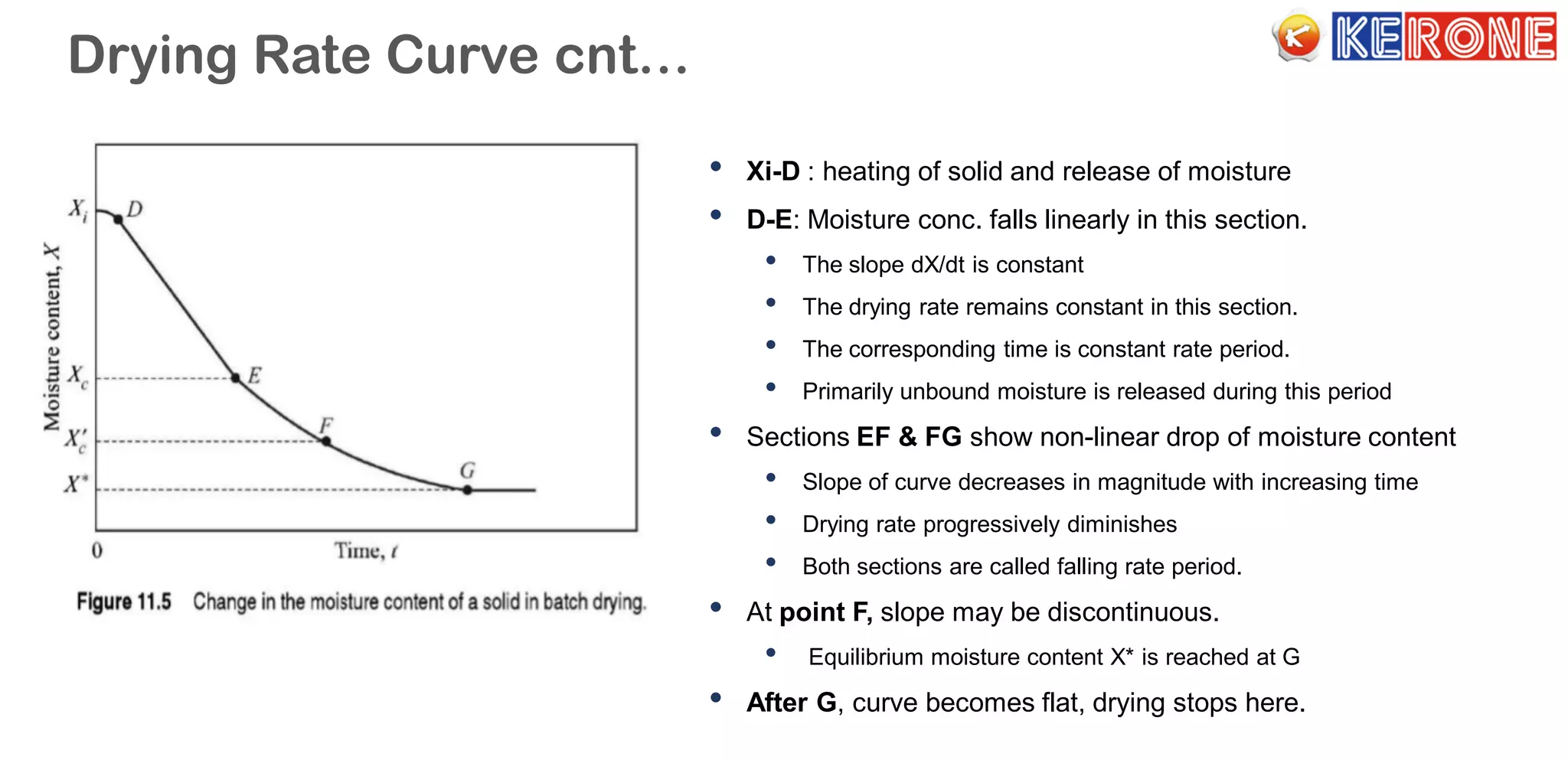
• Xi-D : heating of solid and release of moisture
• D-E: Moisture conc. falls linearly in this section.
• The slope dX/dt is constant
• The drying rate remains constant in this section.
• The corresponding time is constant rate period.
• Primarily unbound moisture is released during this period
• Sections EF & FG show non-linear drop of moisture content
• Slope of curve decreases in magnitude with increasing time
• Drying rate progressively diminishes
• Both sections are called falling rate period.
• At point F, slope may be discontinuous.
• Equilibrium moisture content X* is reached at G
• After G, curve becomes flat, drying stops here.
Drying Rate Curve cnt…
• Section PQ: solid gradually is heated and rate of
drying increases.
• Over section QR: drying rate remains constant at Nc.
• Moisture content at R: is critical moisture content Xc
(the point where constant rate period end)
• Section RS is called first falling rate period.
• Section ST is second falling rate period.
Drying rate curve corresponding to
t-X curve is shown…
Mechanism of moisture transport…
• Moisture transport mechanism and drying is different
over different ranges of time.
• At constant rate period : Solid surface is uniformly
moist due to rapid transport of moisture from inside
solid to its surface.
• Virtually no resistance to liquid transport in the solid.
• At end of constant rate period: dry patches appear on
surface because capillary forces are no longer able to
transport enough moisture to keep entire surface moist.
• First falling period: drying rate is governed by combined
resistances
• Resistance to liquid or vapour transport inside solid.
• Resistance to convective mass transfer of vapour from
surface to bulk of drying gas.
• Second falling period: moisture content of solid becomes
quite low.
• Internal diffusion of moisture essentially controls the rate of
drying.
Critical Moisture Content (CMC)…
• CMC of wet solid is not a constant quantity.
• It depends on factors like
• Pore structure and particle size of solid.
• Bed thickness of wet solid.
• Drying rate.
• CMC: is viewed as transition of the nature and of mass transfer
resistance towards drying.
• For small solid particles: intra-particle resistance to moisture
transport is less.
• Constant rate of drying continues for longer period.
• CMC may be less than that of larger solid particles of same material.
• Solids with more and large pores & small bed thickness CMC is
small.
• More hot air (larger drying rate): CMC is larger due to resistance to
internal moisture diffusion in solids.
Classification of Dryers…
Tray Dryer…
• Direct heat batch dryer is simple in construction.
• They contain trays, trucks, shelf etc.
• The wet material is spread evenly on the trays
which are stacked one over the other.
• Drying gas (air) is generally heated by steam
coils.
• The blower or fan forces the hot gas to flow over
the trays
Rotary Dryer…
• Rotary driers are work horse of chemical dryer
• Most widely used continuous dryers in process industries.
• Suitable for relatively free flowing, non-sticky, granular materials.
• Almost all types of crystals after crystallization and washing are dried by
this drier.
• A rotary drier consists of a slowly rotating slightly inclined cylindrical shell.
• It is fed with moist solid at the upper end.
• The material flows along the rotating shell.
• Gets dried and leaves the dryer at the lower end.
• Supply of heat may be done directly or indirectly.
• In direct heat is supplied – it is direct heat rotary dryer
• In indirect heat supply – it is indirect heat rotary dryer. • Hot gas may flow
directly parallel of counter currently to the feed.
• In indirect dryers: het is supplied through shell wall by a hot flue gas
flowing outside.
Drying of
table salt
Ammonium
sulphate
Sodium
sulphate
Drying of
sand
Drying of
minerals
Drying of
organic
solids
Drying of
polymer
Direct Heat Rotary Dryer …
Flash Dryer…
• The flash dryer is also called Pneumatic conveyer.
• It consist of a vertical conveyer pipe into which the wet solid is fed near the
bottom.
• Hot air enters the dryer at a point below the solid feeding point at 20 to 30 m/s.
• Velocity should be high enough to convey the solid through dryer.
• Small residence time: 1 to 10 s (generally 3 s)
• Drying rate is very high – that why it is called a flash dryer.
• Solid temperature does not rise much because of short residence time.
• Solid temperature often remains at wet bulb temperature of drying gas.
• Suitable for removing heat sensitive material.
• Often used for removing surface moisture
Belt or Conveyer Dryer…
Indirect Heat Dryers: Drum Dryer…
• A drum dryer consists one or more steam heated rotating drums.
• The feed, a solution or a slurry forms a thin layers on the drum.
• The film thickness can be controlled by adjusting the gap between the drums.
• The feed gets dried in contact with the heated drums
• A cyclone is at the top separates the solid from the gas.
• Inlet gas temperature is very high.
• A gas , (air) may be blown over the surface for quick removal of moisture
• The dry product is scrapped off as flakes by a knife.
• Speed of rotation, 1-24 rpm
• Drying rate-10-30 Kg/m2.h
• Drum dryer is suitable for materials that is too thick for spray drying and too
thin for a rotary dryer.
Calculation of drying time from drying rate data
• The drying time can be calculated from drying rate data from lab
experiments
• The drying conditions – velocity, T, Y’ of hot gas(air), geometry of drying
solid should be same.
• Lab experiments are generally done at constant drying conditions.
• Intial moisture content of solid = Xi
• It has to be dried to final moisture content = Xf
• Mass of bone dry gas = Ws
• Drying area = ‘a’
• Drying rate N is constant at Nc till Xi =Xc
• X≥ Xc, N=Nc = constant
• But N depends on X when, X≤ Xc, N=N(X)
• So integration has to be done for two intervals..
Calculation of drying time from drying rate data
• The second integral may be evaluated graphically or numerically if
the tabular data N vs X is available.
• If N decreases with X as a linear function, in the falling rate period,
• N=pX + q
Drying rate N=0, at equilibrium X=X*
Substituting these results in below
equation
Mechanism of Batch Drying …
Cross Circulation Drying
Mechanism of Batch Drying …
• Constant rate period: In this period, surface evaporation of
unbound moisture occurs.
• The rate of drying is established by
• a balance of heat requirements for evaporation and the
rate at which heat reaches the surface.
• The rate at which moisture evaporation is given by
Nc = KY (Ys-Y) (1)
• Consider a section of a material drying in a stream of gas.
• The solid of thickness = zS is placed on a tray
• Tray thickness zM.
• The whole solid is immersed in a stream of hot gas.
• Hot gas temperature, TG,
• humidity, YG (mass moisture/mass of dry gas)
• Gas mass flux, G, mass/time. Area.
• Gas temperature, Ts.
• Drying surface receives heat from
• qC, by convection from hot gas stream
• qK, by conduction through the solid
• qR, by direct radiation from a hot surface i.e, from a tray lying above the
tray of analysis. All units are, energy/area. time.
• The heat arriving from these sources to the , surface, is removed by
evaporating moisture.
• Then, the surface temperature TS, remains constant.
• The entire mechanism resembles the wet bulb temperature process,
complicated by additional heat sources.
• The rate of evaporation and surface temperature can be obtained by
a heat balance,
• If, q is the total heat arriving at the surface, then,
q = qC+ qR + qK (2)
• Considering the latent heat of vaporization, λs
• The flux of evaporation, Nc and the flux of heat flow are related by
• The heat received at the surface by convection is controlled by the
appropriate convection, heat transfer coefficient, hc,
• Heat received by radiation can be estimated by usual means and
can also be expressed as a heat transfer coefficient, hR
• Heat transfer by conduction to solid surface
• Convection at the tray bottom with h.tr.coeff., hc
• Conduction through the tray wall of thickness, zM
• Conduction through the solid layer of thickness, zS
• Heat received by conduction and convection through the solid
can be computed by heat transfer through a series of
resistances
qk = Uk(TG – Ts) (3)
• Local heat transfer coefficient h=k/z
• UK = overall heat transfer coefficient
q =qc + qR + qK
q= hc(TG-Ts) + hR (TR-Ts) + UK (TG-Ts)
q= (hc+ UK )(TG-Ts) + hR (TR-Ts)
N = KY (Ys-Y)
• KY = gas mass transfer coefficient KY
• Combining all equations and substituting of q,
• We get :
hc/KY’ = cH or cS
• The equation has two unknowns, Ts and Y’
• It can be solved using saturation humidity temperature relation
for water graphically by trial and error method.
• If the conduction through solid and radiation effects are
neglected, the above equation reduces to wet bulb equation.
• Then the surface temperature is the wet-bulb temperature of
the gas.
• The drying surface will also be at the wet-bulb temperature if
the solid is dried from all surfaces in the absence of radiation.
• For flow of gas parallel to a surface and confined between
parallel plates , as between the trays of a tray dryers,
• KY’(Y’s-Y’) is the evaporation mass transfer rate
• KY’ - humidity transfer coefficient (m.tr. Coeff.)
• The surface temperature must be known to use this relation.
• By considering the LHS of the equation,
• Divide the numerator and denominator, by h
• The hc and Ky are described by heat – mass transfer
analogy
• de = equivalent diameter of the airflow space
• With properties of air at 95 C, this equation becomes
• For drying of sands in trays
• The correlations and the final equations permit direct
estimates of the rate of drying during the constant rate
period
• They are not considered as complete substitutes for
experimental measurements.
• They are of great value when combined with the limited
experimental data.
Trusted Partner of following consultants…
Our Clients…
KERONE
Serving Across Borders…
Locate-Us
UNIT I
B/10,Marudhar Industrial Estate,
Goddev Fatak road, Bhayander(E),
Mumbai-401105
Phone : +91-22-28150612/13/14
UNIT II
Plot No. B-47, Addl.
MIDC Anandnagar, Ambernath (East),
Dist. Thane- 421506
Phone : +91-251-2620542/43/44/45/46
EMAIL
info@kerone.com| sales@kerone.com |
unit2@kerone.com
WEBSITE
www.kerone.com | www.kerone.net |
www.keroneindia.com

Drying of Wet Solid- KERONE

  • 1.
  • 2.
    Who are we… Conceptualized andshaped in 1976 One of the most admired and valuable company for customer satisfaction. We are pioneer in application and implementation engineering 40+ years experience in engineering excellence. Immense expertise in providing engineering solutions. Witnessed growth in revenue and team strength YoY
  • 3.
    ISO 9001:2008 |ISO 9001:2015 | OHSAS 18001 | EMS 14001 Recognized and Rated by CRISIL CRISIL Verified Member of A.M.P.E.R.E. (Europe) ASCB(E) Certification for Best practice Member of AIMCAL Member of IHEA Strategic Partners of Emitech Italy IRQAO Certified For Quality We are accredited by…
  • 4.
  • 5.
    Drying- Introduction … •Drying – is an operation in which the liquid, generally water, present in a wet solid is removed by vaporization to get a relatively liquid-free solid product. • Drying – removal of moisture from a wet solid, a solution or a gas to make it dry is often necessary in industries. • Examples: Sugar Production – final stage • Washed and centrifuged sugar crystals are dried to get a finished product for packaging. • Drying of leather under controlled condition in leather processing. • Soap bars are dried to reduce moisture content. • Drying of a solid does not demand or ensure complete removal of the moisture. • Sometimes it is desirable to retain a little moisture in the solid after drying. • How does filtration, settling, centrifugation vary from drying? • The first three process are based on mechanical separation and often need drying as final step. • Drying is basically governed by heat and mass transfer principles. • When a wet solid is heated to an appropriate temperature, moisture vaporizes at or near the solid surface. • The heat required is supplied by a hot gas. • As the moisture is vaporized from the surface more moisture is transported from inside the solid to its surface. • Moisture can move within the solid by various mechanisms – depending upon solid type and state of aggregation.
  • 6.
    Drying Process… Types ofsolids for drying • Mechanism of moisture transport in different solids: • Transport by capillary forces • Liquid diffusion • Pressure induced transport • Vapour diffusion • The dominant mechanism depends on nature of solid, its pore structure and drying rate 1 • CRYSTALLINE (SUGAR, SALT ETC) 2 • GRANULAR 3 • POWDERS 4 • BEADS 5 • SHEETS 6 • FILTER-CAKES
  • 7.
    Stages of dryingof moist solid… The solid is uniformly wet The upper region is partly dry a b The upper region of the solid is dry c • The resistance to moisture diffusion increases from (a) to (b) to (c) and the drying rate decreases Vertical arrows indicate direction of diffusion.
  • 8.
    Transport resistance indrying process… Resistance to convective heat transfer from bulk gas to solid surface. Resistance to liquid or vapour transport inside solid1 Convective mass transfer of vapour from solid surface to bulk gas2 3 Conduction resistance due to heating of solid at low temperature operations4 Three major Transport resistance play important role in drying Case Hardening … In certain solids like soap bar If drying is rapid, the outer surfaces lose moisture very quickly, become hard and does not allow moisture to pass through (impervious) to gas. Under such condition, drying almost stops although sufficient moisture is still there inside. Such solids are dried in a controlled rate by adjusting temperature and humidity. 3 1 2
  • 9.
    Drying Phase Equilibria… •Drying equilibria – relation between the moisture content of a solid and the humidity of the ambient air at equilibrium. • If a wet solid is exposed to a continuous supply of fresh gas with partial pressure pA, • The solid will either lose moisture by evaporation or gain moisture from the gas, • Until the PAsatvapour pressure of moisture in solid equals the partial pressure of gas (PAsat = pA) • When PAsat of moisture in solid is equal to pA of moisture in gas, • The solid and the gas are then in equilibrium. • The moisture content of the solid is termed as its equilibrium-moisture content at the prevailing conditions. • Equilibrium moisture in a solid can be determined experimentally by keeping the solid suspended in a gas at constant humidity and temperature for a sufficiently long time. • The liquid content of dried solid varies from product to product. • Occasionally, the product contains no liquid and is called bone-dry. Equilibrium moisture isotherms • Consider the point M on curve 6 for wheat • At (pt.M) relative humidity is RH=1 and the moisture content is XM • For moisture content equal to or more than XM • The equilibrium vap.pr. exerted by the solid is equal to the vapour pressure of water at T (RH=1). • At moisture content less than XM solid exerts vap. Pr. Less than that of pure water. • All moisture in the solid above XM is unbound moisture • All moisture below XM is bound moisture
  • 10.
    Important Definitions… Moisture Content Moisturepresent in the solid (kg moisture /kg dry solid). Bound Moisture The amount of moisture that exerts a vapour pressure less than the vapour pressure of water at the given T. Unbound Moisture Amount of moisture in a wet solid in excess of the bound moisture Equilibrium Moisture Moisture content in a solid that can remain in equilibrium with the drying medium of a given relative humidity at a given T. Free Moisture Moisture in a wet solid in excess of the equilibrium moisture is called free moisture
  • 11.
    Important Definitions… • Asolid with initial moisture content Xi is dried in contact with gas of relative humidity RH . • The moisture in solid exerts a vapour pressure PAsat equal to that of pure water till a moisture Xb is reached. • (Xi-Xb) is the unbound moisture. • As moisture decreases below Xb, the vapour pressure also decreases. • As moisture in solid reaches X* , the vapour pressure in solid becomes equal to the partial pressure of water vapour in gas. i.e. it reaches the equilibrium moisture content. Corresponding relative humidity is R*H • Xb is –bound moisture • Xi - X* - the free moisture content.
  • 12.
    Drying Rate Curve… •Time required for drying of a moist solid to a final moisture be can determined from rate of drying under a given conditions. • Drying rate of a solid is a function of T, Y’, Q, NRe, NScof drying gas. • Drying rate has to be determined experimentally. • The moist solid is taken on a pan which is kept suspended in a drying chamber. • Drying gas is passed at a given flow rate • Change in mass of solid with time is recorded. • Mass of bone dry solid is determined separately
  • 13.
    Drying Rate Curvecnt… • Ws=mass of bone dry solid • a = drying area i.e. exposed area to gas • X = moisture content at any time t, • dX/dt is slope of X-t plot. It is negative quantity. Rate of drying is A plot of N vs X (moisture content) is called drying rate curve
  • 14.
    Drying Rate Curvecnt… • Xi-D : heating of solid and release of moisture • D-E: Moisture conc. falls linearly in this section. • The slope dX/dt is constant • The drying rate remains constant in this section. • The corresponding time is constant rate period. • Primarily unbound moisture is released during this period • Sections EF & FG show non-linear drop of moisture content • Slope of curve decreases in magnitude with increasing time • Drying rate progressively diminishes • Both sections are called falling rate period. • At point F, slope may be discontinuous. • Equilibrium moisture content X* is reached at G • After G, curve becomes flat, drying stops here.
  • 15.
    Drying Rate Curvecnt… • Section PQ: solid gradually is heated and rate of drying increases. • Over section QR: drying rate remains constant at Nc. • Moisture content at R: is critical moisture content Xc (the point where constant rate period end) • Section RS is called first falling rate period. • Section ST is second falling rate period. Drying rate curve corresponding to t-X curve is shown…
  • 16.
    Mechanism of moisturetransport… • Moisture transport mechanism and drying is different over different ranges of time. • At constant rate period : Solid surface is uniformly moist due to rapid transport of moisture from inside solid to its surface. • Virtually no resistance to liquid transport in the solid. • At end of constant rate period: dry patches appear on surface because capillary forces are no longer able to transport enough moisture to keep entire surface moist. • First falling period: drying rate is governed by combined resistances • Resistance to liquid or vapour transport inside solid. • Resistance to convective mass transfer of vapour from surface to bulk of drying gas. • Second falling period: moisture content of solid becomes quite low. • Internal diffusion of moisture essentially controls the rate of drying.
  • 17.
    Critical Moisture Content(CMC)… • CMC of wet solid is not a constant quantity. • It depends on factors like • Pore structure and particle size of solid. • Bed thickness of wet solid. • Drying rate. • CMC: is viewed as transition of the nature and of mass transfer resistance towards drying. • For small solid particles: intra-particle resistance to moisture transport is less. • Constant rate of drying continues for longer period. • CMC may be less than that of larger solid particles of same material. • Solids with more and large pores & small bed thickness CMC is small. • More hot air (larger drying rate): CMC is larger due to resistance to internal moisture diffusion in solids.
  • 18.
  • 19.
    Tray Dryer… • Directheat batch dryer is simple in construction. • They contain trays, trucks, shelf etc. • The wet material is spread evenly on the trays which are stacked one over the other. • Drying gas (air) is generally heated by steam coils. • The blower or fan forces the hot gas to flow over the trays
  • 20.
    Rotary Dryer… • Rotarydriers are work horse of chemical dryer • Most widely used continuous dryers in process industries. • Suitable for relatively free flowing, non-sticky, granular materials. • Almost all types of crystals after crystallization and washing are dried by this drier. • A rotary drier consists of a slowly rotating slightly inclined cylindrical shell. • It is fed with moist solid at the upper end. • The material flows along the rotating shell. • Gets dried and leaves the dryer at the lower end. • Supply of heat may be done directly or indirectly. • In direct heat is supplied – it is direct heat rotary dryer • In indirect heat supply – it is indirect heat rotary dryer. • Hot gas may flow directly parallel of counter currently to the feed. • In indirect dryers: het is supplied through shell wall by a hot flue gas flowing outside. Drying of table salt Ammonium sulphate Sodium sulphate Drying of sand Drying of minerals Drying of organic solids Drying of polymer
  • 21.
  • 22.
    Flash Dryer… • Theflash dryer is also called Pneumatic conveyer. • It consist of a vertical conveyer pipe into which the wet solid is fed near the bottom. • Hot air enters the dryer at a point below the solid feeding point at 20 to 30 m/s. • Velocity should be high enough to convey the solid through dryer. • Small residence time: 1 to 10 s (generally 3 s) • Drying rate is very high – that why it is called a flash dryer. • Solid temperature does not rise much because of short residence time. • Solid temperature often remains at wet bulb temperature of drying gas. • Suitable for removing heat sensitive material. • Often used for removing surface moisture
  • 23.
  • 24.
    Indirect Heat Dryers:Drum Dryer… • A drum dryer consists one or more steam heated rotating drums. • The feed, a solution or a slurry forms a thin layers on the drum. • The film thickness can be controlled by adjusting the gap between the drums. • The feed gets dried in contact with the heated drums • A cyclone is at the top separates the solid from the gas. • Inlet gas temperature is very high. • A gas , (air) may be blown over the surface for quick removal of moisture • The dry product is scrapped off as flakes by a knife. • Speed of rotation, 1-24 rpm • Drying rate-10-30 Kg/m2.h • Drum dryer is suitable for materials that is too thick for spray drying and too thin for a rotary dryer.
  • 25.
    Calculation of dryingtime from drying rate data • The drying time can be calculated from drying rate data from lab experiments • The drying conditions – velocity, T, Y’ of hot gas(air), geometry of drying solid should be same. • Lab experiments are generally done at constant drying conditions. • Intial moisture content of solid = Xi • It has to be dried to final moisture content = Xf • Mass of bone dry gas = Ws • Drying area = ‘a’ • Drying rate N is constant at Nc till Xi =Xc • X≥ Xc, N=Nc = constant • But N depends on X when, X≤ Xc, N=N(X) • So integration has to be done for two intervals..
  • 26.
    Calculation of dryingtime from drying rate data • The second integral may be evaluated graphically or numerically if the tabular data N vs X is available. • If N decreases with X as a linear function, in the falling rate period, • N=pX + q Drying rate N=0, at equilibrium X=X* Substituting these results in below equation
  • 27.
    Mechanism of BatchDrying … Cross Circulation Drying
  • 28.
    Mechanism of BatchDrying … • Constant rate period: In this period, surface evaporation of unbound moisture occurs. • The rate of drying is established by • a balance of heat requirements for evaporation and the rate at which heat reaches the surface. • The rate at which moisture evaporation is given by Nc = KY (Ys-Y) (1) • Consider a section of a material drying in a stream of gas. • The solid of thickness = zS is placed on a tray • Tray thickness zM. • The whole solid is immersed in a stream of hot gas. • Hot gas temperature, TG, • humidity, YG (mass moisture/mass of dry gas) • Gas mass flux, G, mass/time. Area. • Gas temperature, Ts. • Drying surface receives heat from • qC, by convection from hot gas stream • qK, by conduction through the solid • qR, by direct radiation from a hot surface i.e, from a tray lying above the tray of analysis. All units are, energy/area. time. • The heat arriving from these sources to the , surface, is removed by evaporating moisture. • Then, the surface temperature TS, remains constant. • The entire mechanism resembles the wet bulb temperature process, complicated by additional heat sources. • The rate of evaporation and surface temperature can be obtained by a heat balance, • If, q is the total heat arriving at the surface, then, q = qC+ qR + qK (2) • Considering the latent heat of vaporization, λs
  • 29.
    • The fluxof evaporation, Nc and the flux of heat flow are related by • The heat received at the surface by convection is controlled by the appropriate convection, heat transfer coefficient, hc, • Heat received by radiation can be estimated by usual means and can also be expressed as a heat transfer coefficient, hR • Heat transfer by conduction to solid surface • Convection at the tray bottom with h.tr.coeff., hc • Conduction through the tray wall of thickness, zM • Conduction through the solid layer of thickness, zS • Heat received by conduction and convection through the solid can be computed by heat transfer through a series of resistances qk = Uk(TG – Ts) (3) • Local heat transfer coefficient h=k/z • UK = overall heat transfer coefficient
  • 30.
    q =qc +qR + qK q= hc(TG-Ts) + hR (TR-Ts) + UK (TG-Ts) q= (hc+ UK )(TG-Ts) + hR (TR-Ts) N = KY (Ys-Y) • KY = gas mass transfer coefficient KY • Combining all equations and substituting of q, • We get : hc/KY’ = cH or cS • The equation has two unknowns, Ts and Y’ • It can be solved using saturation humidity temperature relation for water graphically by trial and error method. • If the conduction through solid and radiation effects are neglected, the above equation reduces to wet bulb equation. • Then the surface temperature is the wet-bulb temperature of the gas. • The drying surface will also be at the wet-bulb temperature if the solid is dried from all surfaces in the absence of radiation. • For flow of gas parallel to a surface and confined between parallel plates , as between the trays of a tray dryers, • KY’(Y’s-Y’) is the evaporation mass transfer rate • KY’ - humidity transfer coefficient (m.tr. Coeff.) • The surface temperature must be known to use this relation. • By considering the LHS of the equation, • Divide the numerator and denominator, by h
  • 31.
    • The hcand Ky are described by heat – mass transfer analogy • de = equivalent diameter of the airflow space • With properties of air at 95 C, this equation becomes • For drying of sands in trays • The correlations and the final equations permit direct estimates of the rate of drying during the constant rate period • They are not considered as complete substitutes for experimental measurements. • They are of great value when combined with the limited experimental data.
  • 32.
    Trusted Partner offollowing consultants…
  • 33.
  • 34.
  • 35.
    Locate-Us UNIT I B/10,Marudhar IndustrialEstate, Goddev Fatak road, Bhayander(E), Mumbai-401105 Phone : +91-22-28150612/13/14 UNIT II Plot No. B-47, Addl. MIDC Anandnagar, Ambernath (East), Dist. Thane- 421506 Phone : +91-251-2620542/43/44/45/46 EMAIL info@kerone.com| sales@kerone.com | unit2@kerone.com WEBSITE www.kerone.com | www.kerone.net | www.keroneindia.com