DEFORMATION OF SOLID
OBJECTIVE
 Plastic Deformation
 Elastic Deformation
 Heckel Equation
 Stress
 Strain
 Elastic Modulus
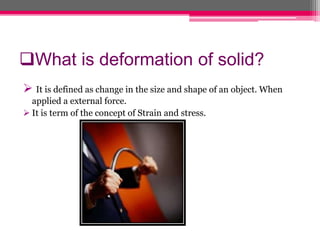
What is deformation of solid?
 It is defined as change in the size and shape of an object. When
applied a external force.
 It is term of the concept of Strain and stress.
 What is stress ?
 Stress (σ) is the force per unit area that applies to an object to
deform it.
 Stress (σ) = Force/Area
 Its unit is Nm-2 or Pa
o Types of stress
 There are three type of stress
1) Direct stress
2) Indirect stress
3) Combined stress
 Types of stress
 Direct Stress:
1) This stress produced under direct loading condition
2) i.e force will be in line with the axis of member.
3) It is force acting on body.
4) It may be tensile or compressive or shear stresses
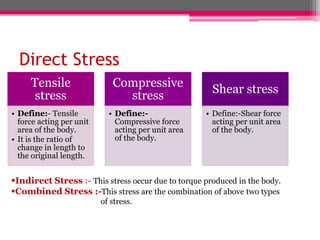
Direct Stress
Tensile
stress
• Define:- Tensile
force acting per unit
area of the body.
• It is the ratio of
change in length to
the original length.
Compressive
stress
• Define:-
Compressive force
acting per unit area
of the body.
Shear stress
• Define:-Shear force
acting per unit area
of the body.
Indirect Stress :- This stress occur due to torque produced in the body.
Combined Stress :-This stress are the combination of above two types
of stress.
What is strain ?
 Strain is the measure of the amount of deformation.
 For E.X- If the Bar has original length(L) and when the load is
applied on a bar the length of bar will change which is indicated as
(∆L)
Strain= ∆L/L
 It has no unit.
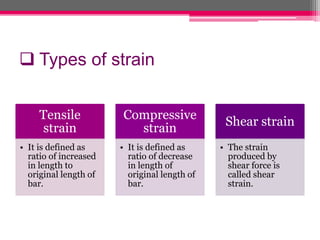
o Types of strain
 There are three type of strain
1) Tensile strain
2) Compressive strain
3) Shear strain
 Types of strain
Tensile
strain
• It is defined as
ratio of increased
in length to
original length of
bar.
Compressive
strain
• It is defined as
ratio of decrease
in length of
original length of
bar.
Shear strain
• The strain
produced by
shear force is
called shear
strain.
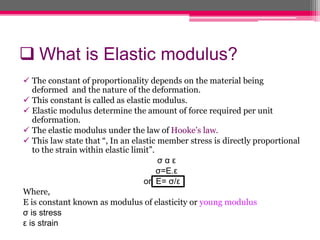
 What is Elastic modulus?
 The constant of proportionality depends on the material being
deformed and the nature of the deformation.
 This constant is called as elastic modulus.
 Elastic modulus determine the amount of force required per unit
deformation.
 The elastic modulus under the law of Hooke’s law.
 This law state that “, In an elastic member stress is directly proportional
to the strain within elastic limit”.
σ α ε
σ=E.ε
or E= σ/ε
Where,
E is constant known as modulus of elasticity or young modulus
σ is stress
ε is strain
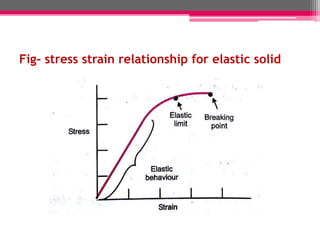
Fig- stress strain relationship for elastic solid
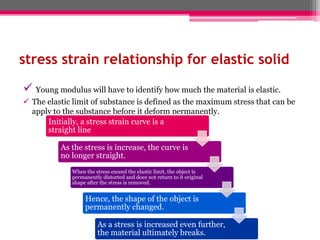
stress strain relationship for elastic solid
 Young modulus will have to identify how much the material is elastic.
 The elastic limit of substance is defined as the maximum stress that can be
apply to the substance before it deform permanently.
Initially, a stress strain curve is a
straight line
As the stress is increase, the curve is
no longer straight.
When the stress exceed the elastic limit, the object is
permanently distorted and does not return to it original
shape after the stress is removed.
Hence, the shape of the object is
permanently changed.
As a stress is increased even further,
the material ultimately breaks.
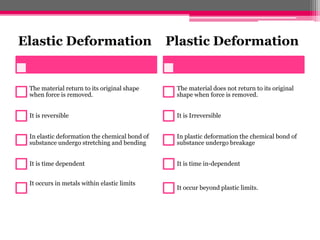
Elastic Deformation
The material return to its original shape
when force is removed.
It is reversible
In elastic deformation the chemical bond of
substance undergo stretching and bending
It is time dependent
It occurs in metals within elastic limits
Plastic Deformation
The material does not return to its original
shape when force is removed.
It is Irreversible
In plastic deformation the chemical bond of
substance undergo breakage
It is time in-dependent
It occur beyond plastic limits.
deformation of solids presentation ppts.

deformation of solids presentation ppts.

  • 1.
  • 2.
    OBJECTIVE  Plastic Deformation Elastic Deformation  Heckel Equation  Stress  Strain  Elastic Modulus
  • 3.
    What is deformationof solid?  It is defined as change in the size and shape of an object. When applied a external force.  It is term of the concept of Strain and stress.
  • 4.
     What isstress ?  Stress (σ) is the force per unit area that applies to an object to deform it.  Stress (σ) = Force/Area  Its unit is Nm-2 or Pa o Types of stress  There are three type of stress 1) Direct stress 2) Indirect stress 3) Combined stress
  • 5.
     Types ofstress  Direct Stress: 1) This stress produced under direct loading condition 2) i.e force will be in line with the axis of member. 3) It is force acting on body. 4) It may be tensile or compressive or shear stresses
  • 6.
    Direct Stress Tensile stress • Define:-Tensile force acting per unit area of the body. • It is the ratio of change in length to the original length. Compressive stress • Define:- Compressive force acting per unit area of the body. Shear stress • Define:-Shear force acting per unit area of the body. Indirect Stress :- This stress occur due to torque produced in the body. Combined Stress :-This stress are the combination of above two types of stress.
  • 7.
    What is strain?  Strain is the measure of the amount of deformation.  For E.X- If the Bar has original length(L) and when the load is applied on a bar the length of bar will change which is indicated as (∆L) Strain= ∆L/L  It has no unit. o Types of strain  There are three type of strain 1) Tensile strain 2) Compressive strain 3) Shear strain
  • 8.
     Types ofstrain Tensile strain • It is defined as ratio of increased in length to original length of bar. Compressive strain • It is defined as ratio of decrease in length of original length of bar. Shear strain • The strain produced by shear force is called shear strain.
  • 9.
     What isElastic modulus?  The constant of proportionality depends on the material being deformed and the nature of the deformation.  This constant is called as elastic modulus.  Elastic modulus determine the amount of force required per unit deformation.  The elastic modulus under the law of Hooke’s law.  This law state that “, In an elastic member stress is directly proportional to the strain within elastic limit”. σ α ε σ=E.ε or E= σ/ε Where, E is constant known as modulus of elasticity or young modulus σ is stress ε is strain
  • 10.
    Fig- stress strainrelationship for elastic solid
  • 11.
    stress strain relationshipfor elastic solid  Young modulus will have to identify how much the material is elastic.  The elastic limit of substance is defined as the maximum stress that can be apply to the substance before it deform permanently. Initially, a stress strain curve is a straight line As the stress is increase, the curve is no longer straight. When the stress exceed the elastic limit, the object is permanently distorted and does not return to it original shape after the stress is removed. Hence, the shape of the object is permanently changed. As a stress is increased even further, the material ultimately breaks.
  • 12.
    Elastic Deformation The materialreturn to its original shape when force is removed. It is reversible In elastic deformation the chemical bond of substance undergo stretching and bending It is time dependent It occurs in metals within elastic limits Plastic Deformation The material does not return to its original shape when force is removed. It is Irreversible In plastic deformation the chemical bond of substance undergo breakage It is time in-dependent It occur beyond plastic limits.