DRUGS USED IN COMMON EYE
DISORDERS
PHARMACOL
OGY
ACTION PRODUCTS
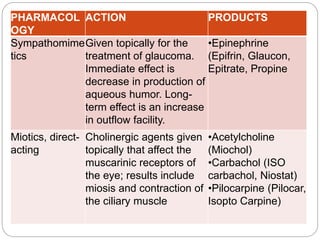
Sympathomime
tics
Given topically for the
treatment of glaucoma.
Immediate effect is
decrease in production of
aqueous humor. Long-
term effect is an increase
in outflow facility.
•Epinephrine
(Epifrin, Glaucon,
Epitrate, Propine
Miotics, direct-
acting
Cholinergic agents given
topically that affect the
muscarinic receptors of
the eye; results include
miosis and contraction of
the ciliary muscle
•Acetylcholine
(Miochol)
•Carbachol (ISO
carbachol, Niostat)
•Pilocarpine (Pilocar,
Isopto Carpine)
PHARMAC
OLOGY
ACTION PRODUCTS
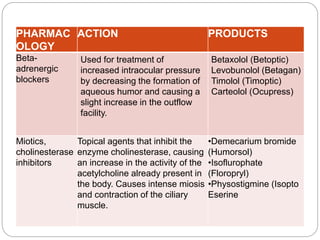
Beta-
adrenergic
blockers
Used for treatment of
increased intraocular pressure
by decreasing the formation of
aqueous humor and causing a
slight increase in the outflow
facility.
Betaxolol (Betoptic)
Levobunolol (Betagan)
Timolol (Timoptic)
Carteolol (Ocupress)
Miotics,
cholinesterase
inhibitors
Topical agents that inhibit the
enzyme cholinesterase, causing
an increase in the activity of the
acetylcholine already present in
the body. Causes intense miosis
and contraction of the ciliary
muscle.
•Demecarium bromide
(Humorsol)
•Isoflurophate
(Floropryl)
•Physostigmine (Isopto
Eserine
PHARMACOL
OGY
ACTION PRODUCTS
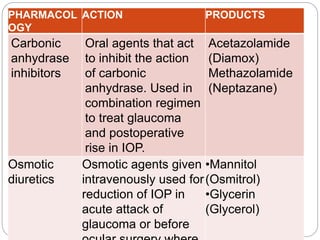
Carbonic
anhydrase
inhibitors
Oral agents that act
to inhibit the action
of carbonic
anhydrase. Used in
combination regimen
to treat glaucoma
and postoperative
rise in IOP.
Acetazolamide
(Diamox)
Methazolamide
(Neptazane)
Osmotic
diuretics
Osmotic agents given
intravenously used for
reduction of IOP in
acute attack of
glaucoma or before
•Mannitol
(Osmitrol)
•Glycerin
(Glycerol)
PHARMACOL
OGY
ACTION PRODUCTS
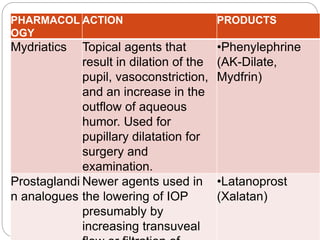
Mydriatics Topical agents that
result in dilation of the
pupil, vasoconstriction,
and an increase in the
outflow of aqueous
humor. Used for
pupillary dilatation for
surgery and
examination.
•Phenylephrine
(AK-Dilate,
Mydfrin)
Prostaglandi
n analogues
Newer agents used in
the lowering of IOP
presumably by
increasing transuveal
•Latanoprost
(Xalatan)
PHARMACOL
OGY
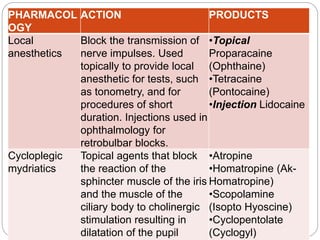
ACTION PRODUCTS
Local
anesthetics
Block the transmission of
nerve impulses. Used
topically to provide local
anesthetic for tests, such
as tonometry, and for
procedures of short
duration. Injections used in
ophthalmology for
retrobulbar blocks.
•Topical
Proparacaine
(Ophthaine)
•Tetracaine
(Pontocaine)
•Injection Lidocaine
Cycloplegic
mydriatics
Topical agents that block
the reaction of the
sphincter muscle of the iris
and the muscle of the
ciliary body to cholinergic
stimulation resulting in
dilatation of the pupil
•Atropine
•Homatropine (Ak-
Homatropine)
•Scopolamine
(Isopto Hyoscine)
•Cyclopentolate
(Cyclogyl)
PHARMAC
OLOGY
ACTION PRODUCTS
Ophthalmic
anti-infectives
Topical agents used for
treatment of ophthalmic
infections. Commercial
products are intended for
treatment of superficial
ocular problems, such as
conjunctivitis and
blepharitis.
Extemporaneous
(compounded) drops are
used for more serious
topical infections (ie,
corneal ulcer,
endophthalmitis [intraocular
infection]).
•Antibiotics Bacitracin (AK-
Tracin)
•Chloramphenicol (Chloroptic)
•Ciprofloxacin (Ciloxan)
•Erythromycin (Ilosone)
•Gentamycin (Garamycin,
Genoptic)
•Levofloxacin (Quixin)
•Moxifloxacin (Vigamox)
•Neomycin/polymyxin/bacitraci
n (Neosporin)
•Norfloxacin (Chibroxin)
•Sulfacetamide (Sulamyd,
Bleph-10)
•Tobramycin (Tobramycin,
Tobrex)
•Antifungal Amphotericin B
(Fungizone)
•Fluconazole
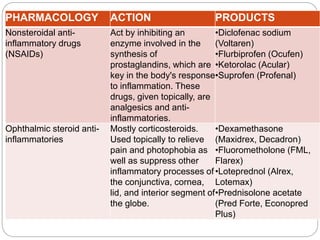
PHARMACOLOGY ACTION PRODUCTS
Nonsteroidal anti-
inflammatory drugs
(NSAIDs)
Act by inhibiting an
enzyme involved in the
synthesis of
prostaglandins, which are
key in the body's response
to inflammation. These
drugs, given topically, are
analgesics and anti-
inflammatories.
•Diclofenac sodium
(Voltaren)
•Flurbiprofen (Ocufen)
•Ketorolac (Acular)
•Suprofen (Profenal)
Ophthalmic steroid anti-
inflammatories
Mostly corticosteroids.
Used topically to relieve
pain and photophobia as
well as suppress other
inflammatory processes of
the conjunctiva, cornea,
lid, and interior segment of
the globe.
•Dexamethasone
(Maxidrex, Decadron)
•Fluorometholone (FML,
Flarex)
•Loteprednol (Alrex,
Lotemax)
•Prednisolone acetate
(Pred Forte, Econopred
Plus)
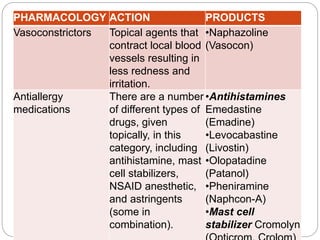
PHARMACOLOGY ACTION PRODUCTS
Vasoconstrictors Topical agents that
contract local blood
vessels resulting in
less redness and
irritation.
•Naphazoline
(Vasocon)
Antiallergy
medications
There are a number
of different types of
drugs, given
topically, in this
category, including
antihistamine, mast
cell stabilizers,
NSAID anesthetic,
and astringents
(some in
combination).
•Antihistamines
Emedastine
(Emadine)
•Levocabastine
(Livostin)
•Olopatadine
(Patanol)
•Pheniramine
(Naphcon-A)
•Mast cell
stabilizer Cromolyn
 THANK YOU

Drugs used in common eye disorders

  • 1.
    DRUGS USED INCOMMON EYE DISORDERS
  • 2.
    PHARMACOL OGY ACTION PRODUCTS Sympathomime tics Given topicallyfor the treatment of glaucoma. Immediate effect is decrease in production of aqueous humor. Long- term effect is an increase in outflow facility. •Epinephrine (Epifrin, Glaucon, Epitrate, Propine Miotics, direct- acting Cholinergic agents given topically that affect the muscarinic receptors of the eye; results include miosis and contraction of the ciliary muscle •Acetylcholine (Miochol) •Carbachol (ISO carbachol, Niostat) •Pilocarpine (Pilocar, Isopto Carpine)
  • 3.
    PHARMAC OLOGY ACTION PRODUCTS Beta- adrenergic blockers Used fortreatment of increased intraocular pressure by decreasing the formation of aqueous humor and causing a slight increase in the outflow facility. Betaxolol (Betoptic) Levobunolol (Betagan) Timolol (Timoptic) Carteolol (Ocupress) Miotics, cholinesterase inhibitors Topical agents that inhibit the enzyme cholinesterase, causing an increase in the activity of the acetylcholine already present in the body. Causes intense miosis and contraction of the ciliary muscle. •Demecarium bromide (Humorsol) •Isoflurophate (Floropryl) •Physostigmine (Isopto Eserine
  • 4.
    PHARMACOL OGY ACTION PRODUCTS Carbonic anhydrase inhibitors Oral agentsthat act to inhibit the action of carbonic anhydrase. Used in combination regimen to treat glaucoma and postoperative rise in IOP. Acetazolamide (Diamox) Methazolamide (Neptazane) Osmotic diuretics Osmotic agents given intravenously used for reduction of IOP in acute attack of glaucoma or before •Mannitol (Osmitrol) •Glycerin (Glycerol)
  • 5.
    PHARMACOL OGY ACTION PRODUCTS Mydriatics Topicalagents that result in dilation of the pupil, vasoconstriction, and an increase in the outflow of aqueous humor. Used for pupillary dilatation for surgery and examination. •Phenylephrine (AK-Dilate, Mydfrin) Prostaglandi n analogues Newer agents used in the lowering of IOP presumably by increasing transuveal •Latanoprost (Xalatan)
  • 6.
    PHARMACOL OGY ACTION PRODUCTS Local anesthetics Block thetransmission of nerve impulses. Used topically to provide local anesthetic for tests, such as tonometry, and for procedures of short duration. Injections used in ophthalmology for retrobulbar blocks. •Topical Proparacaine (Ophthaine) •Tetracaine (Pontocaine) •Injection Lidocaine Cycloplegic mydriatics Topical agents that block the reaction of the sphincter muscle of the iris and the muscle of the ciliary body to cholinergic stimulation resulting in dilatation of the pupil •Atropine •Homatropine (Ak- Homatropine) •Scopolamine (Isopto Hyoscine) •Cyclopentolate (Cyclogyl)
  • 7.
    PHARMAC OLOGY ACTION PRODUCTS Ophthalmic anti-infectives Topical agentsused for treatment of ophthalmic infections. Commercial products are intended for treatment of superficial ocular problems, such as conjunctivitis and blepharitis. Extemporaneous (compounded) drops are used for more serious topical infections (ie, corneal ulcer, endophthalmitis [intraocular infection]). •Antibiotics Bacitracin (AK- Tracin) •Chloramphenicol (Chloroptic) •Ciprofloxacin (Ciloxan) •Erythromycin (Ilosone) •Gentamycin (Garamycin, Genoptic) •Levofloxacin (Quixin) •Moxifloxacin (Vigamox) •Neomycin/polymyxin/bacitraci n (Neosporin) •Norfloxacin (Chibroxin) •Sulfacetamide (Sulamyd, Bleph-10) •Tobramycin (Tobramycin, Tobrex) •Antifungal Amphotericin B (Fungizone) •Fluconazole
  • 8.
    PHARMACOLOGY ACTION PRODUCTS Nonsteroidalanti- inflammatory drugs (NSAIDs) Act by inhibiting an enzyme involved in the synthesis of prostaglandins, which are key in the body's response to inflammation. These drugs, given topically, are analgesics and anti- inflammatories. •Diclofenac sodium (Voltaren) •Flurbiprofen (Ocufen) •Ketorolac (Acular) •Suprofen (Profenal) Ophthalmic steroid anti- inflammatories Mostly corticosteroids. Used topically to relieve pain and photophobia as well as suppress other inflammatory processes of the conjunctiva, cornea, lid, and interior segment of the globe. •Dexamethasone (Maxidrex, Decadron) •Fluorometholone (FML, Flarex) •Loteprednol (Alrex, Lotemax) •Prednisolone acetate (Pred Forte, Econopred Plus)
  • 9.
    PHARMACOLOGY ACTION PRODUCTS VasoconstrictorsTopical agents that contract local blood vessels resulting in less redness and irritation. •Naphazoline (Vasocon) Antiallergy medications There are a number of different types of drugs, given topically, in this category, including antihistamine, mast cell stabilizers, NSAID anesthetic, and astringents (some in combination). •Antihistamines Emedastine (Emadine) •Levocabastine (Livostin) •Olopatadine (Patanol) •Pheniramine (Naphcon-A) •Mast cell stabilizer Cromolyn
  • 10.