DRUG
EXCIPIENT
INTERACTION
18/09/2022 1
Presented By :- Mr. Akash Vikal
M.Pharmacy-1st Year
Department :- Pharmaceutics
I S F COLLEGE OF PHARMACY
CONTENT
➢Introduction
➢Mechanism of drug excipient interaction
➢Analytical techniques used to detect drug
excipient interaction
➢Kinetic of drug stability
➢Stability testing
2
INTRODUCTION
➢ Excipients are ingredients which along with active
pharmaceutical ingredients make up the dosage forms.
➢ Excipients act as protective agents, bulking agents and can also
be used to improve bioavailability of drug.
➢ An pharmaceutical excipient is a pharmacologically inactive
substance formulated alongside the API of a medicine to impart
specific quality of them.
3
Role of excipients-
➢ Provide bulk to the formulation.
➢ Protect, support or enhance the stability of formulation.
➢ Improve bioavailability of drug.
Ideal properties of excipients-
➢ No interactions with drug
➢ Feasible
➢ Cost effective
➢ Pharmacologically inert
➢ Stable for handling
4
Excipient are inactive ingredients said as carriers for the
active ingredients in a pharmaceutical product. These
maybe classified into the following categories:-
• Binders
• Disintegrants
• Fillers (diluents)
• Lubricants
• Glidants
• Compression aids
• Colors
• Sweeteners
• Preservatives
• Flavors
• Coatings/film formers
• Suspending/dispersing agents/surfactants
• Anti-adherents
• Sorbents
• Anti-oxidants
• Buffering agents
• Chelating agents
• Viscosity imparting agents
• humectants
5
Drug excipient interaction
➢Drug substances are usually in intimate contact with excipient.
Although these are pharmacologically inert, they are undergo
chemical and physical interaction with drug substance under
favourable condition. These interactions can lead to instability
resulting in the formulation of new entities.
6
Importance of these studies
➢To find out how compatible an excipient is with API.
➢Maximizes the stability of a dosage form.
➢Do not have impact on stability of API.
➢Determine the list of excipients that can be used in final dosage
form.
➢Helps to avoid surprise problem during formulation process.
➢These studies are the part of preformulation study.
7
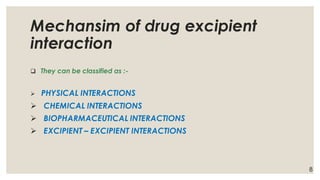
Mechansim of drug excipient
interaction
❑ They can be classified as :-
➢ PHYSICAL INTERACTIONS
➢ CHEMICAL INTERACTIONS
➢ BIOPHARMACEUTICAL INTERACTIONS
➢ EXCIPIENT – EXCIPIENT INTERACTIONS
8
Physical interactions-
➢Physical interactions alter the rate of dissolution, dosage uniformity, etc.
➢Physical interactions do not involve chemical changes, thus permitting the components
in the formulation to retain their molecular structure.
➢Physical interactions are difficult to detect.
Interaction complexation-
➢Usually binds reversibly with drug to form complex.
➢Insoluble complexes are formed which lead to slower dissolution.
➢Decreased absorption of drug.
9
Beneficial effect example
➢Cyclodextrin is often used to improve bioavailability of poorly
water soluble drugs.
➢This increases bioavailability and increases rate.
Detrimental effect example
➢Tetracycline formed insoluble complex with calcium carbonate
leading to slower dissolution and decreased absorption.
10
Chemical interactions
➢ Active pharmaceutical ingredients and excipients react with
each other to form unstable compounds.
▪ Stability under high humidity conditions:-
➢ In presence of moisture, many drug substances hydrolyze react
with other excipients or oxidize.
➢ These tests are performed by exposing the drug to different
relative humidity conditions.
11
Biopharmaceutical interactions
❑ These are the interactions which are observed after administration of
medicine. These interactions occur in the form of -
❖ The interaction is between the medicine ( drug substance and excipients ) and the
body fluids.
❖ The interactions have the tendency to influence the rate of absorption of the drug.
Various example of these interactions are as follow :-
❑ Premature breakdown of enteric coat
❑ Increase in gastrointestinal motility
❑ Effect on P-glycoprotein efflux transporter
12
Premature breakdown of enteric
coat-
➢ Enteric coating polymers e.g.,cellulose acetate phthalate and hydroxyl propyl
cellulose acetate phthalate.
➢ Dissolve prematurely in the stomach in the presence of antacids or drugs.
➢ Cause increase in the ph of the stomach.
➢ Cause premature release of API in stomach itself, which results in degradation of
drug in stomach.
e.g.,side effects like gastric bleeding as in the case of NSAIDs.
13
Increase in gastrointestinal motility
➢ Many excipients such as sorbitol have the tendency to increase gastrointestinal
motility, thus reducing the available time for absorption of drugs like metoprolol.
Effect on P-glycoprotein efflux
transporter
➢ P-glycoprotein thus interferes in the bioavailability of different anticancers and other
drug substances. Thus, several excipients e.g., span 20, tween 20, tween 80, pluronic,
poloxamer, etc., are incorporated in the formulations which help in inhibition of P-
glycoprotein to enhance availability of the drug into the cell, to produce the desired
action.
14
Analytical techniques used to detect
drug-excipients interaction:-
❑ Thermal methods -
❖ DSC-differential scanning calorimetry
❖ DTA-differential thermal analysis
❖ Isothermal micro calorimetry
❖ Hot stage microscopy
❑ Spectroscopic techniques -
❖ FT-IR spectroscopy
❖ Powder X-ray differaction
❖ Solid state NMR
15
❑Chromatography-
❖ TLC-thin layer chromatography
❖ HPLC-high performance liquid chromatography
❑ Accelerated stability study-
❑Miscellaneous-
❖ Radiolabelled techniques
❖ Fluorescence spectroscopy
16
Drug kinetics
➢ Definedas how drug changes with timeeither study of rate of changes.
➢ Many drugs are not chemicallystable and the principle of chemical kinetics are
used to predict the timespan for which
a drug will remain maintain its therapeutic effectiveness or efficacy at a specified
temperature.
❑ Importance of studying kinetics- it determines:-
➢ Stability of drug/half life of drug:-defined as time necessary for a drug to decay to its
half life or 50% conc. (e.g.,100% - 50%, 50% - 25%).
➢ Shelf life:-definedas the timerequired for a drug to decay to 90
17
Rate and order of reaction
❑ The Concentration of drug which influences the rate of reaction or process is called its
order of reaction
❑ The two commonly encountered rate processes are:-
❖ ZERO ORDER REACTION
❖ FIRST ORDER REACTION
18
FIRST ORDER REACTION
➢ These are the reactions whose rate is directly proportional to concentration of the
drugs undergoing reaction I.e., greater the concentration, faster the reaction.
ZERO ORDER REACTION
➢ Also called as constant rate process.
➢ The rate of reaction is independent of concentration either rate of
reaction connot be increased further by increasing the concentration of reactant.
19
Factors affecting rate of reaction
❖ Temperature
❖ Light
❖ Solvent
❖ Phase and surface area
❖ Catalysis
❖ Concentration
Kinetic of drug decomposition
❖ Hydrolysis
❖ Oxidation
❖ Photolysis
❖ Racemization
20
Stability testing
❑ Stability : defined as capability of a particular formulation in a
specific container/closure system to remain within its physical,
chemical, microbiological, toxicological, protective and
informational specifications.
❑ It is the extent to which a product retains, within the specified
limits, throughout its period of storage and use, the same
properties and characteristics possessed at the time of its
packaging.
21
Scope of stability testing
❖ Provide evidence as to how the quality of drug product varies with time.
❖ Establish shelf life of drug product.
❖ Determines recommended storage conditions.
❖ Determine container closure system suitability.
Stability testing methods
❖ Real time stability testing
❖ Accelerated stability testing
❖ Retained sample stability testing
❖ Cyclic temperature stress testing
22
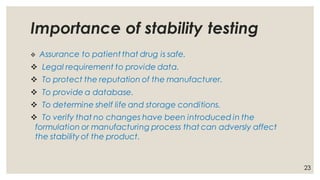
Importance of stability testing
❖ Assurance to patient that drug is safe.
❖ Legal requirement to provide data.
❖ To protect the reputation of the manufacturer.
❖ To provide a database.
❖ To determine shelf life and storage conditions.
❖ To verify that no changes have been introduced in the
formulation or manufacturing process that can adversly affect
the stability of the product.
23
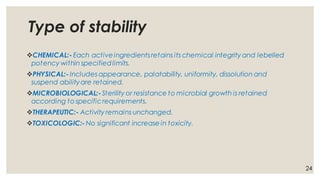
Type of stability
❖CHEMICAL:- Each activeingredientsretains its chemical integrity and lebelled
potency within specifiedlimits.
❖PHYSICAL:- Includes appearance, palatability, uniformity, dissolution and
suspend abilityare retained.
❖MICROBIOLOGICAL:-Sterility or resistance to microbial growth is retained
according to specificrequirements.
❖THERAPEUTIC:- Activity remains unchanged.
❖TOXICOLOGIC:- No significant increase in toxicity.
24
References
❖Lachman and lieberman, the theory and practice of industrial pharmacy.
❖N.Fathima, kajal ahir, vandana patel, lata manani, chirag patel
drug excipients interactions and its importance in dosage form
development, journal of applied pharmaceutical science 2011.
❖Priyanka patel, kajal ahir, vandana patel, lata manani, chirag patel drug-excipient
compatibilty studies: First step for dosage form development, The pharma innovation
journal 2015.
❖P.J. Crowly and L.G. Martini,"excipients in pharmaceutical products" Encylopedia of
pharmaceutical technology(Marcel Dekker Inc. New york, USA.
❖Banker and Rhodes, modern pharmaceutics, Marcel Dekker Inc. 2002.
Thankyou..... 25