T . Sujith
Dept. of Pharmacology
Chalapathi Institute of Pharmaceutical
Introduction
1. the drug is safe
2. it is effective in treating the disease
3. it can be manufactured correctly and
reproducibly each time
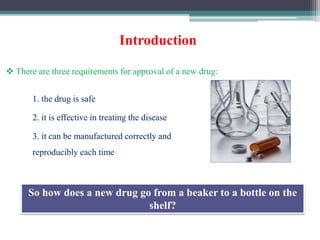
 There are three requirements for approval of a new drug:
So how does a new drug go from a beaker to a bottle on the
shelf?
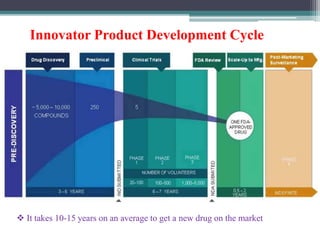
Innovator Product Development Cycle
 It takes 10-15 years on an average to get a new drug on the market
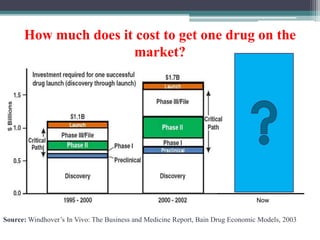
How much does it cost to get one drug on the
market?
Now
Source: Windhover’s In Vivo: The Business and Medicine Report, Bain Drug Economic Models, 2003
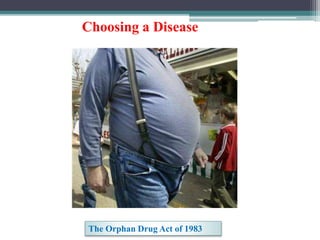
Choosing a Disease
The Orphan Drug Act of 1983
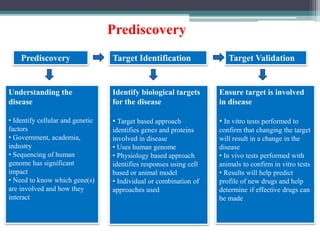
Prediscovery
Prediscovery
Understanding the
disease
• Identify cellular and genetic
factors
• Government, academia,
industry
• Sequencing of human
genome has significant
impact
• Need to know which gene(s)
are involved and how they
interact
Identify biological targets
for the disease
• Target based approach
identifies genes and proteins
involved in disease
• Uses human genome
• Physiology based approach
identifies responses using cell
based or animal model
• Individual or combination of
approaches used
Ensure target is involved
in disease
• In vitro tests performed to
confirm that changing the target
will result in a change in the
disease
• In vivo tests performed with
animals to confirm in vitro tests
• Results will help predict
profile of new drugs and help
determine if effective drugs can
be made
Target Identification Target Validation
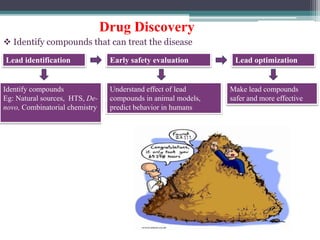
Drug Discovery
 Identify compounds that can treat the disease
Lead identification
Identify compounds
Eg: Natural sources, HTS, De-
novo, Combinatorial chemistry
Early safety evaluation Lead optimization
Understand effect of lead
compounds in animal models,
predict behavior in humans
Make lead compounds
safer and more effective
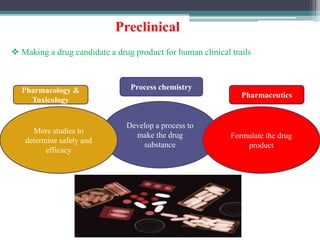
Preclinical
 Making a drug candidate a drug product for human clinical trails
Process chemistryPharmacology &
Toxicology
Pharmaceutics
Develop a process to
make the drug
substance
Formulate the drug
product
More studies to
determine safety and
efficacy
Preclinical
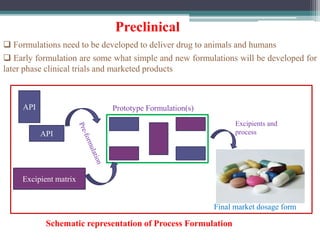
 Formulations need to be developed to deliver drug to animals and humans
 Early formulation are some what simple and new formulations will be developed for
later phase clinical trials and marketed products
API
Excipient matrix
API
Prototype Formulation(s)
Final market dosage form
Excipients and
process
Schematic representation of Process Formulation
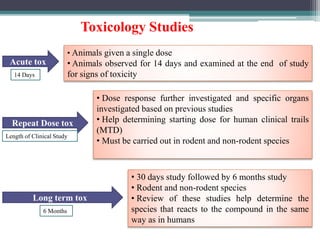
Toxicology Studies
Acute tox
• Animals given a single dose
• Animals observed for 14 days and examined at the end of study
for signs of toxicity
Repeat Dose tox
• Dose response further investigated and specific organs
investigated based on previous studies
• Help determining starting dose for human clinical trails
(MTD)
• Must be carried out in rodent and non-rodent species
14 Days
Length of Clinical Study
Long term tox
6 Months
• 30 days study followed by 6 months study
• Rodent and non-rodent species
• Review of these studies help determine the
species that reacts to the compound in the same
way as in humans
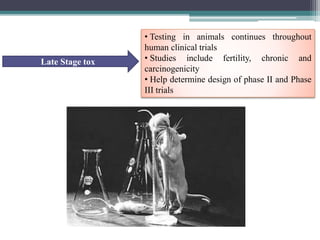
Late Stage tox
• Testing in animals continues throughout
human clinical trials
• Studies include fertility, chronic and
carcinogenicity
• Help determine design of phase II and Phase
III trials
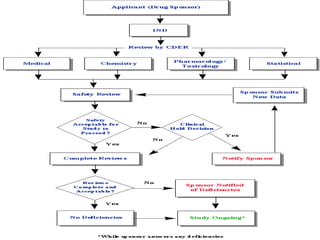
IND
 Investigational New Drug (IND) Application
 Submitted to FDA
 Summary of all work done to date
 Needs to be filed and approved before drug can be used in clinical trials
 Include information on
- Animal pharmacology and toxicology studies
- Manufacturing information
- Clinical protocols and Investigator information
 Sponsor must wait 30 calendar days before initiating studies while FDA
reviews IND
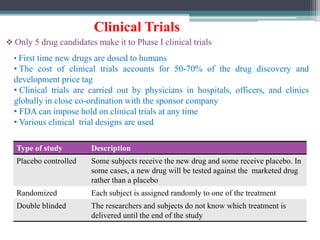
Clinical Trials
 Only 5 drug candidates make it to Phase I clinical trials
• First time new drugs are dosed to humans
• The cost of clinical trials accounts for 50-70% of the drug discovery and
development price tag
• Clinical trials are carried out by physicians in hospitals, officers, and clinics
globally in close co-ordination with the sponsor company
• FDA can impose hold on clinical trials at any time
• Various clinical trial designs are used
Type of study Description
Placebo controlled Some subjects receive the new drug and some receive placebo. In
some cases, a new drug will be tested against the marketed drug
rather than a placebo
Randomized Each subject is assigned randomly to one of the treatment
Double blinded The researchers and subjects do not know which treatment is
delivered until the end of the study
Clinical Trials
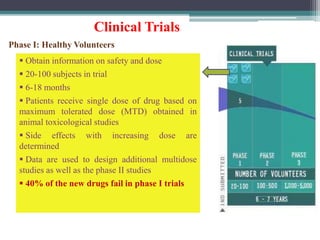
Phase I: Healthy Volunteers
 Obtain information on safety and dose
 20-100 subjects in trial
 6-18 months
 Patients receive single dose of drug based on
maximum tolerated dose (MTD) obtained in
animal toxicological studies
 Side effects with increasing dose are
determined
 Data are used to design additional multidose
studies as well as the phase II studies
 40% of the new drugs fail in phase I trials
Clinical Trials
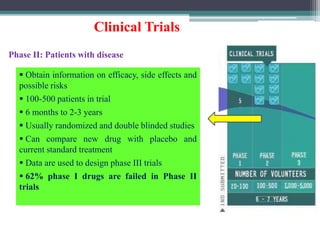
Phase II: Patients with disease
 Obtain information on efficacy, side effects and
possible risks
 100-500 patients in trial
 6 months to 2-3 years
 Usually randomized and double blinded studies
 Can compare new drug with placebo and
current standard treatment
 Data are used to design phase III trials
 62% phase I drugs are failed in Phase II
trials
Clinical Trials
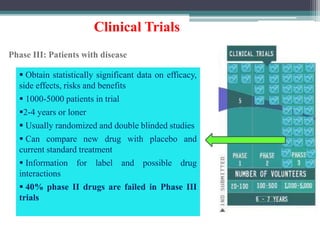
 Obtain statistically significant data on efficacy,
side effects, risks and benefits
 1000-5000 patients in trial
2-4 years or loner
 Usually randomized and double blinded studies
 Can compare new drug with placebo and
current standard treatment
 Information for label and possible drug
interactions
 40% phase II drugs are failed in Phase III
trials
Phase III: Patients with disease
NDA
New Drug Application (NDA)
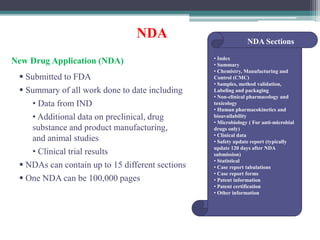
 Submitted to FDA
 Summary of all work done to date including
• Data from IND
• Additional data on preclinical, drug
substance and product manufacturing,
and animal studies
• Clinical trial results
 NDAs can contain up to 15 different sections
 One NDA can be 100,000 pages
NDA Sections
• Index
• Summary
• Chemistry, Manufacturing and
Control (CMC)
• Samples, method validation,
Labeling and packaging
• Non-clinical pharmacology and
toxicology
• Human pharmacokinetics and
bioavailability
• Microbiology ( For anti-microbial
drugs only)
• Clinical data
• Safety update report (typically
update 120 days after NDA
submission)
• Statistical
• Case report tabulations
• Case report forms
• Patent information
• Patent certification
• Other information
New Drug Application (NDA)
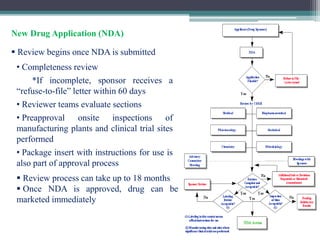
 Review begins once NDA is submitted
• Completeness review
*If incomplete, sponsor receives a
“refuse-to-file” letter within 60 days
• Reviewer teams evaluate sections
• Preapproval onsite inspections of
manufacturing plants and clinical trial sites
performed
• Package insert with instructions for use is
also part of approval process
 Review process can take up to 18 months
 Once NDA is approved, drug can be
marketed immediately
Post Marketing
Phase IV clinical trials
 Some approved drugs may need additional studies after it is on the market as
part of the NDA approval
 Reasons include
- Determine long term risks/benefits
- Determine if drug is effective against other diseases
- Test different drug products (tablets, syrups, etc)
Post Marketing Surveillance
 Companies continue to monitor the drug and submit reports to FDA
 Include cases of adverse effects
 Data analyzed to determine any major problems which could change use or
labeling
 In some cases drugs are taken off the market
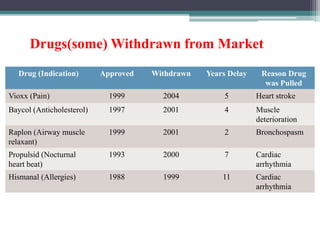
Drugs(some) Withdrawn from Market
Drug (Indication) Approved Withdrawn Years Delay Reason Drug
was Pulled
Vioxx (Pain) 1999 2004 5 Heart stroke
Baycol (Anticholesterol) 1997 2001 4 Muscle
deterioration
Raplon (Airway muscle
relaxant)
1999 2001 2 Bronchospasm
Propulsid (Nocturnal
heart beat)
1993 2000 7 Cardiac
arrhythmia
Hismanal (Allergies) 1988 1999 11 Cardiac
arrhythmia
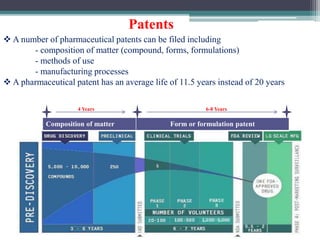
Patents
 A number of pharmaceutical patents can be filed including
- composition of matter (compound, forms, formulations)
- methods of use
- manufacturing processes
 A pharmaceutical patent has an average life of 11.5 years instead of 20 years
Composition of matter Form or formulation patent
4 Years 6-8 Years
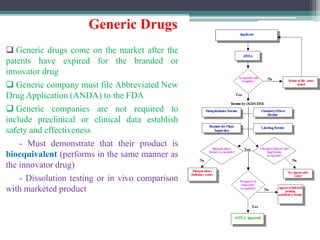
Generic Drugs
 Generic drugs come on the market after the
patents have expired for the branded or
innovator drug
 Generic company must file Abbreviated New
Drug Application (ANDA) to the FDA
 Generic companies are not required to
include preclinical or clinical data establish
safety and effectiveness
- Must demonstrate that their product is
bioequivalent (performs in the same manner as
the innovator drug)
- Dissolution testing or in vivo comparison
with marketed product
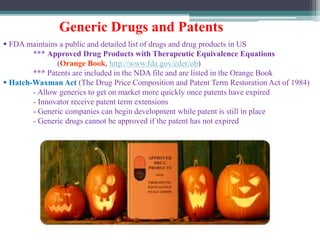
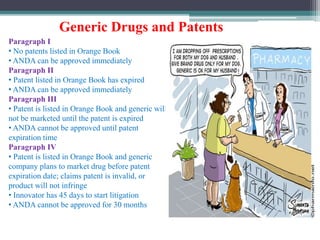
Generic Drugs and Patents
 FDA maintains a public and detailed list of drugs and drug products in US
*** Approved Drug Products with Therapeutic Equivalence Equations
(Orange Book, http://www.fda.gov/cder/ob)
*** Patents are included in the NDA file and are listed in the Orange Book
 Hatch-Waxman Act (The Drug Price Composition and Patent Term Restoration Act of 1984)
- Allow generics to get on market more quickly once patents have expired
- Innovator receive patent term extensions
- Generic companies can begin development while patent is still in place
- Generic drugs cannot be approved if the patent has not expired
Generic Drugs and Patents
Paragraph I
• No patents listed in Orange Book
• ANDA can be approved immediately
Paragraph II
• Patent listed in Orange Book has expired
• ANDA can be approved immediately
Paragraph III
• Patent is listed in Orange Book and generic will
not be marketed until the patent is expired
• ANDA cannot be approved until patent
expiration time
Paragraph IV
• Patent is listed in Orange Book and generic
company plans to market drug before patent
expiration date; claims patent is invalid, or
product will not infringe
• Innovator has 45 days to start litigation
• ANDA cannot be approved for 30 months
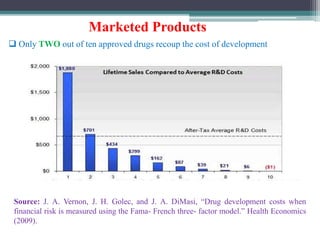
Marketed Products
 Only TWO out of ten approved drugs recoup the cost of development
Source: J. A. Vernon, J. H. Golec, and J. A. DiMasi, “Drug development costs when
financial risk is measured using the Fama- French three- factor model.” Health Economics
(2009).
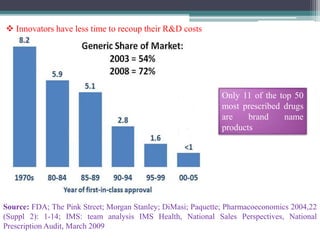
 Innovators have less time to recoup their R&D costs
Only 11 of the top 50
most prescribed drugs
are brand name
products
Source: FDA; The Pink Street; Morgan Stanley; DiMasi; Paquette; Pharmacoeconomics 2004,22
(Suppl 2): 1-14; IMS: team analysis IMS Health, National Sales Perspectives, National
Prescription Audit, March 2009
What’s Next?
 It is recognized by both the pharmaceutical
industry and the FDA that improvements are
needed
 Scientific advances will help get better drugs on
the market faster
 It is important to get into clinical trials faster to
determine if a drug is a viable candidate for
development
 Pharmaceutical companies need to innovate and
make processes more efficient while FDA has to
help with regulatory relief during development
without compromising safety
 Lifecycle management will be an area of growth
with many large selling drug patents expiring
before 2012
Resources
 Food and Drug Administration (FDA): www.fda.gov
 Pharmaceutical Research and Manufacturers of America, “Drug Discovery and
Development” http://www.innovation.org/insideRandD
 R. Butler., “Patent Life-Cycle” Chemistry and Industry, April 19, 2004
http://findarticles.com/p/articles/mi_hb5255/is_8/ai_n29087810/pg_2?tag=artBody;col1
 “Innovation or Stagnation. Challenge and Opportunity on the Critical Path to New
Medicinal Products” 2004. http://fda.gov/oc/initiatives/criticalpath/whitepapper.html
 I.A. DiMasi. “Risks in New Drug Development: Approval Success Rates for
Investigational Drugs” Clin Pharmacol Ther, 2001, May, 297-307
Drug discovery and development

Drug discovery and development

  • 1.
    T . Sujith Dept.of Pharmacology Chalapathi Institute of Pharmaceutical
  • 2.
    Introduction 1. the drugis safe 2. it is effective in treating the disease 3. it can be manufactured correctly and reproducibly each time  There are three requirements for approval of a new drug: So how does a new drug go from a beaker to a bottle on the shelf?
  • 3.
    Innovator Product DevelopmentCycle  It takes 10-15 years on an average to get a new drug on the market
  • 4.
    How much doesit cost to get one drug on the market? Now Source: Windhover’s In Vivo: The Business and Medicine Report, Bain Drug Economic Models, 2003
  • 5.
    Choosing a Disease TheOrphan Drug Act of 1983
  • 6.
    Prediscovery Prediscovery Understanding the disease • Identifycellular and genetic factors • Government, academia, industry • Sequencing of human genome has significant impact • Need to know which gene(s) are involved and how they interact Identify biological targets for the disease • Target based approach identifies genes and proteins involved in disease • Uses human genome • Physiology based approach identifies responses using cell based or animal model • Individual or combination of approaches used Ensure target is involved in disease • In vitro tests performed to confirm that changing the target will result in a change in the disease • In vivo tests performed with animals to confirm in vitro tests • Results will help predict profile of new drugs and help determine if effective drugs can be made Target Identification Target Validation
  • 7.
    Drug Discovery  Identifycompounds that can treat the disease Lead identification Identify compounds Eg: Natural sources, HTS, De- novo, Combinatorial chemistry Early safety evaluation Lead optimization Understand effect of lead compounds in animal models, predict behavior in humans Make lead compounds safer and more effective
  • 8.
    Preclinical  Making adrug candidate a drug product for human clinical trails Process chemistryPharmacology & Toxicology Pharmaceutics Develop a process to make the drug substance Formulate the drug product More studies to determine safety and efficacy
  • 9.
    Preclinical  Formulations needto be developed to deliver drug to animals and humans  Early formulation are some what simple and new formulations will be developed for later phase clinical trials and marketed products API Excipient matrix API Prototype Formulation(s) Final market dosage form Excipients and process Schematic representation of Process Formulation
  • 10.
    Toxicology Studies Acute tox •Animals given a single dose • Animals observed for 14 days and examined at the end of study for signs of toxicity Repeat Dose tox • Dose response further investigated and specific organs investigated based on previous studies • Help determining starting dose for human clinical trails (MTD) • Must be carried out in rodent and non-rodent species 14 Days Length of Clinical Study Long term tox 6 Months • 30 days study followed by 6 months study • Rodent and non-rodent species • Review of these studies help determine the species that reacts to the compound in the same way as in humans
  • 11.
    Late Stage tox •Testing in animals continues throughout human clinical trials • Studies include fertility, chronic and carcinogenicity • Help determine design of phase II and Phase III trials
  • 12.
    IND  Investigational NewDrug (IND) Application  Submitted to FDA  Summary of all work done to date  Needs to be filed and approved before drug can be used in clinical trials  Include information on - Animal pharmacology and toxicology studies - Manufacturing information - Clinical protocols and Investigator information  Sponsor must wait 30 calendar days before initiating studies while FDA reviews IND
  • 14.
    Clinical Trials  Only5 drug candidates make it to Phase I clinical trials • First time new drugs are dosed to humans • The cost of clinical trials accounts for 50-70% of the drug discovery and development price tag • Clinical trials are carried out by physicians in hospitals, officers, and clinics globally in close co-ordination with the sponsor company • FDA can impose hold on clinical trials at any time • Various clinical trial designs are used Type of study Description Placebo controlled Some subjects receive the new drug and some receive placebo. In some cases, a new drug will be tested against the marketed drug rather than a placebo Randomized Each subject is assigned randomly to one of the treatment Double blinded The researchers and subjects do not know which treatment is delivered until the end of the study
  • 15.
    Clinical Trials Phase I:Healthy Volunteers  Obtain information on safety and dose  20-100 subjects in trial  6-18 months  Patients receive single dose of drug based on maximum tolerated dose (MTD) obtained in animal toxicological studies  Side effects with increasing dose are determined  Data are used to design additional multidose studies as well as the phase II studies  40% of the new drugs fail in phase I trials
  • 16.
    Clinical Trials Phase II:Patients with disease  Obtain information on efficacy, side effects and possible risks  100-500 patients in trial  6 months to 2-3 years  Usually randomized and double blinded studies  Can compare new drug with placebo and current standard treatment  Data are used to design phase III trials  62% phase I drugs are failed in Phase II trials
  • 17.
    Clinical Trials  Obtainstatistically significant data on efficacy, side effects, risks and benefits  1000-5000 patients in trial 2-4 years or loner  Usually randomized and double blinded studies  Can compare new drug with placebo and current standard treatment  Information for label and possible drug interactions  40% phase II drugs are failed in Phase III trials Phase III: Patients with disease
  • 18.
    NDA New Drug Application(NDA)  Submitted to FDA  Summary of all work done to date including • Data from IND • Additional data on preclinical, drug substance and product manufacturing, and animal studies • Clinical trial results  NDAs can contain up to 15 different sections  One NDA can be 100,000 pages NDA Sections • Index • Summary • Chemistry, Manufacturing and Control (CMC) • Samples, method validation, Labeling and packaging • Non-clinical pharmacology and toxicology • Human pharmacokinetics and bioavailability • Microbiology ( For anti-microbial drugs only) • Clinical data • Safety update report (typically update 120 days after NDA submission) • Statistical • Case report tabulations • Case report forms • Patent information • Patent certification • Other information
  • 19.
    New Drug Application(NDA)  Review begins once NDA is submitted • Completeness review *If incomplete, sponsor receives a “refuse-to-file” letter within 60 days • Reviewer teams evaluate sections • Preapproval onsite inspections of manufacturing plants and clinical trial sites performed • Package insert with instructions for use is also part of approval process  Review process can take up to 18 months  Once NDA is approved, drug can be marketed immediately
  • 20.
    Post Marketing Phase IVclinical trials  Some approved drugs may need additional studies after it is on the market as part of the NDA approval  Reasons include - Determine long term risks/benefits - Determine if drug is effective against other diseases - Test different drug products (tablets, syrups, etc) Post Marketing Surveillance  Companies continue to monitor the drug and submit reports to FDA  Include cases of adverse effects  Data analyzed to determine any major problems which could change use or labeling  In some cases drugs are taken off the market
  • 21.
    Drugs(some) Withdrawn fromMarket Drug (Indication) Approved Withdrawn Years Delay Reason Drug was Pulled Vioxx (Pain) 1999 2004 5 Heart stroke Baycol (Anticholesterol) 1997 2001 4 Muscle deterioration Raplon (Airway muscle relaxant) 1999 2001 2 Bronchospasm Propulsid (Nocturnal heart beat) 1993 2000 7 Cardiac arrhythmia Hismanal (Allergies) 1988 1999 11 Cardiac arrhythmia
  • 22.
    Patents  A numberof pharmaceutical patents can be filed including - composition of matter (compound, forms, formulations) - methods of use - manufacturing processes  A pharmaceutical patent has an average life of 11.5 years instead of 20 years Composition of matter Form or formulation patent 4 Years 6-8 Years
  • 23.
    Generic Drugs  Genericdrugs come on the market after the patents have expired for the branded or innovator drug  Generic company must file Abbreviated New Drug Application (ANDA) to the FDA  Generic companies are not required to include preclinical or clinical data establish safety and effectiveness - Must demonstrate that their product is bioequivalent (performs in the same manner as the innovator drug) - Dissolution testing or in vivo comparison with marketed product
  • 24.
    Generic Drugs andPatents  FDA maintains a public and detailed list of drugs and drug products in US *** Approved Drug Products with Therapeutic Equivalence Equations (Orange Book, http://www.fda.gov/cder/ob) *** Patents are included in the NDA file and are listed in the Orange Book  Hatch-Waxman Act (The Drug Price Composition and Patent Term Restoration Act of 1984) - Allow generics to get on market more quickly once patents have expired - Innovator receive patent term extensions - Generic companies can begin development while patent is still in place - Generic drugs cannot be approved if the patent has not expired
  • 25.
    Generic Drugs andPatents Paragraph I • No patents listed in Orange Book • ANDA can be approved immediately Paragraph II • Patent listed in Orange Book has expired • ANDA can be approved immediately Paragraph III • Patent is listed in Orange Book and generic will not be marketed until the patent is expired • ANDA cannot be approved until patent expiration time Paragraph IV • Patent is listed in Orange Book and generic company plans to market drug before patent expiration date; claims patent is invalid, or product will not infringe • Innovator has 45 days to start litigation • ANDA cannot be approved for 30 months
  • 26.
    Marketed Products  OnlyTWO out of ten approved drugs recoup the cost of development Source: J. A. Vernon, J. H. Golec, and J. A. DiMasi, “Drug development costs when financial risk is measured using the Fama- French three- factor model.” Health Economics (2009).
  • 27.
     Innovators haveless time to recoup their R&D costs Only 11 of the top 50 most prescribed drugs are brand name products Source: FDA; The Pink Street; Morgan Stanley; DiMasi; Paquette; Pharmacoeconomics 2004,22 (Suppl 2): 1-14; IMS: team analysis IMS Health, National Sales Perspectives, National Prescription Audit, March 2009
  • 28.
    What’s Next?  Itis recognized by both the pharmaceutical industry and the FDA that improvements are needed  Scientific advances will help get better drugs on the market faster  It is important to get into clinical trials faster to determine if a drug is a viable candidate for development  Pharmaceutical companies need to innovate and make processes more efficient while FDA has to help with regulatory relief during development without compromising safety  Lifecycle management will be an area of growth with many large selling drug patents expiring before 2012
  • 29.
    Resources  Food andDrug Administration (FDA): www.fda.gov  Pharmaceutical Research and Manufacturers of America, “Drug Discovery and Development” http://www.innovation.org/insideRandD  R. Butler., “Patent Life-Cycle” Chemistry and Industry, April 19, 2004 http://findarticles.com/p/articles/mi_hb5255/is_8/ai_n29087810/pg_2?tag=artBody;col1  “Innovation or Stagnation. Challenge and Opportunity on the Critical Path to New Medicinal Products” 2004. http://fda.gov/oc/initiatives/criticalpath/whitepapper.html  I.A. DiMasi. “Risks in New Drug Development: Approval Success Rates for Investigational Drugs” Clin Pharmacol Ther, 2001, May, 297-307