COPYRIGHT © 2012 ALCATEL-LUCENT. ALL RIGHTS RESERVED.
1
Benjamin Zores
Droidcon 2013 – 17-18th June 2013 – Paris, FR
Android Platform Anatomy
2
COPYRIGHT © 2013 ALCATEL-LUCENT. ALL RIGHTS RESERVED.
Android Platform Anatomy
About Me
ALCATEL
LUCENT
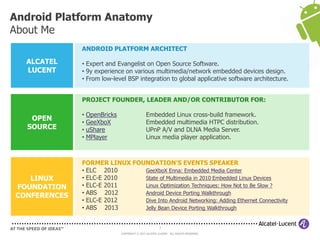
ANDROID PLATFORM ARCHITECT
• Expert and Evangelist on Open Source Software.
• 9y experience on various multimedia/network embedded devices design.
• From low-level BSP integration to global applicative software architecture.
OPEN
SOURCE
PROJECT FOUNDER, LEADER AND/OR CONTRIBUTOR FOR:
• OpenBricks Embedded Linux cross-build framework.
• GeeXboX Embedded multimedia HTPC distribution.
• uShare UPnP A/V and DLNA Media Server.
• MPlayer Linux media player application.
LINUX
FOUNDATION
CONFERENCES
FORMER LINUX FOUNDATION’S EVENTS SPEAKER
• ELC 2010 GeeXboX Enna: Embedded Media Center
• ELC-E 2010 State of Multimedia in 2010 Embedded Linux Devices
• ELC-E 2011 Linux Optimization Techniques: How Not to Be Slow ?
• ABS 2012 Android Device Porting Walkthrough
• ELC-E 2012 Dive Into Android Networking: Adding Ethernet Connectivity
• ABS 2013 Jelly Bean Device Porting Walkthrough
3
COPYRIGHT © 2013 ALCATEL-LUCENT. ALL RIGHTS RESERVED.
Android Platform Anatomy
Bibliographical References
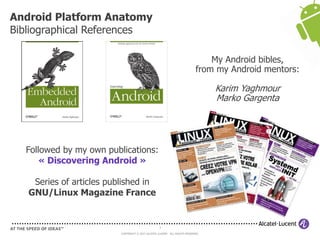
My Android bibles,
from my Android mentors:
Karim Yaghmour
Marko Gargenta
Followed by my own publications:
« Discovering Android »
Series of articles published in
GNU/Linux Magazine France
4
COPYRIGHT © 2013 ALCATEL-LUCENT. ALL RIGHTS RESERVED.
Android Platform Anatomy
The Android Operating System
The Android
Operating System
5
COPYRIGHT © 2013 ALCATEL-LUCENT. ALL RIGHTS RESERVED.
Android Platform Anatomy
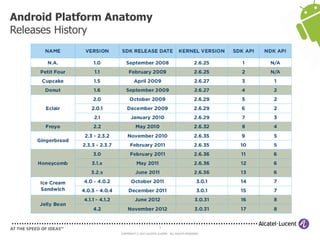
Releases History
6
COPYRIGHT © 2013 ALCATEL-LUCENT. ALL RIGHTS RESERVED.
Android Platform Anatomy
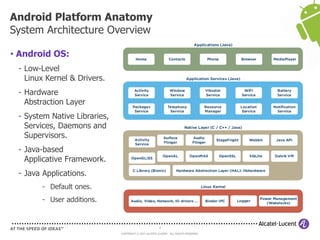
System Architecture Overview
• Android OS:
- Low-Level
Linux Kernel & Drivers.
- Hardware
Abstraction Layer
- System Native Libraries,
Services, Daemons and
Supervisors.
- Java-based
Applicative Framework.
- Java Applications.
- Default ones.
- User additions.
7
COPYRIGHT © 2013 ALCATEL-LUCENT. ALL RIGHTS RESERVED.
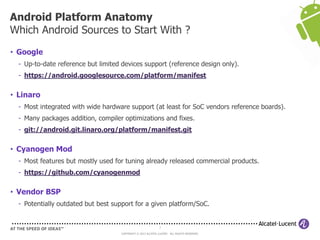
• Google
- Up-to-date reference but limited devices support (reference design only).
- https://android.googlesource.com/platform/manifest
• Linaro
- Most integrated with wide hardware support (at least for SoC vendors reference boards).
- Many packages addition, compiler optimizations and fixes.
- git://android.git.linaro.org/platform/manifest.git
• Cyanogen Mod
- Most features but mostly used for tuning already released commercial products.
- https://github.com/cyanogenmod
• Vendor BSP
- Potentially outdated but best support for a given platform/SoC.
Android Platform Anatomy
Which Android Sources to Start With ?
8
COPYRIGHT © 2013 ALCATEL-LUCENT. ALL RIGHTS RESERVED.
Android Platform Anatomy
Device Porting How-To
Device Porting
How-To
9
COPYRIGHT © 2013 ALCATEL-LUCENT. ALL RIGHTS RESERVED.
Android Platform Anatomy
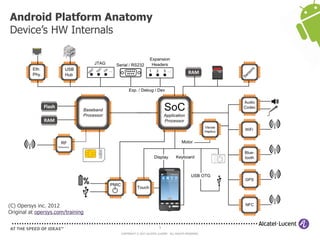
Device’s HW Internals
(C) Opersys inc. 2012
Original at opersys.com/training
10
COPYRIGHT © 2013 ALCATEL-LUCENT. ALL RIGHTS RESERVED.
• Recommendation:
- Ensure your SoC is already supported by Linux kernel.
• 1. Design your custom board around a reference design.
• 2. Ensure your HW is compatible with Android CDD.
• 3. Whenever possible, select HW peripherals that you know are supported.
• 4. Ensure you have detailed specifications for each peripheral !
• 5. Think about SoC pin muxing and avoid multiplexing.
• 6. Ensure you have HW schematics at hand.
• Start writing drivers and adapting the platform ;-)
Android Platform Anatomy
Device Porting Checklist
11
COPYRIGHT © 2013 ALCATEL-LUCENT. ALL RIGHTS RESERVED.
• Compatibility Goals
- Provide a consistent application and HW environment to application developers.
- Enable a consistent application experience for consumers.
- Enable device manufacturers to differentiate while being compatible.
- Minimize costs and overhead associated with compatibility.
• Compatibility Definition Document (CDD)
- List of hardware/software requirements per Android version.
- Mandatory requirements for device certification and access to market place.
• Compatibility Test Suite (CTS)
- Set of unit designed to be integrated into the daily workflow
(such as via a continuous build system) of the engineers building a device.
- Its intent is to reveal incompatibilities early on, and ensure that the software
remains compatible throughout the development process.
• More info on http://source.android.com/compatibility/overview.html
Android Platform Anatomy
Building an Android-Compatible Device
12
COPYRIGHT © 2013 ALCATEL-LUCENT. ALL RIGHTS RESERVED.
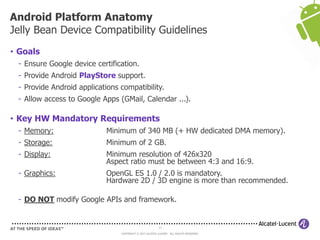
• Goals
- Ensure Google device certification.
- Provide Android PlayStore support.
- Provide Android applications compatibility.
- Allow access to Google Apps (GMail, Calendar ...).
• Key HW Mandatory Requirements
- Memory: Minimum of 340 MB (+ HW dedicated DMA memory).
- Storage: Minimum of 2 GB.
- Display: Minimum resolution of 426x320
Aspect ratio must be between 4:3 and 16:9.
- Graphics: OpenGL ES 1.0 / 2.0 is mandatory.
Hardware 2D / 3D engine is more than recommended.
- DO NOT modify Google APIs and framework.
Android Platform Anatomy
Jelly Bean Device Compatibility Guidelines
13
COPYRIGHT © 2013 ALCATEL-LUCENT. ALL RIGHTS RESERVED.
Android Platform Anatomy
Android Kernel
Android
Kernel
14
COPYRIGHT © 2013 ALCATEL-LUCENT. ALL RIGHTS RESERVED.
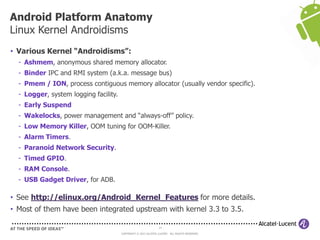
• Various Kernel “Androidisms”:
- Ashmem, anonymous shared memory allocator.
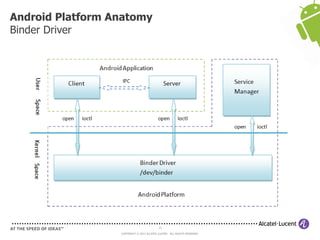
- Binder IPC and RMI system (a.k.a. message bus)
- Pmem / ION, process contiguous memory allocator (usually vendor specific).
- Logger, system logging facility.
- Early Suspend
- Wakelocks, power management and “always-off” policy.
- Low Memory Killer, OOM tuning for OOM-Killer.
- Alarm Timers.
- Paranoid Network Security.
- Timed GPIO.
- RAM Console.
- USB Gadget Driver, for ADB.
• See http://elinux.org/Android_Kernel_Features for more details.
• Most of them have been integrated upstream with kernel 3.3 to 3.5.
Android Platform Anatomy
Linux Kernel Androidisms
15
COPYRIGHT © 2013 ALCATEL-LUCENT. ALL RIGHTS RESERVED.
Android Platform Anatomy
Binder Driver
16
COPYRIGHT © 2013 ALCATEL-LUCENT. ALL RIGHTS RESERVED.
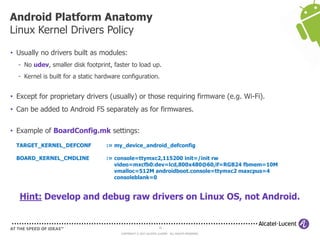
• Usually no drivers built as modules:
- No udev, smaller disk footprint, faster to load up.
- Kernel is built for a static hardware configuration.
• Except for proprietary drivers (usually) or those requiring firmware (e.g. Wi-Fi).
• Can be added to Android FS separately as for firmwares.
• Example of BoardConfig.mk settings:
TARGET_KERNEL_DEFCONF := my_device_android_defconfig
BOARD_KERNEL_CMDLINE := console=ttymxc2,115200 init=/init rw
video=mxcfb0:dev=lcd,800x480@60,if=RGB24 fbmem=10M
vmalloc=512M androidboot.console=ttymxc2 maxcpus=4
consoleblank=0
Hint: Develop and debug raw drivers on Linux OS, not Android.
Android Platform Anatomy
Linux Kernel Drivers Policy
17
COPYRIGHT © 2013 ALCATEL-LUCENT. ALL RIGHTS RESERVED.
Android Platform Anatomy
Android User-Space
Android
User-Space
18
COPYRIGHT © 2013 ALCATEL-LUCENT. ALL RIGHTS RESERVED.
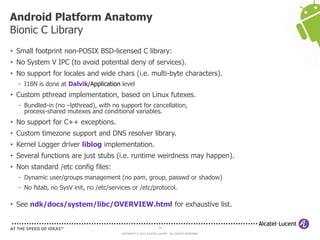
• Small footprint non-POSIX BSD-licensed C library:
• No System V IPC (to avoid potential deny of services).
• No support for locales and wide chars (i.e. multi-byte characters).
- I18N is done at Dalvik/Application level
• Custom pthread implementation, based on Linux futexes.
- Bundled-in (no –lpthread), with no support for cancellation,
process-shared mutexes and conditional variables.
• No support for C++ exceptions.
• Custom timezone support and DNS resolver library.
• Kernel Logger driver liblog implementation.
• Several functions are just stubs (i.e. runtime weirdness may happen).
• Non standard /etc config files:
- Dynamic user/groups management (no pam, group, passwd or shadow)
- No fstab, no SysV init, no /etc/services or /etc/protocol.
• See ndk/docs/system/libc/OVERVIEW.html for exhaustive list.
Android Platform Anatomy
Bionic C Library
19
COPYRIGHT © 2013 ALCATEL-LUCENT. ALL RIGHTS RESERVED.
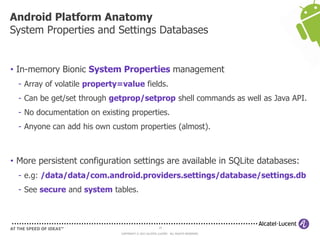
• In-memory Bionic System Properties management
- Array of volatile property=value fields.
- Can be get/set through getprop/setprop shell commands as well as Java API.
- No documentation on existing properties.
- Anyone can add his own custom properties (almost).
• More persistent configuration settings are available in SQLite databases:
- e.g: /data/data/com.android.providers.settings/database/settings.db
- See secure and system tables.
Android Platform Anatomy
System Properties and Settings Databases
20
COPYRIGHT © 2013 ALCATEL-LUCENT. ALL RIGHTS RESERVED.
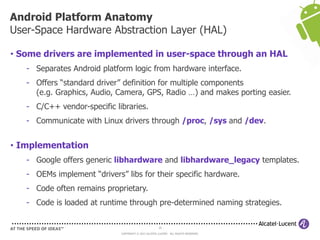
• Some drivers are implemented in user-space through an HAL
- Separates Android platform logic from hardware interface.
- Offers “standard driver” definition for multiple components
(e.g. Graphics, Audio, Camera, GPS, Radio …) and makes porting easier.
- C/C++ vendor-specific libraries.
- Communicate with Linux drivers through /proc, /sys and /dev.
• Implementation
- Google offers generic libhardware and libhardware_legacy templates.
- OEMs implement “drivers” libs for their specific hardware.
- Code often remains proprietary.
- Code is loaded at runtime through pre-determined naming strategies.
Android Platform Anatomy
User-Space Hardware Abstraction Layer (HAL)
21
COPYRIGHT © 2013 ALCATEL-LUCENT. ALL RIGHTS RESERVED.
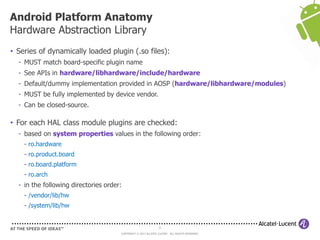
• Series of dynamically loaded plugin (.so files):
- MUST match board-specific plugin name
- See APIs in hardware/libhardware/include/hardware
- Default/dummy implementation provided in AOSP (hardware/libhardware/modules)
- MUST be fully implemented by device vendor.
- Can be closed-source.
• For each HAL class module plugins are checked:
- based on system properties values in the following order:
- ro.hardware
- ro.product.board
- ro.board.platform
- ro.arch
- in the following directories order:
- /vendor/lib/hw
- /system/lib/hw
Android Platform Anatomy
Hardware Abstraction Library
22
COPYRIGHT © 2013 ALCATEL-LUCENT. ALL RIGHTS RESERVED.
Android Platform Anatomy
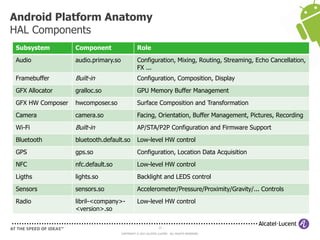
HAL Components
Subsystem Component Role
Audio audio.primary.so Configuration, Mixing, Routing, Streaming, Echo Cancellation,
FX ...
Framebuffer Built-in Configuration, Composition, Display
GFX Allocator gralloc.so GPU Memory Buffer Management
GFX HW Composer hwcomposer.so Surface Composition and Transformation
Camera camera.so Facing, Orientation, Buffer Management, Pictures, Recording
Wi-Fi Built-in AP/STA/P2P Configuration and Firmware Support
Bluetooth bluetooth.default.so Low-level HW control
GPS gps.so Configuration, Location Data Acquisition
NFC nfc.default.so Low-level HW control
Ligths lights.so Backlight and LEDS control
Sensors sensors.so Accelerometer/Pressure/Proximity/Gravity/... Controls
Radio libril-<company>-
<version>.so
Low-level HW control
23
COPYRIGHT © 2013 ALCATEL-LUCENT. ALL RIGHTS RESERVED.
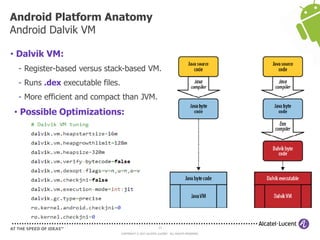
• Dalvik VM:
- Register-based versus stack-based VM.
- Runs .dex executable files.
- More efficient and compact than JVM.
• Possible Optimizations:
Android Platform Anatomy
Android Dalvik VM
24
COPYRIGHT © 2013 ALCATEL-LUCENT. ALL RIGHTS RESERVED.
Android Platform Anatomy
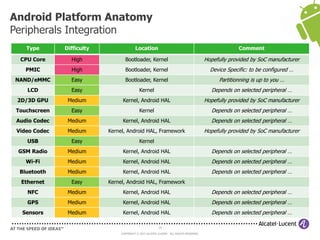
Peripherals Integration
Type Difficulty Location Comment
CPU Core High Bootloader, Kernel Hopefully provided by SoC manufacturer
PMIC High Bootloader, Kernel Device Specific: to be configured …
NAND/eMMC Easy Bootloader, Kernel Partitionning is up to you …
LCD Easy Kernel Depends on selected peripheral …
2D/3D GPU Medium Kernel, Android HAL Hopefully provided by SoC manufacturer
Touchscreen Easy Kernel Depends on selected peripheral …
Audio Codec Medium Kernel, Android HAL Depends on selected peripheral …
Video Codec Medium Kernel, Android HAL, Framework Hopefully provided by SoC manufacturer
USB Easy Kernel
GSM Radio Medium Kernel, Android HAL Depends on selected peripheral …
Wi-Fi Medium Kernel, Android HAL Depends on selected peripheral …
Bluetooth Medium Kernel, Android HAL Depends on selected peripheral …
Ethernet Easy Kernel, Android HAL, Framework
NFC Medium Kernel, Android HAL Depends on selected peripheral …
GPS Medium Kernel, Android HAL Depends on selected peripheral …
Sensors Medium Kernel, Android HAL Depends on selected peripheral …
25
COPYRIGHT © 2013 ALCATEL-LUCENT. ALL RIGHTS RESERVED.
Android Platform Anatomy
Android Initialization
Android
Initialization
26
COPYRIGHT © 2013 ALCATEL-LUCENT. ALL RIGHTS RESERVED.
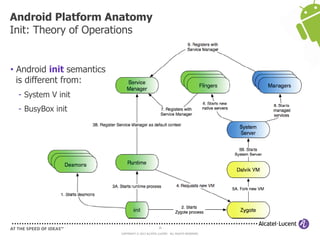
• Android init semantics
is different from:
- System V init
- BusyBox init
Android Platform Anatomy
Init: Theory of Operations
27
COPYRIGHT © 2013 ALCATEL-LUCENT. ALL RIGHTS RESERVED.
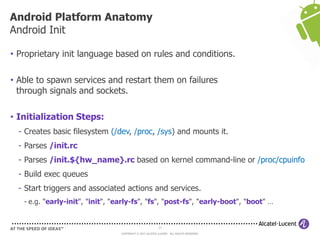
• Proprietary init language based on rules and conditions.
• Able to spawn services and restart them on failures
through signals and sockets.
• Initialization Steps:
- Creates basic filesystem (/dev, /proc, /sys) and mounts it.
- Parses /init.rc
- Parses /init.${hw_name}.rc based on kernel command-line or /proc/cpuinfo
- Build exec queues
- Start triggers and associated actions and services.
- e.g. "early-init", "init", "early-fs", "fs", "post-fs", "early-boot", "boot" …
Android Platform Anatomy
Android Init
28
COPYRIGHT © 2013 ALCATEL-LUCENT. ALL RIGHTS RESERVED.
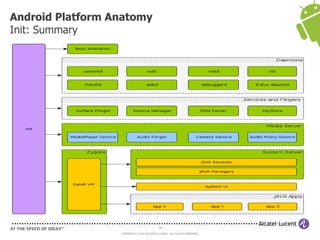
Android Platform Anatomy
Init: Summary
29
COPYRIGHT © 2013 ALCATEL-LUCENT. ALL RIGHTS RESERVED.
Android Platform Anatomy
Graphics Layer
Graphics Layer
30
COPYRIGHT © 2013 ALCATEL-LUCENT. ALL RIGHTS RESERVED.
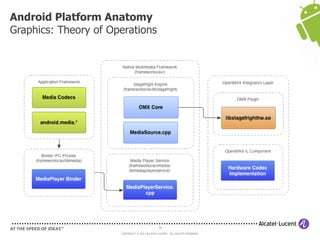
Android Platform Anatomy
Graphics: Theory of Operations
31
COPYRIGHT © 2013 ALCATEL-LUCENT. ALL RIGHTS RESERVED.
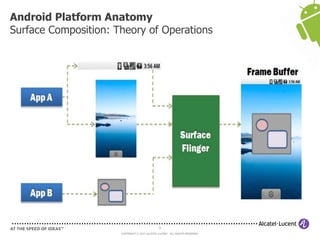
Android Platform Anatomy
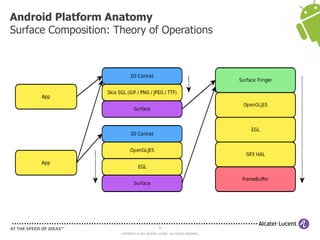
Surface Composition: Theory of Operations
32
COPYRIGHT © 2013 ALCATEL-LUCENT. ALL RIGHTS RESERVED.
Android Platform Anatomy
Surface Composition: Theory of Operations
33
COPYRIGHT © 2013 ALCATEL-LUCENT. ALL RIGHTS RESERVED.
Android Platform Anatomy
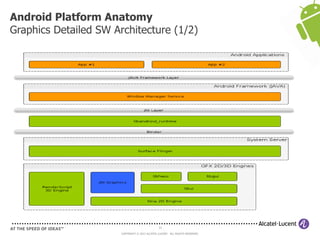
Graphics Detailed SW Architecture (1/2)
34
COPYRIGHT © 2013 ALCATEL-LUCENT. ALL RIGHTS RESERVED.
Android Platform Anatomy
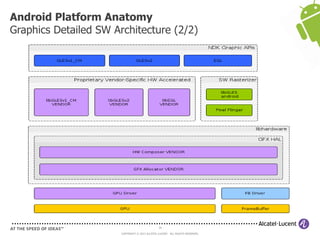
Graphics Detailed SW Architecture (2/2)
35
COPYRIGHT © 2013 ALCATEL-LUCENT. ALL RIGHTS RESERVED.
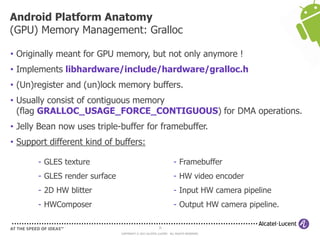
• Originally meant for GPU memory, but not only anymore !
• Implements libhardware/include/hardware/gralloc.h
• (Un)register and (un)lock memory buffers.
• Usually consist of contiguous memory
(flag GRALLOC_USAGE_FORCE_CONTIGUOUS) for DMA operations.
• Jelly Bean now uses triple-buffer for framebuffer.
• Support different kind of buffers:
Android Platform Anatomy
(GPU) Memory Management: Gralloc
- GLES texture
- GLES render surface
- 2D HW blitter
- HWComposer
- Framebuffer
- HW video encoder
- Input HW camera pipeline
- Output HW camera pipeline.
36
COPYRIGHT © 2013 ALCATEL-LUCENT. ALL RIGHTS RESERVED.
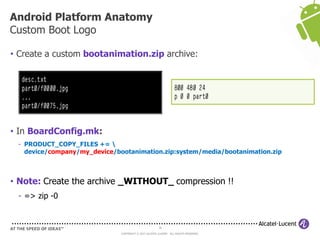
• Create a custom bootanimation.zip archive:
• In BoardConfig.mk:
- PRODUCT_COPY_FILES += 
device/company/my_device/bootanimation.zip:system/media/bootanimation.zip
• Note: Create the archive _WITHOUT_ compression !!
- => zip -0
Android Platform Anatomy
Custom Boot Logo
37
COPYRIGHT © 2013 ALCATEL-LUCENT. ALL RIGHTS RESERVED.
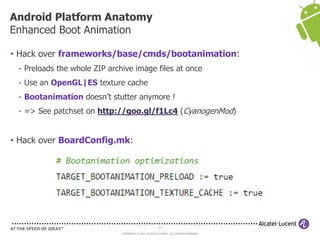
• Hack over frameworks/base/cmds/bootanimation:
- Preloads the whole ZIP archive image files at once
- Use an OpenGL|ES texture cache
- Bootanimation doesn’t stutter anymore !
- => See patchset on http://goo.gl/f1Lc4 (CyanogenMod)
• Hack over BoardConfig.mk:
Android Platform Anatomy
Enhanced Boot Animation
38
COPYRIGHT © 2013 ALCATEL-LUCENT. ALL RIGHTS RESERVED.
Android Platform Anatomy
Input Layer
Input Layer
39
COPYRIGHT © 2013 ALCATEL-LUCENT. ALL RIGHTS RESERVED.
Android Platform Anatomy
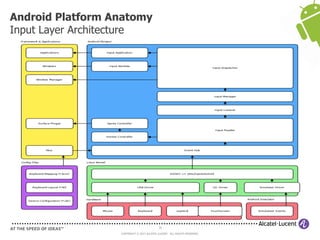
Input Layer Architecture
40
COPYRIGHT © 2013 ALCATEL-LUCENT. ALL RIGHTS RESERVED.
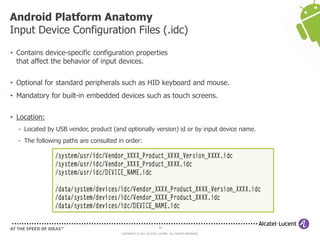
• Contains device-specific configuration properties
that affect the behavior of input devices.
• Optional for standard peripherals such as HID keyboard and mouse.
• Mandatory for built-in embedded devices such as touch screens.
• Location:
- Located by USB vendor, product (and optionally version) id or by input device name.
- The following paths are consulted in order:
Android Platform Anatomy
Input Device Configuration Files (.idc)
41
COPYRIGHT © 2013 ALCATEL-LUCENT. ALL RIGHTS RESERVED.
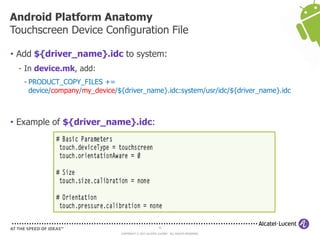
• Add ${driver_name}.idc to system:
- In device.mk, add:
- PRODUCT_COPY_FILES +=
device/company/my_device/${driver_name}.idc:system/usr/idc/${driver_name}.idc
• Example of ${driver_name}.idc:
Android Platform Anatomy
Touchscreen Device Configuration File
42
COPYRIGHT © 2013 ALCATEL-LUCENT. ALL RIGHTS RESERVED.
Android Platform Anatomy
Audio Layer
Audio Layer
43
COPYRIGHT © 2013 ALCATEL-LUCENT. ALL RIGHTS RESERVED.
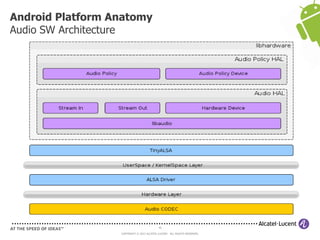
Android Platform Anatomy
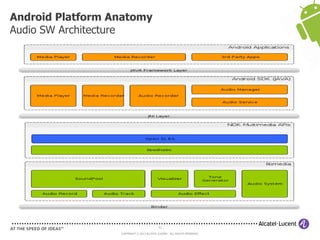
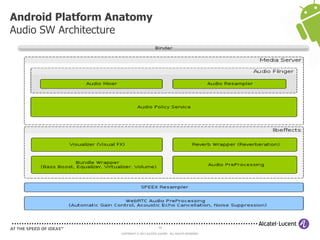
Audio SW Architecture
44
COPYRIGHT © 2013 ALCATEL-LUCENT. ALL RIGHTS RESERVED.
Android Platform Anatomy
Audio SW Architecture
45
COPYRIGHT © 2013 ALCATEL-LUCENT. ALL RIGHTS RESERVED.
Android Platform Anatomy
Audio SW Architecture
46
COPYRIGHT © 2013 ALCATEL-LUCENT. ALL RIGHTS RESERVED.
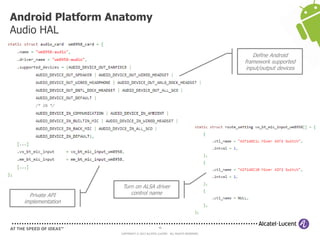
Android Platform Anatomy
Audio HAL
Define Android
framework supported
input/output devices
Private API
implementation
Turn on ALSA driver
control name
47
COPYRIGHT © 2013 ALCATEL-LUCENT. ALL RIGHTS RESERVED.
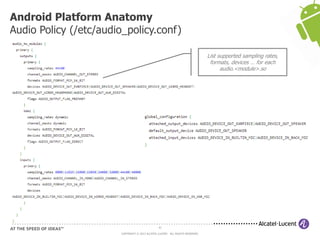
Android Platform Anatomy
Audio Policy (/etc/audio_policy.conf)
List supported sampling rates,
formats, devices … for each
audio.<module>.so
48
COPYRIGHT © 2013 ALCATEL-LUCENT. ALL RIGHTS RESERVED.
Android Platform Anatomy
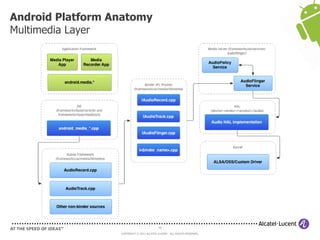
Multimedia Layer
Multimedia Layer
49
COPYRIGHT © 2013 ALCATEL-LUCENT. ALL RIGHTS RESERVED.
Android Platform Anatomy
Multimedia Layer
50
COPYRIGHT © 2013 ALCATEL-LUCENT. ALL RIGHTS RESERVED.
Android Platform Anatomy
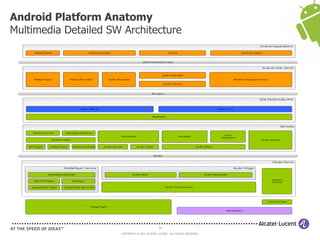
Multimedia Detailed SW Architecture
51
COPYRIGHT © 2013 ALCATEL-LUCENT. ALL RIGHTS RESERVED.
Android Platform Anatomy
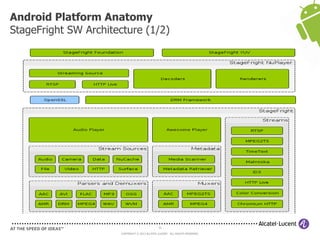
StageFright SW Architecture (1/2)
52
COPYRIGHT © 2013 ALCATEL-LUCENT. ALL RIGHTS RESERVED.
Android Platform Anatomy
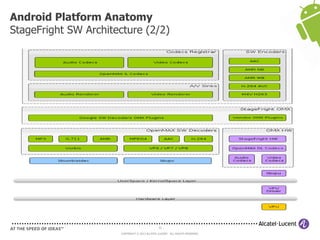
StageFright SW Architecture (2/2)
53
COPYRIGHT © 2013 ALCATEL-LUCENT. ALL RIGHTS RESERVED.
Android Platform Anatomy
Network Layer
Network Layer
54
COPYRIGHT © 2013 ALCATEL-LUCENT. ALL RIGHTS RESERVED.
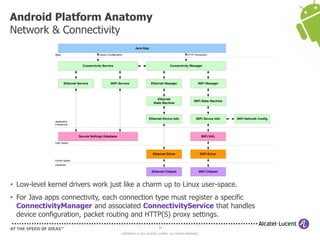
• Low-level kernel drivers work just like a charm up to Linux user-space.
• For Java apps connectivity, each connection type must register a specific
ConnectivityManager and associated ConnectivityService that handles
device configuration, packet routing and HTTP(S) proxy settings.
Android Platform Anatomy
Network & Connectivity
55
COPYRIGHT © 2013 ALCATEL-LUCENT. ALL RIGHTS RESERVED.
Android Platform Anatomy
Conclusion
Conclusion
56
COPYRIGHT © 2013 ALCATEL-LUCENT. ALL RIGHTS RESERVED.
• Android SW architecture is ages away
from your GNU/Linux experience.
- Low-level drivers are Linux-compatible but that’s pretty much all about it.
- One need trained experts to bring Android devices to life.
• Android provides a HAL that unifies hardware interfaces.
- Facilitate device porting.
- But terribly lacks of documentation (same goes for the whole platform).
• Porting devices to Android is an extremely complex task.
- But it makes application developers happy by providing them
a (nearly) seamless experience across all devices.
Android Platform Anatomy
Conclusion
57
COPYRIGHT © 2013 ALCATEL-LUCENT. ALL RIGHTS RESERVED.
Thank You
Android Platform Anatomy
Thanks
Droidcon 2013 France - Android Platform Anatomy

Droidcon 2013 France - Android Platform Anatomy

  • 1.
    COPYRIGHT © 2012ALCATEL-LUCENT. ALL RIGHTS RESERVED. 1 Benjamin Zores Droidcon 2013 – 17-18th June 2013 – Paris, FR Android Platform Anatomy
  • 2.
    2 COPYRIGHT © 2013ALCATEL-LUCENT. ALL RIGHTS RESERVED. Android Platform Anatomy About Me ALCATEL LUCENT ANDROID PLATFORM ARCHITECT • Expert and Evangelist on Open Source Software. • 9y experience on various multimedia/network embedded devices design. • From low-level BSP integration to global applicative software architecture. OPEN SOURCE PROJECT FOUNDER, LEADER AND/OR CONTRIBUTOR FOR: • OpenBricks Embedded Linux cross-build framework. • GeeXboX Embedded multimedia HTPC distribution. • uShare UPnP A/V and DLNA Media Server. • MPlayer Linux media player application. LINUX FOUNDATION CONFERENCES FORMER LINUX FOUNDATION’S EVENTS SPEAKER • ELC 2010 GeeXboX Enna: Embedded Media Center • ELC-E 2010 State of Multimedia in 2010 Embedded Linux Devices • ELC-E 2011 Linux Optimization Techniques: How Not to Be Slow ? • ABS 2012 Android Device Porting Walkthrough • ELC-E 2012 Dive Into Android Networking: Adding Ethernet Connectivity • ABS 2013 Jelly Bean Device Porting Walkthrough
  • 3.
    3 COPYRIGHT © 2013ALCATEL-LUCENT. ALL RIGHTS RESERVED. Android Platform Anatomy Bibliographical References My Android bibles, from my Android mentors: Karim Yaghmour Marko Gargenta Followed by my own publications: « Discovering Android » Series of articles published in GNU/Linux Magazine France
  • 4.
    4 COPYRIGHT © 2013ALCATEL-LUCENT. ALL RIGHTS RESERVED. Android Platform Anatomy The Android Operating System The Android Operating System
  • 5.
    5 COPYRIGHT © 2013ALCATEL-LUCENT. ALL RIGHTS RESERVED. Android Platform Anatomy Releases History
  • 6.
    6 COPYRIGHT © 2013ALCATEL-LUCENT. ALL RIGHTS RESERVED. Android Platform Anatomy System Architecture Overview • Android OS: - Low-Level Linux Kernel & Drivers. - Hardware Abstraction Layer - System Native Libraries, Services, Daemons and Supervisors. - Java-based Applicative Framework. - Java Applications. - Default ones. - User additions.
  • 7.
    7 COPYRIGHT © 2013ALCATEL-LUCENT. ALL RIGHTS RESERVED. • Google - Up-to-date reference but limited devices support (reference design only). - https://android.googlesource.com/platform/manifest • Linaro - Most integrated with wide hardware support (at least for SoC vendors reference boards). - Many packages addition, compiler optimizations and fixes. - git://android.git.linaro.org/platform/manifest.git • Cyanogen Mod - Most features but mostly used for tuning already released commercial products. - https://github.com/cyanogenmod • Vendor BSP - Potentially outdated but best support for a given platform/SoC. Android Platform Anatomy Which Android Sources to Start With ?
  • 8.
    8 COPYRIGHT © 2013ALCATEL-LUCENT. ALL RIGHTS RESERVED. Android Platform Anatomy Device Porting How-To Device Porting How-To
  • 9.
    9 COPYRIGHT © 2013ALCATEL-LUCENT. ALL RIGHTS RESERVED. Android Platform Anatomy Device’s HW Internals (C) Opersys inc. 2012 Original at opersys.com/training
  • 10.
    10 COPYRIGHT © 2013ALCATEL-LUCENT. ALL RIGHTS RESERVED. • Recommendation: - Ensure your SoC is already supported by Linux kernel. • 1. Design your custom board around a reference design. • 2. Ensure your HW is compatible with Android CDD. • 3. Whenever possible, select HW peripherals that you know are supported. • 4. Ensure you have detailed specifications for each peripheral ! • 5. Think about SoC pin muxing and avoid multiplexing. • 6. Ensure you have HW schematics at hand. • Start writing drivers and adapting the platform ;-) Android Platform Anatomy Device Porting Checklist
  • 11.
    11 COPYRIGHT © 2013ALCATEL-LUCENT. ALL RIGHTS RESERVED. • Compatibility Goals - Provide a consistent application and HW environment to application developers. - Enable a consistent application experience for consumers. - Enable device manufacturers to differentiate while being compatible. - Minimize costs and overhead associated with compatibility. • Compatibility Definition Document (CDD) - List of hardware/software requirements per Android version. - Mandatory requirements for device certification and access to market place. • Compatibility Test Suite (CTS) - Set of unit designed to be integrated into the daily workflow (such as via a continuous build system) of the engineers building a device. - Its intent is to reveal incompatibilities early on, and ensure that the software remains compatible throughout the development process. • More info on http://source.android.com/compatibility/overview.html Android Platform Anatomy Building an Android-Compatible Device
  • 12.
    12 COPYRIGHT © 2013ALCATEL-LUCENT. ALL RIGHTS RESERVED. • Goals - Ensure Google device certification. - Provide Android PlayStore support. - Provide Android applications compatibility. - Allow access to Google Apps (GMail, Calendar ...). • Key HW Mandatory Requirements - Memory: Minimum of 340 MB (+ HW dedicated DMA memory). - Storage: Minimum of 2 GB. - Display: Minimum resolution of 426x320 Aspect ratio must be between 4:3 and 16:9. - Graphics: OpenGL ES 1.0 / 2.0 is mandatory. Hardware 2D / 3D engine is more than recommended. - DO NOT modify Google APIs and framework. Android Platform Anatomy Jelly Bean Device Compatibility Guidelines
  • 13.
    13 COPYRIGHT © 2013ALCATEL-LUCENT. ALL RIGHTS RESERVED. Android Platform Anatomy Android Kernel Android Kernel
  • 14.
    14 COPYRIGHT © 2013ALCATEL-LUCENT. ALL RIGHTS RESERVED. • Various Kernel “Androidisms”: - Ashmem, anonymous shared memory allocator. - Binder IPC and RMI system (a.k.a. message bus) - Pmem / ION, process contiguous memory allocator (usually vendor specific). - Logger, system logging facility. - Early Suspend - Wakelocks, power management and “always-off” policy. - Low Memory Killer, OOM tuning for OOM-Killer. - Alarm Timers. - Paranoid Network Security. - Timed GPIO. - RAM Console. - USB Gadget Driver, for ADB. • See http://elinux.org/Android_Kernel_Features for more details. • Most of them have been integrated upstream with kernel 3.3 to 3.5. Android Platform Anatomy Linux Kernel Androidisms
  • 15.
    15 COPYRIGHT © 2013ALCATEL-LUCENT. ALL RIGHTS RESERVED. Android Platform Anatomy Binder Driver
  • 16.
    16 COPYRIGHT © 2013ALCATEL-LUCENT. ALL RIGHTS RESERVED. • Usually no drivers built as modules: - No udev, smaller disk footprint, faster to load up. - Kernel is built for a static hardware configuration. • Except for proprietary drivers (usually) or those requiring firmware (e.g. Wi-Fi). • Can be added to Android FS separately as for firmwares. • Example of BoardConfig.mk settings: TARGET_KERNEL_DEFCONF := my_device_android_defconfig BOARD_KERNEL_CMDLINE := console=ttymxc2,115200 init=/init rw video=mxcfb0:dev=lcd,800x480@60,if=RGB24 fbmem=10M vmalloc=512M androidboot.console=ttymxc2 maxcpus=4 consoleblank=0 Hint: Develop and debug raw drivers on Linux OS, not Android. Android Platform Anatomy Linux Kernel Drivers Policy
  • 17.
    17 COPYRIGHT © 2013ALCATEL-LUCENT. ALL RIGHTS RESERVED. Android Platform Anatomy Android User-Space Android User-Space
  • 18.
    18 COPYRIGHT © 2013ALCATEL-LUCENT. ALL RIGHTS RESERVED. • Small footprint non-POSIX BSD-licensed C library: • No System V IPC (to avoid potential deny of services). • No support for locales and wide chars (i.e. multi-byte characters). - I18N is done at Dalvik/Application level • Custom pthread implementation, based on Linux futexes. - Bundled-in (no –lpthread), with no support for cancellation, process-shared mutexes and conditional variables. • No support for C++ exceptions. • Custom timezone support and DNS resolver library. • Kernel Logger driver liblog implementation. • Several functions are just stubs (i.e. runtime weirdness may happen). • Non standard /etc config files: - Dynamic user/groups management (no pam, group, passwd or shadow) - No fstab, no SysV init, no /etc/services or /etc/protocol. • See ndk/docs/system/libc/OVERVIEW.html for exhaustive list. Android Platform Anatomy Bionic C Library
  • 19.
    19 COPYRIGHT © 2013ALCATEL-LUCENT. ALL RIGHTS RESERVED. • In-memory Bionic System Properties management - Array of volatile property=value fields. - Can be get/set through getprop/setprop shell commands as well as Java API. - No documentation on existing properties. - Anyone can add his own custom properties (almost). • More persistent configuration settings are available in SQLite databases: - e.g: /data/data/com.android.providers.settings/database/settings.db - See secure and system tables. Android Platform Anatomy System Properties and Settings Databases
  • 20.
    20 COPYRIGHT © 2013ALCATEL-LUCENT. ALL RIGHTS RESERVED. • Some drivers are implemented in user-space through an HAL - Separates Android platform logic from hardware interface. - Offers “standard driver” definition for multiple components (e.g. Graphics, Audio, Camera, GPS, Radio …) and makes porting easier. - C/C++ vendor-specific libraries. - Communicate with Linux drivers through /proc, /sys and /dev. • Implementation - Google offers generic libhardware and libhardware_legacy templates. - OEMs implement “drivers” libs for their specific hardware. - Code often remains proprietary. - Code is loaded at runtime through pre-determined naming strategies. Android Platform Anatomy User-Space Hardware Abstraction Layer (HAL)
  • 21.
    21 COPYRIGHT © 2013ALCATEL-LUCENT. ALL RIGHTS RESERVED. • Series of dynamically loaded plugin (.so files): - MUST match board-specific plugin name - See APIs in hardware/libhardware/include/hardware - Default/dummy implementation provided in AOSP (hardware/libhardware/modules) - MUST be fully implemented by device vendor. - Can be closed-source. • For each HAL class module plugins are checked: - based on system properties values in the following order: - ro.hardware - ro.product.board - ro.board.platform - ro.arch - in the following directories order: - /vendor/lib/hw - /system/lib/hw Android Platform Anatomy Hardware Abstraction Library
  • 22.
    22 COPYRIGHT © 2013ALCATEL-LUCENT. ALL RIGHTS RESERVED. Android Platform Anatomy HAL Components Subsystem Component Role Audio audio.primary.so Configuration, Mixing, Routing, Streaming, Echo Cancellation, FX ... Framebuffer Built-in Configuration, Composition, Display GFX Allocator gralloc.so GPU Memory Buffer Management GFX HW Composer hwcomposer.so Surface Composition and Transformation Camera camera.so Facing, Orientation, Buffer Management, Pictures, Recording Wi-Fi Built-in AP/STA/P2P Configuration and Firmware Support Bluetooth bluetooth.default.so Low-level HW control GPS gps.so Configuration, Location Data Acquisition NFC nfc.default.so Low-level HW control Ligths lights.so Backlight and LEDS control Sensors sensors.so Accelerometer/Pressure/Proximity/Gravity/... Controls Radio libril-<company>- <version>.so Low-level HW control
  • 23.
    23 COPYRIGHT © 2013ALCATEL-LUCENT. ALL RIGHTS RESERVED. • Dalvik VM: - Register-based versus stack-based VM. - Runs .dex executable files. - More efficient and compact than JVM. • Possible Optimizations: Android Platform Anatomy Android Dalvik VM
  • 24.
    24 COPYRIGHT © 2013ALCATEL-LUCENT. ALL RIGHTS RESERVED. Android Platform Anatomy Peripherals Integration Type Difficulty Location Comment CPU Core High Bootloader, Kernel Hopefully provided by SoC manufacturer PMIC High Bootloader, Kernel Device Specific: to be configured … NAND/eMMC Easy Bootloader, Kernel Partitionning is up to you … LCD Easy Kernel Depends on selected peripheral … 2D/3D GPU Medium Kernel, Android HAL Hopefully provided by SoC manufacturer Touchscreen Easy Kernel Depends on selected peripheral … Audio Codec Medium Kernel, Android HAL Depends on selected peripheral … Video Codec Medium Kernel, Android HAL, Framework Hopefully provided by SoC manufacturer USB Easy Kernel GSM Radio Medium Kernel, Android HAL Depends on selected peripheral … Wi-Fi Medium Kernel, Android HAL Depends on selected peripheral … Bluetooth Medium Kernel, Android HAL Depends on selected peripheral … Ethernet Easy Kernel, Android HAL, Framework NFC Medium Kernel, Android HAL Depends on selected peripheral … GPS Medium Kernel, Android HAL Depends on selected peripheral … Sensors Medium Kernel, Android HAL Depends on selected peripheral …
  • 25.
    25 COPYRIGHT © 2013ALCATEL-LUCENT. ALL RIGHTS RESERVED. Android Platform Anatomy Android Initialization Android Initialization
  • 26.
    26 COPYRIGHT © 2013ALCATEL-LUCENT. ALL RIGHTS RESERVED. • Android init semantics is different from: - System V init - BusyBox init Android Platform Anatomy Init: Theory of Operations
  • 27.
    27 COPYRIGHT © 2013ALCATEL-LUCENT. ALL RIGHTS RESERVED. • Proprietary init language based on rules and conditions. • Able to spawn services and restart them on failures through signals and sockets. • Initialization Steps: - Creates basic filesystem (/dev, /proc, /sys) and mounts it. - Parses /init.rc - Parses /init.${hw_name}.rc based on kernel command-line or /proc/cpuinfo - Build exec queues - Start triggers and associated actions and services. - e.g. "early-init", "init", "early-fs", "fs", "post-fs", "early-boot", "boot" … Android Platform Anatomy Android Init
  • 28.
    28 COPYRIGHT © 2013ALCATEL-LUCENT. ALL RIGHTS RESERVED. Android Platform Anatomy Init: Summary
  • 29.
    29 COPYRIGHT © 2013ALCATEL-LUCENT. ALL RIGHTS RESERVED. Android Platform Anatomy Graphics Layer Graphics Layer
  • 30.
    30 COPYRIGHT © 2013ALCATEL-LUCENT. ALL RIGHTS RESERVED. Android Platform Anatomy Graphics: Theory of Operations
  • 31.
    31 COPYRIGHT © 2013ALCATEL-LUCENT. ALL RIGHTS RESERVED. Android Platform Anatomy Surface Composition: Theory of Operations
  • 32.
    32 COPYRIGHT © 2013ALCATEL-LUCENT. ALL RIGHTS RESERVED. Android Platform Anatomy Surface Composition: Theory of Operations
  • 33.
    33 COPYRIGHT © 2013ALCATEL-LUCENT. ALL RIGHTS RESERVED. Android Platform Anatomy Graphics Detailed SW Architecture (1/2)
  • 34.
    34 COPYRIGHT © 2013ALCATEL-LUCENT. ALL RIGHTS RESERVED. Android Platform Anatomy Graphics Detailed SW Architecture (2/2)
  • 35.
    35 COPYRIGHT © 2013ALCATEL-LUCENT. ALL RIGHTS RESERVED. • Originally meant for GPU memory, but not only anymore ! • Implements libhardware/include/hardware/gralloc.h • (Un)register and (un)lock memory buffers. • Usually consist of contiguous memory (flag GRALLOC_USAGE_FORCE_CONTIGUOUS) for DMA operations. • Jelly Bean now uses triple-buffer for framebuffer. • Support different kind of buffers: Android Platform Anatomy (GPU) Memory Management: Gralloc - GLES texture - GLES render surface - 2D HW blitter - HWComposer - Framebuffer - HW video encoder - Input HW camera pipeline - Output HW camera pipeline.
  • 36.
    36 COPYRIGHT © 2013ALCATEL-LUCENT. ALL RIGHTS RESERVED. • Create a custom bootanimation.zip archive: • In BoardConfig.mk: - PRODUCT_COPY_FILES += device/company/my_device/bootanimation.zip:system/media/bootanimation.zip • Note: Create the archive _WITHOUT_ compression !! - => zip -0 Android Platform Anatomy Custom Boot Logo
  • 37.
    37 COPYRIGHT © 2013ALCATEL-LUCENT. ALL RIGHTS RESERVED. • Hack over frameworks/base/cmds/bootanimation: - Preloads the whole ZIP archive image files at once - Use an OpenGL|ES texture cache - Bootanimation doesn’t stutter anymore ! - => See patchset on http://goo.gl/f1Lc4 (CyanogenMod) • Hack over BoardConfig.mk: Android Platform Anatomy Enhanced Boot Animation
  • 38.
    38 COPYRIGHT © 2013ALCATEL-LUCENT. ALL RIGHTS RESERVED. Android Platform Anatomy Input Layer Input Layer
  • 39.
    39 COPYRIGHT © 2013ALCATEL-LUCENT. ALL RIGHTS RESERVED. Android Platform Anatomy Input Layer Architecture
  • 40.
    40 COPYRIGHT © 2013ALCATEL-LUCENT. ALL RIGHTS RESERVED. • Contains device-specific configuration properties that affect the behavior of input devices. • Optional for standard peripherals such as HID keyboard and mouse. • Mandatory for built-in embedded devices such as touch screens. • Location: - Located by USB vendor, product (and optionally version) id or by input device name. - The following paths are consulted in order: Android Platform Anatomy Input Device Configuration Files (.idc)
  • 41.
    41 COPYRIGHT © 2013ALCATEL-LUCENT. ALL RIGHTS RESERVED. • Add ${driver_name}.idc to system: - In device.mk, add: - PRODUCT_COPY_FILES += device/company/my_device/${driver_name}.idc:system/usr/idc/${driver_name}.idc • Example of ${driver_name}.idc: Android Platform Anatomy Touchscreen Device Configuration File
  • 42.
    42 COPYRIGHT © 2013ALCATEL-LUCENT. ALL RIGHTS RESERVED. Android Platform Anatomy Audio Layer Audio Layer
  • 43.
    43 COPYRIGHT © 2013ALCATEL-LUCENT. ALL RIGHTS RESERVED. Android Platform Anatomy Audio SW Architecture
  • 44.
    44 COPYRIGHT © 2013ALCATEL-LUCENT. ALL RIGHTS RESERVED. Android Platform Anatomy Audio SW Architecture
  • 45.
    45 COPYRIGHT © 2013ALCATEL-LUCENT. ALL RIGHTS RESERVED. Android Platform Anatomy Audio SW Architecture
  • 46.
    46 COPYRIGHT © 2013ALCATEL-LUCENT. ALL RIGHTS RESERVED. Android Platform Anatomy Audio HAL Define Android framework supported input/output devices Private API implementation Turn on ALSA driver control name
  • 47.
    47 COPYRIGHT © 2013ALCATEL-LUCENT. ALL RIGHTS RESERVED. Android Platform Anatomy Audio Policy (/etc/audio_policy.conf) List supported sampling rates, formats, devices … for each audio.<module>.so
  • 48.
    48 COPYRIGHT © 2013ALCATEL-LUCENT. ALL RIGHTS RESERVED. Android Platform Anatomy Multimedia Layer Multimedia Layer
  • 49.
    49 COPYRIGHT © 2013ALCATEL-LUCENT. ALL RIGHTS RESERVED. Android Platform Anatomy Multimedia Layer
  • 50.
    50 COPYRIGHT © 2013ALCATEL-LUCENT. ALL RIGHTS RESERVED. Android Platform Anatomy Multimedia Detailed SW Architecture
  • 51.
    51 COPYRIGHT © 2013ALCATEL-LUCENT. ALL RIGHTS RESERVED. Android Platform Anatomy StageFright SW Architecture (1/2)
  • 52.
    52 COPYRIGHT © 2013ALCATEL-LUCENT. ALL RIGHTS RESERVED. Android Platform Anatomy StageFright SW Architecture (2/2)
  • 53.
    53 COPYRIGHT © 2013ALCATEL-LUCENT. ALL RIGHTS RESERVED. Android Platform Anatomy Network Layer Network Layer
  • 54.
    54 COPYRIGHT © 2013ALCATEL-LUCENT. ALL RIGHTS RESERVED. • Low-level kernel drivers work just like a charm up to Linux user-space. • For Java apps connectivity, each connection type must register a specific ConnectivityManager and associated ConnectivityService that handles device configuration, packet routing and HTTP(S) proxy settings. Android Platform Anatomy Network & Connectivity
  • 55.
    55 COPYRIGHT © 2013ALCATEL-LUCENT. ALL RIGHTS RESERVED. Android Platform Anatomy Conclusion Conclusion
  • 56.
    56 COPYRIGHT © 2013ALCATEL-LUCENT. ALL RIGHTS RESERVED. • Android SW architecture is ages away from your GNU/Linux experience. - Low-level drivers are Linux-compatible but that’s pretty much all about it. - One need trained experts to bring Android devices to life. • Android provides a HAL that unifies hardware interfaces. - Facilitate device porting. - But terribly lacks of documentation (same goes for the whole platform). • Porting devices to Android is an extremely complex task. - But it makes application developers happy by providing them a (nearly) seamless experience across all devices. Android Platform Anatomy Conclusion
  • 57.
    57 COPYRIGHT © 2013ALCATEL-LUCENT. ALL RIGHTS RESERVED. Thank You Android Platform Anatomy Thanks