Introduction to OpenBricks: an Embedded Linux Framework


                   Benjamin Zores

                  6th February 2011
                  FOSDEM, Brussels
What is OpenBricks ?


      Enterprise-grade embedded
      Linux framework and build system.


      For easy and custom Linux distribution bring-up.


      Runs on a wide variety of hardware.


      For rapid prototyping or full-blown product development.


•        “Hum, seems like I’ve already heard about that ...
         So how is it different from … ?”


                                                                 B. Zores – FOSDEM 2011
State of the Art

      2011 Embedded Linux build systems:

•          OpenEmbedded (Angström, Poky, Yocto, ...)

•          Buildroot

•          OpenWRT

•          T2 SDE

•          Linux Target Image Builder (LTIB)

•          “Professional”: Windriver, Montavista, Mentor Graphics …

•          And now OpenBricks ??


•      More details in a further talk, but in the mean time:
             http://tinyurl.com/EmbeddedLinuxBuildSystems


                                                                B. Zores – FOSDEM 2011
So why yet another build system in 2011 ?


     Because Google’s Android is not the perfect embedded OS.

     History:
•      OpenBricks “brand” in itself was founded in Oct. 2010.
•      But came as an extension to the GeeXboX project - © 2002.
•      Inherited toolchain and philosophy,
          but designed to be more versatile.
•      Now used as custom build framework for GeeXboX OS.


     Each build system has pros and cons,
      but projects all have very different philosophies.
•      So it’s not exactly new …


                                                                B. Zores – FOSDEM 2011
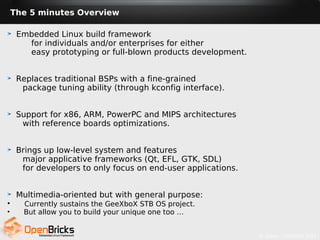
The 5 minutes Overview

     Embedded Linux build framework
       for individuals and/or enterprises for either
       easy prototyping or full-blown products development.


     Replaces traditional BSPs with a fine-grained
      package tuning ability (through kconfig interface).


     Support for x86, ARM, PowerPC and MIPS architectures
      with reference boards optimizations.


     Brings up low-level system and features
      major applicative frameworks (Qt, EFL, GTK, SDL)
      for developers to only focus on end-user applications.


     Multimedia-oriented but with general purpose:
•     Currently sustains the GeeXboX STB OS project.
•     But allow you to build your unique one too …


                                                               B. Zores – FOSDEM 2011
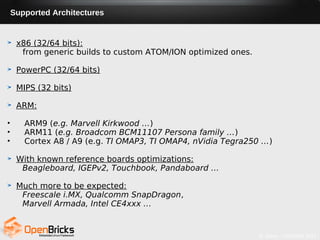
Supported Architectures


     x86 (32/64 bits):
      from generic builds to custom ATOM/ION optimized ones.

     PowerPC (32/64 bits)

     MIPS (32 bits)

     ARM:

•      ARM9 (e.g. Marvell Kirkwood …)
•      ARM11 (e.g. Broadcom BCM11107 Persona family …)
•      Cortex A8 / A9 (e.g. TI OMAP3, TI OMAP4, nVidia Tegra250 …)

     With known reference boards optimizations:
      Beagleboard, IGEPv2, Touchbook, Pandaboard …

     Much more to be expected:
      Freescale i.MX, Qualcomm SnapDragon,
      Marvell Armada, Intel CE4xxx …


                                                               B. Zores – FOSDEM 2011
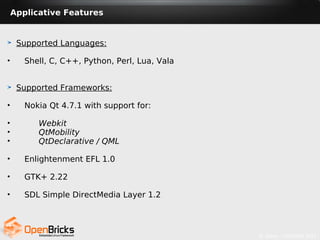
Applicative Features


     Supported Languages:

•      Shell, C, C++, Python, Perl, Lua, Vala


     Supported Frameworks:

•      Nokia Qt 4.7.1 with support for:

•         Webkit
•         QtMobility
•         QtDeclarative / QML

•      Enlightenment EFL 1.0

•      GTK+ 2.22

•      SDL Simple DirectMedia Layer 1.2


                                                B. Zores – FOSDEM 2011
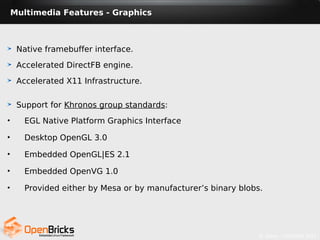
Multimedia Features - Graphics


     Native framebuffer interface.
     Accelerated DirectFB engine.
     Accelerated X11 Infrastructure.

     Support for Khronos group standards:
•     EGL Native Platform Graphics Interface

•     Desktop OpenGL 3.0

•     Embedded OpenGL|ES 2.1

•     Embedded OpenVG 1.0

•     Provided either by Mesa or by manufacturer’s binary blobs.


                                                               B. Zores – FOSDEM 2011
Multimedia Features - Audio/Video


     Audio Frameworks:
•     ALSA, PulseAudio


     Software Video Frameworks:
•     SMP-optimized FFmpeg decoders.


     Hardware Video Frameworks:
•     Khronos OpenMAX (OMAP3, OMAP4, Tegra2).
•     nVidia VDPAU (x86 with nVidia GeForce GPU).
•     Freedesktop VA-API (x86 with Intel or ATI GPUs).
•     Broadcom CrystalHD (BCM 70012/70015 chips).
•     Other native SoC acceleration (OMAP3, OMAP4).


                                                         B. Zores – FOSDEM 2011
Multimedia Features - Applications


     Frameworks and Players:

•         MPlayer, Xine, GStreamer, VLC

•         libplayer Audio/Video abstraction framework


     Media Center frontends:

•         XBMC

•         Video Disk Recorder (VDR)

•         Enna

•         HTS Showtime

•         Nokia QtMediaHub

•         MythTV

                                                        B. Zores – FOSDEM 2011
Build System Overview

     Fully POSIX shell scripts based:

•      Easy understanding, hacking and maintenance ...
•      … at least much more than obfuscated Makefiles or Python stuff ;-)

  Does not require any externals tools or environment.
•  Required host build tools and packages are built along the way.

• Cross-Compilation Safety and Robustness
•   Triggers GCC internal errors on -I/usr/include and -L/usr/lib

     Fully customizable:

•      Supports customized distribution flavours
         pre-generated configurations.
•      Complete standalone package/feature selection
         through Kconfig interface.
•      Per-package fine-tuning through use flags (similar to Gentoo).

     Features per-package metadata rules for abstracted in/out.
     With more than 550 supported packages.

                                                                  B. Zores – FOSDEM 2011
Toolchain Overview

      Support for multiple GCC-based cross-compilers:

•     OpenBricks multi-architectures native one.

•     Linaro for ARM.

•     CodeSourcery for ARM.


• Support for multiple C libraries:

•     GNU libc (glibc)

•     Embedded GLIBC (eGlibc). This is default one !

•     uClibc

•     klibc (for early ramdisk bits).

     Do your own mix !


                                                        B. Zores – FOSDEM 2011
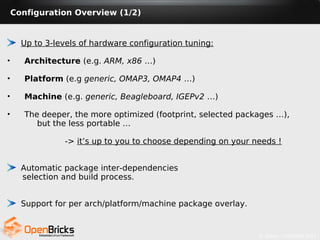
Configuration Overview (1/2)


      Up to 3-levels of hardware configuration tuning:

•      Architecture (e.g. ARM, x86 …)

•      Platform (e.g generic, OMAP3, OMAP4 …)

•      Machine (e.g. generic, Beagleboard, IGEPv2 …)

•      The deeper, the more optimized (footprint, selected packages …),
          but the less portable …

                -> it’s up to you to choose depending on your needs !


      Automatic package inter-dependencies
      selection and build process.


      Support for per arch/platform/machine package overlay.


                                                               B. Zores – FOSDEM 2011
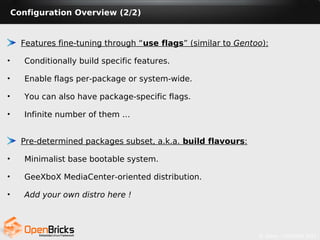
Configuration Overview (2/2)


      Features fine-tuning through “use flags” (similar to Gentoo):

•      Conditionally build specific features.

•      Enable flags per-package or system-wide.

•      You can also have package-specific flags.

•      Infinite number of them …


      Pre-determined packages subset, a.k.a. build flavours:

•      Minimalist base bootable system.

•      GeeXboX MediaCenter-oriented distribution.

•      Add your own distro here !


                                                                B. Zores – FOSDEM 2011
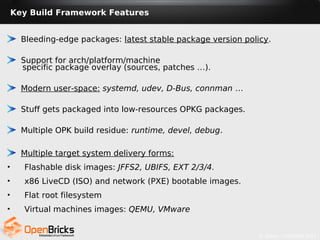
Key Build Framework Features


      Bleeding-edge packages: latest stable package version policy.

      Support for arch/platform/machine
      specific package overlay (sources, patches …).

      Modern user-space: systemd, udev, D-Bus, connman …

      Stuff gets packaged into low-resources OPKG packages.

      Multiple OPK build residue: runtime, devel, debug.

      Multiple target system delivery forms:
•     Flashable disk images: JFFS2, UBIFS, EXT 2/3/4.
•     x86 LiveCD (ISO) and network (PXE) bootable images.
•     Flat root filesystem
•     Virtual machines images: QEMU, VMware


                                                                B. Zores – FOSDEM 2011
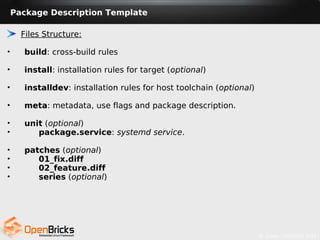
Package Description Template

      Files Structure:

•     build: cross-build rules

•     install: installation rules for target (optional)

•     installdev: installation rules for host toolchain (optional)

•     meta: metadata, use flags and package description.

•     unit (optional)
•        package.service: systemd service.

•     patches (optional)
•        01_fix.diff
•        02_feature.diff
•        series (optional)


                                                                     B. Zores – FOSDEM 2011
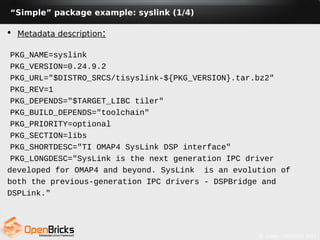
“Simple” package example: syslink (1/4)

●
    Metadata description:

 PKG_NAME=syslink
 PKG_VERSION=0.24.9.2
 PKG_URL="$DISTRO_SRCS/tisyslink-${PKG_VERSION}.tar.bz2"
 PKG_REV=1
 PKG_DEPENDS="$TARGET_LIBC tiler"
 PKG_BUILD_DEPENDS="toolchain"
 PKG_PRIORITY=optional
 PKG_SECTION=libs
 PKG_SHORTDESC="TI OMAP4 SysLink DSP interface"
 PKG_LONGDESC="SysLink is the next generation IPC driver
developed for OMAP4 and beyond. SysLink is an evolution of
both the previous-generation IPC drivers - DSPBridge and
DSPLink."


                                                   B. Zores – FOSDEM 2011
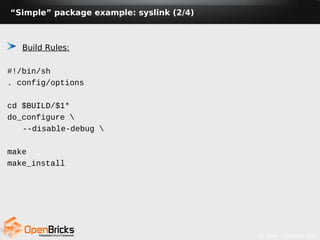
“Simple” package example: syslink (2/4)


   Build Rules:

#!/bin/sh
. config/options

cd $BUILD/$1*
do_configure 
   --disable-debug 

make
make_install


                                          B. Zores – FOSDEM 2011
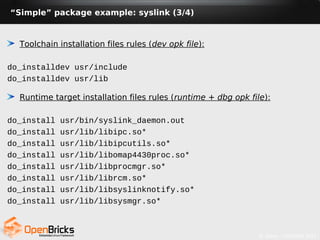
“Simple” package example: syslink (3/4)


  Toolchain installation files rules (dev opk file):

do_installdev usr/include
do_installdev usr/lib

  Runtime target installation files rules (runtime + dbg opk file):

do_install   usr/bin/syslink_daemon.out
do_install   usr/lib/libipc.so*
do_install   usr/lib/libipcutils.so*
do_install   usr/lib/libomap4430proc.so*
do_install   usr/lib/libprocmgr.so*
do_install   usr/lib/librcm.so*
do_install   usr/lib/libsyslinknotify.so*
do_install   usr/lib/libsysmgr.so*


                                                                B. Zores – FOSDEM 2011
“Simple” package example: syslink (4/4)

  SystemD Service:

[Unit]
Description=Ducati Syslink daemon
ConditionPathExists=/etc/syslink.conf
After=syslog.target

[Service]
EnvironmentFile=/etc/syslink.conf
Type=forking
ExecStart=/usr/bin/syslink_daemon.out $SYSM3_IMAGE $APPM3_IMAGE
Restart=always

[Install]
WantedBy=multi-user.target


                                                    B. Zores – FOSDEM 2011
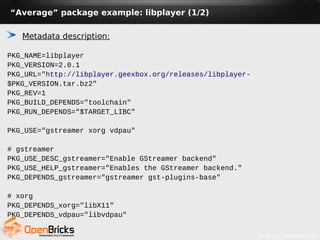
“Average” package example: libplayer (1/2)

   Metadata description:

PKG_NAME=libplayer
PKG_VERSION=2.0.1
PKG_URL="http://libplayer.geexbox.org/releases/libplayer-
$PKG_VERSION.tar.bz2"
PKG_REV=1
PKG_BUILD_DEPENDS="toolchain"
PKG_RUN_DEPENDS="$TARGET_LIBC"

PKG_USE="gstreamer xorg vdpau"

# gstreamer
PKG_USE_DESC_gstreamer="Enable GStreamer backend"
PKG_USE_HELP_gstreamer="Enables the GStreamer backend."
PKG_DEPENDS_gstreamer="gstreamer gst-plugins-base"

# xorg
PKG_DEPENDS_xorg="libX11"
PKG_DEPENDS_vdpau="libvdpau"

                                                            B. Zores – FOSDEM 2011
“Average” package example: libplayer (2/2)

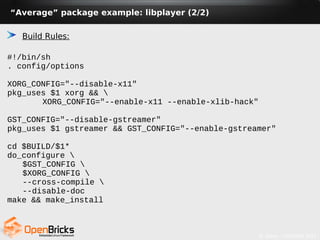
   Build Rules:

#!/bin/sh
. config/options

XORG_CONFIG="--disable-x11"
pkg_uses $1 xorg && 
       XORG_CONFIG="--enable-x11 --enable-xlib-hack"

GST_CONFIG="--disable-gstreamer"
pkg_uses $1 gstreamer && GST_CONFIG="--enable-gstreamer"

cd $BUILD/$1*
do_configure 
   $GST_CONFIG 
   $XORG_CONFIG 
   --cross-compile 
   --disable-doc
make && make_install


                                                       B. Zores – FOSDEM 2011
How you can one help (or get helped) ?


      Get some help or information:
•      Website provides a complete documentation on build system internals.
•      On our mailing list: devel@openbricks.org

      Join the development team:
•      Add new packages, hence features.
•      Add support for new/more hardware (yours ?).
•      Increase flavours support by adding your custom distribution subset.

      Sponsor us with a couple of reference boards.
•      Only way for the team to really support your architecture …
•      We’re still interested in Intel / Freescale / Qualcomm / Marvell boards.

      Donations
•      The usual way: helps us buy new toys to be supported ...


                                                                   B. Zores – FOSDEM 2011
Thanks ...


             http://www.openbricks.org/


                     THANKS !!

                                          B. Zores – FOSDEM 2011

Introduction to OpenBricks: an Embedded Linux Framework

  • 1.
    Introduction to OpenBricks:an Embedded Linux Framework Benjamin Zores 6th February 2011 FOSDEM, Brussels
  • 2.
    What is OpenBricks? Enterprise-grade embedded Linux framework and build system. For easy and custom Linux distribution bring-up. Runs on a wide variety of hardware. For rapid prototyping or full-blown product development. • “Hum, seems like I’ve already heard about that ... So how is it different from … ?” B. Zores – FOSDEM 2011
  • 3.
    State of theArt 2011 Embedded Linux build systems: • OpenEmbedded (Angström, Poky, Yocto, ...) • Buildroot • OpenWRT • T2 SDE • Linux Target Image Builder (LTIB) • “Professional”: Windriver, Montavista, Mentor Graphics … • And now OpenBricks ?? • More details in a further talk, but in the mean time: http://tinyurl.com/EmbeddedLinuxBuildSystems B. Zores – FOSDEM 2011
  • 4.
    So why yetanother build system in 2011 ? Because Google’s Android is not the perfect embedded OS. History: • OpenBricks “brand” in itself was founded in Oct. 2010. • But came as an extension to the GeeXboX project - © 2002. • Inherited toolchain and philosophy, but designed to be more versatile. • Now used as custom build framework for GeeXboX OS. Each build system has pros and cons, but projects all have very different philosophies. • So it’s not exactly new … B. Zores – FOSDEM 2011
  • 5.
    The 5 minutesOverview Embedded Linux build framework for individuals and/or enterprises for either easy prototyping or full-blown products development. Replaces traditional BSPs with a fine-grained package tuning ability (through kconfig interface). Support for x86, ARM, PowerPC and MIPS architectures with reference boards optimizations. Brings up low-level system and features major applicative frameworks (Qt, EFL, GTK, SDL) for developers to only focus on end-user applications. Multimedia-oriented but with general purpose: • Currently sustains the GeeXboX STB OS project. • But allow you to build your unique one too … B. Zores – FOSDEM 2011
  • 6.
    Supported Architectures x86 (32/64 bits): from generic builds to custom ATOM/ION optimized ones. PowerPC (32/64 bits) MIPS (32 bits) ARM: • ARM9 (e.g. Marvell Kirkwood …) • ARM11 (e.g. Broadcom BCM11107 Persona family …) • Cortex A8 / A9 (e.g. TI OMAP3, TI OMAP4, nVidia Tegra250 …) With known reference boards optimizations: Beagleboard, IGEPv2, Touchbook, Pandaboard … Much more to be expected: Freescale i.MX, Qualcomm SnapDragon, Marvell Armada, Intel CE4xxx … B. Zores – FOSDEM 2011
  • 7.
    Applicative Features Supported Languages: • Shell, C, C++, Python, Perl, Lua, Vala Supported Frameworks: • Nokia Qt 4.7.1 with support for: • Webkit • QtMobility • QtDeclarative / QML • Enlightenment EFL 1.0 • GTK+ 2.22 • SDL Simple DirectMedia Layer 1.2 B. Zores – FOSDEM 2011
  • 8.
    Multimedia Features -Graphics Native framebuffer interface. Accelerated DirectFB engine. Accelerated X11 Infrastructure. Support for Khronos group standards: • EGL Native Platform Graphics Interface • Desktop OpenGL 3.0 • Embedded OpenGL|ES 2.1 • Embedded OpenVG 1.0 • Provided either by Mesa or by manufacturer’s binary blobs. B. Zores – FOSDEM 2011
  • 9.
    Multimedia Features -Audio/Video Audio Frameworks: • ALSA, PulseAudio Software Video Frameworks: • SMP-optimized FFmpeg decoders. Hardware Video Frameworks: • Khronos OpenMAX (OMAP3, OMAP4, Tegra2). • nVidia VDPAU (x86 with nVidia GeForce GPU). • Freedesktop VA-API (x86 with Intel or ATI GPUs). • Broadcom CrystalHD (BCM 70012/70015 chips). • Other native SoC acceleration (OMAP3, OMAP4). B. Zores – FOSDEM 2011
  • 10.
    Multimedia Features -Applications Frameworks and Players: • MPlayer, Xine, GStreamer, VLC • libplayer Audio/Video abstraction framework Media Center frontends: • XBMC • Video Disk Recorder (VDR) • Enna • HTS Showtime • Nokia QtMediaHub • MythTV B. Zores – FOSDEM 2011
  • 11.
    Build System Overview Fully POSIX shell scripts based: • Easy understanding, hacking and maintenance ... • … at least much more than obfuscated Makefiles or Python stuff ;-) Does not require any externals tools or environment. • Required host build tools and packages are built along the way. • Cross-Compilation Safety and Robustness • Triggers GCC internal errors on -I/usr/include and -L/usr/lib Fully customizable: • Supports customized distribution flavours pre-generated configurations. • Complete standalone package/feature selection through Kconfig interface. • Per-package fine-tuning through use flags (similar to Gentoo). Features per-package metadata rules for abstracted in/out. With more than 550 supported packages. B. Zores – FOSDEM 2011
  • 12.
    Toolchain Overview Support for multiple GCC-based cross-compilers: • OpenBricks multi-architectures native one. • Linaro for ARM. • CodeSourcery for ARM. • Support for multiple C libraries: • GNU libc (glibc) • Embedded GLIBC (eGlibc). This is default one ! • uClibc • klibc (for early ramdisk bits). Do your own mix ! B. Zores – FOSDEM 2011
  • 13.
    Configuration Overview (1/2) Up to 3-levels of hardware configuration tuning: • Architecture (e.g. ARM, x86 …) • Platform (e.g generic, OMAP3, OMAP4 …) • Machine (e.g. generic, Beagleboard, IGEPv2 …) • The deeper, the more optimized (footprint, selected packages …), but the less portable … -> it’s up to you to choose depending on your needs ! Automatic package inter-dependencies selection and build process. Support for per arch/platform/machine package overlay. B. Zores – FOSDEM 2011
  • 14.
    Configuration Overview (2/2) Features fine-tuning through “use flags” (similar to Gentoo): • Conditionally build specific features. • Enable flags per-package or system-wide. • You can also have package-specific flags. • Infinite number of them … Pre-determined packages subset, a.k.a. build flavours: • Minimalist base bootable system. • GeeXboX MediaCenter-oriented distribution. • Add your own distro here ! B. Zores – FOSDEM 2011
  • 15.
    Key Build FrameworkFeatures Bleeding-edge packages: latest stable package version policy. Support for arch/platform/machine specific package overlay (sources, patches …). Modern user-space: systemd, udev, D-Bus, connman … Stuff gets packaged into low-resources OPKG packages. Multiple OPK build residue: runtime, devel, debug. Multiple target system delivery forms: • Flashable disk images: JFFS2, UBIFS, EXT 2/3/4. • x86 LiveCD (ISO) and network (PXE) bootable images. • Flat root filesystem • Virtual machines images: QEMU, VMware B. Zores – FOSDEM 2011
  • 16.
    Package Description Template Files Structure: • build: cross-build rules • install: installation rules for target (optional) • installdev: installation rules for host toolchain (optional) • meta: metadata, use flags and package description. • unit (optional) • package.service: systemd service. • patches (optional) • 01_fix.diff • 02_feature.diff • series (optional) B. Zores – FOSDEM 2011
  • 17.
    “Simple” package example:syslink (1/4) ● Metadata description: PKG_NAME=syslink PKG_VERSION=0.24.9.2 PKG_URL="$DISTRO_SRCS/tisyslink-${PKG_VERSION}.tar.bz2" PKG_REV=1 PKG_DEPENDS="$TARGET_LIBC tiler" PKG_BUILD_DEPENDS="toolchain" PKG_PRIORITY=optional PKG_SECTION=libs PKG_SHORTDESC="TI OMAP4 SysLink DSP interface" PKG_LONGDESC="SysLink is the next generation IPC driver developed for OMAP4 and beyond. SysLink is an evolution of both the previous-generation IPC drivers - DSPBridge and DSPLink." B. Zores – FOSDEM 2011
  • 18.
    “Simple” package example:syslink (2/4) Build Rules: #!/bin/sh . config/options cd $BUILD/$1* do_configure --disable-debug make make_install B. Zores – FOSDEM 2011
  • 19.
    “Simple” package example:syslink (3/4) Toolchain installation files rules (dev opk file): do_installdev usr/include do_installdev usr/lib Runtime target installation files rules (runtime + dbg opk file): do_install usr/bin/syslink_daemon.out do_install usr/lib/libipc.so* do_install usr/lib/libipcutils.so* do_install usr/lib/libomap4430proc.so* do_install usr/lib/libprocmgr.so* do_install usr/lib/librcm.so* do_install usr/lib/libsyslinknotify.so* do_install usr/lib/libsysmgr.so* B. Zores – FOSDEM 2011
  • 20.
    “Simple” package example:syslink (4/4) SystemD Service: [Unit] Description=Ducati Syslink daemon ConditionPathExists=/etc/syslink.conf After=syslog.target [Service] EnvironmentFile=/etc/syslink.conf Type=forking ExecStart=/usr/bin/syslink_daemon.out $SYSM3_IMAGE $APPM3_IMAGE Restart=always [Install] WantedBy=multi-user.target B. Zores – FOSDEM 2011
  • 21.
    “Average” package example:libplayer (1/2) Metadata description: PKG_NAME=libplayer PKG_VERSION=2.0.1 PKG_URL="http://libplayer.geexbox.org/releases/libplayer- $PKG_VERSION.tar.bz2" PKG_REV=1 PKG_BUILD_DEPENDS="toolchain" PKG_RUN_DEPENDS="$TARGET_LIBC" PKG_USE="gstreamer xorg vdpau" # gstreamer PKG_USE_DESC_gstreamer="Enable GStreamer backend" PKG_USE_HELP_gstreamer="Enables the GStreamer backend." PKG_DEPENDS_gstreamer="gstreamer gst-plugins-base" # xorg PKG_DEPENDS_xorg="libX11" PKG_DEPENDS_vdpau="libvdpau" B. Zores – FOSDEM 2011
  • 22.
    “Average” package example:libplayer (2/2) Build Rules: #!/bin/sh . config/options XORG_CONFIG="--disable-x11" pkg_uses $1 xorg && XORG_CONFIG="--enable-x11 --enable-xlib-hack" GST_CONFIG="--disable-gstreamer" pkg_uses $1 gstreamer && GST_CONFIG="--enable-gstreamer" cd $BUILD/$1* do_configure $GST_CONFIG $XORG_CONFIG --cross-compile --disable-doc make && make_install B. Zores – FOSDEM 2011
  • 23.
    How you canone help (or get helped) ? Get some help or information: • Website provides a complete documentation on build system internals. • On our mailing list: devel@openbricks.org Join the development team: • Add new packages, hence features. • Add support for new/more hardware (yours ?). • Increase flavours support by adding your custom distribution subset. Sponsor us with a couple of reference boards. • Only way for the team to really support your architecture … • We’re still interested in Intel / Freescale / Qualcomm / Marvell boards. Donations • The usual way: helps us buy new toys to be supported ... B. Zores – FOSDEM 2011
  • 24.
    Thanks ... http://www.openbricks.org/ THANKS !! B. Zores – FOSDEM 2011