Introduction to Robotics ENGR-5301-55 Lamar University Spring, 2009 Ram Balasubramanian & Gary Decaney April 30, 2009
What is a Robot? What is Robotics? Robix Robot What is Draw-Bot? Project Calculations Phase I –  Kinematic Analysis Phase II – Dynamic Analysis & The Jacobian Phase III – Differential Motion/Velocity Analysis Phase IV – Trajectory Planning Draw-Bot construction Draw-Bot programming Questions Demo
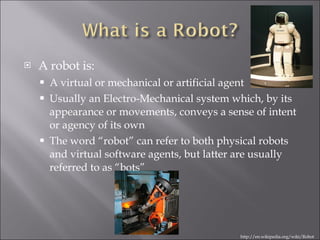
A robot is: A virtual or mechanical or artificial agent Usually an Electro-Mechanical system which, by its appearance or movements, conveys a sense of intent or agency of its own The word “robot” can refer to both physical robots and virtual software agents, but latter are usually referred to as “bots” http://en.wikipedia.org/wiki/Robot
Robotics - the Science and Technology of robots Their design Their manufacture Their application Robotics has connections to electronics, mechanics and software The word “Robotics” was first used in Isaac Asimov’s short story Runaround (1942).  Asimov proposed the “Laws of Robotics”: Law Zero - A robot may not injure humanity, or, through inaction, allow humanity to come to harm Law One – A robot may not injure a human being, or, through inaction, allow a human being to come to harm, unless this would violate a higher order law. Law Two – A robot must obey orders given it by human beings, except where such orders would conflict with a higher order law. Law Three - A robot must protect its own existence as long as such protection does not conflict with a higher order law. http://www.robotmatrix.org/whatisrobot.htm
Robix Rascal Classroom Robot Set Low Cost ($550US) On the Market for 15 years Complete with Controller Card and Software Repeatable, reusable, reprogrammable http://www.robix.com/default.html
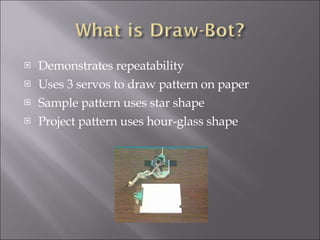
Demonstrates repeatability Uses 3 servos to draw pattern on paper Sample pattern uses star shape Project pattern uses hour-glass shape
Phase I –  Kinematic Analysis Phase II – Dynamic Analysis & The Jacobian Phase III – Differential Motion/Velocity Analysis Phase IV – Trajectory Planning
Students were to use the Denavit-Hartenberg model representation to form the Equations of Motion Total Transformation Matrix: R T H  =  R T 1 1 T 2 2 T 3  = A 1 A 2 A 3 Each A Matrix represents the transformation between each joint, from one frame of reference to the next. Equations of Motion: n z =C 3 S 2 θ 1  = tan -1 (o y /o x ) and  θ 1 =   θ 1 +180˚ o z =C 2   θ 2  = tan -1 (p z /[p x C 1 +p y S 1 -a 1 ]) a z =S 2 S 3
Using concepts taught in class, students were to perform a dynamic analysis of n-degree of freedom system (in this case, 3-DOF) Students were to generate the Jacobian and differential operators Jacobian – representation of the geometry of the elements of a mechanism in time Differential Operator – product of differential translations and rotations, minus the unit matrix
Jacobian: Differential Operator:
Students were to develop the dynamic equations of motion for their setup Also, determine how much torque is required in each joint to complete an action with a certain speed or in a certain time Extremely long calculations General format: Equations for all three joints:
For the Final Phase, students were to determine the needed motions of their setup and to perform Trajectory Planning for their robot For simplicity’s sake, Third Order Polynomial Trajectory Planning was utilized Third order polynomial: θ ( t ) = c 0  + c 1 t  + c 2 t 2  + c 3 t 3 Boundary conditions:
Less than 1 hour to construct Base w/ diagonal link, 3 servos, 5 links, pen, rubber band, clamps
1 st  Attempt, program from Project Book Star-shaped pattern (supposedly) Did not work, parameters for each servo different for our setup 2 nd  Attempt, program shape corners using “teach method” Hour-glass shape pattern Did not work, went from corner to corner in correct sequence, but in severely curved lines. 3 rd  Attempt, program interval points along shape pattern Repeat hour-glass shape pattern Not perfect, but does resemble pattern, and is repeatable Individual segments are still curvy Additional interval points needed to straighten out Trajectory planning complex concept for simple pattern


Drawbot Final Presentation

  • 1.
    Introduction to RoboticsENGR-5301-55 Lamar University Spring, 2009 Ram Balasubramanian & Gary Decaney April 30, 2009
  • 2.
    What is aRobot? What is Robotics? Robix Robot What is Draw-Bot? Project Calculations Phase I – Kinematic Analysis Phase II – Dynamic Analysis & The Jacobian Phase III – Differential Motion/Velocity Analysis Phase IV – Trajectory Planning Draw-Bot construction Draw-Bot programming Questions Demo
  • 3.
    A robot is:A virtual or mechanical or artificial agent Usually an Electro-Mechanical system which, by its appearance or movements, conveys a sense of intent or agency of its own The word “robot” can refer to both physical robots and virtual software agents, but latter are usually referred to as “bots” http://en.wikipedia.org/wiki/Robot
  • 4.
    Robotics - theScience and Technology of robots Their design Their manufacture Their application Robotics has connections to electronics, mechanics and software The word “Robotics” was first used in Isaac Asimov’s short story Runaround (1942). Asimov proposed the “Laws of Robotics”: Law Zero - A robot may not injure humanity, or, through inaction, allow humanity to come to harm Law One – A robot may not injure a human being, or, through inaction, allow a human being to come to harm, unless this would violate a higher order law. Law Two – A robot must obey orders given it by human beings, except where such orders would conflict with a higher order law. Law Three - A robot must protect its own existence as long as such protection does not conflict with a higher order law. http://www.robotmatrix.org/whatisrobot.htm
  • 5.
    Robix Rascal ClassroomRobot Set Low Cost ($550US) On the Market for 15 years Complete with Controller Card and Software Repeatable, reusable, reprogrammable http://www.robix.com/default.html
  • 6.
    Demonstrates repeatability Uses3 servos to draw pattern on paper Sample pattern uses star shape Project pattern uses hour-glass shape
  • 7.
    Phase I – Kinematic Analysis Phase II – Dynamic Analysis & The Jacobian Phase III – Differential Motion/Velocity Analysis Phase IV – Trajectory Planning
  • 8.
    Students were touse the Denavit-Hartenberg model representation to form the Equations of Motion Total Transformation Matrix: R T H = R T 1 1 T 2 2 T 3 = A 1 A 2 A 3 Each A Matrix represents the transformation between each joint, from one frame of reference to the next. Equations of Motion: n z =C 3 S 2 θ 1 = tan -1 (o y /o x ) and θ 1 = θ 1 +180˚ o z =C 2 θ 2 = tan -1 (p z /[p x C 1 +p y S 1 -a 1 ]) a z =S 2 S 3
  • 9.
    Using concepts taughtin class, students were to perform a dynamic analysis of n-degree of freedom system (in this case, 3-DOF) Students were to generate the Jacobian and differential operators Jacobian – representation of the geometry of the elements of a mechanism in time Differential Operator – product of differential translations and rotations, minus the unit matrix
  • 10.
  • 11.
    Students were todevelop the dynamic equations of motion for their setup Also, determine how much torque is required in each joint to complete an action with a certain speed or in a certain time Extremely long calculations General format: Equations for all three joints:
  • 12.
    For the FinalPhase, students were to determine the needed motions of their setup and to perform Trajectory Planning for their robot For simplicity’s sake, Third Order Polynomial Trajectory Planning was utilized Third order polynomial: θ ( t ) = c 0 + c 1 t + c 2 t 2 + c 3 t 3 Boundary conditions:
  • 13.
    Less than 1hour to construct Base w/ diagonal link, 3 servos, 5 links, pen, rubber band, clamps
  • 14.
    1 st Attempt, program from Project Book Star-shaped pattern (supposedly) Did not work, parameters for each servo different for our setup 2 nd Attempt, program shape corners using “teach method” Hour-glass shape pattern Did not work, went from corner to corner in correct sequence, but in severely curved lines. 3 rd Attempt, program interval points along shape pattern Repeat hour-glass shape pattern Not perfect, but does resemble pattern, and is repeatable Individual segments are still curvy Additional interval points needed to straighten out Trajectory planning complex concept for simple pattern
  • 15.
  • 16.