Dramatic Theory of
Entertainment
Dramatic Theory
• Dramatic theory is a term used for works that
attempt to form theories about theatre and drama.
• Drama is the printed text of a play while
the Theater is the actual production of the play.
Drama
• Drama is a word that comes from Greek Dran, which
means to do or perform.
• It literally means action.
• The act or process of performing a play in front of an
audience is dramatization.
• Drama can be in the form of a text, prose or a verse
composition delineating a story full of human
emotions and conflicts.
Drama
• Drama is given life by performers on stage.
• Drama can be an episode of life such as love story of
shakuntala.
• Drama has many forms and must be construed as a
generic term taking on many forms, one of which is
theater.
Theater
• Theater is the personification of a drama on stage.
• Theater is a collective effort of many people,
dramatist or a playwright, a director, actors, and
technicians to make audience believe that whatever
is happening on stage is real.
• Audience and stage are necessary for theater.
Theater
• Theater is physical while drama can be
abstract and subjective.
• Theatre refers to the actual production of
the play on the stage.
• Theater is a particular setting of stage and
audience.
• The term ‘theater is derived from the Greek
term theasthai (to behold).
Drama - Theater
• Drama is the script of a
play.
• There is direct
interaction between the
reader and dramatist.
• Interpretation of the
play depends on the
reader.
• Drama is an abstract
entity.
• Theater is the onstage
production of a play.
• There is no direct
interaction between
audience and the
dramatist.
• Interpretation of the play
depends on the artists.
• Theater is a physical
entity.
Tragedy And Comedy
• Tragedy and comedy have evolved over time
and offer and interesting way of looking at how
time, place and ideas are reflected in drama,
and in life.
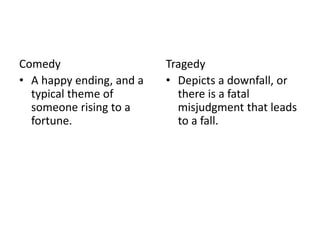
Comedy
• A happy ending, and a
typical theme of
someone rising to a
fortune.
Tragedy
• Depicts a downfall, or
there is a fatal
misjudgment that leads
to a fall.
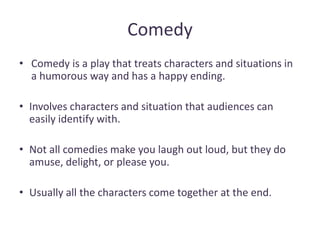
Comedy
• Comedy is a play that treats characters and situations in
a humorous way and has a happy ending.
• Involves characters and situation that audiences can
easily identify with.
• Not all comedies make you laugh out loud, but they do
amuse, delight, or please you.
• Usually all the characters come together at the end.
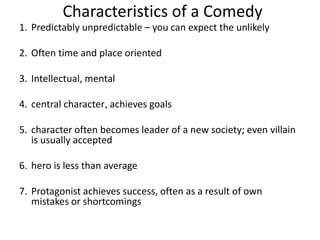
Characteristics of a Comedy
1. Predictably unpredictable – you can expect the unlikely
2. Often time and place oriented
3. Intellectual, mental
4. central character, achieves goals
5. character often becomes leader of a new society; even villain
is usually accepted
6. hero is less than average
7. Protagonist achieves success, often as a result of own
mistakes or shortcomings
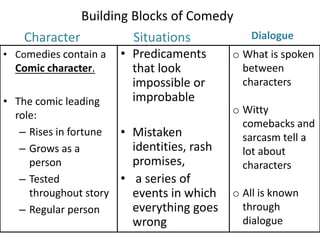
Building Blocks of Comedy
Character
• Comedies contain a
Comic character.
• The comic leading
role:
– Rises in fortune
– Grows as a
person
– Tested
throughout story
– Regular person
Situations
• Predicaments
that look
impossible or
improbable
• Mistaken
identities, rash
promises,
• a series of
events in which
everything goes
wrong
Dialogue
o What is spoken
between
characters
o Witty
comebacks and
sarcasm tell a
lot about
characters
o All is known
through
dialogue
Tragedy
Tragedy – sober, thoughtful plays that are based on
human emotions and conflicts that do not change with
time or place.
Tragedies end in catastrophe – often the death of the
tragic hero.
The focus of the tragedy is on the Tragic
character/protagonist.
Tragedy Characteristics
1. Universal theme and appeal
2. Emotional
3. Protagonist fails to achieve goals
4. Protagonist is alienated from society
5. Protagonist is an average or better person
6. Protagonist falls from high (leadership, respect, dreams,
position)
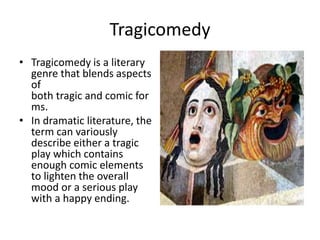
Tragicomedy
• Tragicomedy is a literary
genre that blends aspects
of
both tragic and comic for
ms.
• In dramatic literature, the
term can variously
describe either a tragic
play which contains
enough comic elements
to lighten the overall
mood or a serious play
with a happy ending.
•
Characteristics of a Tragic Character
1. Tragic flaw - tragic hero “falls” due to a flaw in personality
2. Free Choice – Hero fate do to a choice they made
3.. Increased awareness – hero understand why this has
happened before “fall”
4. Fall from high – hero must be of high or noble status in
society.
5. Punishment exceeds the crime – hero’s punishment seems to
much for what was done. Audience should not feel like hero
deserved the extreme punishment
Melodrama
• A melodrama is a dramatic or literary work in which
the plot, which is typically sensational and designed
to appeal strongly to the emotions, takes precedence
over detailed characterization.
• Characters are often simply drawn, and may
appear stereotyped.
• Melodramas are Victorian dramas in which orchestral
music or song was used to accompany the action.
Dramatic theory of entertainment

Dramatic theory of entertainment

  • 1.
  • 2.
    Dramatic Theory • Dramatictheory is a term used for works that attempt to form theories about theatre and drama. • Drama is the printed text of a play while the Theater is the actual production of the play.
  • 3.
    Drama • Drama isa word that comes from Greek Dran, which means to do or perform. • It literally means action. • The act or process of performing a play in front of an audience is dramatization. • Drama can be in the form of a text, prose or a verse composition delineating a story full of human emotions and conflicts.
  • 4.
    Drama • Drama isgiven life by performers on stage. • Drama can be an episode of life such as love story of shakuntala. • Drama has many forms and must be construed as a generic term taking on many forms, one of which is theater.
  • 5.
    Theater • Theater isthe personification of a drama on stage. • Theater is a collective effort of many people, dramatist or a playwright, a director, actors, and technicians to make audience believe that whatever is happening on stage is real. • Audience and stage are necessary for theater.
  • 6.
    Theater • Theater isphysical while drama can be abstract and subjective. • Theatre refers to the actual production of the play on the stage. • Theater is a particular setting of stage and audience. • The term ‘theater is derived from the Greek term theasthai (to behold).
  • 7.
    Drama - Theater •Drama is the script of a play. • There is direct interaction between the reader and dramatist. • Interpretation of the play depends on the reader. • Drama is an abstract entity. • Theater is the onstage production of a play. • There is no direct interaction between audience and the dramatist. • Interpretation of the play depends on the artists. • Theater is a physical entity.
  • 8.
    Tragedy And Comedy •Tragedy and comedy have evolved over time and offer and interesting way of looking at how time, place and ideas are reflected in drama, and in life.
  • 9.
    Comedy • A happyending, and a typical theme of someone rising to a fortune. Tragedy • Depicts a downfall, or there is a fatal misjudgment that leads to a fall.
  • 10.
    Comedy • Comedy isa play that treats characters and situations in a humorous way and has a happy ending. • Involves characters and situation that audiences can easily identify with. • Not all comedies make you laugh out loud, but they do amuse, delight, or please you. • Usually all the characters come together at the end.
  • 11.
    Characteristics of aComedy 1. Predictably unpredictable – you can expect the unlikely 2. Often time and place oriented 3. Intellectual, mental 4. central character, achieves goals 5. character often becomes leader of a new society; even villain is usually accepted 6. hero is less than average 7. Protagonist achieves success, often as a result of own mistakes or shortcomings
  • 12.
    Building Blocks ofComedy Character • Comedies contain a Comic character. • The comic leading role: – Rises in fortune – Grows as a person – Tested throughout story – Regular person Situations • Predicaments that look impossible or improbable • Mistaken identities, rash promises, • a series of events in which everything goes wrong Dialogue o What is spoken between characters o Witty comebacks and sarcasm tell a lot about characters o All is known through dialogue
  • 13.
    Tragedy Tragedy – sober,thoughtful plays that are based on human emotions and conflicts that do not change with time or place. Tragedies end in catastrophe – often the death of the tragic hero. The focus of the tragedy is on the Tragic character/protagonist.
  • 14.
    Tragedy Characteristics 1. Universaltheme and appeal 2. Emotional 3. Protagonist fails to achieve goals 4. Protagonist is alienated from society 5. Protagonist is an average or better person 6. Protagonist falls from high (leadership, respect, dreams, position)
  • 15.
    Tragicomedy • Tragicomedy isa literary genre that blends aspects of both tragic and comic for ms. • In dramatic literature, the term can variously describe either a tragic play which contains enough comic elements to lighten the overall mood or a serious play with a happy ending. •
  • 16.
    Characteristics of aTragic Character 1. Tragic flaw - tragic hero “falls” due to a flaw in personality 2. Free Choice – Hero fate do to a choice they made 3.. Increased awareness – hero understand why this has happened before “fall” 4. Fall from high – hero must be of high or noble status in society. 5. Punishment exceeds the crime – hero’s punishment seems to much for what was done. Audience should not feel like hero deserved the extreme punishment
  • 17.
    Melodrama • A melodramais a dramatic or literary work in which the plot, which is typically sensational and designed to appeal strongly to the emotions, takes precedence over detailed characterization. • Characters are often simply drawn, and may appear stereotyped. • Melodramas are Victorian dramas in which orchestral music or song was used to accompany the action.