Dealing with Data
   Detailed descriptions of primary research
    Methods.
   Include specifics about how you gathered the
    data: who, where, when.
   Explain rationale for choices
   Discuss limitations.
   If you are not using IMRD, you may instead
    discuss why theories and texts were chosen,
    relevant, significant.
   Use two strategies for presenting results:
    ◦ Visuals: Share data in graphical form (e.g., tables,
      charts, graphs, photographs).
      Provide a descriptive title, clear headings and labels,
       units of measurement, etc.
    ◦ Written: Draw attention to major observations and
      key trends in paragraph form. Don’t interpret or
      give reactions yet if you are using IMRD.
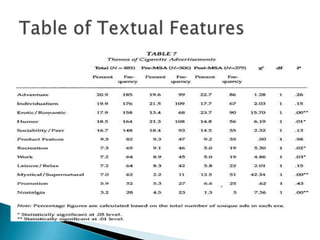
   Table: Arranges data in rows and columns to
    show intersections of two factors. Includes
    Numerical (amounts, percentages) and Text (uses
    words, phrases).
   Graph: Shows relationships between numbers.
    Includes Line (change in quantity over time), Bar
    (compare amounts), and Pie (pieces of the whole)
   Chart: Shows relationships between parts, steps,
    or stages.
   Images: Maps, Photos, Drawings, Screenshots.
   See EW 32-33 for examples
   What kind of data have you collected?
   What sorts of relationships do you need to
    show?
   What kinds of visuals will illuminate the topic?
   What types of visuals are used by your
    sources? Why were they chosen? How are
    they used?
   Aim for simple and uncluttered
   Include a Title for each visual (e.g. “Table 1.
    Women Vs. Men in Cleaning Commercials”)
   Use appropriate headings, units of
    measurement, intervals, etc.
   Cite any visual you did not create (See EW
    page 378-79)
   Consider size and placement carefully
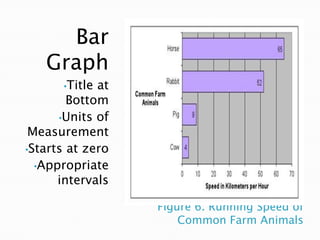
Bar
   Graph
      •Title at
        Bottom
      •Units of
 Measurement
•Starts at zero
  •Appropriate
      intervals

                  Figure 6. Running Speed of
                      Common Farm Animals
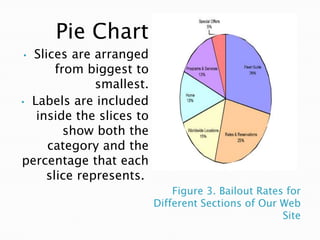
Pie Chart
• Slices are arranged
       from biggest to
              smallest.
• Labels are included
   inside the slices to
         show both the
     category and the
percentage that each
     slice represents.
                              Figure 3. Bailout Rates for
                          Different Sections of Our Web
                                                     Site
Figure 1. Bill Clinton the Kitten Plays Peek-a-
                                            Boo
   Don’t overly rely on your visuals.
   Type up the most important results in paragraph
    form.
   If multiple forms of primary research were used,
    follow the organization you used in your
    methods section (e.g., first observations, then
    surveys).
   For interviews, summarize answers and include a
    few select quotes from transcript that were most
    important, not the whole thing.
   When discussing data presented in a visual,
    direct reader’s attention to chart or graph with a
    parenthetical: (Fig. 1).
   Some projects may not lend themselves as
    readily to the IMRD method. If presenting
    your results without discussing them seems
    like it doesn’t work, you may decide to
    integrate the results (findings) and discussion
    (interpretations).
   On a piece of paper:
    ◦ Write your name at the top in large letters.
    ◦ Underneath, write a brief description of
      your research--just enough to help others
      make sense of your data.
    ◦ Leave space under the description for
      others to write.
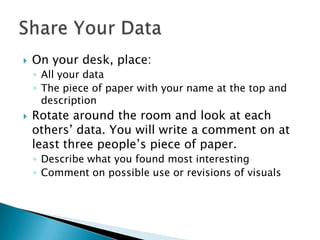
   On your desk, place:
    ◦ All your data
    ◦ The piece of paper with your name at the top and
      description
   Rotate around the room and look at each
    others’ data. You will write a comment on at
    least three people’s piece of paper.
    ◦ Describe what you found most interesting
    ◦ Comment on possible use or revisions of visuals
   Return to your desk. Read the comments.
   Add one more comment: what did you find
    most interesting about your data?
   Make Writing Center Appointments 5 points
    participation Extra Credit on Final Research
    Article (print and attach e-mailed notes from
    appointment). You may attend up to two
    consultations for up to 10 points.
   Finish Any Primary Research.
   Revise Literature Review/Introduction and
    Methods section.
   Draft Results and Discussion sections (or
    equivalent). Include visuals.
   Bring Draft of Research Article for Tuesday 4/9.

Drafting results

  • 1.
  • 2.
    Detailed descriptions of primary research Methods.  Include specifics about how you gathered the data: who, where, when.  Explain rationale for choices  Discuss limitations.  If you are not using IMRD, you may instead discuss why theories and texts were chosen, relevant, significant.
  • 3.
    Use two strategies for presenting results: ◦ Visuals: Share data in graphical form (e.g., tables, charts, graphs, photographs).  Provide a descriptive title, clear headings and labels, units of measurement, etc. ◦ Written: Draw attention to major observations and key trends in paragraph form. Don’t interpret or give reactions yet if you are using IMRD.
  • 4.
    Table: Arranges data in rows and columns to show intersections of two factors. Includes Numerical (amounts, percentages) and Text (uses words, phrases).  Graph: Shows relationships between numbers. Includes Line (change in quantity over time), Bar (compare amounts), and Pie (pieces of the whole)  Chart: Shows relationships between parts, steps, or stages.  Images: Maps, Photos, Drawings, Screenshots.  See EW 32-33 for examples
  • 5.
    What kind of data have you collected?  What sorts of relationships do you need to show?  What kinds of visuals will illuminate the topic?  What types of visuals are used by your sources? Why were they chosen? How are they used?
  • 6.
    Aim for simple and uncluttered  Include a Title for each visual (e.g. “Table 1. Women Vs. Men in Cleaning Commercials”)  Use appropriate headings, units of measurement, intervals, etc.  Cite any visual you did not create (See EW page 378-79)  Consider size and placement carefully
  • 7.
    Bar Graph •Title at Bottom •Units of Measurement •Starts at zero •Appropriate intervals Figure 6. Running Speed of Common Farm Animals
  • 8.
    Pie Chart • Slicesare arranged from biggest to smallest. • Labels are included inside the slices to show both the category and the percentage that each slice represents. Figure 3. Bailout Rates for Different Sections of Our Web Site
  • 11.
    Figure 1. BillClinton the Kitten Plays Peek-a- Boo
  • 12.
    Don’t overly rely on your visuals.  Type up the most important results in paragraph form.  If multiple forms of primary research were used, follow the organization you used in your methods section (e.g., first observations, then surveys).  For interviews, summarize answers and include a few select quotes from transcript that were most important, not the whole thing.  When discussing data presented in a visual, direct reader’s attention to chart or graph with a parenthetical: (Fig. 1).
  • 14.
    Some projects may not lend themselves as readily to the IMRD method. If presenting your results without discussing them seems like it doesn’t work, you may decide to integrate the results (findings) and discussion (interpretations).
  • 15.
    On a piece of paper: ◦ Write your name at the top in large letters. ◦ Underneath, write a brief description of your research--just enough to help others make sense of your data. ◦ Leave space under the description for others to write.
  • 16.
    On your desk, place: ◦ All your data ◦ The piece of paper with your name at the top and description  Rotate around the room and look at each others’ data. You will write a comment on at least three people’s piece of paper. ◦ Describe what you found most interesting ◦ Comment on possible use or revisions of visuals
  • 17.
    Return to your desk. Read the comments.  Add one more comment: what did you find most interesting about your data?
  • 18.
    Make Writing Center Appointments 5 points participation Extra Credit on Final Research Article (print and attach e-mailed notes from appointment). You may attend up to two consultations for up to 10 points.  Finish Any Primary Research.  Revise Literature Review/Introduction and Methods section.  Draft Results and Discussion sections (or equivalent). Include visuals.  Bring Draft of Research Article for Tuesday 4/9.