What skills do learners really need?
TRANSFERABLE SKILLS: THE MOST IMPORTANT FOR
LEARNERS IN A GLOBALISED WORLD
Dr. Mai Thi Quynh Lan,
Vietnam National University Hanoi, Institute for Education Quality Assurance
(VNU INFEQA)
Going Global 2018: Global connections,
local impact'
Malaysia 2-4 May, 2018
Graduate attributes
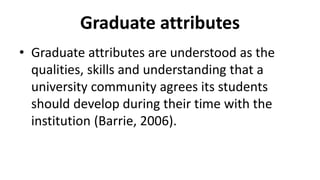
• Graduate attributes are understood as the
qualities, skills and understanding that a
university community agrees its students
should develop during their time with the
institution (Barrie, 2006).
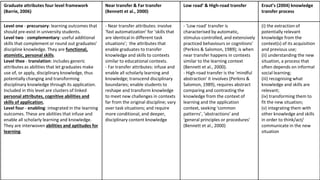
Graduate attributes four level framework
(Barrie, 2006)
Near transfer & Far transfer
(Bennett et al., 2000)
Low road’ & High-road transfer Eraut’s (2004) knowledge
transfer process
Level one - precursory: learning outcomes that
should pre-exist in university students.
Level two - complementary: useful additional
skills that complement or round out graduates’
discipline knowledge. They are functional,
atomistic, personal skills.
Level thee - translation: includes generic
attributes as abilities that let graduates make
use of, or apply, disciplinary knowledge, thus
potentially changing and transforming
disciplinary knowledge through its application.
Included in this level are clusters of linked
personal attributes, cognitive abilities and
skills of application,
Level four - enabling: integrated in the learning
outcomes. These are abilities that infuse and
enable all scholarly learning and knowledge.
They are interwoven abilities and aptitudes for
learning.
- Near transfer attributes: involve
‘fast automatization’ for ‘skills that
are identical in different task
situations’; the attributes that
enable graduates to transfer
knowledge and skills to contexts
similar to educational contexts.
- Far transfer attributes: infuse and
enable all scholarly learning and
knowledge; transcend disciplinary
boundaries; enable students to
reshape and transform knowledge
to meet new challenges in contexts
far from the original discipline; vary
over task situations; and require
more conditional, and deeper,
disciplinary content knowledge
- ‘Low road’ transfer is
characterised by automatic,
stimulus-controlled, and extensively
practiced behaviours or cognitions’
(Perkins & Salomon, 1989); is when
near transfer happens in contexts
similar to the learning context
(Bennett et al., 2000).
- High-road transfer is the ‘mindful
abstraction’ it involves (Perkins &
Salomon, 1989), requires abstract
comparing and contrasting the
knowledge from the context of
learning and the application
context, seeking ‘common
patterns’, ‘abstractions’ and
‘general principles or procedures’
(Bennett et al., 2000)
(i) the extraction of
potentially relevant
knowledge from the
context(s) of its acquisition
and previous use;
(ii) understanding the new
situation, a process that
often depends on informal
social learning;
(iii) recognising what
knowledge and skills are
relevant;
(iv) transforming them to
fit the new situation;
(v) integrating them with
other knowledge and skills
in order to think/act/
communicate in the new
situation
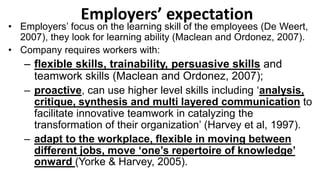
• Employers’ focus on the learning skill of the employees (De Weert,
2007), they look for learning ability (Maclean and Ordonez, 2007).
• Company requires workers with:
– flexible skills, trainability, persuasive skills and
teamwork skills (Maclean and Ordonez, 2007);
– proactive, can use higher level skills including ‘analysis,
critique, synthesis and multi layered communication to
facilitate innovative teamwork in catalyzing the
transformation of their organization’ (Harvey et al, 1997).
– adapt to the workplace, flexible in moving between
different jobs, move ‘one’s repertoire of knowledge’
onward (Yorke & Harvey, 2005).
Employers’ expectation
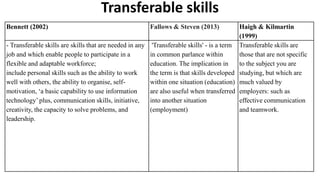
Transferable skills
Bennett (2002) Fallows & Steven (2013) Haigh & Kilmartin
(1999)
- Transferable skills are skills that are needed in any
job and which enable people to participate in a
flexible and adaptable workforce;
include personal skills such as the ability to work
well with others, the ability to organise, self-
motivation, ‘a basic capability to use information
technology’ plus, communication skills, initiative,
creativity, the capacity to solve problems, and
leadership.
'Transferable skills' - is a term
in common parlance within
education. The implication in
the term is that skills developed
within one situation (education)
are also useful when transferred
into another situation
(employment)
Transferable skills are
those that are not specific
to the subject you are
studying, but which are
much valued by
employers: such as
effective communication
and teamwork.
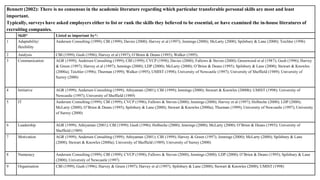
Bennett (2002): There is no consensus in the academic literature regarding which particular transferable personal skills are most and least
important.
Typically, surveys have asked employers either to list or rank the skills they believed to be essential, or have examined the in-house literatures of
recruiting companies.
Skill* Listed as important by*:
1 Adaptability/
flexibility
Andersen Consulting (1999); CBI (1999); Davies (2000); Harvey et al (1997); Jennings (2000); McLarty (2000); Spilsbury & Lane (2000); Teichler (1996)
2 Analysis CBI (1999); Gush (1996); Harvey et al (1997); O’Brien & Deans (1995); Walker (1995).
3 Communication AGR (1999); Andersen Consulting (1999); CBI (1999); CVCP (1998); Davies (2000); Fallows & Steven (2000); Greenwood et al (1987); Gush (1996); Harvey
& Green (1997); Harvey et al (1997); Jennings (2000); LDP (2000); McLarty (2000); O’Brien & Deans (1995); Spilsbury & Lane (2000); Stewart & Knowles
(2000a); Teichler (1996); Thurman (1999); Walker (1995); UMIST (1998); University of Newcastle (1997); University of Sheffield (1989); University of
Surrey (2000)
4 Initiative AGR (1999); Andersen Consulting (1999); Athiyaman (2001); CBI (1999); Jennings (2000); Stewart & Knowles (2000b); UMIST (1998); University of
Newcastle (1997); University of Sheffield (1989)
5 IT Andersen Consulting (1999); CBI (1999); CVCP (1996); Fallows & Steven (2000); Jennings (2000); Harvey et al (1997); Holbeche (2000); LDP (2000);
McLarty (2000); O’Brien & Deans (1995); Spilsbury & Lane (2000); Stewart & Knowles (2000a); Thurman (1999); University of Newcastle (1997); University
of Surrey (2000)
6 Leadership AGR (1999); Athiyaman (2001); CBI (1999); Gush (1996); Holbeche (2000); Jennings (2000); McLarty (2000); O’Brien & Deans (1995); University of
Sheffield (1989)
7 Motivation AGR (1999); Andersen Consulting (1999); Athiyaman (2001); CBI (1999); Harvey & Green (1997); Jennings (2000); McLarty (2000); Spilsbury & Lane
(2000); Stewart & Knowles (2000a); University of Sheffield (1989); University of Surrey (2000)
8 Numeracy Andersen Consulting (1999); CBI (1999); CVCP (1998); Fallows & Steven (2000); Jennings (2000); LDP (2000); O’Brien & Deans (1995); Spilsbury & Lane
(2000); University of Newcastle (1997)
9 Organisation CBI (1999); Gush (1996); Harvey & Green (1997); Harvey et al (1997); Spilsbury & Lane (2000); Stewart & Knowles (2000); UMIST (1998)
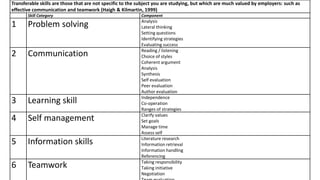
Transferable skills are those that are not specific to the subject you are studying, but which are much valued by employers: such as
effective communication and teamwork (Haigh & Kilmartin, 1999)
Skill Category Component
1 Problem solving Analysis
Lateral thinking
Setting questions
Identifying strategies
Evaluating success
2 Communication Reading / listening
Choice of styles
Coherent argument
Analysis
Synthesis
Self evaluation
Peer evaluation
Author evaluation
3 Learning skill Independence
Co-operation
Ranges of strategies
4 Self management Clarify values
Set goals
Manage time
Assess self
5 Information skills Literature research
Information retrieval
Information handling
Referencing
6 Teamwork Taking responsibility
Taking initiative
Negotiation
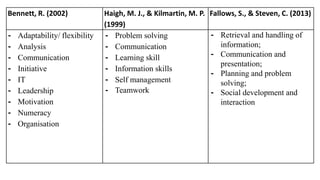
Bennett, R. (2002) Haigh, M. J., & Kilmartin, M. P.
(1999)
Fallows, S., & Steven, C. (2013)
⁃ Adaptability/ flexibility
⁃ Analysis
⁃ Communication
⁃ Initiative
⁃ IT
⁃ Leadership
⁃ Motivation
⁃ Numeracy
⁃ Organisation
⁃ Problem solving
⁃ Communication
⁃ Learning skill
⁃ Information skills
⁃ Self management
⁃ Teamwork
⁃ Retrieval and handling of
information;
⁃ Communication and
presentation;
⁃ Planning and problem
solving;
⁃ Social development and
interaction
Graduate employability
• Reported literature suggests there is no one best way to examine the set
of skills that makes graduate more employable. Employers’ perceptions
play a key role in the definition of the required skills for graduates
(Suleman, 2016).
• A blend of understanding, skilful practices, efficacy beliefs (or legitimate
self-confidence) and reflectiveness (or metacognition) (Little, 2006)
• Capable people have confidence in their ability to take effective and
appropriate action, explain what they are seeking to achieve, live and
work effectively with others, and continue to learn from their
experiences, both as individuals and in association with others, in a
diverse and changing society (Stephenson, 2013).
USEM model
• The literature on employability has suggested that it depends upon a
synergic blend of personal qualities, skills of various kinds (of which
‘key skills’ are a subset) and disciplinary understanding (Knight & Yorke,
2002).
• The USEM model developed from the concept of ‘capability’ combines
the interpretation of the literature with insights from cognitive and
social psychology:
− Understanding
− Skills (subject-specific and generic)
− Efficacy beliefs (and self-theories generally)
− Metacognition (including reflection).
(Knight & Yorke, 2002)
• Why wide agreement was only found for interpersonal skills,
communication and team-work skills, which are relational skills? This can
be explained by the fact that they are included in almost all catalogues
and more importantly because they can be observed directly. Employers
can therefore easily observe and assess relational skills (Suleman, 2016,
p.173).
• Other hard-to-observe skills are also required. Employers have always
been concerned about the unobservable characteristics of job candidates.
They often use third-party certification to ascertain whether a job seeker
is suitable for the position and consequently use education as a screening
device to distinguish the more able from the less able applicants without
incurring additional costs (Suleman, 2016, p.173).
Our question:
What skills do learners
really need?
Acknowledgments
• This work is in a sense an outcome of
research we started at Vietnam National
University Hanoi (VNU), funded under
research project number QG 18.58. We
gratefully acknowledge enormous support
from VNU Hanoi colleagues.
Reference
• Barrie, S. (2006). Understanding What We Mean by the Generic Attributes of Graduates. Higher Education, 51(2), 215-241.
• Bennett, N., Dunne, E., Carré, C. (2000). Skills development in higher education and employment, (Buckingham; Philadelphia, PA :,
Society for Research into Higher Education & Open University Press).
• Bennett, R. (2002). Employers' Demands for Personal Transferable Skills in Graduates: a content analysis of 1000 job advertisements
and an associated empirical study, Journal of Vocational Education and Training, 54:4, 457-476, DOI: 10.1080/13636820200200209
• Fallows, S., & Steven, C. (2013). Integrating key skills in higher education: Employability, transferable skills and learning for life.
Routledge.
• Haigh, M. J., & Kilmartin, M. P. (1999). Student perceptions of the development of personal transferable skills. Journal of Geography in
Higher Education, 23(2), 195-206. Retrieved from https://search.proquest.com/docview/214735353?accountid=39811
• Knight, P. T., & Yorke, M. (2002). Employability through the curriculum. Tertiary Education & Management, 8(4), 261-276.
• Little, B. (2006). Employability and work-based learning. York: Higher Education Academy
• Stephenson, J. (2013). The Concept of Capability and Its Importance in Higher Education. In J. Stephenson & M. Yorke (Eds) Capability
and quality in higher education. Routledge, 1-13
• Suleman, F. (2016). Employability skills of higher education graduates: Little consensus on a much-discussed subject. Procedia-Social
and Behavioral Sciences, 228, 169-174. Paper presented in the Proceedings of 2nd International Conference on Higher Education
Advances, HEAd´16, 21-23 June 2016, València, Spain.
• Tynjälä, P., Slotte, V., Nieminen, J., Lonka, K., & Olkinuora, E. (2006). From university to working life: Graduates’ workplace skills in
practice. Higher education and working life: Collaborations, confrontations and challenges, 73-88.

Dr Mai Thi Quynh Lan

  • 1.
    What skills dolearners really need? TRANSFERABLE SKILLS: THE MOST IMPORTANT FOR LEARNERS IN A GLOBALISED WORLD Dr. Mai Thi Quynh Lan, Vietnam National University Hanoi, Institute for Education Quality Assurance (VNU INFEQA) Going Global 2018: Global connections, local impact' Malaysia 2-4 May, 2018
  • 2.
    Graduate attributes • Graduateattributes are understood as the qualities, skills and understanding that a university community agrees its students should develop during their time with the institution (Barrie, 2006).
  • 3.
    Graduate attributes fourlevel framework (Barrie, 2006) Near transfer & Far transfer (Bennett et al., 2000) Low road’ & High-road transfer Eraut’s (2004) knowledge transfer process Level one - precursory: learning outcomes that should pre-exist in university students. Level two - complementary: useful additional skills that complement or round out graduates’ discipline knowledge. They are functional, atomistic, personal skills. Level thee - translation: includes generic attributes as abilities that let graduates make use of, or apply, disciplinary knowledge, thus potentially changing and transforming disciplinary knowledge through its application. Included in this level are clusters of linked personal attributes, cognitive abilities and skills of application, Level four - enabling: integrated in the learning outcomes. These are abilities that infuse and enable all scholarly learning and knowledge. They are interwoven abilities and aptitudes for learning. - Near transfer attributes: involve ‘fast automatization’ for ‘skills that are identical in different task situations’; the attributes that enable graduates to transfer knowledge and skills to contexts similar to educational contexts. - Far transfer attributes: infuse and enable all scholarly learning and knowledge; transcend disciplinary boundaries; enable students to reshape and transform knowledge to meet new challenges in contexts far from the original discipline; vary over task situations; and require more conditional, and deeper, disciplinary content knowledge - ‘Low road’ transfer is characterised by automatic, stimulus-controlled, and extensively practiced behaviours or cognitions’ (Perkins & Salomon, 1989); is when near transfer happens in contexts similar to the learning context (Bennett et al., 2000). - High-road transfer is the ‘mindful abstraction’ it involves (Perkins & Salomon, 1989), requires abstract comparing and contrasting the knowledge from the context of learning and the application context, seeking ‘common patterns’, ‘abstractions’ and ‘general principles or procedures’ (Bennett et al., 2000) (i) the extraction of potentially relevant knowledge from the context(s) of its acquisition and previous use; (ii) understanding the new situation, a process that often depends on informal social learning; (iii) recognising what knowledge and skills are relevant; (iv) transforming them to fit the new situation; (v) integrating them with other knowledge and skills in order to think/act/ communicate in the new situation
  • 4.
    • Employers’ focuson the learning skill of the employees (De Weert, 2007), they look for learning ability (Maclean and Ordonez, 2007). • Company requires workers with: – flexible skills, trainability, persuasive skills and teamwork skills (Maclean and Ordonez, 2007); – proactive, can use higher level skills including ‘analysis, critique, synthesis and multi layered communication to facilitate innovative teamwork in catalyzing the transformation of their organization’ (Harvey et al, 1997). – adapt to the workplace, flexible in moving between different jobs, move ‘one’s repertoire of knowledge’ onward (Yorke & Harvey, 2005). Employers’ expectation
  • 5.
    Transferable skills Bennett (2002)Fallows & Steven (2013) Haigh & Kilmartin (1999) - Transferable skills are skills that are needed in any job and which enable people to participate in a flexible and adaptable workforce; include personal skills such as the ability to work well with others, the ability to organise, self- motivation, ‘a basic capability to use information technology’ plus, communication skills, initiative, creativity, the capacity to solve problems, and leadership. 'Transferable skills' - is a term in common parlance within education. The implication in the term is that skills developed within one situation (education) are also useful when transferred into another situation (employment) Transferable skills are those that are not specific to the subject you are studying, but which are much valued by employers: such as effective communication and teamwork.
  • 6.
    Bennett (2002): Thereis no consensus in the academic literature regarding which particular transferable personal skills are most and least important. Typically, surveys have asked employers either to list or rank the skills they believed to be essential, or have examined the in-house literatures of recruiting companies. Skill* Listed as important by*: 1 Adaptability/ flexibility Andersen Consulting (1999); CBI (1999); Davies (2000); Harvey et al (1997); Jennings (2000); McLarty (2000); Spilsbury & Lane (2000); Teichler (1996) 2 Analysis CBI (1999); Gush (1996); Harvey et al (1997); O’Brien & Deans (1995); Walker (1995). 3 Communication AGR (1999); Andersen Consulting (1999); CBI (1999); CVCP (1998); Davies (2000); Fallows & Steven (2000); Greenwood et al (1987); Gush (1996); Harvey & Green (1997); Harvey et al (1997); Jennings (2000); LDP (2000); McLarty (2000); O’Brien & Deans (1995); Spilsbury & Lane (2000); Stewart & Knowles (2000a); Teichler (1996); Thurman (1999); Walker (1995); UMIST (1998); University of Newcastle (1997); University of Sheffield (1989); University of Surrey (2000) 4 Initiative AGR (1999); Andersen Consulting (1999); Athiyaman (2001); CBI (1999); Jennings (2000); Stewart & Knowles (2000b); UMIST (1998); University of Newcastle (1997); University of Sheffield (1989) 5 IT Andersen Consulting (1999); CBI (1999); CVCP (1996); Fallows & Steven (2000); Jennings (2000); Harvey et al (1997); Holbeche (2000); LDP (2000); McLarty (2000); O’Brien & Deans (1995); Spilsbury & Lane (2000); Stewart & Knowles (2000a); Thurman (1999); University of Newcastle (1997); University of Surrey (2000) 6 Leadership AGR (1999); Athiyaman (2001); CBI (1999); Gush (1996); Holbeche (2000); Jennings (2000); McLarty (2000); O’Brien & Deans (1995); University of Sheffield (1989) 7 Motivation AGR (1999); Andersen Consulting (1999); Athiyaman (2001); CBI (1999); Harvey & Green (1997); Jennings (2000); McLarty (2000); Spilsbury & Lane (2000); Stewart & Knowles (2000a); University of Sheffield (1989); University of Surrey (2000) 8 Numeracy Andersen Consulting (1999); CBI (1999); CVCP (1998); Fallows & Steven (2000); Jennings (2000); LDP (2000); O’Brien & Deans (1995); Spilsbury & Lane (2000); University of Newcastle (1997) 9 Organisation CBI (1999); Gush (1996); Harvey & Green (1997); Harvey et al (1997); Spilsbury & Lane (2000); Stewart & Knowles (2000); UMIST (1998)
  • 7.
    Transferable skills arethose that are not specific to the subject you are studying, but which are much valued by employers: such as effective communication and teamwork (Haigh & Kilmartin, 1999) Skill Category Component 1 Problem solving Analysis Lateral thinking Setting questions Identifying strategies Evaluating success 2 Communication Reading / listening Choice of styles Coherent argument Analysis Synthesis Self evaluation Peer evaluation Author evaluation 3 Learning skill Independence Co-operation Ranges of strategies 4 Self management Clarify values Set goals Manage time Assess self 5 Information skills Literature research Information retrieval Information handling Referencing 6 Teamwork Taking responsibility Taking initiative Negotiation
  • 8.
    Bennett, R. (2002)Haigh, M. J., & Kilmartin, M. P. (1999) Fallows, S., & Steven, C. (2013) ⁃ Adaptability/ flexibility ⁃ Analysis ⁃ Communication ⁃ Initiative ⁃ IT ⁃ Leadership ⁃ Motivation ⁃ Numeracy ⁃ Organisation ⁃ Problem solving ⁃ Communication ⁃ Learning skill ⁃ Information skills ⁃ Self management ⁃ Teamwork ⁃ Retrieval and handling of information; ⁃ Communication and presentation; ⁃ Planning and problem solving; ⁃ Social development and interaction
  • 9.
    Graduate employability • Reportedliterature suggests there is no one best way to examine the set of skills that makes graduate more employable. Employers’ perceptions play a key role in the definition of the required skills for graduates (Suleman, 2016). • A blend of understanding, skilful practices, efficacy beliefs (or legitimate self-confidence) and reflectiveness (or metacognition) (Little, 2006) • Capable people have confidence in their ability to take effective and appropriate action, explain what they are seeking to achieve, live and work effectively with others, and continue to learn from their experiences, both as individuals and in association with others, in a diverse and changing society (Stephenson, 2013).
  • 10.
    USEM model • Theliterature on employability has suggested that it depends upon a synergic blend of personal qualities, skills of various kinds (of which ‘key skills’ are a subset) and disciplinary understanding (Knight & Yorke, 2002). • The USEM model developed from the concept of ‘capability’ combines the interpretation of the literature with insights from cognitive and social psychology: − Understanding − Skills (subject-specific and generic) − Efficacy beliefs (and self-theories generally) − Metacognition (including reflection). (Knight & Yorke, 2002)
  • 11.
    • Why wideagreement was only found for interpersonal skills, communication and team-work skills, which are relational skills? This can be explained by the fact that they are included in almost all catalogues and more importantly because they can be observed directly. Employers can therefore easily observe and assess relational skills (Suleman, 2016, p.173). • Other hard-to-observe skills are also required. Employers have always been concerned about the unobservable characteristics of job candidates. They often use third-party certification to ascertain whether a job seeker is suitable for the position and consequently use education as a screening device to distinguish the more able from the less able applicants without incurring additional costs (Suleman, 2016, p.173).
  • 12.
    Our question: What skillsdo learners really need?
  • 13.
    Acknowledgments • This workis in a sense an outcome of research we started at Vietnam National University Hanoi (VNU), funded under research project number QG 18.58. We gratefully acknowledge enormous support from VNU Hanoi colleagues.
  • 14.
    Reference • Barrie, S.(2006). Understanding What We Mean by the Generic Attributes of Graduates. Higher Education, 51(2), 215-241. • Bennett, N., Dunne, E., Carré, C. (2000). Skills development in higher education and employment, (Buckingham; Philadelphia, PA :, Society for Research into Higher Education & Open University Press). • Bennett, R. (2002). Employers' Demands for Personal Transferable Skills in Graduates: a content analysis of 1000 job advertisements and an associated empirical study, Journal of Vocational Education and Training, 54:4, 457-476, DOI: 10.1080/13636820200200209 • Fallows, S., & Steven, C. (2013). Integrating key skills in higher education: Employability, transferable skills and learning for life. Routledge. • Haigh, M. J., & Kilmartin, M. P. (1999). Student perceptions of the development of personal transferable skills. Journal of Geography in Higher Education, 23(2), 195-206. Retrieved from https://search.proquest.com/docview/214735353?accountid=39811 • Knight, P. T., & Yorke, M. (2002). Employability through the curriculum. Tertiary Education & Management, 8(4), 261-276. • Little, B. (2006). Employability and work-based learning. York: Higher Education Academy • Stephenson, J. (2013). The Concept of Capability and Its Importance in Higher Education. In J. Stephenson & M. Yorke (Eds) Capability and quality in higher education. Routledge, 1-13 • Suleman, F. (2016). Employability skills of higher education graduates: Little consensus on a much-discussed subject. Procedia-Social and Behavioral Sciences, 228, 169-174. Paper presented in the Proceedings of 2nd International Conference on Higher Education Advances, HEAd´16, 21-23 June 2016, València, Spain. • Tynjälä, P., Slotte, V., Nieminen, J., Lonka, K., & Olkinuora, E. (2006). From university to working life: Graduates’ workplace skills in practice. Higher education and working life: Collaborations, confrontations and challenges, 73-88.