ROI revisited
4 Oct. 2019
Sveinn Aðalsteinsson
Education and Training Service Centre, Iceland
Our task at ETSC has two goals
• Increase productivity and competitiveness of Icelandic
companies
• Increase and visualize/certify the competences of our
target group – the individuals in the group
• The groups are equally important in our work
• Different groups require different engaging methods
Changed focus in education
Education gives the basics
Working makes you a professional
The Chemical Industry Federation of Finland
Return of Investment - ROI
• Is it useful?
• Is it an eligible term to use for training and education?
• ROI – for whom? Employers? Employees (students)?
• Is ROI coupled to motivation? For whom then?
• If it is useful, how do we measure?
• Not the only measurement of the value of training
The training process and company performance
T0
T1
Training Need
Analysis:
1) Focus groups $$$
or
2) Survey $$
or
3) Meeting $
Training
Plan
Increased customer satisfaction?
Increased revenues pr. employee?
Increased job satisfaction?
Less staff turn-over?
Changed behaviour of staff and
middle-managers?
Training
provider
Benchmarking
Tourism Skills Center: System design and tools
Training provider: Implementation and data collection
Contract
Evaluation of
company
performance
External
course(s)
on-site
Internal
training:
on-site
iteration
Electronic
training:
iteration
External
course(s)
on-site
Evaluation of
company
performance
Decreased customer satisfaction
Decreased revenues pr employee
Decreased job satisfaction
High staff turn-over
Undesired behaviour of staff and
middle-managers
- marketing!
26 Feb. 2019
Counselling?Counselling?Counselling?
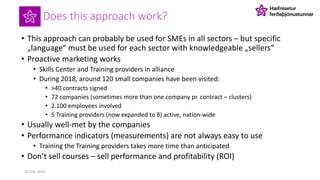
Does this approach work?
• This approach can probably be used for SMEs in all sectors – but specific
„language“ must be used for each sector with knowledgeable „sellers“
• Proactive marketing works
• Skills Center and Training providers in alliance
• During 2018, around 120 small companies have been visited:
• >40 contracts signed
• 72 companies (sometimes more than one company pr. contract – clusters)
• 2.100 employees involved
• 5 Training providers (now expanded to 8) active, nation-wide
• Usually well-met by the companies
• Performance indicators (measurements) are not always easy to use
• Training the Training providers takes more time than anticipated
• Don‘t sell courses – sell performance and profitability (ROI)
26 Feb. 2019
Event management ROI
(Edwards et al. 2011)
Return of Investment - ROI
• Is it useful?
• Is it an eligible term to use for training and education?
• ROI – for whom? Employers? Employees (students)?
• Is ROI coupled to motivation? For whom then?
• If it is useful, how do we measure?
Measuring results of training at Tourism
Skills Center
1. Tripadvisor score
2. Productivity (units sold/employee)
3. Staff turnover
4. Revenues pr. employee
5. No. of customer complaints
6. Employee job satisfaction survey
7. Customer satisfaction survey
Important: Just one type of measurement does not give an answer, a
combination of measurements gives an indication
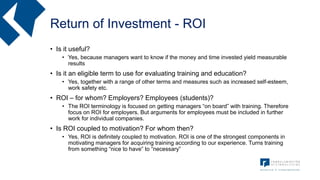
Return of Investment - ROI
• Is it useful?
• Yes, because managers want to know if the money and time invested yield measurable
results
• Is it an eligible term to use for evaluating training and education?
• Yes, together with a range of other terms and measures such as increased self-esteem,
work safety etc.
• ROI – for whom? Employers? Employees (students)?
• The ROI terminology is focused on getting managers “on board” with training. Therefore
focus on ROI for employers. But arguments for employees must be included in further
work for individual companies.
• Is ROI coupled to motivation? For whom then?
• Yes, ROI is definitely coupled to motivation. ROI is one of the strongest components in
motivating managers for acquiring training according to our experience. Turns training
from something “nice to have” to “necessary”

ROI revisited 

  • 1.
    ROI revisited 4 Oct.2019 Sveinn Aðalsteinsson Education and Training Service Centre, Iceland
  • 2.
    Our task atETSC has two goals • Increase productivity and competitiveness of Icelandic companies • Increase and visualize/certify the competences of our target group – the individuals in the group • The groups are equally important in our work • Different groups require different engaging methods
  • 3.
    Changed focus ineducation Education gives the basics Working makes you a professional The Chemical Industry Federation of Finland
  • 4.
    Return of Investment- ROI • Is it useful? • Is it an eligible term to use for training and education? • ROI – for whom? Employers? Employees (students)? • Is ROI coupled to motivation? For whom then? • If it is useful, how do we measure? • Not the only measurement of the value of training
  • 5.
    The training processand company performance T0 T1 Training Need Analysis: 1) Focus groups $$$ or 2) Survey $$ or 3) Meeting $ Training Plan Increased customer satisfaction? Increased revenues pr. employee? Increased job satisfaction? Less staff turn-over? Changed behaviour of staff and middle-managers? Training provider Benchmarking Tourism Skills Center: System design and tools Training provider: Implementation and data collection Contract Evaluation of company performance External course(s) on-site Internal training: on-site iteration Electronic training: iteration External course(s) on-site Evaluation of company performance Decreased customer satisfaction Decreased revenues pr employee Decreased job satisfaction High staff turn-over Undesired behaviour of staff and middle-managers - marketing! 26 Feb. 2019 Counselling?Counselling?Counselling?
  • 6.
    Does this approachwork? • This approach can probably be used for SMEs in all sectors – but specific „language“ must be used for each sector with knowledgeable „sellers“ • Proactive marketing works • Skills Center and Training providers in alliance • During 2018, around 120 small companies have been visited: • >40 contracts signed • 72 companies (sometimes more than one company pr. contract – clusters) • 2.100 employees involved • 5 Training providers (now expanded to 8) active, nation-wide • Usually well-met by the companies • Performance indicators (measurements) are not always easy to use • Training the Training providers takes more time than anticipated • Don‘t sell courses – sell performance and profitability (ROI) 26 Feb. 2019
  • 7.
  • 8.
    Return of Investment- ROI • Is it useful? • Is it an eligible term to use for training and education? • ROI – for whom? Employers? Employees (students)? • Is ROI coupled to motivation? For whom then? • If it is useful, how do we measure?
  • 9.
    Measuring results oftraining at Tourism Skills Center 1. Tripadvisor score 2. Productivity (units sold/employee) 3. Staff turnover 4. Revenues pr. employee 5. No. of customer complaints 6. Employee job satisfaction survey 7. Customer satisfaction survey Important: Just one type of measurement does not give an answer, a combination of measurements gives an indication
  • 10.
    Return of Investment- ROI • Is it useful? • Yes, because managers want to know if the money and time invested yield measurable results • Is it an eligible term to use for evaluating training and education? • Yes, together with a range of other terms and measures such as increased self-esteem, work safety etc. • ROI – for whom? Employers? Employees (students)? • The ROI terminology is focused on getting managers “on board” with training. Therefore focus on ROI for employers. But arguments for employees must be included in further work for individual companies. • Is ROI coupled to motivation? For whom then? • Yes, ROI is definitely coupled to motivation. ROI is one of the strongest components in motivating managers for acquiring training according to our experience. Turns training from something “nice to have” to “necessary”