K.Y.D.S.C.T.’s college of pharmacy, sakegaon
Jens Martensson 2
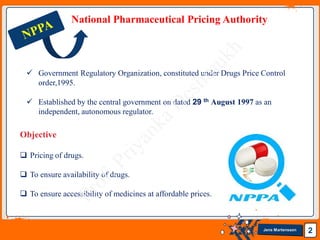
National Pharmaceutical Pricing Authority
 Government Regulatory Organization, constituted under Drugs Price Control
order,1995.
 Established by the central government on dated 29 th August 1997 as an
independent, autonomous regulator.
Objective
 Pricing of drugs.
 To ensure availability of drugs.
 To ensure accessibility of medicines at affordable prices.
Jens Martensson 3
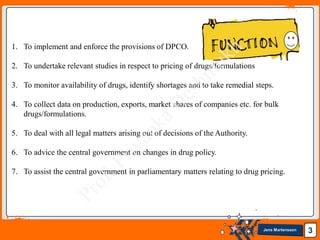
1. To implement and enforce the provisions of DPCO.
2. To undertake relevant studies in respect to pricing of drugs/formulations
3. To monitor availability of drugs, identify shortages and to take remedial steps.
4. To collect data on production, exports, market shares of companies etc. for bulk
drugs/formulations.
5. To deal with all legal matters arising out of decisions of the Authority.
6. To advice the central government on changes in drug policy.
7. To assist the central government in parliamentary matters relating to drug pricing.
Jens Martensson 4
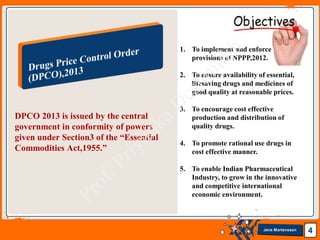
DPCO 2013 is issued by the central
government in conformity of powers
given under Section3 of the “Essential
Commodities Act,1955.”
1. To implement and enforce
provisions of NPPP,2012.
2. To ensure availability of essential,
lifesaving drugs and medicines of
good quality at reasonable prices.
3. To encourage cost effective
production and distribution of
quality drugs.
4. To promote rational use drugs in
cost effective manner.
5. To enable Indian Pharmaceutical
Industry, to grow in the innovative
and competitive international
economic environment.
Jens Martensson 5
1. Price control of essential drugs and formulations specified in “National list of
Essential Medicines”.
2. Fixation of ceiling price and Retail price of scheduled formulations.
3. Market based pricing of Scheduled formulations, in place of cost based.
4. Regulation and monitoring of bulk drugs and formulations.
5. Monitoring price of of Scheduled formulations.
6. Recovery of over charged amount.
7. Monitoring prices of non-scheduled formulations.
8. Price hike of non-scheduled formulations.
9. Display of price lists and maximum Retail prices.
10. Reduction in margins of wholesalers and retailers to 8% and 16% respectively.
Jens Martensson 6
DEFINATIONS
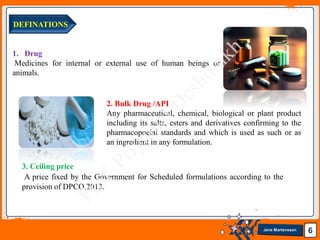
1. Drug
Medicines for internal or external use of human beings or
animals.
2. Bulk Drug /API
Any pharmaceutical, chemical, biological or plant product
including its salts, esters and derivatives confirming to the
pharmacopoeial standards and which is used as such or as
an ingredient in any formulation.
3. Ceiling price
A price fixed by the Government for Scheduled formulations according to the
provision of DPCO,2013.
Jens Martensson 7
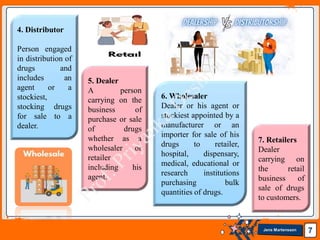
4. Distributor
Person engaged
in distribution of
drugs and
includes an
agent or a
stockiest,
stocking drugs
for sale to a
dealer.
5. Dealer
A person
carrying on the
business of
purchase or sale
of drugs
whether as a
wholesaler or
retailer
including his
agent.
7. Retailers
Dealer
carrying on
the retail
business of
sale of drugs
to customers.
6. Wholesaler
Dealer or his agent or
stockiest appointed by a
manufacturer or an
importer for sale of his
drugs to retailer,
hospital, dispensary,
medical, educational or
research institutions
purchasing bulk
quantities of drugs.
Jens Martensson 8
8. Formulation
A medicine containing one or more bulk drugs with or without
pharmaceutical aids, for internal or external use in diagnosis, treatment,
mitigation or prevention of diseases in human beings or animals, but
does not include:
i. Ayurvedic, Siddha, Unani and Homoeopathic medicines and
ii. Any substance to which provisions of Drugs and Cosmetics Act , do
not apply.
9. Scheduled Formulation
Any formulation included in the First Schedule whether referred to by
generic versions or brand name.
10. Non- Scheduled Formulation
Formulation the dosage and strength of which are not specified in First
Schedule.
Jens Martensson 9
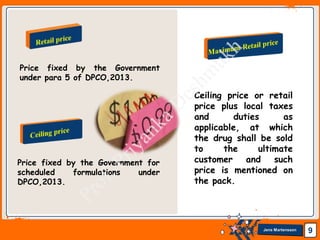
Price fixed by the Government for
scheduled formulations under
DPCO,2013.
Price fixed by the Government
under para 5 of DPCO,2013.
Ceiling price or retail
price plus local taxes
and duties as
applicable, at which
the drug shall be sold
to the ultimate
customer and such
price is mentioned on
the pack.
Jens Martensson 10
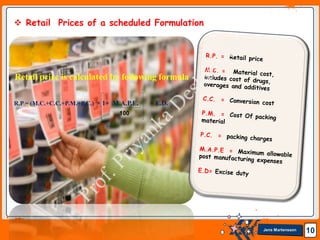
 Retail Prices of a scheduled Formulation
R.P = (M.C.+C.C.+P.M.+P.C.) × 1+ M.A.P.E. + E.D.
100
Retail price is calculated by following formula
Jens Martensson 11
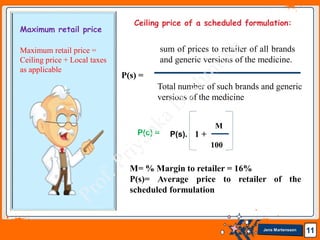
Maximum retail price
Maximum retail price =
Ceiling price + Local taxes
as applicable
sum of prices to retailer of all brands
and generic versions of the medicine.
Total number of such brands and generic
versions of the medicine
P(s) =
P(c) = P(s).
M
100
1 +
Ceiling price of a scheduled formulation:
M= % Margin to retailer = 16%
P(s)= Average price to retailer of the
scheduled formulation
Jens Martensson 12
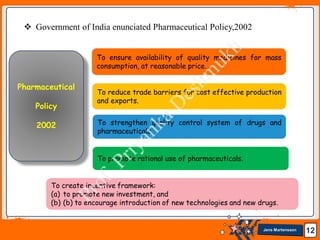
 Government of India enunciated Pharmaceutical Policy,2002
To ensure availability of quality medicines for mass
consumption, at reasonable price.
To reduce trade barriers for cost effective production
and exports.
To strengthen quality control system of drugs and
pharmaceuticals.
To create incentive framework:
(a) to promote new investment, and
(b) (b) to encourage introduction of new technologies and new drugs.
To promote rational use of pharmaceuticals.
Pharmaceutical
Policy
2002
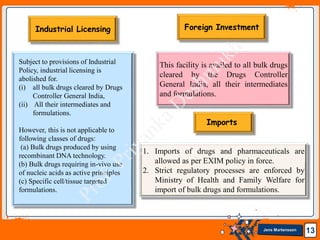
Jens Martensson 13
Subject to provisions of Industrial
Policy, industrial licensing is
abolished for.
(i) all bulk drugs cleared by Drugs
Controller General India,
(ii) All their intermediates and
formulations.
However, this is not applicable to
following classes of drugs:
(a) Bulk drugs produced by using
recombinant DNA technology.
(b) Bulk drugs requiring in-vivo use
of nucleic acids as active principles
(c) Specific cell/tissue targeted
formulations.
This facility is availed to all bulk drugs
cleared by the Drugs Controller
General India, all their intermediates
and formulations.
1. Imports of drugs and pharmaceuticals are
allowed as per EXIM policy in force.
2. Strict regulatory processes are enforced by
Ministry of Health and Family Welfare for
import of bulk drugs and formulations.
Imports
Foreign Investment
Industrial Licensing
Jens Martensson 14
Pricing
1. Span of price control.
2. Maximum Allowable Post
Manufacturing Expenses
(MAPE).
3. Margin for Imported
Formulations.
4. Pricing of formulations.
5. Ceiling prices of
formulations
6. Pricing of Scheduled bulk
drugs
7. Utilization of amount
accrued in Drug Price
Equalization Account
(DPEA)
Encouragement to R&D
1. The establishment of the
Pharmaceutical Research and
Development Support Fund
(PRDSF) under administrative
control of Department of Science and
Technology, is approved.
2. A Drugs Development Promotion
Fund (DDPF) is constituted to
administer the utilization of PRDSF.
Jens Martensson
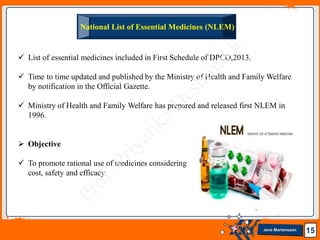
National List of Essential Medicines (NLEM)
15
 List of essential medicines included in First Schedule of DPCO,2013.
 Time to time updated and published by the Ministry of Health and Family Welfare
by notification in the Official Gazette.
 Ministry of Health and Family Welfare has prepared and released first NLEM in
1996.
 Objective
 To promote rational use of medicines considering
cost, safety and efficacy.
Jens Martensson 16
(i) It provides cost effective medicines.
(ii) It is useful in quality care and better management of medicines.
(iii) It helps in monitoring prices of medicines.
(iv) It guides the procurement and supply of medicines in public sector.
(v) It directs correct dosage form and strength while prescribing.
(vi) It improves prescribing and health results.
(vii)It helps in public education and training of health care providers.
(viii) It promotes rational use of medicines.
USES
National Pharmaceutical Pricing Authority

National Pharmaceutical Pricing Authority

  • 1.
    K.Y.D.S.C.T.’s college ofpharmacy, sakegaon
  • 2.
    Jens Martensson 2 NationalPharmaceutical Pricing Authority  Government Regulatory Organization, constituted under Drugs Price Control order,1995.  Established by the central government on dated 29 th August 1997 as an independent, autonomous regulator. Objective  Pricing of drugs.  To ensure availability of drugs.  To ensure accessibility of medicines at affordable prices.
  • 3.
    Jens Martensson 3 1.To implement and enforce the provisions of DPCO. 2. To undertake relevant studies in respect to pricing of drugs/formulations 3. To monitor availability of drugs, identify shortages and to take remedial steps. 4. To collect data on production, exports, market shares of companies etc. for bulk drugs/formulations. 5. To deal with all legal matters arising out of decisions of the Authority. 6. To advice the central government on changes in drug policy. 7. To assist the central government in parliamentary matters relating to drug pricing.
  • 4.
    Jens Martensson 4 DPCO2013 is issued by the central government in conformity of powers given under Section3 of the “Essential Commodities Act,1955.” 1. To implement and enforce provisions of NPPP,2012. 2. To ensure availability of essential, lifesaving drugs and medicines of good quality at reasonable prices. 3. To encourage cost effective production and distribution of quality drugs. 4. To promote rational use drugs in cost effective manner. 5. To enable Indian Pharmaceutical Industry, to grow in the innovative and competitive international economic environment.
  • 5.
    Jens Martensson 5 1.Price control of essential drugs and formulations specified in “National list of Essential Medicines”. 2. Fixation of ceiling price and Retail price of scheduled formulations. 3. Market based pricing of Scheduled formulations, in place of cost based. 4. Regulation and monitoring of bulk drugs and formulations. 5. Monitoring price of of Scheduled formulations. 6. Recovery of over charged amount. 7. Monitoring prices of non-scheduled formulations. 8. Price hike of non-scheduled formulations. 9. Display of price lists and maximum Retail prices. 10. Reduction in margins of wholesalers and retailers to 8% and 16% respectively.
  • 6.
    Jens Martensson 6 DEFINATIONS 1.Drug Medicines for internal or external use of human beings or animals. 2. Bulk Drug /API Any pharmaceutical, chemical, biological or plant product including its salts, esters and derivatives confirming to the pharmacopoeial standards and which is used as such or as an ingredient in any formulation. 3. Ceiling price A price fixed by the Government for Scheduled formulations according to the provision of DPCO,2013.
  • 7.
    Jens Martensson 7 4.Distributor Person engaged in distribution of drugs and includes an agent or a stockiest, stocking drugs for sale to a dealer. 5. Dealer A person carrying on the business of purchase or sale of drugs whether as a wholesaler or retailer including his agent. 7. Retailers Dealer carrying on the retail business of sale of drugs to customers. 6. Wholesaler Dealer or his agent or stockiest appointed by a manufacturer or an importer for sale of his drugs to retailer, hospital, dispensary, medical, educational or research institutions purchasing bulk quantities of drugs.
  • 8.
    Jens Martensson 8 8.Formulation A medicine containing one or more bulk drugs with or without pharmaceutical aids, for internal or external use in diagnosis, treatment, mitigation or prevention of diseases in human beings or animals, but does not include: i. Ayurvedic, Siddha, Unani and Homoeopathic medicines and ii. Any substance to which provisions of Drugs and Cosmetics Act , do not apply. 9. Scheduled Formulation Any formulation included in the First Schedule whether referred to by generic versions or brand name. 10. Non- Scheduled Formulation Formulation the dosage and strength of which are not specified in First Schedule.
  • 9.
    Jens Martensson 9 Pricefixed by the Government for scheduled formulations under DPCO,2013. Price fixed by the Government under para 5 of DPCO,2013. Ceiling price or retail price plus local taxes and duties as applicable, at which the drug shall be sold to the ultimate customer and such price is mentioned on the pack.
  • 10.
    Jens Martensson 10 Retail Prices of a scheduled Formulation R.P = (M.C.+C.C.+P.M.+P.C.) × 1+ M.A.P.E. + E.D. 100 Retail price is calculated by following formula
  • 11.
    Jens Martensson 11 Maximumretail price Maximum retail price = Ceiling price + Local taxes as applicable sum of prices to retailer of all brands and generic versions of the medicine. Total number of such brands and generic versions of the medicine P(s) = P(c) = P(s). M 100 1 + Ceiling price of a scheduled formulation: M= % Margin to retailer = 16% P(s)= Average price to retailer of the scheduled formulation
  • 12.
    Jens Martensson 12 Government of India enunciated Pharmaceutical Policy,2002 To ensure availability of quality medicines for mass consumption, at reasonable price. To reduce trade barriers for cost effective production and exports. To strengthen quality control system of drugs and pharmaceuticals. To create incentive framework: (a) to promote new investment, and (b) (b) to encourage introduction of new technologies and new drugs. To promote rational use of pharmaceuticals. Pharmaceutical Policy 2002
  • 13.
    Jens Martensson 13 Subjectto provisions of Industrial Policy, industrial licensing is abolished for. (i) all bulk drugs cleared by Drugs Controller General India, (ii) All their intermediates and formulations. However, this is not applicable to following classes of drugs: (a) Bulk drugs produced by using recombinant DNA technology. (b) Bulk drugs requiring in-vivo use of nucleic acids as active principles (c) Specific cell/tissue targeted formulations. This facility is availed to all bulk drugs cleared by the Drugs Controller General India, all their intermediates and formulations. 1. Imports of drugs and pharmaceuticals are allowed as per EXIM policy in force. 2. Strict regulatory processes are enforced by Ministry of Health and Family Welfare for import of bulk drugs and formulations. Imports Foreign Investment Industrial Licensing
  • 14.
    Jens Martensson 14 Pricing 1.Span of price control. 2. Maximum Allowable Post Manufacturing Expenses (MAPE). 3. Margin for Imported Formulations. 4. Pricing of formulations. 5. Ceiling prices of formulations 6. Pricing of Scheduled bulk drugs 7. Utilization of amount accrued in Drug Price Equalization Account (DPEA) Encouragement to R&D 1. The establishment of the Pharmaceutical Research and Development Support Fund (PRDSF) under administrative control of Department of Science and Technology, is approved. 2. A Drugs Development Promotion Fund (DDPF) is constituted to administer the utilization of PRDSF.
  • 15.
    Jens Martensson National Listof Essential Medicines (NLEM) 15  List of essential medicines included in First Schedule of DPCO,2013.  Time to time updated and published by the Ministry of Health and Family Welfare by notification in the Official Gazette.  Ministry of Health and Family Welfare has prepared and released first NLEM in 1996.  Objective  To promote rational use of medicines considering cost, safety and efficacy.
  • 16.
    Jens Martensson 16 (i)It provides cost effective medicines. (ii) It is useful in quality care and better management of medicines. (iii) It helps in monitoring prices of medicines. (iv) It guides the procurement and supply of medicines in public sector. (v) It directs correct dosage form and strength while prescribing. (vi) It improves prescribing and health results. (vii)It helps in public education and training of health care providers. (viii) It promotes rational use of medicines. USES