Down Syndrome
Sallyanna Cohen
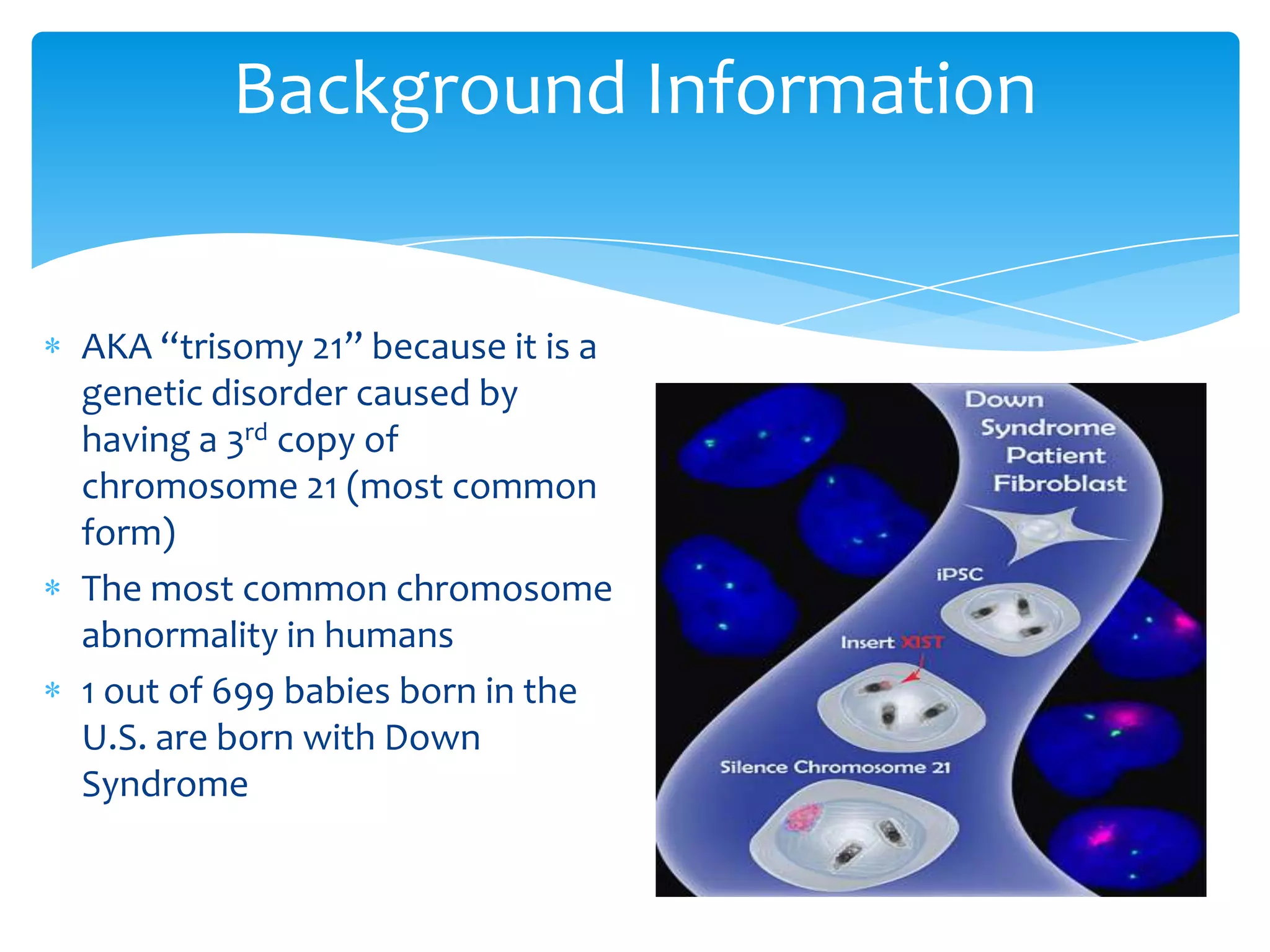
AKA “trisomy 21” because it is a
genetic disorder caused by
having a 3rd copy of
chromosome 21 (most common
form)
The most common chromosome
abnormality in humans
1 out of 699 babies born in the
U.S. are born with Down
Syndrome
Background Information
Different Types
of
Down Syndrome
① Trisomy 21: account for 95% -extra chromosome 21 (three rather
than a pair)
② Translocation Down Syndrome: 3-4% of people with Down
Syndrome-extra #21 chromosome is present, but attached to a diff
chromosome in the egg or sperm
③ Mosaic Down Syndrome: account for <1%- born having some cells
with 3 copies of chromosome 21 and some with the usual pair;
usually have same features and health problems as the other
types, but may result in fewer characteristics- also may score a few
points higher in IQ
Physical Features
 Stunted growth
 Upward slanted eyes & eyelid crease
 Low-set and rounded ears
 Flattened nose
 Smaller teeth
 Shortened hands
Neurological Symptoms
o Most have intellectual disability in the
mild (IQ 50-70) to moderate (IQ 35-50)
range
o Common to have a speech delay
o Delay in gross & fine motor skills
o Greater risk for developing epilepsy
and Alzheimer’s Disease
Prenatal Testing
 The highest detection rate in
screening is from a combined test
using ultrasound (Nuchal
translucency/free beta hCG/PAPP-A
screen)
 Blood Tests
Post Natal
 Fried’s Diagnostic Index :
- Detects 8 characteristics
- if the baby has 0-2 characteristics it
is likely to not have the syndrome
- 3-5 characteristics its unclear
- 6-8 characteristics they are
confident he or she has Down
Syndrome
Adaptive Skills
• Children with Down Syndrome do
seem to acquire skills in a similar
sequence as regular children in
adaptive levels of motor, daily
living, communicative, and social
behavioral skills but at a slower pace
and reach their ceiling at about the
age of 12
• Most, depending on the intensity of
the syndrome, are able to live
independently and hold job
Interventions
 Screen for middle ear problems and
hearing loss- hearing aids or other
amplification devices can be useful for
language learning
 Early communication intervention
fosters linguistic skills
 Language assessments can help
profile strengths and weaknesses
 Individualized speech therapy
 Augmentative and alternative
communication (AAC) methods such
as pointing, body language, objects, or
graphics are often used to aid
communication

Down syndrome Class Presentation

  • 1.
  • 2.
    AKA “trisomy 21”because it is a genetic disorder caused by having a 3rd copy of chromosome 21 (most common form) The most common chromosome abnormality in humans 1 out of 699 babies born in the U.S. are born with Down Syndrome Background Information
  • 3.
    Different Types of Down Syndrome ①Trisomy 21: account for 95% -extra chromosome 21 (three rather than a pair) ② Translocation Down Syndrome: 3-4% of people with Down Syndrome-extra #21 chromosome is present, but attached to a diff chromosome in the egg or sperm ③ Mosaic Down Syndrome: account for <1%- born having some cells with 3 copies of chromosome 21 and some with the usual pair; usually have same features and health problems as the other types, but may result in fewer characteristics- also may score a few points higher in IQ
  • 4.
    Physical Features  Stuntedgrowth  Upward slanted eyes & eyelid crease  Low-set and rounded ears  Flattened nose  Smaller teeth  Shortened hands
  • 5.
    Neurological Symptoms o Mosthave intellectual disability in the mild (IQ 50-70) to moderate (IQ 35-50) range o Common to have a speech delay o Delay in gross & fine motor skills o Greater risk for developing epilepsy and Alzheimer’s Disease
  • 6.
    Prenatal Testing  Thehighest detection rate in screening is from a combined test using ultrasound (Nuchal translucency/free beta hCG/PAPP-A screen)  Blood Tests
  • 7.
    Post Natal  Fried’sDiagnostic Index : - Detects 8 characteristics - if the baby has 0-2 characteristics it is likely to not have the syndrome - 3-5 characteristics its unclear - 6-8 characteristics they are confident he or she has Down Syndrome
  • 8.
    Adaptive Skills • Childrenwith Down Syndrome do seem to acquire skills in a similar sequence as regular children in adaptive levels of motor, daily living, communicative, and social behavioral skills but at a slower pace and reach their ceiling at about the age of 12 • Most, depending on the intensity of the syndrome, are able to live independently and hold job
  • 9.
    Interventions  Screen formiddle ear problems and hearing loss- hearing aids or other amplification devices can be useful for language learning  Early communication intervention fosters linguistic skills  Language assessments can help profile strengths and weaknesses  Individualized speech therapy  Augmentative and alternative communication (AAC) methods such as pointing, body language, objects, or graphics are often used to aid communication