Down Syndrome
By
Prof Dr.A.SAMUEL DINESH,M.D
Institute of internal medicine,MMC
TRISOMY 21:DOWN SYNDROME
• Incidence: 1 in 733 live births
• Incidence in India: 1 in 916 to 1 in 1150 live births
• Most common genetic cause of moderate intellectual
disability.
• First described 1866 by John Langdon Down
• Jean Lejeune and his colleagues identified the genetic cause in
1959.
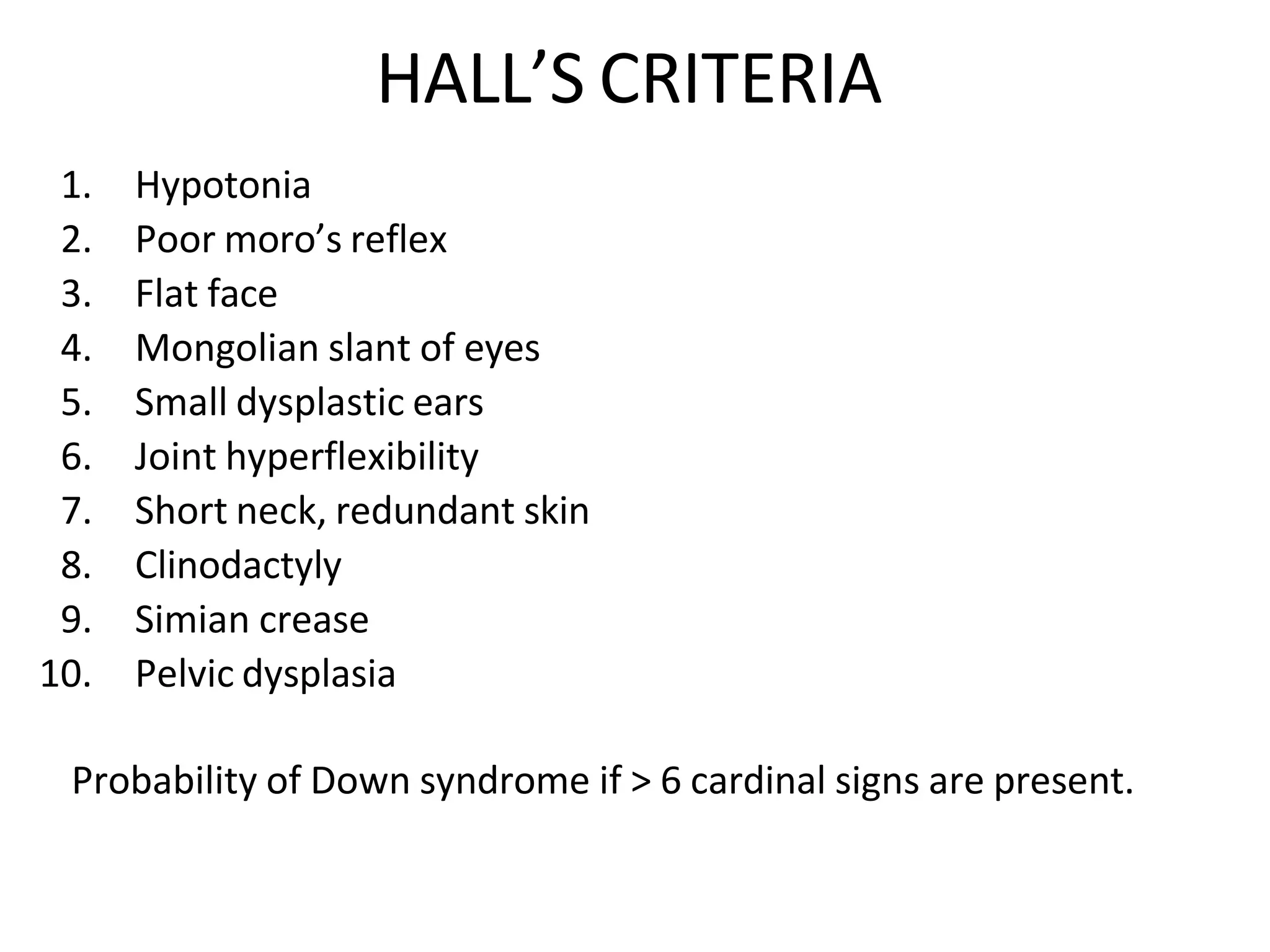
HALL’S CRITERIA
1. Hypotonia
2. Poor moro’s reflex
3. Flat face
4. Mongolian slant of eyes
5. Small dysplastic ears
6. Joint hyperflexibility
7. Short neck, redundant skin
8. Clinodactyly
9. Simian crease
10. Pelvic dysplasia
Probability of Down syndrome if > 6 cardinal signs are present.
FLAT FACE
Face, Flat—Definition: Absence of concavity or convexity of the
face when viewed in profile
Brachycephaly—Definition: Cephalic index greater than 81%
objective OR
Apparently shortened anteroposterior dimension (length) of the
head compared to width.subjective
BRACHYCEPHALY
Occiput, Flat—Definition: Reduced convexity of the occiput
LOW SET EARS
Definition: Upper insertion of the ear to the scalp below an
imaginary horizontal passing through the inner canthi and
extend that line posteriorly to the ear . objective
Single transverse crease that runs across the palm of the hand
CLINODACTYLY
SIMIAN CREASE
Definition: A digit that is laterally curved in the plane of the
palm. subjective The curvature in this term is restricted to the
phalanges and does not refer to deviation at the MCPJ/MTPJ
Epicantal folds
Upslanting of eyes
Flat nasal bridge
Flat face
Protruded tongue
FACIAL FEATURES OF A DOWN SYNDROME CHILD
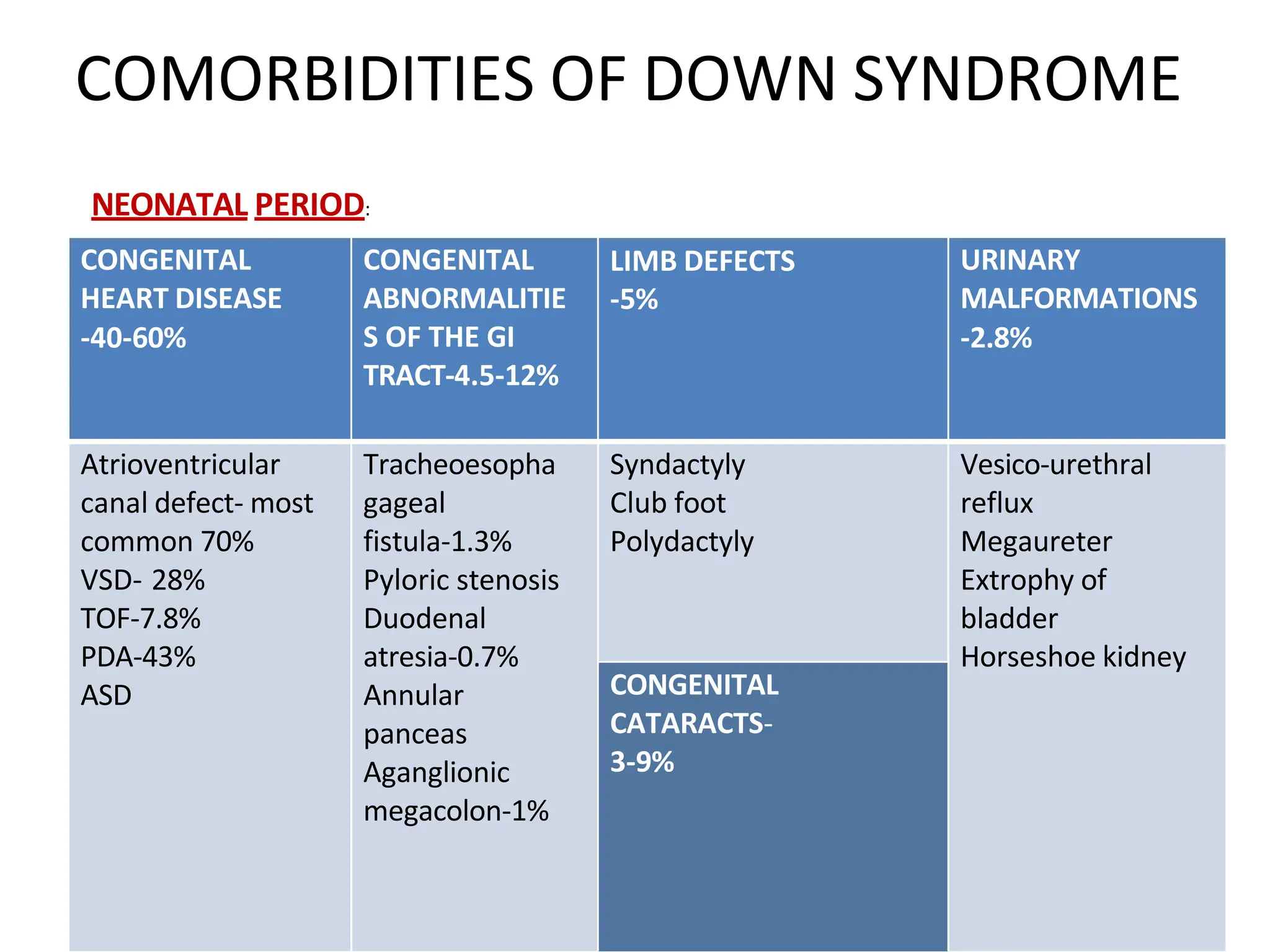
COMORBIDITIES OF DOWN SYNDROME
CONGENITAL
HEART DISEASE
-40-60%
CONGENITAL
ABNORMALITIE
S OF THE GI
TRACT-4.5-12%
LIMB DEFECTS
-5%
URINARY
MALFORMATIONS
-2.8%
Atrioventricular
canal defect- most
common 70%
VSD- 28%
TOF-7.8%
PDA-43%
ASD
Tracheoesopha
gageal
fistula-1.3%
Pyloric stenosis
Duodenal
atresia-0.7%
Annular
panceas
Aganglionic
megacolon-1%
Syndactyly
Club foot
Polydactyly
Vesico-urethral
reflux
Megaureter
Extrophy of
bladder
Horseshoe kidney
CONGENITAL
CATARACTS-
3-9%
NEONATAL PERIOD:
VISUAL IMPAIRMENT AUDIOLOGIC
DYSFUNCTION
SEIZURE DISORDER-
2.6-8.8%
THYROID
DISORDERS-3-50%
Refractive errors-70%,
most common is
myopia
Strabismus-50%
Congenital
nystagmus-35%
Blocked lacrimal
duct-20%
conductive hearing
loss- 60-80%
Sensorineural -4-9%
GTCS- 8.1%
Infantile
spasms-0.6-18%
Hypothyroidsim- 20%
Hyperthyroidism
INFECTIONS NUTRITION: PERIDONTAL
DISEASE:
ATLANLOAXIAL AND
ATLANTOOCCIPITAL
INSTABILITY-10-30%
Respiratory tract
infections
Otitis media
Poor weight gain and
feeding issues
Increased weight gain
SLEEP APNOEA
77-80%
CHILDHOOD
ADOLESCENCE: ADULTHOOD:
□Adolescent development
▪Secondary sexual
characters similar
▪Average onset of
menstruation 12.5 years,
regular menstrual cycles,
▪Ovulation - 39%
□Increased weight gain
□Skin infections-50-60%
□Psychiatric disorders
▪Depressive disorders
▪Conduct disorders
▪Adjustment problems
□Acquired cataracts-30-60%
□Hypothyroidism-50%
□Mitral valve prolapse
□Hearing loss
□Alzheimer disease-15-25%
•DOWN SYNDROME
•GASTRO-
•INTESTINAL
•ALZHEIMER’S
•LEUKAEMIA
APP
(amyloid precursor protein)
BACE2
(beta secretase2)
PICALM
(phosphatidlyinositol binding
clathrin assembly protein)
APOE
(apolipoprotein E)
CRELD1
(cysteine rich EGF like domain 1)
GATA1
JAK2
(Janus
kinase 2)
DSCAM
•HEART DEFE
(d
Co
Tw
S n syndrome cell adhesion molecule)
CAUSATIVE GENES IN VARIOUS CONDITONS
CLINICAL FEATURES IN INDIA
CRANIOFACIAL: >50% CONGENITAL HEART
DISEASE-18.3%-60%
GASTROINTESTINAL
ANOMALIES- 1.3-12%
Epicanthic fold -60-93.7%
Brachicephaly -90.6%
Flat nasal bridge-84.2%
Upward angle of eyes-80-83.2%
Sandle gap-45-81.1%
Clinodactyly-30-77.9%
Small nose-74.7%
Short broad neck-72.6%
Single palmar crease-30-61.1%
Increased nuchal skin
fold-35-61.1%
Fissured tongue-52.6%
HYPOTONIA-76.3%
Endocardial Cushion
Defect-70%
VSD-25.8%
TOF-15.5%
ASD-12.1%
Imperforate anus-42.8%
Hirshprung
disease-28.5%
Duodenal atresia-14.2%
Morgagni hernia-14.2%
HEMATOLOGICAL
ABNORMALITIES-6.2%
DERMATOLOGICAL
MANIFESTATIONS:
Transient myeloproliferative
disorder-20%
Acute leukaemia-26%
Dual deficency anaemia-13%
Myelofibrosis-6.6%
Idiopathic
thrombocytopenia-6.6%
Lichenification-52.6%
Dental anomaly-38.8%
Fine sparse hair-27.4%
Delayed dentition-25.3%
OPHTHALMOLOGIC-
Hypertelorism-33.9%
Nystagmus-3.2%
Brushfield spots-3.2%
Squint-2.7%
KARYOTYPE OF TRISOMY 21
FISH
MANAGEMENT
• Examination and review of the phenotype at first visit.
• Confirmation and diagnosis using:
□Karyotype analysis
□FISH
• Early detection of various co-morbidities.
• Early intervention and educational therapy.
• Growth monitoring using specific Down syndrome growth
charts
• Treatment therapies
□physical therapy including activities and
exercises
□Speech and language therapy
□Occupational therapy
□Emotional and behavioral therapies
• Drugs and supplements
• Assisted devices
□Amplification devices for hearing problem
□Bands that help with movement
□Special pencils, computers etc
SYSTEM
DRUGS AND SUPPLEMENTS IN DOWN SYNDROME
DRUG RESULT STUDIES
CHOLINERGIC DONEPEZIL Improvement in
language ability
heller,2003
Improvement in daily
function
PRASHER,2004;Kishani
,1999;Kondoh,2011
Reduced dementia
scores
Lott,2002
RIVASTIGMINE No significant
cognitive
improvement
Spiridiglizzi,2016
DYRK1A INHIBITION EPIGALLACECHIN-3-G
ALLATE
Rescue
cortico-hippocampal-d
ependent leaning and
memory deficiets
De la
Torre,2014;pons-espin
al,2013;Stagni,2017
GLUTAMANERGIC MEMANTINE No detectable benefit Mohan,2009
Improvement in
episodic memory
Broada,2012
NEW ADVANCES
• Digital analysis of selected regions (DANSR) sequences loci
only from target chromosomes.
• Single nucleotide polymorphisms (SNPS) alleviate
chromosome to chromosome amplification variability.
• X chromosome silencing by Xist non coding RNA.
• Various drugs are under trial.
TAKE HOME MESSAGE
• NDSS uses the preferred spelling, Down syndrome, rather
than Down’s syndrome.
• Life expectancy for people with Down syndrome has
increased dramatically in recent decades –from 25 in 1983
to 60 today.
• Attempts to be made to identify cases in the neonatal
period.
• Periodic follow-up and management of specific conditions.
• Quality educational programs, a stimulating home
environment, good health care and positive support from
family, friends and the community enable people with
Down syndrome to lead fulfilling and productive lives.
Down Syndrome- A clinical Approach and Overview

Down Syndrome- A clinical Approach and Overview

  • 1.
    Down Syndrome By Prof Dr.A.SAMUELDINESH,M.D Institute of internal medicine,MMC
  • 2.
    TRISOMY 21:DOWN SYNDROME •Incidence: 1 in 733 live births • Incidence in India: 1 in 916 to 1 in 1150 live births • Most common genetic cause of moderate intellectual disability. • First described 1866 by John Langdon Down • Jean Lejeune and his colleagues identified the genetic cause in 1959.
  • 3.
    HALL’S CRITERIA 1. Hypotonia 2.Poor moro’s reflex 3. Flat face 4. Mongolian slant of eyes 5. Small dysplastic ears 6. Joint hyperflexibility 7. Short neck, redundant skin 8. Clinodactyly 9. Simian crease 10. Pelvic dysplasia Probability of Down syndrome if > 6 cardinal signs are present.
  • 4.
    FLAT FACE Face, Flat—Definition:Absence of concavity or convexity of the face when viewed in profile Brachycephaly—Definition: Cephalic index greater than 81% objective OR Apparently shortened anteroposterior dimension (length) of the head compared to width.subjective BRACHYCEPHALY Occiput, Flat—Definition: Reduced convexity of the occiput
  • 5.
    LOW SET EARS Definition:Upper insertion of the ear to the scalp below an imaginary horizontal passing through the inner canthi and extend that line posteriorly to the ear . objective Single transverse crease that runs across the palm of the hand CLINODACTYLY SIMIAN CREASE Definition: A digit that is laterally curved in the plane of the palm. subjective The curvature in this term is restricted to the phalanges and does not refer to deviation at the MCPJ/MTPJ
  • 6.
    Epicantal folds Upslanting ofeyes Flat nasal bridge Flat face Protruded tongue FACIAL FEATURES OF A DOWN SYNDROME CHILD
  • 7.
    COMORBIDITIES OF DOWNSYNDROME CONGENITAL HEART DISEASE -40-60% CONGENITAL ABNORMALITIE S OF THE GI TRACT-4.5-12% LIMB DEFECTS -5% URINARY MALFORMATIONS -2.8% Atrioventricular canal defect- most common 70% VSD- 28% TOF-7.8% PDA-43% ASD Tracheoesopha gageal fistula-1.3% Pyloric stenosis Duodenal atresia-0.7% Annular panceas Aganglionic megacolon-1% Syndactyly Club foot Polydactyly Vesico-urethral reflux Megaureter Extrophy of bladder Horseshoe kidney CONGENITAL CATARACTS- 3-9% NEONATAL PERIOD:
  • 8.
    VISUAL IMPAIRMENT AUDIOLOGIC DYSFUNCTION SEIZUREDISORDER- 2.6-8.8% THYROID DISORDERS-3-50% Refractive errors-70%, most common is myopia Strabismus-50% Congenital nystagmus-35% Blocked lacrimal duct-20% conductive hearing loss- 60-80% Sensorineural -4-9% GTCS- 8.1% Infantile spasms-0.6-18% Hypothyroidsim- 20% Hyperthyroidism INFECTIONS NUTRITION: PERIDONTAL DISEASE: ATLANLOAXIAL AND ATLANTOOCCIPITAL INSTABILITY-10-30% Respiratory tract infections Otitis media Poor weight gain and feeding issues Increased weight gain SLEEP APNOEA 77-80% CHILDHOOD
  • 9.
    ADOLESCENCE: ADULTHOOD: □Adolescent development ▪Secondarysexual characters similar ▪Average onset of menstruation 12.5 years, regular menstrual cycles, ▪Ovulation - 39% □Increased weight gain □Skin infections-50-60% □Psychiatric disorders ▪Depressive disorders ▪Conduct disorders ▪Adjustment problems □Acquired cataracts-30-60% □Hypothyroidism-50% □Mitral valve prolapse □Hearing loss □Alzheimer disease-15-25%
  • 10.
    •DOWN SYNDROME •GASTRO- •INTESTINAL •ALZHEIMER’S •LEUKAEMIA APP (amyloid precursorprotein) BACE2 (beta secretase2) PICALM (phosphatidlyinositol binding clathrin assembly protein) APOE (apolipoprotein E) CRELD1 (cysteine rich EGF like domain 1) GATA1 JAK2 (Janus kinase 2) DSCAM •HEART DEFE (d Co Tw S n syndrome cell adhesion molecule) CAUSATIVE GENES IN VARIOUS CONDITONS
  • 11.
    CLINICAL FEATURES ININDIA CRANIOFACIAL: >50% CONGENITAL HEART DISEASE-18.3%-60% GASTROINTESTINAL ANOMALIES- 1.3-12% Epicanthic fold -60-93.7% Brachicephaly -90.6% Flat nasal bridge-84.2% Upward angle of eyes-80-83.2% Sandle gap-45-81.1% Clinodactyly-30-77.9% Small nose-74.7% Short broad neck-72.6% Single palmar crease-30-61.1% Increased nuchal skin fold-35-61.1% Fissured tongue-52.6% HYPOTONIA-76.3% Endocardial Cushion Defect-70% VSD-25.8% TOF-15.5% ASD-12.1% Imperforate anus-42.8% Hirshprung disease-28.5% Duodenal atresia-14.2% Morgagni hernia-14.2% HEMATOLOGICAL ABNORMALITIES-6.2% DERMATOLOGICAL MANIFESTATIONS: Transient myeloproliferative disorder-20% Acute leukaemia-26% Dual deficency anaemia-13% Myelofibrosis-6.6% Idiopathic thrombocytopenia-6.6% Lichenification-52.6% Dental anomaly-38.8% Fine sparse hair-27.4% Delayed dentition-25.3% OPHTHALMOLOGIC- Hypertelorism-33.9% Nystagmus-3.2% Brushfield spots-3.2% Squint-2.7%
  • 12.
  • 13.
    MANAGEMENT • Examination andreview of the phenotype at first visit. • Confirmation and diagnosis using: □Karyotype analysis □FISH • Early detection of various co-morbidities. • Early intervention and educational therapy. • Growth monitoring using specific Down syndrome growth charts
  • 14.
    • Treatment therapies □physicaltherapy including activities and exercises □Speech and language therapy □Occupational therapy □Emotional and behavioral therapies • Drugs and supplements • Assisted devices □Amplification devices for hearing problem □Bands that help with movement □Special pencils, computers etc
  • 15.
    SYSTEM DRUGS AND SUPPLEMENTSIN DOWN SYNDROME DRUG RESULT STUDIES CHOLINERGIC DONEPEZIL Improvement in language ability heller,2003 Improvement in daily function PRASHER,2004;Kishani ,1999;Kondoh,2011 Reduced dementia scores Lott,2002 RIVASTIGMINE No significant cognitive improvement Spiridiglizzi,2016 DYRK1A INHIBITION EPIGALLACECHIN-3-G ALLATE Rescue cortico-hippocampal-d ependent leaning and memory deficiets De la Torre,2014;pons-espin al,2013;Stagni,2017 GLUTAMANERGIC MEMANTINE No detectable benefit Mohan,2009 Improvement in episodic memory Broada,2012
  • 16.
    NEW ADVANCES • Digitalanalysis of selected regions (DANSR) sequences loci only from target chromosomes. • Single nucleotide polymorphisms (SNPS) alleviate chromosome to chromosome amplification variability. • X chromosome silencing by Xist non coding RNA. • Various drugs are under trial.
  • 17.
    TAKE HOME MESSAGE •NDSS uses the preferred spelling, Down syndrome, rather than Down’s syndrome. • Life expectancy for people with Down syndrome has increased dramatically in recent decades –from 25 in 1983 to 60 today. • Attempts to be made to identify cases in the neonatal period. • Periodic follow-up and management of specific conditions. • Quality educational programs, a stimulating home environment, good health care and positive support from family, friends and the community enable people with Down syndrome to lead fulfilling and productive lives.