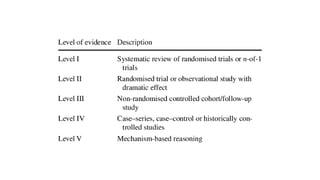
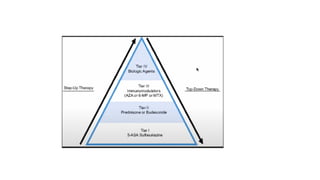
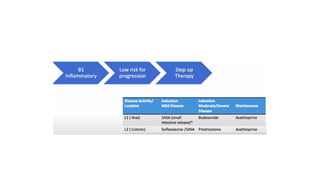
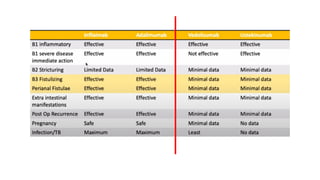
We suggest againstthe use of 5-ASA for induction of remission of Crohn’s disease
[weak recommendation, moderate-quality evidence]
• meta-analysis- 7 RCTs--oral 5-ASA (5 trials) or sulphasalazine (2 trials) vs placebo
• dosage of 5-ASA--1 g to 3.2 g/day
• Inclusion- mild-to-moderate disease with ileal, ileocolonic, or colonic disease were included
• No significant effect for induction of clinical remission (relative risk [RR]: 1.28; 95% [CI]: 0.97–
1.69)
• Adverse effects [AEs] when compared with placebo [RR: 1.13; 95% CI: 0.73–1.84]
• Ford AC, Kane SV, Khan KJ, et al. Efficacy of 5-aminosalicylates in Crohn’s disease: systematic review and meta-analysis. Am J Gastroenterol 2011;106:617–29
• Rasmussen SN, Lauritsen K, Tage-Jensen U, et al. 5-Aminosalicylic acid in the treatment of Crohn’s disease. A 16-week double-blind, placebocontrolled, multicentre study with
Pentasa. Scand J Gastroenterol 1987;22:877–83. 26. Singleton JW, Hanauer SB, Gitnick GL, et al. Mesalamine capsules for the treatment of active Crohn’s disease: results of
a 16-week trial. Pentasa Crohn’s Disease Study Group. Gastroenterology 1993;104:1293–301
• Tremaine WJ, Schroeder KW, Harrison JM, Zinsmeister AR. A randomized, double-blind, placebo-controlled trial of the oral mesalamine [5-ASA] preparation, Asacol, in the
treatment of symptomatic Crohn’s colitis and ileocolitis. J Clin Gastroenterol 1994;19:278–82
• Ferring Pharmaceuticals. PEACE study: a study with Pentasa in patients with active Crohn’s disease. 2012. https://clinicaltrials.gov/ct2/show/ NCT00862121 Accessed Sep 16,
2019
4.
We recommend usingbudesonide for the induction of clinical remission in
patients with active mild-to moderate Crohn’s disease limited to the ileum
and/or ascending colon [strong recommendation, moderate quality evidence]
• 3 RCTs—budesonide 9 mg/day vs placebo
• mildly active CD in the small and/or large intestine limited to the ascending colon
• Budesonide--superior to placebo for inducing---
• clinical response [RR: 1.46; 95% CI: 1.03–2.07] and
• clinical remission [RR: 1.93; 95% CI: 1.37–2.73]
• 2 RCTs --budesonide at a dose of 9 mg/d vs mesalazine up to 4.5 g/d
• Budesonide was not superior to mesalazine for inducing clinical remission [RR: 1.30; 95% CI: 0.98–1.72]
• clinical response was more frequently seen in patients receiving budesonide [RR: 1.22; 95% CI: 1.03–
1.45]
• Greenberg GR, Feagan BG, Martin F, et al. Oral budesonide for active Crohn’s disease. Canadian Inflammatory Bowel Disease Study Group. N Engl J Med 1994;331:836–41
• Tremaine WJ, Hanauer SB, Katz S, et al.; Budesonide CIR United States Study Group. Budesonide CIR capsules [once or twice daily divided-dose] in active Crohn’s disease: a randomized placebo-
controlled study in the United States. Am J Gastroenterol 2002;97:1748–54.
• Suzuki Y, Motoya S, Takazoe M, et al. Efficacy and tolerability of oral budesonide in Japanese patients with active Crohn’s disease: a multicentre, double-blind, randomized, parallel-group Phase II
study. J Crohns Colitis 2013;7:239–47.
5.
• In patientswith active, moderate-to-severe Crohn’s disease, we suggest the use of systemic
corticosteroids for the induction of clinical response and remission [weak recommendation,
moderate-quality evidence]
• 1 trial- 105 patients
• Clinical response- methylprednisolone vs placebo [93.6% vs 53.4%; RR: 1.75; 95% CI: 1.36–2.25]
• 2 studies--267 patients-
• Corticosteroids--twice as effective in inducing clinical remission than placebo
• [RR: 1.99; 95% CI: 1.51–2.64]
• AEs was 5-fold higher in patients receiving corticosteroids compared with placebo [31.8%
vs 6.5%; RR: 4.89; 95% CI: 1.98–12.07
• Malchow H, Ewe K, Brandes JW, et al. European Cooperative Crohn’s Disease Study [ECCDS]: results of drug treatment. Gastroenterology 1984;86:249–6
• Singleton JW, Law DH, Kelley ML Jr, Mekhjian HS, Sturdevant RA. National Cooperative Crohn’s Disease Study: adverse reactions to study drugs. Gastroenterology
1979;77:870–82
• Summers RW, Switz DM, Sessions JT Jr, et al. National cooperative Crohn’s disease study: results of drug treatment. Gastroenterology 1979;77:847–69
6.
• We suggestagainst the use of thiopurines as monotherapy for the induction of
remission of moderate-to severe luminal Crohn’s disease [weak
recommendation, very low-quality evidence]
• Five trials-- 380 patients–
• no differences for induction of remission between thiopurines and placebo [RR: 1.23; 95% CI: 0.97–
1.55]
• 3 trials reported on clinical response–
• RR of obtaining clinical response was 1.87 [95% CI: 0.44–7.96]
• Heterogeneity was serious [I2 = 69%]
• AEs was not significantly different between placebo and thiopurines [86% vs 69%; RR:
0.81; 95% CI: 0.64–1.02]
• Summers RW, Switz DM, Sessions JT Jr, et al. National cooperative Crohn’s disease study: results of drug treatment. Gastroenterology 1979;77:847–69
• Candy S, Wright J, Gerber M, Adams G, Gerig M, Goodman R. A controlled double blind study of azathioprine in the management of Crohn’s disease. Gut 1995;37:674–8
• Ewe K, Press AG, Singe CC, et al. Azathioprine combined with prednisolone or monotherapy with prednisolone in active Crohn’s disease. Gastroenterology 1993;105:367–72
7.
Methotrexate
• MTX maybe considered as an option for steroid-dependent patients with moderate-to-severe disease
when alternative options [including surgery] cannot be used
• 141 steroid-dependent patients with active CD
• 25 mg/week of intramuscular MTX or placebo for 16 weeks, with a concomitant daily dose of prednisolone
[20 mg at initiation] that was reduced over a 3-month period
• Clinical remission at 16 wks [RR: 2.06; 95% CI: 1.09–3.89]
• AE- [RR: 8.00; 95% CI: 1.09–58.51]
3 small and heterogeneous studies
• MTX for induction of remission in CD
• different dosages of MTX
• No significant likelihood to achieve remission [RR: 0.87; 95% CI: 0.70–1.09
Feagan BG, Rochon J, Fedorak RN, et al. Methotrexate for the treatment of Crohn’s disease. The North American Crohn’s Study Group Investigators. N Engl J Med 1995;332:292–7
8.
• We recommendthe use of TNF inhibitors [infliximab, adalimumab, and certolizumab pegol] to
induce remission in patients with moderate-to-severe Crohn’s disease who have not responded to
conventional therapy [strong recommendation, moderate-quality evidence]
• Several meta analysis-- anti-TNF agents versus placebo [infliximab, adalimumab, and certolizumab pegol]
• induction of clinical remission [RR: 1.6; 95% CI: 1.17–2.36]
• clinical response [RR: 1.43; 95% CI: 1.17–1.73]
• Infliximab--chimeric mouse-human immunoglobulin [Ig] G1 monoclonal antibody
• IV- 5 mg/kg at 0, 2, and 6 weeks during induction and every 8 weeks thereafter
• Adalimumab--fully humanised IgG1 monoclonal antibody
• subcutaneously [SC] at a dose of 160 mg, and then 80 mg 2 weeks after induction, followed by 40 mg SC every 2 weeks
• Limited endoscopic data were available for the induction period; two studies showed a non-significant trend
towards enhanced mucosal healing [RR: 3.25; 95% CI: 0.53–19.8]
• AEs [RR: 0.99; 95% CI: 0.90–1.08
• Stidham RW, Lee TC, Higgins PD, et al. Systematic review with network meta-analysis: the efficacy of anti-TNF agents for the treatment of Crohn’s disease. Aliment Pharmacol
Ther 2014;39:1349–62
• Cholapranee A, Hazlewood GS, Kaplan GG, Peyrin-Biroulet L, Ananthakrishnan AN. Systematic review with meta-analysis: comparative efficacy of biologics for induction
and maintenance of mucosal healing in Crohn’s disease and ulcerative colitis controlled trials. Aliment Pharmacol Ther 2017;45:1291–302
• Ford AC, Sandborn WJ, Khan KJ, et al. Efficacy of biological therapies in inflammatory bowel disease: systematic review and meta-analysis. Am J Gastroenterol 2011;106:644–
59, quiz 60.
9.
• We suggestagainst the combination of adalimumab and thiopurines over adalimumab
alone to achieve clinical remission and response [weak recommendation, moderate
quality evidence]
• DIAMOND trial- adalimumab + thiopurine vs adalimumab monotherapy
• combination therapy was not superior to adalimumab monotherapy for inducing clinical remission [RR:
0.95; 95% CI: 0.78–1.15]
• combination therapy--associated with endoscopic improvement at Week 26 [RR: 1.32; 95%
CI: 1.06–1.65], although this benefit was lost at the end of 1 year
• No increase in AEs leading to discontinuation associated with combination therapy [RR:
1.03; 95% CI:
0.60–1.78]
Matsumoto T, Motoya S, Watanabe K, et al.; DIAMOND study group. Adalimumab monotherapy and a combination with azathioprine for Crohn’s
disease: a prospective, randomized trial. J Crohns Colitis 2016;10:1259–66
10.
• We recommendcombination therapy with a thiopurine when starting infliximab to
induce remission in patients with moderate-to-severe Crohn’s disease, who have had
an inadequate response to conventional therapy [strong recommendation, moderate-
quality evidence]
• SONIC—infliximab+ AZA vs infliximab monotherapy (failure to respond to steroids or 5-ASA)
• Combination therapy--higher rates of clinical remission at Week 26 [RR: 1.64; 95% CI: 1.07–2.53]
• Combination therapy--more likely to result in mucosal healing at this timepoint [RR: 1.82; 95% CI: 1.01–
3.26]
• significantly lower rates of serious Aes (RR: 0.56; 95% CI: 0.32–0.97)
Colombel JF, Sandborn WJ, Reinisch W, et al.; SONIC Study Group. Infliximab, azathioprine, or combination therapy for Crohn’s disease. N Engl J Med
2010;362:1383–95
11.
• We recommendustekinumab for induction of remission in patients with moderate-to-
severe Crohn’s disease with inadequate response to conventional therapy and/or to
anti-TNF therapy [strong recommendation, high-quality evidence]
• IgG1 monoclonal antibody--binds to the p40 subunit– IL 12 and 23
• Four trials-- 1947 patients --ustekinumab vs placebo
• RR of obtaining clinical response of 1.56 [95% CI: 1.38–1.77] versus placebo
• RR of obtaining clinical remission was 1.76 [95% CI: 1.40–2.22]
• any AEs was not significantly different [62.0% vs 63.9%; RR: 0.96; 95% CI: 0.90–1.03]
• Sandborn WJ, Gasink C, Gao LL, et al.; CERTIFI Study Group. Ustekinumab induction and maintenance therapy in refractory Crohn’s disease. N Engl J Med 2012;367:1519–28
• Sandborn WJ, Feagan BG, Fedorak RN, et al.; Ustekinumab Crohn’s Disease Study Group. A randomized trial of Ustekinumab, a human interleukin-12/23 monoclonal
antibody, in patients with moderate-to-severe Crohn’s disease. Gastroenterology 2008;135:1130–41.
• Feagan BG, Sandborn WJ, Gasink C, et al.; UNITI–IM-UNITI Study Group. Ustekinumab as induction and maintenance therapy for Crohn’s disease. N Engl J Med
2016;375:1946–60
• Rutgeerts P, Gasink C, Chan D, et al. Efficacy of Ustekinumab for inducing endoscopic healing in patients with Crohn’s disease. Gastroenterology 2018;155:1045–58
12.
• We recommendvedolizumab for induction of response and remission in patients with
moderate-to-severe Crohn’s disease with inadequate response to conventional therapy and/or
to anti-TNF therapy [strong recommendation, moderate-quality evidence]
• α4β7 integrin--gut-selective anti-inflammatory activity
• Iv--300 mg at 0, 2, and 6 weeks for induction, and every 8 weeks thereafter
• 3 randomized trials--969 patients
• Clinical remission [RR: 2.01; 95% CI: 1.50–2.71]
• clinical response--[40.8% vs 25.7%; RR: 1.55; 95% CI: 1.14–2.11]
• serious AEs with vedolizumab were not significantly different with placebo [RR: 0.94; 95%
CI: 0.61–1.45]
• European Medicine Agency. Entyvio Summary of Product Characteristics. 2014. https://www.ema.europa.eu/en/documents/product-information/ entyvio-epar-product-
information_en.pdf
• Feagan BG, Greenberg GR, Wild G, et al. Treatment of active Crohn’s disease with MLN0002, a humanized antibody to the alpha4beta7 integrin. Clin Gastroenterol Hepatol
2008;6:1370–7
• Sands B, Feagan B, Rutgeerts P, et al. Effects of vedolizumab induction therapy for patients with Crohn’s disease in whom tumor necrosis factor antagonist treatment failed.
Gastroenterology 2014;3;618–27.e3
13.
• We equallysuggest the use of either ustekinumab or vedolizumab for the
treatment of moderate-to-severe active luminal Crohn’s disease in patients
who have previously failed anti-TNF therapy [weak recommendation, very
low-quality evidence]
• 4 trials (indirect comparison)-- 1249 patients treated with ustekinumab or vedolizumab
• pooled RR of clinical response [35.8% vs 33.1%; RR:1.14; 95% CI: 0.65–1.99]
• clinical remission [16.3% vs. 13.3%; RR: 1.16; 95% CI: 0.54–2.48]
• Pooled RR of any AE--[64.2% vs 56.2%; RR: 1.00; 95% CI: 0.82–1.23]
• Pooled RR of any serious AEs was not significantly different between ustekinumab and
vedolizumab [7.1% vs 7.7%; RR: 0.95; 95% CI: 0.43–2.12]
Sandborn WJ, Gasink C, Gao LL, et al.; CERTIFI Study Group. Ustekinumab induction and maintenance therapy in refractory Crohn’s disease. N Engl J Med 2012;367:1519–28
Feagan BG, Sandborn WJ, Gasink C, et al.; UNITI–IM-UNITI Study Group. Ustekinumab as induction and maintenance therapy for Crohn’s disease. N Engl J Med 2016;375:1946–60.
Sandborn WJ, Feagan BG, Rutgeerts P, et al.; GEMINI 2 Study Group. Vedolizumab as induction and maintenance therapy for Crohn’s disease. N Engl J Med 2013;369:711–21.
Sands B, Feagan B, Rutgeerts P, et al. Effects of vedolizumab induction therapy for patients with Crohn’s disease in whom tumor necrosis factor antagonist treatment failed.
Gastroenterology 2014;3;618–27.e3.
• We recommendagainst the use of oral 5-aminosalicylic acid for maintenance of medically
induced remission in patients with Crohn’s disease [strong recommendation, low-quality
evidence]
• No statistically significant benefit [RR: 1.03; 95% CI: 0.92–1.16]
• no significant differences in the proportion of patients experiencing an AE [RR: 1.93; 95% CI:
0.18–21.1]
Akobeng AK, Zhang D, Gordon M, MacDonald JK. Oral 5-aminosalicylic acid for maintenance of medically-induced remission in Crohn’s disease.
Cochrane Database Syst Rev 2016;9:CD003715
16.
• Thiopurines arerecommended for the maintenance of remission in
patients with steroid-dependent Crohn’s disease [strong
recommendation, moderate-quality evidence]
• AZA--superior to placebo--maintenance of remission in steroid dependent patients [RR: 1.19;
95% CI: 1.05–1.34]
• serious AE- [RR: 2.45; 95% CI: 1.22–4.90]
Chande N, Patton PH, Tsoulis DJ, Thomas BS, MacDonald JK. Azathioprine or 6-mercaptopurine for maintenance of remission in Crohn’s disease. Cochrane Database Syst Rev; 2015;10:Cd000067
O’Donoghue DP, Dawson AM, Powell-Tuck J, Bown RL, LennardJones JE. Double-blind withdrawal trial of azathioprine as maintenance treatment for Crohn’s disease. Lancet 1978;2:955–7.
17.
• We recommendagainst the early introduction of thiopurine therapy in
patients with newly diagnosed Crohn’s disease for maintaining
remission [weak recommendation, low-quality evidence]
AZTEC Trial-
• recent [<8 weeks] of diagnosis of uncomplicated CD
• AZA+ CS or placebo+CS up to Week 76
• clinical remission did not differ between the two groups [RR: 1.27; 95% CI: 0.94–1.72]
• Serious AES occurred in 14 patients [20.6%] in the AZA group and 7 [11.1%] in the placebo
group [RR: 1.85; 95% CI: 0.8–4.29]
Panés J, López-Sanromán A, Bermejo F, et al. Early azathioprine therapy is no more effective than placebo for newly diagnosed Crohn’s disease. Gastroenterology 2013;145:766–74.e1
18.
• We recommendmethotrexate administered parenterally for the maintenance of
remission in patients with steroid dependent Crohn’s disease [weak recommendation,
moderate-quality evidence]
• Fega et al—
• previously active CD, who had entered remission after 16 to 24 weeks of treatment with 25 mg MTX
• randomly assigned to receive either MTX at a dose of 15 mg IM once weekly or placebo, for 40 weeks
• No other treatments for CD were permitted
• After 40 weeks-- remission was higher in the MTX [65% vs 39 %; RR: 1.67; 95% CI: 1.05–2.67]
• no differences in severe AEs in the MTX group [n = 40] as compared with the placebo group [n = 36]
Feagan BG, Rochon J, Fedorak RN, et al. Methotrexate for the treatment of Crohn’s disease. The North American Crohn’s Study Group Investigators. N
Engl J Med 1995;332:292–7
19.
• In patientswith Crohn’s disease who achieved remission with anti-TNF
agents, maintenance treatment using the same treatment is
recommended [strong recommendation, moderate-quality evidence]
• Stidham et al– metananlysis--Five landmark trials published between 2002 and 2007
• Infliximab-1, adalimumab 2, certolizumab pegol- 2
• Total 1771 patients
• followed for 24 to 30 weeks
• remission with anti-TNFs versus placebo--1.78 [95% CI: 1.51–2.09]
• no statistically significant differences between the three agents
• SAEs for adalimumab, infliximab, and certolizumab pegol were 1.01 [0.64–1.59], 1.13 [0.79–1.62], and 1.57
[0.96–2.57], respectively
Stidham RW, Lee TC, Higgins PD, et al. Systematic review with network meta-analysis: the efficacy of anti-TNF agents for the treatment of Crohn’s disease. Aliment Pharmacol
Ther 2014;39:1349–62
Singh JA, Wells GA, Christensen R, et al. Adverse effects of biologics: a network meta-analysis and Cochrane overview. Cochrane Database Syst Rev 2011;2:CD008794.
20.
• We recommendvedolizumab for maintaining clinical remission in patients with
moderate-to-severe Crohn’s disease who achieved remission with vedolizumab [strong
recommendation, moderate-quality evidence]
• Vedolizumab monotherapy
• IV at 300 mg every 8 weeks
• superior to placebo in maintaining clinical remission in patients with moderate-to-severe CD who
achieved remission with vedolizumab [RR: 1.81; 95% CI: 1.26–2.59]
• At Week 52, 60/154 patients [39.0%] receiving vedolizumab every 8 weeks and 56/154 patients [36.4%]
receiving vedolizumab every 4 weeks were in clinical remission as compared with 33/153 patients
[21.6%] receiving placebo [p <0.001 and p = 0.004, respectively]
• AEs compared with placebo through week 54 [RR: 1.21; 95% CI: 0.73–2.00]
Sandborn WJ, Feagan BG, Rutgeerts P, et al.; GEMINI 2 Study Group. Vedolizumab as induction and maintenance therapy for Crohn’s disease. N Engl J Med 2013;369:711–21
21.
• We recommendthe use of ustekinumab to maintain clinical remission in
patients with Crohn’s disease who achieved remission with ustekinumab
[strong recommendation, moderate-quality evidence]
• Patients responding to ustekinumab in the induction period were re-randomised to receive
ustekinumab every 8 or 12 weeks or placebo
• Over a 44-week period, ustekinumab- 51% vs placebo- 35.9%--clinical remission [RR: 1.42; 95% CI:
1.10–1.84
• corticosteroid-free remission was achieved in 29.8% of patients receiving placebo versus 44.7% of
patients receiving ustekinumab [RR: 1.50; 95% CI: 1.12–2.02]
• Pooled RR– Aes--not significantly different between patients [15.0% vs 11.0%; RR: 0.73; 95%
CI: 0.43–1.25
• endoscopic remission—no statistically significant difference in endoscopic remission-- [RR: 2.61;
95% CI: 0.32–21.08]
Feagan BG, Sandborn WJ, Gasink C, et al.; UNITI–IM-UNITI Study Group. Ustekinumab as induction and maintenance therapy for Crohn’s disease. N Engl J Med
2016;375:1946–60.
22.
• In Crohn’sdisease patients in clinical remission under anti-TNF
treatment, there is currently insufficient evidence to recommend for or
against the use of proactive therapeutic drug monitoring to improve
clinical outcomes as compared to routine care [weak recommendation,
moderate-quality evidence]
• two RCTs --no advantage of TDM over clinically based anti-TNF dosing for—
• clinical remission [62.6% vs 54.9%; RR: 1.14; 95% CI: 0.89–1.47]
• steroid-free clinical remission [30.5% vs 40.0%; RR: 0.76; 95% CI: 0.46–1.26]
• endoscopic remission [51.2% vs 52.5%; RR: 0.98; 95% CI: 0.68–1.40]
• biochemical remission [62.6% vs 54.9%; RR: 1.14; 95% CI: 0.89–1.47]
• serious AEs [34.1% vs 27.5%; RR: 1.24; 95% CI: 0.68–2.23]
Vande Casteele N, Ferrante M, Van Assche G, et al. Trough concentrations of infliximab guide dosing for patients with inflammatory bowel disease. Gastroenterology
2015;148:1320–9.e3
D’Haens G, Vermeire S, Lambrecht G, et al.; GETAID. Increasing infliximab dose based on symptoms, biomarkers, and serum drug concentrations does not increase
clinical, endoscopic, and corticosteroid-free remission in patients with active luminal Crohn’s disease. Gastroenterology 2018;154:1343–51.e1.
23.
• TAILORIX trial
•122 biologically naïve patients
• Treated with infliximab and immunosuppressant
• Randomised after 14 weeks to the following three groups:
1. dose intensification based on clinical features
2. Biomarkers
3. trough levels of infliximab
• Optimisation steps of 2.5 mg/kg [TDM1]; or of 5 mg/kg [TDM2]; or dose intensification based on clinical features
alone [control group]
• Infliximab dose- trough level >3 μg/mL
• No difference in sustained steroid-free clinical remission with mucosal healing [CDAI <150 from Weeks 22 to 54] in
the three randomization arms [33% in TDM1; 27% in TDM2; 40% in control; p = 0.50]
D’Haens G, Vermeire S, Lambrecht G, et al.; GETAID. Increasing infliximab dose based on symptoms, biomarkers, and serum drug concentrations does not increase clinical, endoscopic, and
corticosteroid-free remission in patients with active luminal Crohn’s disease. Gastroenterology 2018;154:1343–51.e1
24.
• In Crohn’sdisease patients who have lost response to an anti-TNF agent, there is
currently insufficient evidence to recommend for or against the use of reactive
therapeutic drug monitoring to improve clinical outcomes [weak
recommendation, low-quality evidence]
• Reactive TDM--measuring anti-TNF trough level drug concentration and/or antidrug antibodies [ADA] in
patients on anti-TNF therapy with active disease
• TDM vs empirical IFX
• 69 patients with CD with secondary IFX failure
• IFX dose intensification [5 mg/kg every 4 weeks; n = 36] or interventions based on serum IFX and IFX ADA
levels using the proposed algorithm [n = 33]
• No difference in regaining clinical response between the TDM-based group [19/33, 57.6%] and the
symptom-based group [19/36, 52.8%] [RR: 1.09; 95% CI: 0.71–1.67; p = 0.81]
Steenholdt C, Brynskov J, Thomsen OØ, et al. Individualised therapy is more cost-effective than dose intensification in patients with Crohn’s disease who lose response to anti-TNF
treatment: a randomised, controlled trial. Gut 2014;63:919–27
25.
• Positive association-
•Retrospective study--312 patients with endoscopically active IBD treated with IFX who
underwent dose escalation, TDM-based [n = 149] and clinical decision-based [n = 163]
• Endoscopic remission- 63% TDM vs 48% non-TDM [p = 0.05]
• Clinical response--69% versus 57% [p = 0.01]
• Fewer hospitalizations in the TDM group [22% TDM vs 35% non-TDM; p = 0.025]
Kelly OB, Donnell SO, Stempak JM, Steinhart AH, Silverberg MS. Therapeutic Drug monitoring to guide infliximab dose adjustment is associated
with better endoscopic outcomes than clinical decision making alone in active inflammatory bowel disease. Inflamm Bowel Dis 2017;23:1202–9
26.
• We suggestcontinuation of thiopurines in Crohn’s disease patients in
long-term remission on thiopurine maintenance therapy, as the risk of
relapse is higher when the treatment is discontinued [weak
recommendation, low quality evidence]
• Meta-analysis (4 studies)-- cessation vs continuation of treatment in 215 CD patients in long-
term remission on thiopurine maintenance therapy
• Inclusion-- AZA from 6 to 42 months
• Randomized to continue or stop AZA
• Follow-up time of 12 to 18 months
• RR of clinical relapse is 2.39 [95% CI: 1.38–4.13]
• serious AEs was RR 0.32 [95% CI: 0.04–2.92]
Lémann M, Mary JY, Colombel JF, et al.; Groupe D’Etude Thérapeutique des Affections Inflammatoires du Tube Digestif. A randomized, double-blind, controlled withdrawal trial in Crohn’s disease
patients in long-term remission on azathioprine. Gastroenterology 2005;128:1812–8
O’Donoghue DP, Dawson AM, Powell-Tuck J, Bown RL, LennardJones JE. Double-blind withdrawal trial of azathioprine as maintenance treatment for Crohn’s disease. Lancet 1978;2:955–7
Vilien M, Dahlerup JF, Munck LK, Nørregaard P, Grønbaek K, Fallingborg J. Randomized controlled azathioprine withdrawal after more than two years treatment in Crohn’s disease: increased
relapse rate the following year. Aliment Pharmacol Ther 2004;19:1147–52
Wenzl HH, Primas C, Novacek G, et al. Withdrawal of long-term maintenance treatment with azathioprine tends to increase relapse risk in patients with Crohn’s disease. Dig Dis Sci 2015;60:1414–23
Boyapati RK, Torres J, Palmela C, et al. Withdrawal of immunosuppressant or biologic therapy for patients with quiescent Crohn’s disease. Cochrane Database Syst Rev 2018;5:CD012540
27.
• In patientswith Crohn’s disease who have achieved long-term remission
with the combination of infliximab and immunosuppressants, we
suggest monotherapy with infliximab [weak recommendation, very low
quality evidence]
• Cochrane review--two RCTs –same relapse rate among patients who continued combination
therapy
with AZA [27/56; 48%] or infliximab monotherapy [27/55; 49%] [RR: 1.02; 95% CI: 0.68–1.52]
• AEs for infliximab versus combination therapy [RR:1.11; 95% CI: 0.44–2.81; very low-quality
evidence]
• serious AEs [RR: 1.00; 95% CI: 0.21–4.66; very low-quality evidence]
• Higher risk of lymphoma exists-- anti-TNF agents are combined with conventional
immunosuppression. However, the absolute rates remain very low [3.23; 95% CI 1.5–6.9]--
estimated as 1.9 per 10 000 patient-years
Boyapati RK, Torres J, Palmela C, et al. Withdrawal of immunosuppressant or biologic therapy for patients with quiescent Crohn’s disease. Cochrane Database Syst Rev
2018;5:CD012540
Roblin X, Boschetti G, Williet N, et al. Azathioprine dose reduction in inflammatory bowel disease patients on combination therapy: an openlabel, prospective and randomised clinical
trial. Aliment Pharmacol Ther 2017;46:142–9.
Van Assche G, Magdelaine-Beuzelin C, D’Haens G, et al. Withdrawal of immunosuppression in Crohn’s disease treated with scheduled infliximab maintenance: a randomized trial.
Gastroenterology 2008;134:1861–8
Siegel CA, Marden SM, Persing SM, Larson RJ, Sands BE. Risk of lymphoma associated with combination anti-tumor necrosis factor and immunomodulator therapy for the treatment
of Crohn’s disease: a metaanalysis. Clin Gastroenterol Hepatol 2009;7:874–81
28.
• In patientswith Crohn’s disease who have achieved long-term remission
with the combination of adalimumab and immunosuppressants, we
suggest monotherapy with adalimumab [weak recommendation, low-
quality evidence]
• meta-analysis of nine studies on adalimumab– No significant differences in maintenance of
clinical remission [RR: 1.01; 95% CI: 0.91–1.13]
• meta-analysis-- limited to 1 year of follow-up [Week 56]
• serious AES- [RR: 0.88; 95% CI: 0.62–1.26]
Chalhoub JM, Rimmani HH, Gumaste VV, Sharara AI. Systematic review and meta-analysis: adalimumab monotherapy versus combination therapy with immunomodulators
for induction and maintenance of remission and response in patients with Crohn’s disease. Inflamm Bowel Dis 2017;23:1316–27.
29.
• There isinsufficient evidence to recommend either continuation or
withdrawal of anti-TNF therapy in Crohn’s disease patients after achieving
long-term remission. Therefore, the decision to continue anti-TNF therapy
should be individualised and potential consequences [risks and benefits]
should always be discussed with the patient.
• no RCT--withdrawal of anti-TNF therapy in inactive disease
• Prospective study-- followed 115 patients with CD on combination therapy for at least 1 year, who
discontinued anti-TNF after being in steroid-free clinical remission for at least 6 months
• Relapse rates at 12 and 24 months--43.9% ± 5.0% and 52.2% ± 5.2%, respectively
• systematic review and meta-analysis--23 observational cohort studies--920 CD patients--overall relapse rate
of 44% [95% CI: 36–51%; follow-up range: 6–125 months]
• Relapse rate was 38% [95% CI: 13–63%; 126 patients] at 6 months after discontinuation
• 40% [95% CI: 33–48%; 813 patients] at 12 months
• 49% [95% CI: 31–68%; 228 patients] at >25 months
Torres J, Boyapati RK, Kennedy NA, Louis E, Colombel JF, Satsangi J. Systematic review of effects of withdrawal of immunomodulators or biologic agents from patients with inflammatory bowel
disease. Gastroenterology 2015;149:1716–30
Colombel JF, Sandborn WJ, Reinisch W, et al.; SONIC Study Group. Infliximab, azathioprine, or combination therapy for Crohn’s disease. N Engl J Med 2010;362:1383–95
Gisbert JP, Marín AC, Chaparro M. The risk of relapse after anti-TNF discontinuation in inflammatory bowel disease: systematic review and meta-analysis. Am J Gastroenterol 2016;111:632–47
• We recommendinfliximab for the induction and maintenance of
remission in complex perianal fistulae in Crohn’s disease [strong
recommendation; low quality of evidence]
• ACCENT II-- infliximab [5 mg/kg every 8 weeks] in a maintenance trial in 195 patients who had
a response [defined as a reduction of 50% of draining fistulae in two visits at least 4 weeks
apart] at Week 14 after
open-label induction treatment with infliximab.
• Complete response--maintained until Week 54 in 19 of 99 placebo patients [19.2%] vs 33 of 96
infliximab patients [34.4%] [RR: 1.79; 95% CI: 1.10– 2.92]
• Infliximab--effective in inducing fistula healing [RR: 3.57; 95% CI:1.38–9.25]
• Maintaining clinical fistula healing [RR: 1.79; 95% CI:1.10–2.92]
• No significant risk of serious AEs as compared with placebo [RR: 1.31; 95% CI: 0.11–15.25]
Present DH, Rutgeerts P, Targan S, et al. Infliximab for the treatment of fistulas in patients with Crohn’s disease. N Engl J Med 1999;340:1398–405a
32.
• We suggestadalimumab may be used for induction and maintenance of
remission in complex perianal fistulae in Crohn’s disease [weak
recommendation, very low-quality evidence]
• CHARM trail--superiority of adalimumab over placebo [RR: 2.57; 95% CI: 1.13–5.84] for fistula
healing after 56 weeks
• No significant increase in serious AES with adalimumab [RR: 1.21; 95% CI: 0.43–3.38]
Colombel JF, Schwartz DA, Sandborn WJ, et al. Adalimumab for the treatment of fistulas in patients with Crohn’s disease. Gut 2009;58:940–8
33.
• In patientswith Crohn’s disease and complex perianal fistula there is
insufficient evidence regarding the effect of adding immunomodulators
to anti-TNF on fistula healing [weak recommendation, very low-quality
evidence]
• single study-- Only a pooled effect estimate was provided [OR of complete fistula closure in
those on immunomodulators vs those not on immunomodulators was 1.10; 95% CI: 0.68–
1.78]
• Retrospective study--hazard ratio of 2.58 [95% CI: 1.16–5.6] for fistula healing in favor of the
intervention arm [combination infliximab and immunomodulator] in patients with CD naïve to
immunosuppressive therapy
Jones JL, Kaplan GG, Peyrin-Biroulet L, et al. Effects of concomitant immunomodulator therapy on efficacy and safety of anti-tumor necrosis
Bouguen G, Siproudhis L, Gizard E, et al. Long-term outcome of perianal fistulizing Crohn’s disease treated with infliximab. Clin Gastroenterol Hepatol 2013;11:975–81.e1–4
34.
• In patientswith Crohn’s disease and complex perianal fistula there is
insufficient evidence to recommend the use of ustekinumab for fistula
healing [weak recommendation, moderate-quality evidence]
• No randomised trial has directly assessed the role of ustekinumab in fistula healing
• A post-hoc analysis of 238 patients who entered the phase 2 CERTIFI and phase 3 UNITI 1/2
studies with fistulae at baseline has been reported
• included only patients with perianal fistulae and did not differentiate between simple and
complex fistulae
• insignificant effect of ustekinumab for induction of remission [RR: 1.77; 95% CI:0.93–3.37]
• no difference in comparison with placebo was found for maintenance of remission
Sands BE, Gasink C, Jacobstein D, et al. Fistula healing in pivotal studies of ustekinumab in Crohn’s disease. Gastroenterology 2017;152:S185
Lee MJ, Parker CE, Taylor SR, et al. Efficacy of medical therapies for fistulizing Crohn’s disease: systematic review and meta-analysis. Clin Gastroenterol Hepatol 2018;16:1879–92
35.
• In patientswith Crohn’s disease and complex perianal fistula there is
insufficient evidence to recommend the use of vedolizumab for fistula
healing [weak recommendation, low-quality evidence]
• post-hoc analysis--45 patients--GEMINI 2 study with complex perianal fistulae at baseline
• Vedolizumab vs placebo for fistula healing [RR: 2.23; 95% CI: 0.57–8.72]-- not statistically
significant
Lee MJ, Parker CE, Taylor SR, et al. Efficacy of medical therapies for fistulizing Crohn’s disease: systematic review and meta-analysis. Clin Gastroenterol Hepatol
2018;16:1879–92
Feagan BG, Schwartz D, Danese S, et al. Efficacy of vedolizumab in fistulising Crohn’s disease: exploratory analyses of data from GEMINI 2. J Crohns Colitis 2018;12:621–6
36.
• We suggestagainst using antibiotics alone for fistula closure in patients
with Crohn’s disease and complex perianal fistulae [weak
recommendation, low-quality evidence]
• 1 RCT--placebo vs antibiotics in perianal fistulae–
• Remission at Week 10-- 1/8 [12.5%] placebo patients vs 3/17 [17.6%] patients treated with
antibiotics [RR: 1.41; 95% CI: 0.17–11.54
Panés J, Rimola J. Perianal fistulizing Crohn’s disease: pathogenesis, diagnosis and therapy. Nat Rev Gastroenterol Hepatol 2017;14:652–64
37.
• We suggestagainst using thiopurine monotherapy [azathioprine,
mercaptopurine] for fistula closure in patients with Crohn’s disease and
complex perianal fistulae [weak recommendation, very low-quality
evidence]
• effect of AZA on fistula healing in complex perianal CD has been numerically reported in
RCTs in 18 patients only
• AZA is not superior to placebo for fistula healing [RR: 2.00; 95% CI: 0.67–5.93]
Chande N, Patton PH, Tsoulis DJ, Thomas BS, MacDonald JK. Azathioprine or 6-mercaptopurine for maintenance of remission in Crohn’s disease. Cochrane Database Syst
Rev; 2015;10:Cd000067
Section 1. Complexperianal fistula
1. No prospective study directly compares medical or surgical treatment of complex perianal
Crohn’s disease
fistulae, either in isolation or in combination with both modalities. Observational studies
support a combined medical/surgical approach to control sepsis and luminal activity [EL5]
2. Advancement flaps are a therapeutic option for patients with Crohn´s disease and complex
perianal fistulae [EL4]
3. Fibrin glue may be a potential treatment, with limited efficacy, for patients with complex
perianal Crohn’s disease [EL4]
4. Ligation of the intersphincteric fistula tract is an option for treatment of patients with
Crohn’s disease and complex perianal fistulae [EL4]
5. Anal fistula plugs [AFP] should not be routinely considered for ano-perineal fistula closure in
Crohn’s disease, as seton removal alone is equally effective [EL3]
6. Ano- and rectogenital fistulae related to Crohn’s disease are very complex and rare;
accordingly, they should be treated by an experienced multidisciplinary team [EL5]
40.
7) Allogeneic adipose-derivedstem cell therapy could be an effective
and safe treatment for complex perianal fistulae in patients with
Crohn’s disease [EL2]
8) Autologous adipose-derived stem cells may have positive effect for
patients with Crohn’s disease and complex perianal fistulae with good
tolerability and safety [EL4]
41.
Section 2. Refractorypelvic sepsis
1. Pelvic sepsis and symptoms from complex perineal Crohn’s disease
refractory to medical or surgical interventions can be controlled by a
diverting stoma. However, the fistula healing rate and stoma closure
rate are limited [EL4]
42.
Section 3. Approachto intra-abdominal abscess
1. Percutaneous image-guided drainage of well-defined accessible intra-
abdominal abscesses is recommended as the primary approach [EL4]
2. Following successful image-guided drainage of an intraabdominal
abscess, medical management without surgery may be considered. A
low threshold for surgery is recommended in the event that medical
management is not successful [EL4]
43.
Section 4. Preoperativeoptimisation
• Preoperative nutritional assessment should be performed for all patients with Crohn’s
disease who need surgery. Nutritional optimisation prior to surgery, with enteral or
parenteral nutrition, is recommended for those patients with nutritional deficiencies [EL3]
• Preoperative corticosteroid use is associated with increased risk of postoperative
complications [EL3]. Preoperative reduction of corticosteroid doses may reduce
postoperative complications but should be monitored carefully to avoid increasing disease
burden [EL4]
• Current evidence suggests that preoperative treatment with anti-TNF therapy [EL3],
vedolizumab [EL4], or ustekinumab [EL4] does not increase the risk of post operative
complications in patients with CD having abdominal surgery. Cessation of these
medications prior to surgery is not mandatory
• Preoperative control of sepsis is recommended prior to abdominal surgery for Crohn’s
disease [EL4]
44.
Section 5-- Small-bowelobstruction
• Deferred surgery is the preferred option in adult patients with Crohn´s disease
presenting with acute small-bowel obstruction without bowel ischaemia or
peritonitis [EL4]
• Endoscopic balloon dilatation or surgery are both suitable treatment options for
patients with short [<5 cm]
strictures of the terminal ileum in Crohn’s disease. The choice of treatment
depends on local expertise and patient preference [EL5]
• Strictureplasty is a safe option to treat small-bowel strictures related to Crohn’s
disease. Strictureplasty may be preferable to resection of long segments of
bowel, with potential reduction in surgical recurrence rates [EL3]
45.
Section 6. Surgicaltechniques for abdominal CD
• Laparoscopic surgery should be offered as the first-lineapproach in surgery
for Crohn’s disease, dependent on appropriate expertise [EL2]
• A temporary stoma should be considered if steroids cannot be withdrawn
or significantly reduced prior to surgery [EL5]
• Primary anastomosis may safely be performed in the presence of anti-TNF
therapy [EL3], vedolizumab [EL4], and ustekinumab [EL4], provided other risk
factors have been accounted for.
• Laparoscopic resection in patients with limited, nonstricturing, ileocaecal
Crohn’s disease [[diseased terminal ileum <40 cm] is a reasonable alternative
to infliximab therapy [EL2]
• Stapled small-bowel or ileocolic side-to-side anastomoses are associated
with lower rates of postoperative complications than end-to-end
anastomoses, in Crohn’s disease [EL3]
46.
• Segmental colectomyis appropriate for patients with a single involved colonic segment in
Crohn’s disease [EL3]
• A defunctioning stoma for non-acute refractory Crohn’s colitis may delay or avoid the need for
colectomy [EL5]
• Restorative proctocolectomy with ileal pouch-anal anastomosis can be considered in selected
patients with refractory pancolonic Crohn’s disease without history of perianal disease, taking
into account the high risk of
pouch failure [EL4]

![We suggest against the use of 5-ASA for induction of remission of Crohn’s disease
[weak recommendation, moderate-quality evidence]
• meta-analysis- 7 RCTs--oral 5-ASA (5 trials) or sulphasalazine (2 trials) vs placebo
• dosage of 5-ASA--1 g to 3.2 g/day
• Inclusion- mild-to-moderate disease with ileal, ileocolonic, or colonic disease were included
• No significant effect for induction of clinical remission (relative risk [RR]: 1.28; 95% [CI]: 0.97–
1.69)
• Adverse effects [AEs] when compared with placebo [RR: 1.13; 95% CI: 0.73–1.84]
• Ford AC, Kane SV, Khan KJ, et al. Efficacy of 5-aminosalicylates in Crohn’s disease: systematic review and meta-analysis. Am J Gastroenterol 2011;106:617–29
• Rasmussen SN, Lauritsen K, Tage-Jensen U, et al. 5-Aminosalicylic acid in the treatment of Crohn’s disease. A 16-week double-blind, placebocontrolled, multicentre study with
Pentasa. Scand J Gastroenterol 1987;22:877–83. 26. Singleton JW, Hanauer SB, Gitnick GL, et al. Mesalamine capsules for the treatment of active Crohn’s disease: results of
a 16-week trial. Pentasa Crohn’s Disease Study Group. Gastroenterology 1993;104:1293–301
• Tremaine WJ, Schroeder KW, Harrison JM, Zinsmeister AR. A randomized, double-blind, placebo-controlled trial of the oral mesalamine [5-ASA] preparation, Asacol, in the
treatment of symptomatic Crohn’s colitis and ileocolitis. J Clin Gastroenterol 1994;19:278–82
• Ferring Pharmaceuticals. PEACE study: a study with Pentasa in patients with active Crohn’s disease. 2012. https://clinicaltrials.gov/ct2/show/ NCT00862121 Accessed Sep 16,
2019](https://image.slidesharecdn.com/eccoguidelines-250921170852-910992b5/85/ECCO-guidelines-for-crohns-disease-pptx-3-320.jpg)
![We recommend using budesonide for the induction of clinical remission in
patients with active mild-to moderate Crohn’s disease limited to the ileum
and/or ascending colon [strong recommendation, moderate quality evidence]
• 3 RCTs—budesonide 9 mg/day vs placebo
• mildly active CD in the small and/or large intestine limited to the ascending colon
• Budesonide--superior to placebo for inducing---
• clinical response [RR: 1.46; 95% CI: 1.03–2.07] and
• clinical remission [RR: 1.93; 95% CI: 1.37–2.73]
• 2 RCTs --budesonide at a dose of 9 mg/d vs mesalazine up to 4.5 g/d
• Budesonide was not superior to mesalazine for inducing clinical remission [RR: 1.30; 95% CI: 0.98–1.72]
• clinical response was more frequently seen in patients receiving budesonide [RR: 1.22; 95% CI: 1.03–
1.45]
• Greenberg GR, Feagan BG, Martin F, et al. Oral budesonide for active Crohn’s disease. Canadian Inflammatory Bowel Disease Study Group. N Engl J Med 1994;331:836–41
• Tremaine WJ, Hanauer SB, Katz S, et al.; Budesonide CIR United States Study Group. Budesonide CIR capsules [once or twice daily divided-dose] in active Crohn’s disease: a randomized placebo-
controlled study in the United States. Am J Gastroenterol 2002;97:1748–54.
• Suzuki Y, Motoya S, Takazoe M, et al. Efficacy and tolerability of oral budesonide in Japanese patients with active Crohn’s disease: a multicentre, double-blind, randomized, parallel-group Phase II
study. J Crohns Colitis 2013;7:239–47.](https://image.slidesharecdn.com/eccoguidelines-250921170852-910992b5/85/ECCO-guidelines-for-crohns-disease-pptx-4-320.jpg)
![• In patients with active, moderate-to-severe Crohn’s disease, we suggest the use of systemic
corticosteroids for the induction of clinical response and remission [weak recommendation,
moderate-quality evidence]
• 1 trial- 105 patients
• Clinical response- methylprednisolone vs placebo [93.6% vs 53.4%; RR: 1.75; 95% CI: 1.36–2.25]
• 2 studies--267 patients-
• Corticosteroids--twice as effective in inducing clinical remission than placebo
• [RR: 1.99; 95% CI: 1.51–2.64]
• AEs was 5-fold higher in patients receiving corticosteroids compared with placebo [31.8%
vs 6.5%; RR: 4.89; 95% CI: 1.98–12.07
• Malchow H, Ewe K, Brandes JW, et al. European Cooperative Crohn’s Disease Study [ECCDS]: results of drug treatment. Gastroenterology 1984;86:249–6
• Singleton JW, Law DH, Kelley ML Jr, Mekhjian HS, Sturdevant RA. National Cooperative Crohn’s Disease Study: adverse reactions to study drugs. Gastroenterology
1979;77:870–82
• Summers RW, Switz DM, Sessions JT Jr, et al. National cooperative Crohn’s disease study: results of drug treatment. Gastroenterology 1979;77:847–69](https://image.slidesharecdn.com/eccoguidelines-250921170852-910992b5/85/ECCO-guidelines-for-crohns-disease-pptx-5-320.jpg)
![• We suggest against the use of thiopurines as monotherapy for the induction of
remission of moderate-to severe luminal Crohn’s disease [weak
recommendation, very low-quality evidence]
• Five trials-- 380 patients–
• no differences for induction of remission between thiopurines and placebo [RR: 1.23; 95% CI: 0.97–
1.55]
• 3 trials reported on clinical response–
• RR of obtaining clinical response was 1.87 [95% CI: 0.44–7.96]
• Heterogeneity was serious [I2 = 69%]
• AEs was not significantly different between placebo and thiopurines [86% vs 69%; RR:
0.81; 95% CI: 0.64–1.02]
• Summers RW, Switz DM, Sessions JT Jr, et al. National cooperative Crohn’s disease study: results of drug treatment. Gastroenterology 1979;77:847–69
• Candy S, Wright J, Gerber M, Adams G, Gerig M, Goodman R. A controlled double blind study of azathioprine in the management of Crohn’s disease. Gut 1995;37:674–8
• Ewe K, Press AG, Singe CC, et al. Azathioprine combined with prednisolone or monotherapy with prednisolone in active Crohn’s disease. Gastroenterology 1993;105:367–72](https://image.slidesharecdn.com/eccoguidelines-250921170852-910992b5/85/ECCO-guidelines-for-crohns-disease-pptx-6-320.jpg)
![Methotrexate
• MTX may be considered as an option for steroid-dependent patients with moderate-to-severe disease
when alternative options [including surgery] cannot be used
• 141 steroid-dependent patients with active CD
• 25 mg/week of intramuscular MTX or placebo for 16 weeks, with a concomitant daily dose of prednisolone
[20 mg at initiation] that was reduced over a 3-month period
• Clinical remission at 16 wks [RR: 2.06; 95% CI: 1.09–3.89]
• AE- [RR: 8.00; 95% CI: 1.09–58.51]
3 small and heterogeneous studies
• MTX for induction of remission in CD
• different dosages of MTX
• No significant likelihood to achieve remission [RR: 0.87; 95% CI: 0.70–1.09
Feagan BG, Rochon J, Fedorak RN, et al. Methotrexate for the treatment of Crohn’s disease. The North American Crohn’s Study Group Investigators. N Engl J Med 1995;332:292–7](https://image.slidesharecdn.com/eccoguidelines-250921170852-910992b5/85/ECCO-guidelines-for-crohns-disease-pptx-7-320.jpg)
![• We recommend the use of TNF inhibitors [infliximab, adalimumab, and certolizumab pegol] to
induce remission in patients with moderate-to-severe Crohn’s disease who have not responded to
conventional therapy [strong recommendation, moderate-quality evidence]
• Several meta analysis-- anti-TNF agents versus placebo [infliximab, adalimumab, and certolizumab pegol]
• induction of clinical remission [RR: 1.6; 95% CI: 1.17–2.36]
• clinical response [RR: 1.43; 95% CI: 1.17–1.73]
• Infliximab--chimeric mouse-human immunoglobulin [Ig] G1 monoclonal antibody
• IV- 5 mg/kg at 0, 2, and 6 weeks during induction and every 8 weeks thereafter
• Adalimumab--fully humanised IgG1 monoclonal antibody
• subcutaneously [SC] at a dose of 160 mg, and then 80 mg 2 weeks after induction, followed by 40 mg SC every 2 weeks
• Limited endoscopic data were available for the induction period; two studies showed a non-significant trend
towards enhanced mucosal healing [RR: 3.25; 95% CI: 0.53–19.8]
• AEs [RR: 0.99; 95% CI: 0.90–1.08
• Stidham RW, Lee TC, Higgins PD, et al. Systematic review with network meta-analysis: the efficacy of anti-TNF agents for the treatment of Crohn’s disease. Aliment Pharmacol
Ther 2014;39:1349–62
• Cholapranee A, Hazlewood GS, Kaplan GG, Peyrin-Biroulet L, Ananthakrishnan AN. Systematic review with meta-analysis: comparative efficacy of biologics for induction
and maintenance of mucosal healing in Crohn’s disease and ulcerative colitis controlled trials. Aliment Pharmacol Ther 2017;45:1291–302
• Ford AC, Sandborn WJ, Khan KJ, et al. Efficacy of biological therapies in inflammatory bowel disease: systematic review and meta-analysis. Am J Gastroenterol 2011;106:644–
59, quiz 60.](https://image.slidesharecdn.com/eccoguidelines-250921170852-910992b5/85/ECCO-guidelines-for-crohns-disease-pptx-8-320.jpg)
![• We suggest against the combination of adalimumab and thiopurines over adalimumab
alone to achieve clinical remission and response [weak recommendation, moderate
quality evidence]
• DIAMOND trial- adalimumab + thiopurine vs adalimumab monotherapy
• combination therapy was not superior to adalimumab monotherapy for inducing clinical remission [RR:
0.95; 95% CI: 0.78–1.15]
• combination therapy--associated with endoscopic improvement at Week 26 [RR: 1.32; 95%
CI: 1.06–1.65], although this benefit was lost at the end of 1 year
• No increase in AEs leading to discontinuation associated with combination therapy [RR:
1.03; 95% CI:
0.60–1.78]
Matsumoto T, Motoya S, Watanabe K, et al.; DIAMOND study group. Adalimumab monotherapy and a combination with azathioprine for Crohn’s
disease: a prospective, randomized trial. J Crohns Colitis 2016;10:1259–66](https://image.slidesharecdn.com/eccoguidelines-250921170852-910992b5/85/ECCO-guidelines-for-crohns-disease-pptx-9-320.jpg)
![• We recommend combination therapy with a thiopurine when starting infliximab to
induce remission in patients with moderate-to-severe Crohn’s disease, who have had
an inadequate response to conventional therapy [strong recommendation, moderate-
quality evidence]
• SONIC—infliximab+ AZA vs infliximab monotherapy (failure to respond to steroids or 5-ASA)
• Combination therapy--higher rates of clinical remission at Week 26 [RR: 1.64; 95% CI: 1.07–2.53]
• Combination therapy--more likely to result in mucosal healing at this timepoint [RR: 1.82; 95% CI: 1.01–
3.26]
• significantly lower rates of serious Aes (RR: 0.56; 95% CI: 0.32–0.97)
Colombel JF, Sandborn WJ, Reinisch W, et al.; SONIC Study Group. Infliximab, azathioprine, or combination therapy for Crohn’s disease. N Engl J Med
2010;362:1383–95](https://image.slidesharecdn.com/eccoguidelines-250921170852-910992b5/85/ECCO-guidelines-for-crohns-disease-pptx-10-320.jpg)
![• We recommend ustekinumab for induction of remission in patients with moderate-to-
severe Crohn’s disease with inadequate response to conventional therapy and/or to
anti-TNF therapy [strong recommendation, high-quality evidence]
• IgG1 monoclonal antibody--binds to the p40 subunit– IL 12 and 23
• Four trials-- 1947 patients --ustekinumab vs placebo
• RR of obtaining clinical response of 1.56 [95% CI: 1.38–1.77] versus placebo
• RR of obtaining clinical remission was 1.76 [95% CI: 1.40–2.22]
• any AEs was not significantly different [62.0% vs 63.9%; RR: 0.96; 95% CI: 0.90–1.03]
• Sandborn WJ, Gasink C, Gao LL, et al.; CERTIFI Study Group. Ustekinumab induction and maintenance therapy in refractory Crohn’s disease. N Engl J Med 2012;367:1519–28
• Sandborn WJ, Feagan BG, Fedorak RN, et al.; Ustekinumab Crohn’s Disease Study Group. A randomized trial of Ustekinumab, a human interleukin-12/23 monoclonal
antibody, in patients with moderate-to-severe Crohn’s disease. Gastroenterology 2008;135:1130–41.
• Feagan BG, Sandborn WJ, Gasink C, et al.; UNITI–IM-UNITI Study Group. Ustekinumab as induction and maintenance therapy for Crohn’s disease. N Engl J Med
2016;375:1946–60
• Rutgeerts P, Gasink C, Chan D, et al. Efficacy of Ustekinumab for inducing endoscopic healing in patients with Crohn’s disease. Gastroenterology 2018;155:1045–58](https://image.slidesharecdn.com/eccoguidelines-250921170852-910992b5/85/ECCO-guidelines-for-crohns-disease-pptx-11-320.jpg)
![• We recommend vedolizumab for induction of response and remission in patients with
moderate-to-severe Crohn’s disease with inadequate response to conventional therapy and/or
to anti-TNF therapy [strong recommendation, moderate-quality evidence]
• α4β7 integrin--gut-selective anti-inflammatory activity
• Iv--300 mg at 0, 2, and 6 weeks for induction, and every 8 weeks thereafter
• 3 randomized trials--969 patients
• Clinical remission [RR: 2.01; 95% CI: 1.50–2.71]
• clinical response--[40.8% vs 25.7%; RR: 1.55; 95% CI: 1.14–2.11]
• serious AEs with vedolizumab were not significantly different with placebo [RR: 0.94; 95%
CI: 0.61–1.45]
• European Medicine Agency. Entyvio Summary of Product Characteristics. 2014. https://www.ema.europa.eu/en/documents/product-information/ entyvio-epar-product-
information_en.pdf
• Feagan BG, Greenberg GR, Wild G, et al. Treatment of active Crohn’s disease with MLN0002, a humanized antibody to the alpha4beta7 integrin. Clin Gastroenterol Hepatol
2008;6:1370–7
• Sands B, Feagan B, Rutgeerts P, et al. Effects of vedolizumab induction therapy for patients with Crohn’s disease in whom tumor necrosis factor antagonist treatment failed.
Gastroenterology 2014;3;618–27.e3](https://image.slidesharecdn.com/eccoguidelines-250921170852-910992b5/85/ECCO-guidelines-for-crohns-disease-pptx-12-320.jpg)
![• We equally suggest the use of either ustekinumab or vedolizumab for the
treatment of moderate-to-severe active luminal Crohn’s disease in patients
who have previously failed anti-TNF therapy [weak recommendation, very
low-quality evidence]
• 4 trials (indirect comparison)-- 1249 patients treated with ustekinumab or vedolizumab
• pooled RR of clinical response [35.8% vs 33.1%; RR:1.14; 95% CI: 0.65–1.99]
• clinical remission [16.3% vs. 13.3%; RR: 1.16; 95% CI: 0.54–2.48]
• Pooled RR of any AE--[64.2% vs 56.2%; RR: 1.00; 95% CI: 0.82–1.23]
• Pooled RR of any serious AEs was not significantly different between ustekinumab and
vedolizumab [7.1% vs 7.7%; RR: 0.95; 95% CI: 0.43–2.12]
Sandborn WJ, Gasink C, Gao LL, et al.; CERTIFI Study Group. Ustekinumab induction and maintenance therapy in refractory Crohn’s disease. N Engl J Med 2012;367:1519–28
Feagan BG, Sandborn WJ, Gasink C, et al.; UNITI–IM-UNITI Study Group. Ustekinumab as induction and maintenance therapy for Crohn’s disease. N Engl J Med 2016;375:1946–60.
Sandborn WJ, Feagan BG, Rutgeerts P, et al.; GEMINI 2 Study Group. Vedolizumab as induction and maintenance therapy for Crohn’s disease. N Engl J Med 2013;369:711–21.
Sands B, Feagan B, Rutgeerts P, et al. Effects of vedolizumab induction therapy for patients with Crohn’s disease in whom tumor necrosis factor antagonist treatment failed.
Gastroenterology 2014;3;618–27.e3.](https://image.slidesharecdn.com/eccoguidelines-250921170852-910992b5/85/ECCO-guidelines-for-crohns-disease-pptx-13-320.jpg)
![• We recommend against the use of oral 5-aminosalicylic acid for maintenance of medically
induced remission in patients with Crohn’s disease [strong recommendation, low-quality
evidence]
• No statistically significant benefit [RR: 1.03; 95% CI: 0.92–1.16]
• no significant differences in the proportion of patients experiencing an AE [RR: 1.93; 95% CI:
0.18–21.1]
Akobeng AK, Zhang D, Gordon M, MacDonald JK. Oral 5-aminosalicylic acid for maintenance of medically-induced remission in Crohn’s disease.
Cochrane Database Syst Rev 2016;9:CD003715](https://image.slidesharecdn.com/eccoguidelines-250921170852-910992b5/85/ECCO-guidelines-for-crohns-disease-pptx-15-320.jpg)
![• Thiopurines are recommended for the maintenance of remission in
patients with steroid-dependent Crohn’s disease [strong
recommendation, moderate-quality evidence]
• AZA--superior to placebo--maintenance of remission in steroid dependent patients [RR: 1.19;
95% CI: 1.05–1.34]
• serious AE- [RR: 2.45; 95% CI: 1.22–4.90]
Chande N, Patton PH, Tsoulis DJ, Thomas BS, MacDonald JK. Azathioprine or 6-mercaptopurine for maintenance of remission in Crohn’s disease. Cochrane Database Syst Rev; 2015;10:Cd000067
O’Donoghue DP, Dawson AM, Powell-Tuck J, Bown RL, LennardJones JE. Double-blind withdrawal trial of azathioprine as maintenance treatment for Crohn’s disease. Lancet 1978;2:955–7.](https://image.slidesharecdn.com/eccoguidelines-250921170852-910992b5/85/ECCO-guidelines-for-crohns-disease-pptx-16-320.jpg)
![• We recommend against the early introduction of thiopurine therapy in
patients with newly diagnosed Crohn’s disease for maintaining
remission [weak recommendation, low-quality evidence]
AZTEC Trial-
• recent [<8 weeks] of diagnosis of uncomplicated CD
• AZA+ CS or placebo+CS up to Week 76
• clinical remission did not differ between the two groups [RR: 1.27; 95% CI: 0.94–1.72]
• Serious AES occurred in 14 patients [20.6%] in the AZA group and 7 [11.1%] in the placebo
group [RR: 1.85; 95% CI: 0.8–4.29]
Panés J, López-Sanromán A, Bermejo F, et al. Early azathioprine therapy is no more effective than placebo for newly diagnosed Crohn’s disease. Gastroenterology 2013;145:766–74.e1](https://image.slidesharecdn.com/eccoguidelines-250921170852-910992b5/85/ECCO-guidelines-for-crohns-disease-pptx-17-320.jpg)
![• We recommend methotrexate administered parenterally for the maintenance of
remission in patients with steroid dependent Crohn’s disease [weak recommendation,
moderate-quality evidence]
• Fega et al—
• previously active CD, who had entered remission after 16 to 24 weeks of treatment with 25 mg MTX
• randomly assigned to receive either MTX at a dose of 15 mg IM once weekly or placebo, for 40 weeks
• No other treatments for CD were permitted
• After 40 weeks-- remission was higher in the MTX [65% vs 39 %; RR: 1.67; 95% CI: 1.05–2.67]
• no differences in severe AEs in the MTX group [n = 40] as compared with the placebo group [n = 36]
Feagan BG, Rochon J, Fedorak RN, et al. Methotrexate for the treatment of Crohn’s disease. The North American Crohn’s Study Group Investigators. N
Engl J Med 1995;332:292–7](https://image.slidesharecdn.com/eccoguidelines-250921170852-910992b5/85/ECCO-guidelines-for-crohns-disease-pptx-18-320.jpg)
![• In patients with Crohn’s disease who achieved remission with anti-TNF
agents, maintenance treatment using the same treatment is
recommended [strong recommendation, moderate-quality evidence]
• Stidham et al– metananlysis--Five landmark trials published between 2002 and 2007
• Infliximab-1, adalimumab 2, certolizumab pegol- 2
• Total 1771 patients
• followed for 24 to 30 weeks
• remission with anti-TNFs versus placebo--1.78 [95% CI: 1.51–2.09]
• no statistically significant differences between the three agents
• SAEs for adalimumab, infliximab, and certolizumab pegol were 1.01 [0.64–1.59], 1.13 [0.79–1.62], and 1.57
[0.96–2.57], respectively
Stidham RW, Lee TC, Higgins PD, et al. Systematic review with network meta-analysis: the efficacy of anti-TNF agents for the treatment of Crohn’s disease. Aliment Pharmacol
Ther 2014;39:1349–62
Singh JA, Wells GA, Christensen R, et al. Adverse effects of biologics: a network meta-analysis and Cochrane overview. Cochrane Database Syst Rev 2011;2:CD008794.](https://image.slidesharecdn.com/eccoguidelines-250921170852-910992b5/85/ECCO-guidelines-for-crohns-disease-pptx-19-320.jpg)
![• We recommend vedolizumab for maintaining clinical remission in patients with
moderate-to-severe Crohn’s disease who achieved remission with vedolizumab [strong
recommendation, moderate-quality evidence]
• Vedolizumab monotherapy
• IV at 300 mg every 8 weeks
• superior to placebo in maintaining clinical remission in patients with moderate-to-severe CD who
achieved remission with vedolizumab [RR: 1.81; 95% CI: 1.26–2.59]
• At Week 52, 60/154 patients [39.0%] receiving vedolizumab every 8 weeks and 56/154 patients [36.4%]
receiving vedolizumab every 4 weeks were in clinical remission as compared with 33/153 patients
[21.6%] receiving placebo [p <0.001 and p = 0.004, respectively]
• AEs compared with placebo through week 54 [RR: 1.21; 95% CI: 0.73–2.00]
Sandborn WJ, Feagan BG, Rutgeerts P, et al.; GEMINI 2 Study Group. Vedolizumab as induction and maintenance therapy for Crohn’s disease. N Engl J Med 2013;369:711–21](https://image.slidesharecdn.com/eccoguidelines-250921170852-910992b5/85/ECCO-guidelines-for-crohns-disease-pptx-20-320.jpg)
![• We recommend the use of ustekinumab to maintain clinical remission in
patients with Crohn’s disease who achieved remission with ustekinumab
[strong recommendation, moderate-quality evidence]
• Patients responding to ustekinumab in the induction period were re-randomised to receive
ustekinumab every 8 or 12 weeks or placebo
• Over a 44-week period, ustekinumab- 51% vs placebo- 35.9%--clinical remission [RR: 1.42; 95% CI:
1.10–1.84
• corticosteroid-free remission was achieved in 29.8% of patients receiving placebo versus 44.7% of
patients receiving ustekinumab [RR: 1.50; 95% CI: 1.12–2.02]
• Pooled RR– Aes--not significantly different between patients [15.0% vs 11.0%; RR: 0.73; 95%
CI: 0.43–1.25
• endoscopic remission—no statistically significant difference in endoscopic remission-- [RR: 2.61;
95% CI: 0.32–21.08]
Feagan BG, Sandborn WJ, Gasink C, et al.; UNITI–IM-UNITI Study Group. Ustekinumab as induction and maintenance therapy for Crohn’s disease. N Engl J Med
2016;375:1946–60.](https://image.slidesharecdn.com/eccoguidelines-250921170852-910992b5/85/ECCO-guidelines-for-crohns-disease-pptx-21-320.jpg)
![• In Crohn’s disease patients in clinical remission under anti-TNF
treatment, there is currently insufficient evidence to recommend for or
against the use of proactive therapeutic drug monitoring to improve
clinical outcomes as compared to routine care [weak recommendation,
moderate-quality evidence]
• two RCTs --no advantage of TDM over clinically based anti-TNF dosing for—
• clinical remission [62.6% vs 54.9%; RR: 1.14; 95% CI: 0.89–1.47]
• steroid-free clinical remission [30.5% vs 40.0%; RR: 0.76; 95% CI: 0.46–1.26]
• endoscopic remission [51.2% vs 52.5%; RR: 0.98; 95% CI: 0.68–1.40]
• biochemical remission [62.6% vs 54.9%; RR: 1.14; 95% CI: 0.89–1.47]
• serious AEs [34.1% vs 27.5%; RR: 1.24; 95% CI: 0.68–2.23]
Vande Casteele N, Ferrante M, Van Assche G, et al. Trough concentrations of infliximab guide dosing for patients with inflammatory bowel disease. Gastroenterology
2015;148:1320–9.e3
D’Haens G, Vermeire S, Lambrecht G, et al.; GETAID. Increasing infliximab dose based on symptoms, biomarkers, and serum drug concentrations does not increase
clinical, endoscopic, and corticosteroid-free remission in patients with active luminal Crohn’s disease. Gastroenterology 2018;154:1343–51.e1.](https://image.slidesharecdn.com/eccoguidelines-250921170852-910992b5/85/ECCO-guidelines-for-crohns-disease-pptx-22-320.jpg)
![• TAILORIX trial
• 122 biologically naïve patients
• Treated with infliximab and immunosuppressant
• Randomised after 14 weeks to the following three groups:
1. dose intensification based on clinical features
2. Biomarkers
3. trough levels of infliximab
• Optimisation steps of 2.5 mg/kg [TDM1]; or of 5 mg/kg [TDM2]; or dose intensification based on clinical features
alone [control group]
• Infliximab dose- trough level >3 μg/mL
• No difference in sustained steroid-free clinical remission with mucosal healing [CDAI <150 from Weeks 22 to 54] in
the three randomization arms [33% in TDM1; 27% in TDM2; 40% in control; p = 0.50]
D’Haens G, Vermeire S, Lambrecht G, et al.; GETAID. Increasing infliximab dose based on symptoms, biomarkers, and serum drug concentrations does not increase clinical, endoscopic, and
corticosteroid-free remission in patients with active luminal Crohn’s disease. Gastroenterology 2018;154:1343–51.e1](https://image.slidesharecdn.com/eccoguidelines-250921170852-910992b5/85/ECCO-guidelines-for-crohns-disease-pptx-23-320.jpg)
![• In Crohn’s disease patients who have lost response to an anti-TNF agent, there is
currently insufficient evidence to recommend for or against the use of reactive
therapeutic drug monitoring to improve clinical outcomes [weak
recommendation, low-quality evidence]
• Reactive TDM--measuring anti-TNF trough level drug concentration and/or antidrug antibodies [ADA] in
patients on anti-TNF therapy with active disease
• TDM vs empirical IFX
• 69 patients with CD with secondary IFX failure
• IFX dose intensification [5 mg/kg every 4 weeks; n = 36] or interventions based on serum IFX and IFX ADA
levels using the proposed algorithm [n = 33]
• No difference in regaining clinical response between the TDM-based group [19/33, 57.6%] and the
symptom-based group [19/36, 52.8%] [RR: 1.09; 95% CI: 0.71–1.67; p = 0.81]
Steenholdt C, Brynskov J, Thomsen OØ, et al. Individualised therapy is more cost-effective than dose intensification in patients with Crohn’s disease who lose response to anti-TNF
treatment: a randomised, controlled trial. Gut 2014;63:919–27](https://image.slidesharecdn.com/eccoguidelines-250921170852-910992b5/85/ECCO-guidelines-for-crohns-disease-pptx-24-320.jpg)
![• Positive association-
• Retrospective study--312 patients with endoscopically active IBD treated with IFX who
underwent dose escalation, TDM-based [n = 149] and clinical decision-based [n = 163]
• Endoscopic remission- 63% TDM vs 48% non-TDM [p = 0.05]
• Clinical response--69% versus 57% [p = 0.01]
• Fewer hospitalizations in the TDM group [22% TDM vs 35% non-TDM; p = 0.025]
Kelly OB, Donnell SO, Stempak JM, Steinhart AH, Silverberg MS. Therapeutic Drug monitoring to guide infliximab dose adjustment is associated
with better endoscopic outcomes than clinical decision making alone in active inflammatory bowel disease. Inflamm Bowel Dis 2017;23:1202–9](https://image.slidesharecdn.com/eccoguidelines-250921170852-910992b5/85/ECCO-guidelines-for-crohns-disease-pptx-25-320.jpg)
![• We suggest continuation of thiopurines in Crohn’s disease patients in
long-term remission on thiopurine maintenance therapy, as the risk of
relapse is higher when the treatment is discontinued [weak
recommendation, low quality evidence]
• Meta-analysis (4 studies)-- cessation vs continuation of treatment in 215 CD patients in long-
term remission on thiopurine maintenance therapy
• Inclusion-- AZA from 6 to 42 months
• Randomized to continue or stop AZA
• Follow-up time of 12 to 18 months
• RR of clinical relapse is 2.39 [95% CI: 1.38–4.13]
• serious AEs was RR 0.32 [95% CI: 0.04–2.92]
Lémann M, Mary JY, Colombel JF, et al.; Groupe D’Etude Thérapeutique des Affections Inflammatoires du Tube Digestif. A randomized, double-blind, controlled withdrawal trial in Crohn’s disease
patients in long-term remission on azathioprine. Gastroenterology 2005;128:1812–8
O’Donoghue DP, Dawson AM, Powell-Tuck J, Bown RL, LennardJones JE. Double-blind withdrawal trial of azathioprine as maintenance treatment for Crohn’s disease. Lancet 1978;2:955–7
Vilien M, Dahlerup JF, Munck LK, Nørregaard P, Grønbaek K, Fallingborg J. Randomized controlled azathioprine withdrawal after more than two years treatment in Crohn’s disease: increased
relapse rate the following year. Aliment Pharmacol Ther 2004;19:1147–52
Wenzl HH, Primas C, Novacek G, et al. Withdrawal of long-term maintenance treatment with azathioprine tends to increase relapse risk in patients with Crohn’s disease. Dig Dis Sci 2015;60:1414–23
Boyapati RK, Torres J, Palmela C, et al. Withdrawal of immunosuppressant or biologic therapy for patients with quiescent Crohn’s disease. Cochrane Database Syst Rev 2018;5:CD012540](https://image.slidesharecdn.com/eccoguidelines-250921170852-910992b5/85/ECCO-guidelines-for-crohns-disease-pptx-26-320.jpg)
![• In patients with Crohn’s disease who have achieved long-term remission
with the combination of infliximab and immunosuppressants, we
suggest monotherapy with infliximab [weak recommendation, very low
quality evidence]
• Cochrane review--two RCTs –same relapse rate among patients who continued combination
therapy
with AZA [27/56; 48%] or infliximab monotherapy [27/55; 49%] [RR: 1.02; 95% CI: 0.68–1.52]
• AEs for infliximab versus combination therapy [RR:1.11; 95% CI: 0.44–2.81; very low-quality
evidence]
• serious AEs [RR: 1.00; 95% CI: 0.21–4.66; very low-quality evidence]
• Higher risk of lymphoma exists-- anti-TNF agents are combined with conventional
immunosuppression. However, the absolute rates remain very low [3.23; 95% CI 1.5–6.9]--
estimated as 1.9 per 10 000 patient-years
Boyapati RK, Torres J, Palmela C, et al. Withdrawal of immunosuppressant or biologic therapy for patients with quiescent Crohn’s disease. Cochrane Database Syst Rev
2018;5:CD012540
Roblin X, Boschetti G, Williet N, et al. Azathioprine dose reduction in inflammatory bowel disease patients on combination therapy: an openlabel, prospective and randomised clinical
trial. Aliment Pharmacol Ther 2017;46:142–9.
Van Assche G, Magdelaine-Beuzelin C, D’Haens G, et al. Withdrawal of immunosuppression in Crohn’s disease treated with scheduled infliximab maintenance: a randomized trial.
Gastroenterology 2008;134:1861–8
Siegel CA, Marden SM, Persing SM, Larson RJ, Sands BE. Risk of lymphoma associated with combination anti-tumor necrosis factor and immunomodulator therapy for the treatment
of Crohn’s disease: a metaanalysis. Clin Gastroenterol Hepatol 2009;7:874–81](https://image.slidesharecdn.com/eccoguidelines-250921170852-910992b5/85/ECCO-guidelines-for-crohns-disease-pptx-27-320.jpg)
![• In patients with Crohn’s disease who have achieved long-term remission
with the combination of adalimumab and immunosuppressants, we
suggest monotherapy with adalimumab [weak recommendation, low-
quality evidence]
• meta-analysis of nine studies on adalimumab– No significant differences in maintenance of
clinical remission [RR: 1.01; 95% CI: 0.91–1.13]
• meta-analysis-- limited to 1 year of follow-up [Week 56]
• serious AES- [RR: 0.88; 95% CI: 0.62–1.26]
Chalhoub JM, Rimmani HH, Gumaste VV, Sharara AI. Systematic review and meta-analysis: adalimumab monotherapy versus combination therapy with immunomodulators
for induction and maintenance of remission and response in patients with Crohn’s disease. Inflamm Bowel Dis 2017;23:1316–27.](https://image.slidesharecdn.com/eccoguidelines-250921170852-910992b5/85/ECCO-guidelines-for-crohns-disease-pptx-28-320.jpg)
![• There is insufficient evidence to recommend either continuation or
withdrawal of anti-TNF therapy in Crohn’s disease patients after achieving
long-term remission. Therefore, the decision to continue anti-TNF therapy
should be individualised and potential consequences [risks and benefits]
should always be discussed with the patient.
• no RCT--withdrawal of anti-TNF therapy in inactive disease
• Prospective study-- followed 115 patients with CD on combination therapy for at least 1 year, who
discontinued anti-TNF after being in steroid-free clinical remission for at least 6 months
• Relapse rates at 12 and 24 months--43.9% ± 5.0% and 52.2% ± 5.2%, respectively
• systematic review and meta-analysis--23 observational cohort studies--920 CD patients--overall relapse rate
of 44% [95% CI: 36–51%; follow-up range: 6–125 months]
• Relapse rate was 38% [95% CI: 13–63%; 126 patients] at 6 months after discontinuation
• 40% [95% CI: 33–48%; 813 patients] at 12 months
• 49% [95% CI: 31–68%; 228 patients] at >25 months
Torres J, Boyapati RK, Kennedy NA, Louis E, Colombel JF, Satsangi J. Systematic review of effects of withdrawal of immunomodulators or biologic agents from patients with inflammatory bowel
disease. Gastroenterology 2015;149:1716–30
Colombel JF, Sandborn WJ, Reinisch W, et al.; SONIC Study Group. Infliximab, azathioprine, or combination therapy for Crohn’s disease. N Engl J Med 2010;362:1383–95
Gisbert JP, Marín AC, Chaparro M. The risk of relapse after anti-TNF discontinuation in inflammatory bowel disease: systematic review and meta-analysis. Am J Gastroenterol 2016;111:632–47](https://image.slidesharecdn.com/eccoguidelines-250921170852-910992b5/85/ECCO-guidelines-for-crohns-disease-pptx-29-320.jpg)
![• We recommend infliximab for the induction and maintenance of
remission in complex perianal fistulae in Crohn’s disease [strong
recommendation; low quality of evidence]
• ACCENT II-- infliximab [5 mg/kg every 8 weeks] in a maintenance trial in 195 patients who had
a response [defined as a reduction of 50% of draining fistulae in two visits at least 4 weeks
apart] at Week 14 after
open-label induction treatment with infliximab.
• Complete response--maintained until Week 54 in 19 of 99 placebo patients [19.2%] vs 33 of 96
infliximab patients [34.4%] [RR: 1.79; 95% CI: 1.10– 2.92]
• Infliximab--effective in inducing fistula healing [RR: 3.57; 95% CI:1.38–9.25]
• Maintaining clinical fistula healing [RR: 1.79; 95% CI:1.10–2.92]
• No significant risk of serious AEs as compared with placebo [RR: 1.31; 95% CI: 0.11–15.25]
Present DH, Rutgeerts P, Targan S, et al. Infliximab for the treatment of fistulas in patients with Crohn’s disease. N Engl J Med 1999;340:1398–405a](https://image.slidesharecdn.com/eccoguidelines-250921170852-910992b5/85/ECCO-guidelines-for-crohns-disease-pptx-31-320.jpg)
![• We suggest adalimumab may be used for induction and maintenance of
remission in complex perianal fistulae in Crohn’s disease [weak
recommendation, very low-quality evidence]
• CHARM trail--superiority of adalimumab over placebo [RR: 2.57; 95% CI: 1.13–5.84] for fistula
healing after 56 weeks
• No significant increase in serious AES with adalimumab [RR: 1.21; 95% CI: 0.43–3.38]
Colombel JF, Schwartz DA, Sandborn WJ, et al. Adalimumab for the treatment of fistulas in patients with Crohn’s disease. Gut 2009;58:940–8](https://image.slidesharecdn.com/eccoguidelines-250921170852-910992b5/85/ECCO-guidelines-for-crohns-disease-pptx-32-320.jpg)
![• In patients with Crohn’s disease and complex perianal fistula there is
insufficient evidence regarding the effect of adding immunomodulators
to anti-TNF on fistula healing [weak recommendation, very low-quality
evidence]
• single study-- Only a pooled effect estimate was provided [OR of complete fistula closure in
those on immunomodulators vs those not on immunomodulators was 1.10; 95% CI: 0.68–
1.78]
• Retrospective study--hazard ratio of 2.58 [95% CI: 1.16–5.6] for fistula healing in favor of the
intervention arm [combination infliximab and immunomodulator] in patients with CD naïve to
immunosuppressive therapy
Jones JL, Kaplan GG, Peyrin-Biroulet L, et al. Effects of concomitant immunomodulator therapy on efficacy and safety of anti-tumor necrosis
Bouguen G, Siproudhis L, Gizard E, et al. Long-term outcome of perianal fistulizing Crohn’s disease treated with infliximab. Clin Gastroenterol Hepatol 2013;11:975–81.e1–4](https://image.slidesharecdn.com/eccoguidelines-250921170852-910992b5/85/ECCO-guidelines-for-crohns-disease-pptx-33-320.jpg)
![• In patients with Crohn’s disease and complex perianal fistula there is
insufficient evidence to recommend the use of ustekinumab for fistula
healing [weak recommendation, moderate-quality evidence]
• No randomised trial has directly assessed the role of ustekinumab in fistula healing
• A post-hoc analysis of 238 patients who entered the phase 2 CERTIFI and phase 3 UNITI 1/2
studies with fistulae at baseline has been reported
• included only patients with perianal fistulae and did not differentiate between simple and
complex fistulae
• insignificant effect of ustekinumab for induction of remission [RR: 1.77; 95% CI:0.93–3.37]
• no difference in comparison with placebo was found for maintenance of remission
Sands BE, Gasink C, Jacobstein D, et al. Fistula healing in pivotal studies of ustekinumab in Crohn’s disease. Gastroenterology 2017;152:S185
Lee MJ, Parker CE, Taylor SR, et al. Efficacy of medical therapies for fistulizing Crohn’s disease: systematic review and meta-analysis. Clin Gastroenterol Hepatol 2018;16:1879–92](https://image.slidesharecdn.com/eccoguidelines-250921170852-910992b5/85/ECCO-guidelines-for-crohns-disease-pptx-34-320.jpg)
![• In patients with Crohn’s disease and complex perianal fistula there is
insufficient evidence to recommend the use of vedolizumab for fistula
healing [weak recommendation, low-quality evidence]
• post-hoc analysis--45 patients--GEMINI 2 study with complex perianal fistulae at baseline
• Vedolizumab vs placebo for fistula healing [RR: 2.23; 95% CI: 0.57–8.72]-- not statistically
significant
Lee MJ, Parker CE, Taylor SR, et al. Efficacy of medical therapies for fistulizing Crohn’s disease: systematic review and meta-analysis. Clin Gastroenterol Hepatol
2018;16:1879–92
Feagan BG, Schwartz D, Danese S, et al. Efficacy of vedolizumab in fistulising Crohn’s disease: exploratory analyses of data from GEMINI 2. J Crohns Colitis 2018;12:621–6](https://image.slidesharecdn.com/eccoguidelines-250921170852-910992b5/85/ECCO-guidelines-for-crohns-disease-pptx-35-320.jpg)
![• We suggest against using antibiotics alone for fistula closure in patients
with Crohn’s disease and complex perianal fistulae [weak
recommendation, low-quality evidence]
• 1 RCT--placebo vs antibiotics in perianal fistulae–
• Remission at Week 10-- 1/8 [12.5%] placebo patients vs 3/17 [17.6%] patients treated with
antibiotics [RR: 1.41; 95% CI: 0.17–11.54
Panés J, Rimola J. Perianal fistulizing Crohn’s disease: pathogenesis, diagnosis and therapy. Nat Rev Gastroenterol Hepatol 2017;14:652–64](https://image.slidesharecdn.com/eccoguidelines-250921170852-910992b5/85/ECCO-guidelines-for-crohns-disease-pptx-36-320.jpg)
![• We suggest against using thiopurine monotherapy [azathioprine,
mercaptopurine] for fistula closure in patients with Crohn’s disease and
complex perianal fistulae [weak recommendation, very low-quality
evidence]
• effect of AZA on fistula healing in complex perianal CD has been numerically reported in
RCTs in 18 patients only
• AZA is not superior to placebo for fistula healing [RR: 2.00; 95% CI: 0.67–5.93]
Chande N, Patton PH, Tsoulis DJ, Thomas BS, MacDonald JK. Azathioprine or 6-mercaptopurine for maintenance of remission in Crohn’s disease. Cochrane Database Syst
Rev; 2015;10:Cd000067](https://image.slidesharecdn.com/eccoguidelines-250921170852-910992b5/85/ECCO-guidelines-for-crohns-disease-pptx-37-320.jpg)
![Section 1. Complex perianal fistula
1. No prospective study directly compares medical or surgical treatment of complex perianal
Crohn’s disease
fistulae, either in isolation or in combination with both modalities. Observational studies
support a combined medical/surgical approach to control sepsis and luminal activity [EL5]
2. Advancement flaps are a therapeutic option for patients with Crohn´s disease and complex
perianal fistulae [EL4]
3. Fibrin glue may be a potential treatment, with limited efficacy, for patients with complex
perianal Crohn’s disease [EL4]
4. Ligation of the intersphincteric fistula tract is an option for treatment of patients with
Crohn’s disease and complex perianal fistulae [EL4]
5. Anal fistula plugs [AFP] should not be routinely considered for ano-perineal fistula closure in
Crohn’s disease, as seton removal alone is equally effective [EL3]
6. Ano- and rectogenital fistulae related to Crohn’s disease are very complex and rare;
accordingly, they should be treated by an experienced multidisciplinary team [EL5]](https://image.slidesharecdn.com/eccoguidelines-250921170852-910992b5/85/ECCO-guidelines-for-crohns-disease-pptx-39-320.jpg)
![7) Allogeneic adipose-derived stem cell therapy could be an effective
and safe treatment for complex perianal fistulae in patients with
Crohn’s disease [EL2]
8) Autologous adipose-derived stem cells may have positive effect for
patients with Crohn’s disease and complex perianal fistulae with good
tolerability and safety [EL4]](https://image.slidesharecdn.com/eccoguidelines-250921170852-910992b5/85/ECCO-guidelines-for-crohns-disease-pptx-40-320.jpg)
![Section 2. Refractory pelvic sepsis
1. Pelvic sepsis and symptoms from complex perineal Crohn’s disease
refractory to medical or surgical interventions can be controlled by a
diverting stoma. However, the fistula healing rate and stoma closure
rate are limited [EL4]](https://image.slidesharecdn.com/eccoguidelines-250921170852-910992b5/85/ECCO-guidelines-for-crohns-disease-pptx-41-320.jpg)
![Section 3. Approach to intra-abdominal abscess
1. Percutaneous image-guided drainage of well-defined accessible intra-
abdominal abscesses is recommended as the primary approach [EL4]
2. Following successful image-guided drainage of an intraabdominal
abscess, medical management without surgery may be considered. A
low threshold for surgery is recommended in the event that medical
management is not successful [EL4]](https://image.slidesharecdn.com/eccoguidelines-250921170852-910992b5/85/ECCO-guidelines-for-crohns-disease-pptx-42-320.jpg)
![Section 4. Preoperative optimisation
• Preoperative nutritional assessment should be performed for all patients with Crohn’s
disease who need surgery. Nutritional optimisation prior to surgery, with enteral or
parenteral nutrition, is recommended for those patients with nutritional deficiencies [EL3]
• Preoperative corticosteroid use is associated with increased risk of postoperative
complications [EL3]. Preoperative reduction of corticosteroid doses may reduce
postoperative complications but should be monitored carefully to avoid increasing disease
burden [EL4]
• Current evidence suggests that preoperative treatment with anti-TNF therapy [EL3],
vedolizumab [EL4], or ustekinumab [EL4] does not increase the risk of post operative
complications in patients with CD having abdominal surgery. Cessation of these
medications prior to surgery is not mandatory
• Preoperative control of sepsis is recommended prior to abdominal surgery for Crohn’s
disease [EL4]](https://image.slidesharecdn.com/eccoguidelines-250921170852-910992b5/85/ECCO-guidelines-for-crohns-disease-pptx-43-320.jpg)
![Section 5-- Small-bowel obstruction
• Deferred surgery is the preferred option in adult patients with Crohn´s disease
presenting with acute small-bowel obstruction without bowel ischaemia or
peritonitis [EL4]
• Endoscopic balloon dilatation or surgery are both suitable treatment options for
patients with short [<5 cm]
strictures of the terminal ileum in Crohn’s disease. The choice of treatment
depends on local expertise and patient preference [EL5]
• Strictureplasty is a safe option to treat small-bowel strictures related to Crohn’s
disease. Strictureplasty may be preferable to resection of long segments of
bowel, with potential reduction in surgical recurrence rates [EL3]](https://image.slidesharecdn.com/eccoguidelines-250921170852-910992b5/85/ECCO-guidelines-for-crohns-disease-pptx-44-320.jpg)
![Section 6. Surgical techniques for abdominal CD
• Laparoscopic surgery should be offered as the first-lineapproach in surgery
for Crohn’s disease, dependent on appropriate expertise [EL2]
• A temporary stoma should be considered if steroids cannot be withdrawn
or significantly reduced prior to surgery [EL5]
• Primary anastomosis may safely be performed in the presence of anti-TNF
therapy [EL3], vedolizumab [EL4], and ustekinumab [EL4], provided other risk
factors have been accounted for.
• Laparoscopic resection in patients with limited, nonstricturing, ileocaecal
Crohn’s disease [[diseased terminal ileum <40 cm] is a reasonable alternative
to infliximab therapy [EL2]
• Stapled small-bowel or ileocolic side-to-side anastomoses are associated
with lower rates of postoperative complications than end-to-end
anastomoses, in Crohn’s disease [EL3]](https://image.slidesharecdn.com/eccoguidelines-250921170852-910992b5/85/ECCO-guidelines-for-crohns-disease-pptx-45-320.jpg)
![• Segmental colectomy is appropriate for patients with a single involved colonic segment in
Crohn’s disease [EL3]
• A defunctioning stoma for non-acute refractory Crohn’s colitis may delay or avoid the need for
colectomy [EL5]
• Restorative proctocolectomy with ileal pouch-anal anastomosis can be considered in selected
patients with refractory pancolonic Crohn’s disease without history of perianal disease, taking
into account the high risk of
pouch failure [EL4]](https://image.slidesharecdn.com/eccoguidelines-250921170852-910992b5/85/ECCO-guidelines-for-crohns-disease-pptx-46-320.jpg)