Down Memory Lane:
Two Decades with the Slab Allocator
CTO
bryan@joyent.com
Bryan Cantrill
@bcantrill
Two decades ago…
Aside: Me, two decades ago…
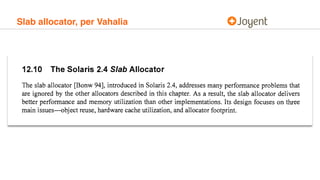
Slab allocator, per Vahalia
First <3: Allocator footprint
I <3: Cache-aware data structures
Hardware Antiques Roadshow!
I <3: Magazine layer
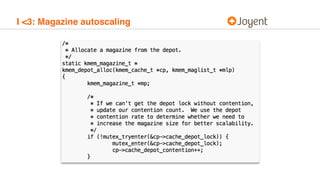
I <3: Magazine autoscaling
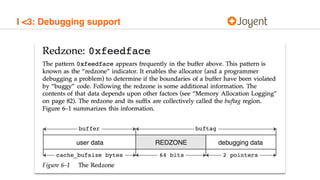
I <3: Debugging support
• For many, the most salient property of the slab allocator is its
eponymous allocation properties…
• …but for me, its debugging support is much more meaningful
• Rich support for debugging memory corruption issues:
allocation auditing + detection of double-free/use-after-free/
use-before-initialize/buffer overrun
• Emphasis was leaving the functionality compiled in (and
therefore available in production) — even if off by default
• kmem_flags often used to debug many kinds of problems!
I <3: Debugging support
I <3: Debugger support
I <3: MDB support
• Work in crash(1M) inspired deeper kmem debugging support
in MDB, including commands to:
• Walk the buffers from a cache (::walk kmem)
• Display buffers allocated by a thread (::allocdby)
• Verify integrity of kernel memory (::kmem_verify)
• Determine the kmem cache of a buffer (::whatis)
• Find memory leaks (::findleaks)
• And of course, for Bonwick, ::kmastat and ::kmausers!
I <3: libumem
• Tragic to have a gold-plated kernel facility while user-land
suffered in the squalor of malloc(3C)…
• In the (go-go!) summer of 2000, Jonathan Adams (then a Sun
Microsystems intern from CalTech) ported the kernel memory
allocator to user-land as libumem
• Jonathan returned to Sun as a full-time engineer to finish and
integrate libumem; became open source with OpenSolaris
• libumem is the allocator for illumos and derivatives like
SmartOS — and has since been ported to other systems
libumem performance
• The slab allocator was designed to be scalable — not
necessarily to accommodate pathological software
• At user-level, pathological software is much more common…
• Worse, the flexibility of user-level means that operations that
are quick in the kernel (e.g., grabbing an uncontended lock)
are more expensive at user-level
• Upshot: while libumem provided great scalability, its latency
was worse than other allocators for applications with small,
short-lived allocations
libumem performance: node.js running MD5
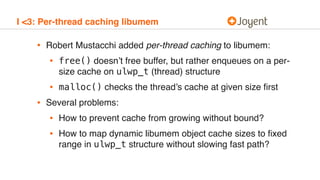
I <3: Per-thread caching libumem
• Robert Mustacchi added per-thread caching to libumem:
• free() doesn’t free buffer, but rather enqueues on a per-
size cache on ulwp_t (thread) structure
• malloc() checks the thread’s cache at given size first
• Several problems:
• How to prevent cache from growing without bound?
• How to map dynamic libumem object cache sizes to fixed
range in ulwp_t structure without slowing fast path?
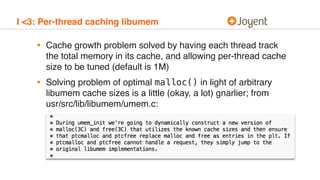
I <3: Per-thread caching libumem
• Cache growth problem solved by having each thread track
the total memory in its cache, and allowing per-thread cache
size to be tuned (default is 1M)
• Solving problem of optimal malloc() in light of arbitrary
libumem cache sizes is a little (okay, a lot) gnarlier; from

usr/src/lib/libumem/umem.c:
I <3 the slab allocator!
• It shows the importance of well-designed, well-considered,
well-described core services
• We haven’t need to rewrite it — it has withstood ~4 orders of
magnitude increase in machine size
• We have been able to meaningfully enhance it over the years
• It is (for me) the canonical immaculate system: more one to
use and be inspired by than need to fix or change
• It remains at the heart of our system — and its ethos very
much remains the zeitgeist of illumos!
Acknowledgements
• Jeff Bonwick for creating not just an allocator, but a way of
thinking about systems problems and of implementing their
solutions — and the courage to rewrite broken software!
• Jonathan Adams for not just taking on libumem, but also
writing about it formally and productizing it
• Robert Mustacchi for per-thread caching libumem
• Ryan Zezeski for bringing the slab allocator to a new
generation with his Papers We Love talk
Further reading
• Jeff Bonwick, The Slab Allocator: An Object-Caching Kernel Memory
Allocator, Summer USENIX, 1994
• Jeff Bonwick and Jonathan Adams, Magazines and Vmem: Extending
the Slab Allocator to Many CPUs and Arbitrary Resources, USENIX
Annual Technical Conference, 2001
• Robert Mustacchi, Per-thread caching in libumem, blog entry on
dtrace.org, July 2012
• Ryan Zezeski, Memory by the Slab: The Tale of Bonwick’s Slab
Allocator, Papers We Love NYC, September 2015
• Uresh Vahalia, UNIX Internals, 1996

Down Memory Lane: Two Decades with the Slab Allocator

  • 1.
    Down Memory Lane: TwoDecades with the Slab Allocator CTO bryan@joyent.com Bryan Cantrill @bcantrill
  • 2.
  • 3.
    Aside: Me, twodecades ago…
  • 4.
    Aside: Me, twodecades ago…
  • 5.
  • 6.
  • 7.
    I <3: Cache-awaredata structures
  • 8.
    I <3: Cache-awaredata structures Hardware Antiques Roadshow!
  • 9.
  • 10.
    I <3: Magazineautoscaling
  • 11.
    I <3: Debuggingsupport • For many, the most salient property of the slab allocator is its eponymous allocation properties… • …but for me, its debugging support is much more meaningful • Rich support for debugging memory corruption issues: allocation auditing + detection of double-free/use-after-free/ use-before-initialize/buffer overrun • Emphasis was leaving the functionality compiled in (and therefore available in production) — even if off by default • kmem_flags often used to debug many kinds of problems!
  • 12.
  • 13.
  • 14.
    I <3: MDBsupport • Work in crash(1M) inspired deeper kmem debugging support in MDB, including commands to: • Walk the buffers from a cache (::walk kmem) • Display buffers allocated by a thread (::allocdby) • Verify integrity of kernel memory (::kmem_verify) • Determine the kmem cache of a buffer (::whatis) • Find memory leaks (::findleaks) • And of course, for Bonwick, ::kmastat and ::kmausers!
  • 15.
    I <3: libumem •Tragic to have a gold-plated kernel facility while user-land suffered in the squalor of malloc(3C)… • In the (go-go!) summer of 2000, Jonathan Adams (then a Sun Microsystems intern from CalTech) ported the kernel memory allocator to user-land as libumem • Jonathan returned to Sun as a full-time engineer to finish and integrate libumem; became open source with OpenSolaris • libumem is the allocator for illumos and derivatives like SmartOS — and has since been ported to other systems
  • 16.
    libumem performance • Theslab allocator was designed to be scalable — not necessarily to accommodate pathological software • At user-level, pathological software is much more common… • Worse, the flexibility of user-level means that operations that are quick in the kernel (e.g., grabbing an uncontended lock) are more expensive at user-level • Upshot: while libumem provided great scalability, its latency was worse than other allocators for applications with small, short-lived allocations
  • 17.
  • 18.
    I <3: Per-threadcaching libumem • Robert Mustacchi added per-thread caching to libumem: • free() doesn’t free buffer, but rather enqueues on a per- size cache on ulwp_t (thread) structure • malloc() checks the thread’s cache at given size first • Several problems: • How to prevent cache from growing without bound? • How to map dynamic libumem object cache sizes to fixed range in ulwp_t structure without slowing fast path?
  • 19.
    I <3: Per-threadcaching libumem • Cache growth problem solved by having each thread track the total memory in its cache, and allowing per-thread cache size to be tuned (default is 1M) • Solving problem of optimal malloc() in light of arbitrary libumem cache sizes is a little (okay, a lot) gnarlier; from
 usr/src/lib/libumem/umem.c:
  • 20.
    I <3 theslab allocator! • It shows the importance of well-designed, well-considered, well-described core services • We haven’t need to rewrite it — it has withstood ~4 orders of magnitude increase in machine size • We have been able to meaningfully enhance it over the years • It is (for me) the canonical immaculate system: more one to use and be inspired by than need to fix or change • It remains at the heart of our system — and its ethos very much remains the zeitgeist of illumos!
  • 21.
    Acknowledgements • Jeff Bonwickfor creating not just an allocator, but a way of thinking about systems problems and of implementing their solutions — and the courage to rewrite broken software! • Jonathan Adams for not just taking on libumem, but also writing about it formally and productizing it • Robert Mustacchi for per-thread caching libumem • Ryan Zezeski for bringing the slab allocator to a new generation with his Papers We Love talk
  • 22.
    Further reading • JeffBonwick, The Slab Allocator: An Object-Caching Kernel Memory Allocator, Summer USENIX, 1994 • Jeff Bonwick and Jonathan Adams, Magazines and Vmem: Extending the Slab Allocator to Many CPUs and Arbitrary Resources, USENIX Annual Technical Conference, 2001 • Robert Mustacchi, Per-thread caching in libumem, blog entry on dtrace.org, July 2012 • Ryan Zezeski, Memory by the Slab: The Tale of Bonwick’s Slab Allocator, Papers We Love NYC, September 2015 • Uresh Vahalia, UNIX Internals, 1996