Make it Cooler
With Decentralized Version Control


Indy Nagpal
Straker Software
A bit about me
• CTO, Straker Software, New Zealand

• Lots of CF and Flex experience

• In love with Groovy

• Tackling challenges of creating cloud-based
  software

• nagpals.com/blog
Once upon a time,
in a galaxy not too far away...


     There was CVS
And it was a little... well... painful
Subversion made it a little easier
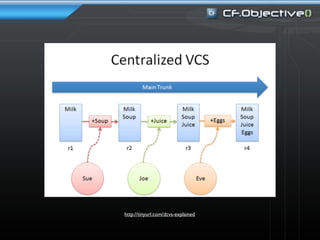
Both are centralized
version control systems
Central Server


Network in between


     Clients
http://tinyurl.com/dcvs-explained
A little history
• Emerged in 1970s
  – Yes, that’s about 40 years back


• That was the time of
  – weak clients
  – grunty mainframes


• Centralized teams
Centralized Version Control
• Simpler

• Works nicely for
  – backup
  – undo
  – synchronization


• “Everyone in my team knows how to use it”
So what’s the problem?
• Reliance on being connected

• Single point of failure

• Branching and merging -- a big pain

• Growing projects

• Diffused teams
Enter...
Decentralized Version Control Systems
Not too long a ago
     on a planet called Earth
Lived a nerd called Linus Torvalds


And then there was Linux
        and Git
Other DVCS Systems

     Mercurial
      Bazaar
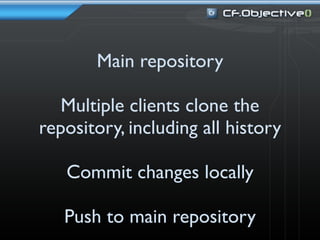
Main repository

   Multiple clients clone the
repository, including all history

   Commit changes locally

   Push to main repository
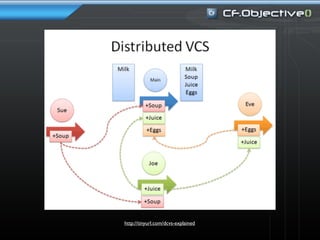
http://tinyurl.com/dcvs-explained
Decentralized Version Control
• Relatively recent innovation

• Focus on sharing changes

• Recording changes and Applying changes are
  separated

• Fast

• Efficient
Decentralized Version Control
• Works offline

• Branching is cheap

• Merging a pleasure

• Support for non-linear development

• Distributed development
Considerations in switching from
 Centralized to Decentralized
IDE Support
• git-gui, egit (Eclipse), gitx (Mac)

• Command-line works very well

• Configurable to work with other diff-ing/
  merging and editing utilities

• Nothing as simple as TortoiseSVN
Repository Hosting Infrastructure
• Third party hosting works well
  – Unfuddle, Assembla
  – repo.or.cz, github


• Host own server

• *nix friendly, but have Windows ports
Learning Curve
• There is one! And it is a little steep

• Getting everyone to change development
  practice is a biggie

• Need a champion who doubles up as trainer

• If business finds reason, development teams
  have limited choice
Existing Repos
• Size of repositories

• Most DVCS can import SVN repos, including
  history

• Process of migration needs to be planned and
  implemented
Integration with Third-party Tools
• Code repos are tied to other systems:
  – Bug Tracking
  – Continuous Integration Systems
  – Code Review Systems


• Switching requires updates to those processes

• Do-able
Eternal Truth #1

The longer you use a system,
  the harder it is to switch
Eternal Truth #2

Inertia does not help
Eternal Truth #3

Lack of a business case does not
           help either
Eternal Truth #4

Change is the only constant
So where does that leave us?
Choose Git
• Seems to have more legs than others

• A little more difficult to grasp and work with

• But once you’ve got your head around it, and
  worked with it for a while, it is easy
git-svn
• Very useful feature

• Checkout a SVN repo as a Git repo

• Work with locally as a Git repo

• Branch/merge locally as much as you like

• Commit locally, and then push to SVN repo
A few other useful things
• Only one .git folder, not a zillion .svn folders

• Create local repos for things you normally
  wouldn’t

• Efficiency
   – 1.5 GB svn repo = 700 MB git repo

• Speed
   – Of local commits and pull/push from main repo
Resources
• Git
  – git-scm.com

• Peepcode
  – peepcode.com/products/git


• Pragmatic Programmers
  – pragprog.com/titles/tsgit/
One Last Truth

Automation is the key
On Automation and Developers
 Given a choice between spending an hour
 doing a task manually, or spending three
 hours writing a program to do it
 automatically... a geek will write the
 program, every single time. And, if not given
 the choice, if explicitly ordered to do the job
 manually, we'll disobey and write the
 program anyway.
 Catherine Devlin (http://tinyurl.com/devautomation)
Hook DVCS up with Testing and CI
Unit Testing
• MXUnit works well
• mxunit.org/

• Writing testable code -- key to automation

• Retro-fitting tests does not work

• Have to write tests before writing code

• Makes the code more robust
What is testable code
• Marc Esher’s presentation on Testable Code:

   – Extracted

   – Abstracted

   – Injected
Git with Unit Testing
• Agnostic

• Key issues are:

  – Where do you store tests

  – How do you run them
Continuous Integration
• Hudson works extremely well

• https://hudson.dev.java.net/
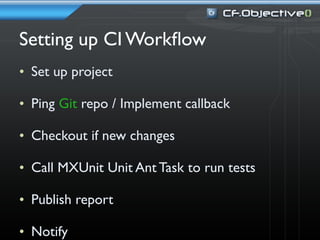
Setting up CI Workflow
• Set up project

• Ping Git repo / Implement callback

• Checkout if new changes

• Call MXUnit Unit Ant Task to run tests

• Publish report

• Notify
Thank you!
indy@strakersoftware.com
   strakersoftware.com
     nagpals.com/blog

Make It Cooler: Using Decentralized Version Control

  • 1.
    Make it Cooler WithDecentralized Version Control Indy Nagpal Straker Software
  • 2.
    A bit aboutme • CTO, Straker Software, New Zealand • Lots of CF and Flex experience • In love with Groovy • Tackling challenges of creating cloud-based software • nagpals.com/blog
  • 4.
    Once upon atime, in a galaxy not too far away... There was CVS
  • 5.
    And it wasa little... well... painful
  • 6.
    Subversion made ita little easier
  • 7.
  • 8.
  • 9.
  • 10.
    A little history •Emerged in 1970s – Yes, that’s about 40 years back • That was the time of – weak clients – grunty mainframes • Centralized teams
  • 11.
    Centralized Version Control •Simpler • Works nicely for – backup – undo – synchronization • “Everyone in my team knows how to use it”
  • 12.
    So what’s theproblem? • Reliance on being connected • Single point of failure • Branching and merging -- a big pain • Growing projects • Diffused teams
  • 13.
  • 14.
  • 16.
    Not too longa ago on a planet called Earth Lived a nerd called Linus Torvalds And then there was Linux and Git
  • 17.
    Other DVCS Systems Mercurial Bazaar
  • 18.
    Main repository Multiple clients clone the repository, including all history Commit changes locally Push to main repository
  • 19.
  • 20.
    Decentralized Version Control •Relatively recent innovation • Focus on sharing changes • Recording changes and Applying changes are separated • Fast • Efficient
  • 21.
    Decentralized Version Control •Works offline • Branching is cheap • Merging a pleasure • Support for non-linear development • Distributed development
  • 22.
    Considerations in switchingfrom Centralized to Decentralized
  • 23.
    IDE Support • git-gui,egit (Eclipse), gitx (Mac) • Command-line works very well • Configurable to work with other diff-ing/ merging and editing utilities • Nothing as simple as TortoiseSVN
  • 24.
    Repository Hosting Infrastructure •Third party hosting works well – Unfuddle, Assembla – repo.or.cz, github • Host own server • *nix friendly, but have Windows ports
  • 25.
    Learning Curve • Thereis one! And it is a little steep • Getting everyone to change development practice is a biggie • Need a champion who doubles up as trainer • If business finds reason, development teams have limited choice
  • 26.
    Existing Repos • Sizeof repositories • Most DVCS can import SVN repos, including history • Process of migration needs to be planned and implemented
  • 27.
    Integration with Third-partyTools • Code repos are tied to other systems: – Bug Tracking – Continuous Integration Systems – Code Review Systems • Switching requires updates to those processes • Do-able
  • 28.
    Eternal Truth #1 Thelonger you use a system, the harder it is to switch
  • 29.
  • 30.
    Eternal Truth #3 Lackof a business case does not help either
  • 31.
    Eternal Truth #4 Changeis the only constant
  • 32.
    So where doesthat leave us?
  • 33.
    Choose Git • Seemsto have more legs than others • A little more difficult to grasp and work with • But once you’ve got your head around it, and worked with it for a while, it is easy
  • 34.
    git-svn • Very usefulfeature • Checkout a SVN repo as a Git repo • Work with locally as a Git repo • Branch/merge locally as much as you like • Commit locally, and then push to SVN repo
  • 35.
    A few otheruseful things • Only one .git folder, not a zillion .svn folders • Create local repos for things you normally wouldn’t • Efficiency – 1.5 GB svn repo = 700 MB git repo • Speed – Of local commits and pull/push from main repo
  • 36.
    Resources • Git – git-scm.com • Peepcode – peepcode.com/products/git • Pragmatic Programmers – pragprog.com/titles/tsgit/
  • 37.
  • 38.
    On Automation andDevelopers Given a choice between spending an hour doing a task manually, or spending three hours writing a program to do it automatically... a geek will write the program, every single time. And, if not given the choice, if explicitly ordered to do the job manually, we'll disobey and write the program anyway. Catherine Devlin (http://tinyurl.com/devautomation)
  • 39.
    Hook DVCS upwith Testing and CI
  • 40.
    Unit Testing • MXUnitworks well • mxunit.org/ • Writing testable code -- key to automation • Retro-fitting tests does not work • Have to write tests before writing code • Makes the code more robust
  • 41.
    What is testablecode • Marc Esher’s presentation on Testable Code: – Extracted – Abstracted – Injected
  • 42.
    Git with UnitTesting • Agnostic • Key issues are: – Where do you store tests – How do you run them
  • 43.
    Continuous Integration • Hudsonworks extremely well • https://hudson.dev.java.net/
  • 44.
    Setting up CIWorkflow • Set up project • Ping Git repo / Implement callback • Checkout if new changes • Call MXUnit Unit Ant Task to run tests • Publish report • Notify
  • 45.
    Thank you! indy@strakersoftware.com strakersoftware.com nagpals.com/blog