But we're already open source!
Why would I want to bring my code to Apache?
But we're already open source!
Why would I want to bring my code to Apache?
Nick Burch
CTO, Quanticate
Nick Burch
CTO, Quanticate
Open, Open and Open!
• Open vs Open Source
• The ASF – What's the deal?
• Case Study 1 – Alfresco and Apache Tika
• Case Study 2 – Alfresco and Apache Chemistry
• Case Study 3 – Alfresco and Activiti
• The Benefits
• And the downsides...
Open vs OpenOpen vs Open
Open Source
“denoting software for which the original source code is made
freely available and may be redistributed and modified”
• You can get the source behind a program (if you want)
• You can study it, learn from it, understand it, debug it
• You can make changes to it (or pay someone else to)
• You can use your new version without having to pay
• You can share your changes and improvements
• There is a license, but it's a distribution not use one
Open Development
• Open Source is all about the software today
• Open Development is about the software tomorrow
• Quite possible to be Open Source but Closed Development
• Who decides what the priorities are?
• Where do those discussions happen, and are they shared?
• Who can influence the direction of the project?
• Who can contribute (directly or indirectly)?
• Who dictates releases, “done” etc?
Copyright Assignments
• Applies when you want to contribute a fix or enhancement
• Assignement requires you sign over your rights to your
changes to another entity, to do with as they wish
• Most common with Commercial+CopyLeft
• Can be used “for good”, to permit relicensing in future, and
to allow a central entity to fight infringement claims
• Can be used “for money”, to allow a company to license
out your changes to their enterprise customers
• Typically very divisive, problems if not accepted
CLAs (License Agreements)
• At first glance, these look quite similar
• Legal agreement about a contribution
• But... Very different kettle of fish!
• Copyright Assignment requires you hand over your rights
• CLAs are about ensuring you understand the open source
license, and are allowed to contribute under it
• “License says you can have this, and I confirm you can”
• Paper trail of contributions
• Defends against “but that's our code!”
Community Direction
• Within any project, whether open or closed, proprietary or
shared, there's a process to decide on direction
• When will the next release be considered “done”?
• What features should be worked on? Not worked on?
• What's the vision for the project? What's out of scope?
• Who can join in? Who can contribute?
• How are new changes reviewed+accepted? And by who?
• How are conflicts and debates handled? Who has a say?
• How can this be changed over time?
Licensing
• All Open Source licenses are distribution licenses
• Use of the software is free (support + add-ons may not be!)
• To broad families of Open Source licenses
• Copyleft (eg GNU-GPL, LGPL)
• Permissive (eg Apache License, BSD, MIT)
• Strong philosophical differences divide, plenty of license
flame-wars online debating all of these!
• Have different restrictions on building on top of them
• Influences the business models you can build on top
Many Models
• There isn't a “One True Way”
• But the ASF has a “often least worst way!”
• More on the ASF shortly
• More on pluses and minuses later
• No one model is “always right” or “always wrong”, need to
weigh up the benefits and downsides
• There is help for weighing this all up!
The Apache Software
Foundation
The Apache Software
Foundation
What is the ASF?
• US 501(c)3 not-for-profit foundation
• Founded in 1999 with one project (webserver)
• Today has over 150!
• Meritocratic, community driven open source
• Anyone can get involved, and not just as a coder
• Decisions taken by the community
• Work done by volunteers
• Open Development, friendly to business involvement
Driven by projects
• A number of projects
• Each project is responsible for their own code, community and direction
• Board provides oversight, but that's it
• Board has no say on what code gets written, nor what direction projects
take, nor what projects we should start. All of that is devolved to the
projects themselves
• Foundation has some common support (eg infra, press, trademarks), to
help projects focus on their code and on their communities
For more on the Apache Way:
Slides from today @ 10.30am
For more on the Apache Way:
Slides from today @ 10.30am
Case Study 1:
Alfresco and Apache Tika
Case Study 1:
Alfresco and Apache Tika
Alfresco
• Open Source Enterprise Content Management
• >1 million active users, >4 million downloads, plus Cloud
• Open Source, but not Open Development (mostly)
• Written mostly in Java and JavaScript
• ECM – Capture, Manage, Store, Preserve, Deliver, Search, Collaborate,
within and between organisations
• Includes Document Management, Records Management, Asset
Management, WCM, Workflow etc
• Alfresco is Open Source, and builds on lots of of Open Source projects,
especially from Apache and Spring
Metadata & Transformers
• Content Transformers and Metadata Extractors are core Alfresco
services, present from the very start
• Transformers are used for full text indexing, web previews, icons,
web friendly versions etc
• Metadata Extraction used to synchronise the document properties
with the repository
• Both normally used with uploaded binary files
• eg upload a Word Document, text extracted for indexing, PDF
version generated, title + author extracted
Alfresco 3.3 - Formats
• PDF
• Word, PowerPoint, Excel
• HTML
• Open Document Formats (OpenOffice)
• RFC822 Email
• Outlook .msg Email
•
• And that's it!
Apache Tika tika.apache.org
• Apache Project, started in 2006
• Initially grew out of Lucene, but now very widely used
• Provides detection capabilities – eg this is a Word Doc
• Parsers for a very wide range of formats
• Extracts metadata, and provides a consistent model, eg created by
vs author
• Textual content available as Plain Text and XHTML
• Hides complexity of file formats and librarys, presents a simple and
powerful API across all of them
• Easy to use and extend
Sharing process
• Identify upstream projects (mostly Apache Tika + POI)
• Get the latest versions of the code
• Compared Alfresco code to upstream, and identify areas where
Alfresco did more / upstream didn't handle
• Wrote unit tests for things Alfresco did better, to avoid regressions
after the push upstream
• Identified which bits of upstream would be improved, and what bits
would be whole new features
• Worked with upstream projects, shared ideas for enhancements,
checked hadn't missed things
Sharing process continued
• Produced patches, submitted to the Apache projects
• Get feedback and improvements on patches
• Gained trust of communities, granted commit rights
•
• Once most things upstream, update Tika and POI versions used in
Alfresco, check everything worked
• Wrote Tika wrappers for Alfresco
• Converted Alfresco code to call Tika
• Used unit tests to ensure no lost functionality
• Enabled other formats via Tika
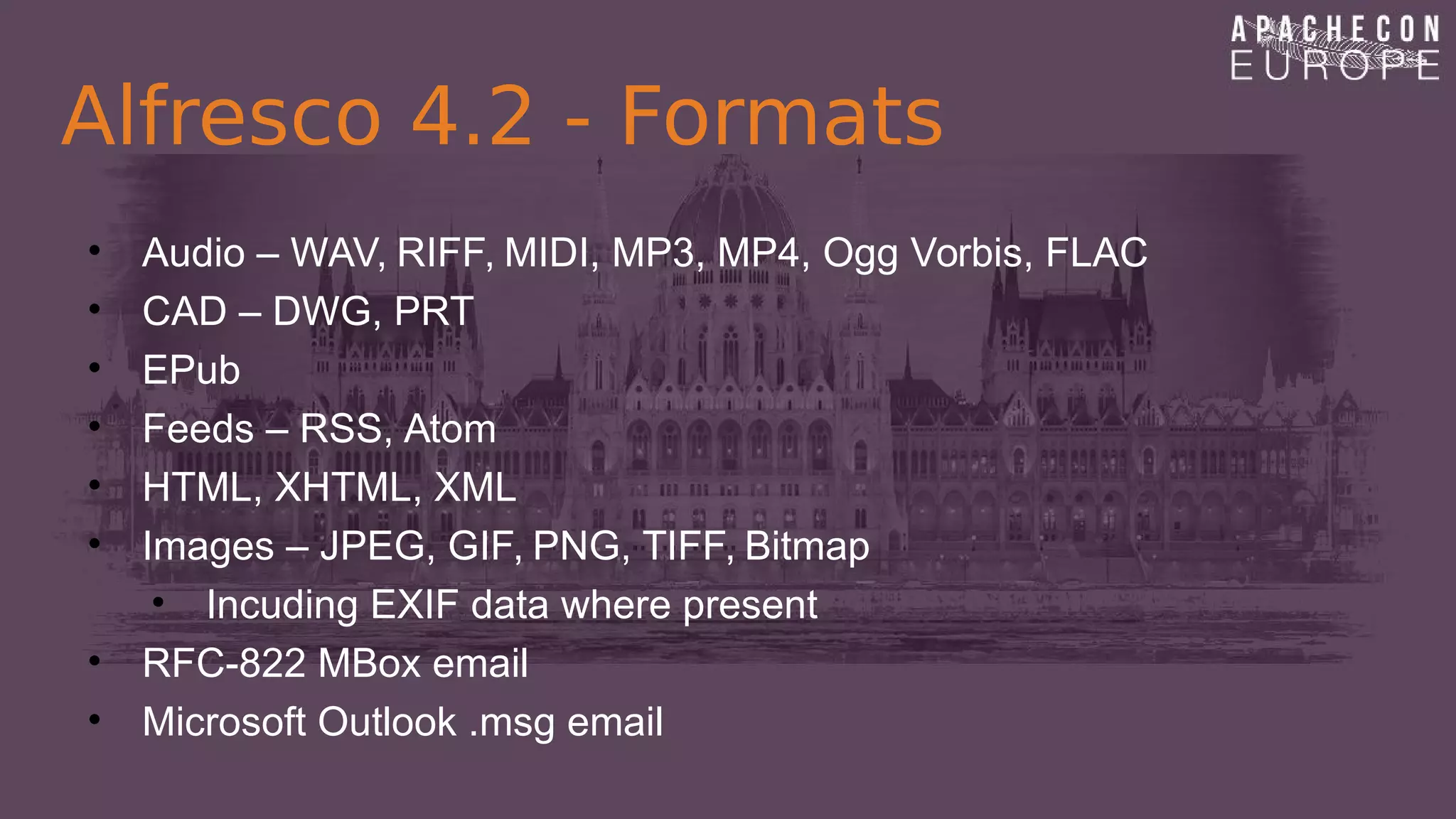
Alfresco 4.2 - Formats
• Audio – WAV, RIFF, MIDI, MP3, MP4, Ogg Vorbis, FLAC
• CAD – DWG, PRT
• EPub
• Feeds – RSS, Atom
• HTML, XHTML, XML
• Images – JPEG, GIF, PNG, TIFF, Bitmap
• Incuding EXIF data where present
• RFC-822 MBox email
• Microsoft Outlook .msg email
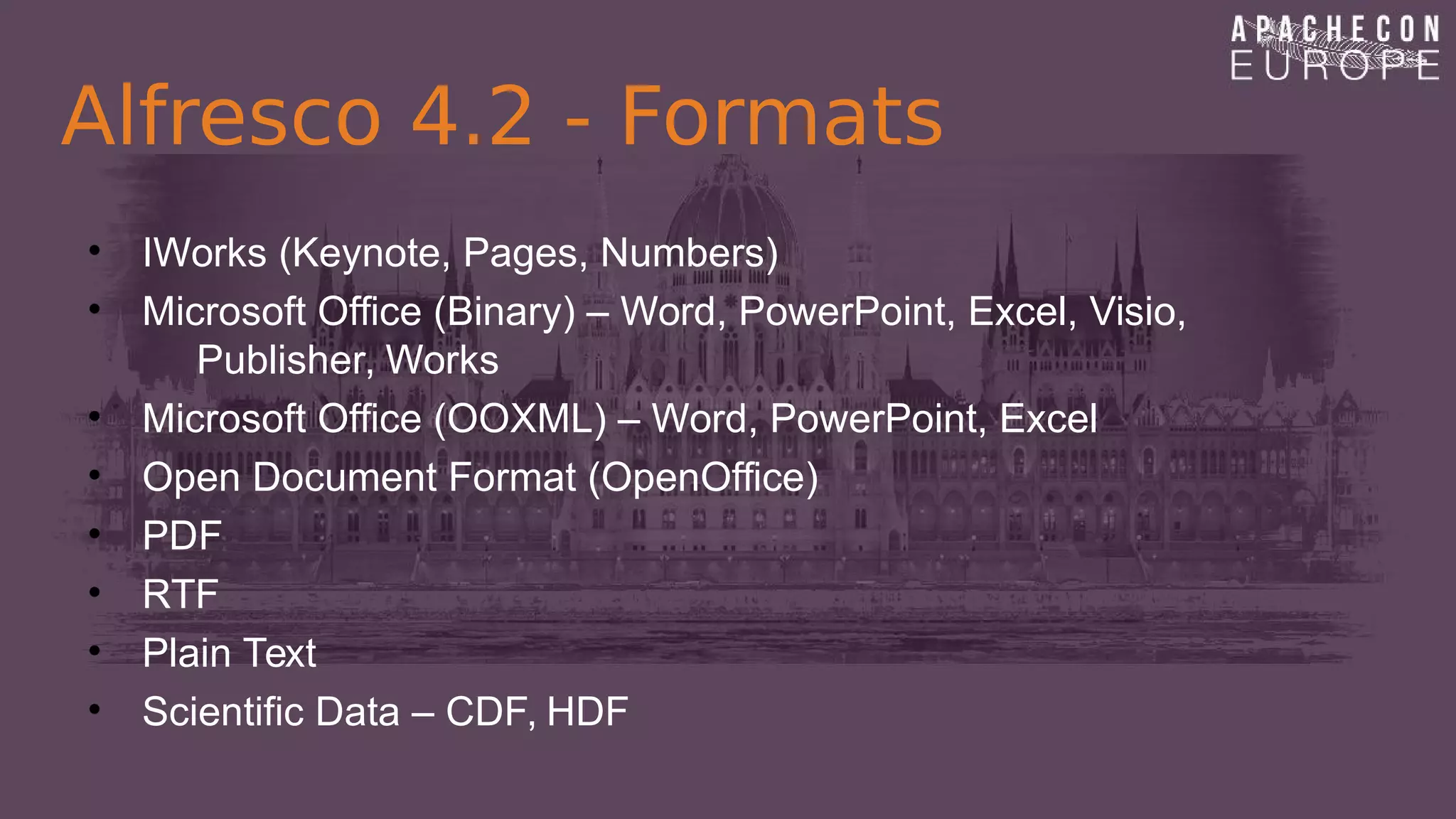
Alfresco 4.2 - Formats
• IWorks (Keynote, Pages, Numbers)
• Microsoft Office (Binary) – Word, PowerPoint, Excel, Visio,
Publisher, Works
• Microsoft Office (OOXML) – Word, PowerPoint, Excel
• Open Document Format (OpenOffice)
• PDF
• RTF
• Plain Text
• Scientific Data – CDF, HDF
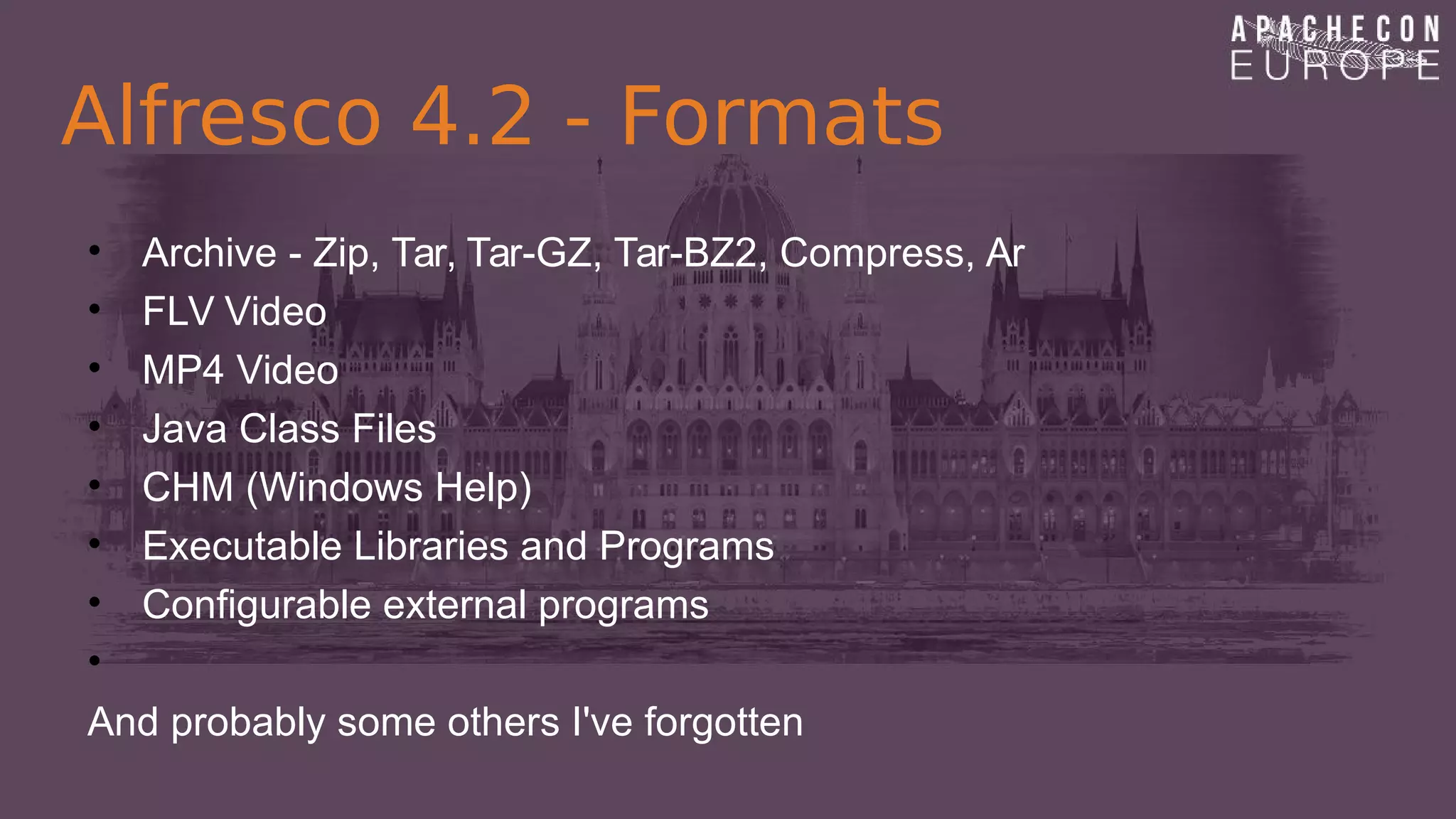
Alfresco 4.2 - Formats
• Archive - Zip, Tar, Tar-GZ, Tar-BZ2, Compress, Ar
• FLV Video
• MP4 Video
• Java Class Files
• CHM (Windows Help)
• Executable Libraries and Programs
• Configurable external programs
•
And probably some others I've forgotten
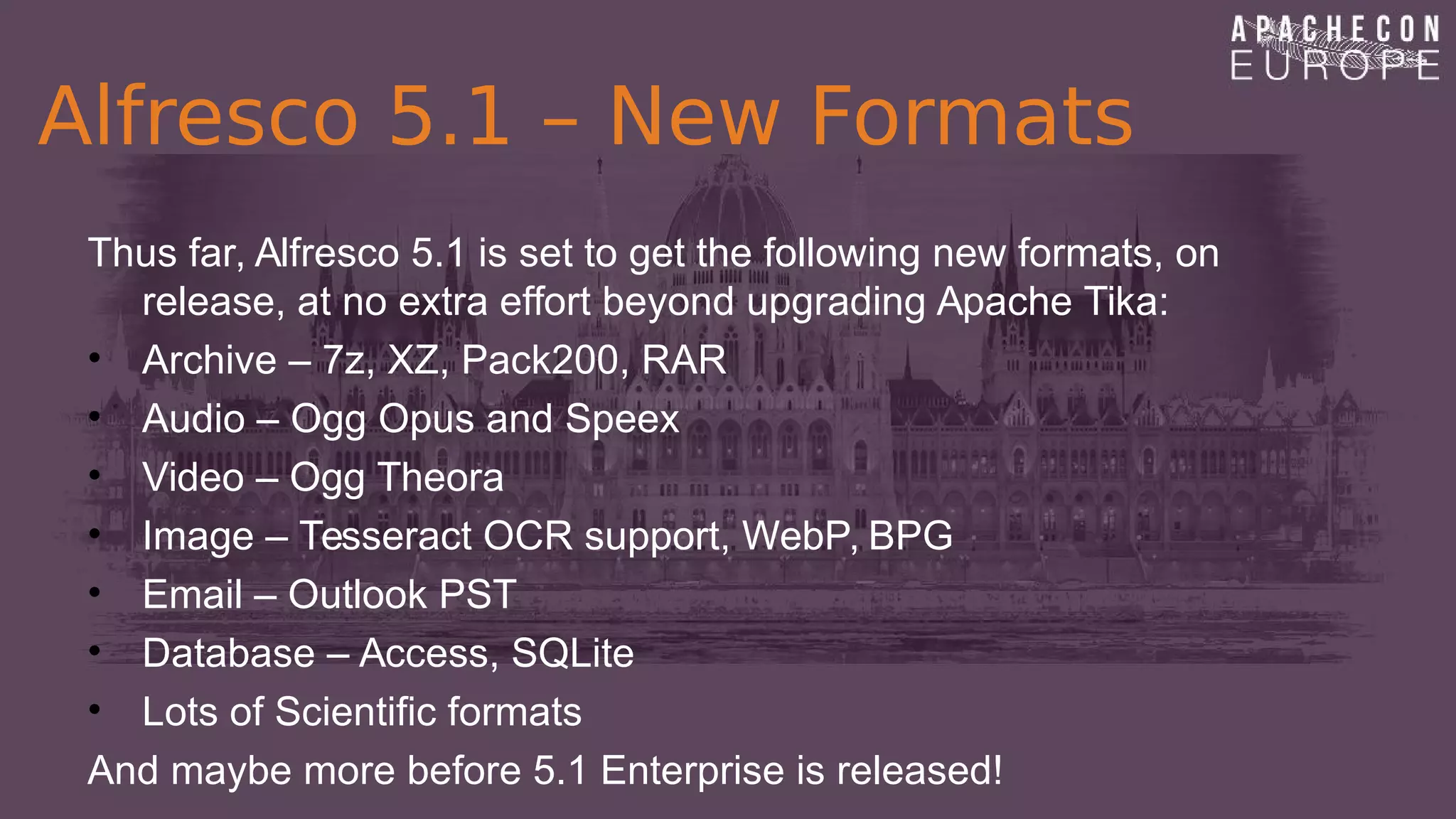
Alfresco 5.1 – New Formats
Thus far, Alfresco 5.1 is set to get the following new formats, on
release, at no extra effort beyond upgrading Apache Tika:
• Archive – 7z, XZ, Pack200, RAR
• Audio – Ogg Opus and Speex
• Video – Ogg Theora
• Image – Tesseract OCR support, WebP, BPG
• Email – Outlook PST
• Database – Access, SQLite
• Lots of Scientific formats
And maybe more before 5.1 Enterprise is released!
Case Study 2:
Alfresco and Apache
Chemistry
Case Study 2:
Alfresco and Apache
Chemistry
CMIS (OASIS Standard)
• CMIS – Content Management Interoperability Services
• Standard for talking to content repositories
• Provides a standard way to login, navigate, search, upload, version,
delete, change permissions, alter properties, set relationships,
query etc
• Supported by a wide range of content repositories
• Adobe, IBM, Microsoft, Alfresco, SAP, EMC, HP, Liferay, Nuxeo,
OpenText, Oracle, and some others
• CMIS 1.0 released in 2010
• CMIS 1.1 released in late 2012
First Alfresco Support
• Alfresco was involved in CMIS from an early stage
• First Alfresco CMIS support was added before the CMIS 1.0 spec
was completed, and was used to feed back on the proposed
standard
• First support was developed internally, took quite a while, and
turned out to have some issues
• Desire for a pure-Java server implementation, which would be more
rhobust and easier to test + validate
• Desire for a CMIS client for a few different platforms
• Desire not to have to do it all in-house
Two Rival Camps
• Alfresco, OpenText and SAP started working on an open source
Java client and server as OpenCMIS
• Nuxeo, Adobe and friends started on Apache Chemistry
• Both had strengths and weaknesses
• Quite different development and governance approaches
• Some lack of trust between camps
• Quite a lot of misunderstandings about what Apache and the
Apache Way was, and worry about a loss of control or direction,
from some in OpenCMIS
• Then an idea to contribute OpenCMIS as another project
The Joining Together
• Lots of debate on mailing lists and in private
• Eventually a get-together in Munich, coupled with lots of feedback
to the mailing list, and rattification there
• Outcome was a merged project, Apache Chemistry, which
combined the best of both
• Lots of activity, lead quite quickly to a CMIS-1.0 compatible test
server, server framework, client and test suite
• Took some work to implement this new server into Alfresco, but it
proved better than the in-house one
• Initially only a handful of companies used it, rest tested
Going Forward
• Alfresco received lots of bug fixes “for free” just from upgrading the
OpenCMIS libraries
• More companies started basing their CMIS implementations on
Apache Chemistry, having realised that it was both high quality
and already available
• Virtuous circle of enhancements and fixes
•
• CMIS 1.1 support added to Apache Chemistry mostly by SAP, with
help from others
• Adding CMIS 1.1 support to Alfresco took a tiny fraction of the time
CMIS 1.0 did, due to Chemistry support
Case Study 3:
Alfresco and Activiti
Case Study 3:
Alfresco and Activiti
BPMN-2.0 Workflows
• BPMN – Business Process Modeling Notation
• Way of describing business processes (workflows), which can be
displayed visually, but also executed
• Covers most of the key elements of a workflow
• Ideally can be created by business analysts
• Big step on from previous BPMN versions is that the format is
executable – the same thing that the analyst creates / changes
is what gets run
• Industry standard for doing this (previously each engine had its own
way of doing that)
Alfresco and Workflow
• Alfresco Workflows were based on jBPM
• In 2010, jBMP was LGPL and owned by Redhat
• Alfresco were finding some problems with jBPM that were hard to
fix, and seemed to be architectural
• jBPM core devs were interested in a re-write, Redhat less so
• Alfresco was trying to reduce the number of copyleft dependencies
in the codebase, jBMP was a big part
• Alfresco had moved from Hibernate to iBatis, and jBMP remainging
with Hibernate was making development + support harder
The Birth of Activiti
• Alfresco hired two of the core jBPM developers, Tom Baeyens and
Joram Barrez, plus some others
• Charged with developing an Apache licensed, open source
implementation of BPMN 2.0
• Alfresco was the be the “launch customer”, but being open source
anyone can (and hopefully would) use it too
• Needed some changes to Alfresco to make the the Workflow APIs
(already pluggable) work well with Activiti as well as jBMP
• Aim was for Activiti to be the default engine, and more powerful /
richer than jBPM was
ASL v2, but not ASF
• License was picked as Apache License v2
• However, after lots of internal debate, decision was made not to
submit the project to the Apache Incubator
• Alfresco wanted their next release to ship with Activiti, meant they
had strong pressures to hit a ship date
• Initial feature set largely dominated by what was needed for
Alfresco, other features were added but mostly after the first
release
• Tom Baeyens is a “BPM-God”, really knows his stuff, but after
Redhat frustrations wanted to drive it
• Initially not good Incubator fit, later why change?
BenefitsBenefits
Shared Maintenance
• By sharing upstream, your support overhead is shared
• Many companies, organisations and individuals can join in and
contribute towards the project
• When others extend your project, you benefit for free
• More users means greater chance of community enhancements /
new features
• More users means more bug reports, but also more bug reports
that come with fixes (patches)!
• Lower per-organisation maintenance costs
• Often faster development
Better Bug Reports
• People familiar with Open Source often know how to report bugs
better
• By sharing your code, more people can use it, so there's a wider pool
of people to test and report on it
• “I have found a bug, but I can't share the details of it” is less
common, and more chances of a duplicate which can
• More likely that another user can come along and fill in the details of
existing bugs
• If you're open and other companies are joining in, greater chance
someone will have dedicated testers!
New Ideas, New Features
• When other companies feel they can base their business on your
project, then they can dedicate more resources
• When individuals feel they have a say, they're more likely to spend
their time working on it
• More developers means more ideas for fixing problems, enhancing
exisiting code, and adding new things
• When contributions are felt to be welomed and appreciated, more
likely for people to share back
• Can be small changes over time, or can be large new features, all
for (almost) free!
Learning from the best
• The world is a very big place
• No matter how great you are, there's someone out there who's
smarter than you are!
• And many more people who've been there before
•
• If you have more contributors, there's more chance of someone
improving your idea or code
• By seeing how they do it better, you not only get a better project,
but learn from it to improve yourself
• Collaborate to get the best of everyone
Diverse Users and Devs
• We are often a bit of a mono-culture
• Some worse than others.....
•
• If you draw from a very small pool, you'll have people who tend to
think the same, and will be blinded by that
• If you have people from all around the world, from all walks of life,
you've more chance of diverse opinions
• Best time to fix a mistake is at the start
• Even if it's just “hmm, that breaks when you're not +00:00” !
Community and Goodwill
• Sharing and being open can bring positive press
• Your organisation can gain recognition from their involvement
• Halo effect – share in the buzz from the project
• And an open project with lots of people has more buzz!
•
• If you're a known good team player, it's easier to call in favours from
the community (eg critical bug fix)
• If you're known generally as a good team player, easier to get help or
support in related projects (eg dependencies)
DownsidesDownsides
Lack of Control
• If it's your project, you can do with it as you want
• Very easy to make decisions, get things done
• If it's an ASF project, you need to explain your ideas, and convince
the rest of the community of why
• If it's in-house, you can have a quick chat to decide
• If it's an ASF project, you need to write it all down, explain it, and wait
to allow everyone to have a chance to review
• Management understand traditional projects
• Can lead to confusion and hard questions if not properly explained,
expect some “what do you mean?”s
Release dates
• If it's your project, you have full control (and responsibility) about
“done”, and the associated release dates
• If it's an ASF project, it's a community decision
• You can't “demand” that someone else fixes a bug
• If the community is all excited and working on a new feature, it may
not be the right time for a stable release
• If you're on a different cycle to many other contributors, expect to
still have to do much of the “boring bits”
• Need to get the community to share release vision
Direction / Features
• If it's your project, you decide what's in, you direct the developers,
off they go (or fail trying....)
• If it's an ASF project, you need to explain the idea to the community,
and get their buy-in
• You may still then have to do most of the work on it – you can't
force the volunteers to work on something!
• Your vision for where it should go may not match others
• Your “value add” might end up getting re-done by the community,
and you can't stop that
• Can confuse management, who expect a different dynamic about
getting new things in
Marketing & Branding
• If it's your project, you can brand it how you want, associate your
company with it how you want
• ASF has trademark rules which apply, you mustn't confuse your
product with the project
• Need to co-ordinate with the rest of the community on branding,
press releases, conferences etc
• Can be hard to get agreement on these things, can be prone to
bike-shedding if not careful
• Potentially big loss of control
In SummaryIn Summary
Why it's Good
• More involvement
• Better bug reports, wider testing
• Other companies (including competitors) much more
willing to join in and share resources
• Learn from others, and collaborate with them to improve
• More diverse community can mean problems get spotted
and fixed sooner (+cheaper)
• More opportunities from wider use
• New features and fixes “for free”
But not for everyone!
• You're no longer in charge!
• Need to be willing to give up some control in order to
welcome in the wider community
• Not instant – will be an up-front cost, you need to be in for
the longer term to take advantage
• Need to train up your marketing team, and management
• Won't all be smooth sailing, there will be problems
• BDFLs aren't allowed
• “No jerks”, you need to work with the community
Any Questions?Any Questions?
Nick Burch
@Gagravarr
nick@apache.org
Nick Burch
@Gagravarr
nick@apache.org

But we're already open source! Why would I want to bring my code to Apache?

  • 1.
    But we're alreadyopen source! Why would I want to bring my code to Apache? But we're already open source! Why would I want to bring my code to Apache?
  • 2.
    Nick Burch CTO, Quanticate NickBurch CTO, Quanticate
  • 3.
    Open, Open andOpen! • Open vs Open Source • The ASF – What's the deal? • Case Study 1 – Alfresco and Apache Tika • Case Study 2 – Alfresco and Apache Chemistry • Case Study 3 – Alfresco and Activiti • The Benefits • And the downsides...
  • 4.
  • 5.
    Open Source “denoting softwarefor which the original source code is made freely available and may be redistributed and modified” • You can get the source behind a program (if you want) • You can study it, learn from it, understand it, debug it • You can make changes to it (or pay someone else to) • You can use your new version without having to pay • You can share your changes and improvements • There is a license, but it's a distribution not use one
  • 6.
    Open Development • OpenSource is all about the software today • Open Development is about the software tomorrow • Quite possible to be Open Source but Closed Development • Who decides what the priorities are? • Where do those discussions happen, and are they shared? • Who can influence the direction of the project? • Who can contribute (directly or indirectly)? • Who dictates releases, “done” etc?
  • 7.
    Copyright Assignments • Applieswhen you want to contribute a fix or enhancement • Assignement requires you sign over your rights to your changes to another entity, to do with as they wish • Most common with Commercial+CopyLeft • Can be used “for good”, to permit relicensing in future, and to allow a central entity to fight infringement claims • Can be used “for money”, to allow a company to license out your changes to their enterprise customers • Typically very divisive, problems if not accepted
  • 8.
    CLAs (License Agreements) •At first glance, these look quite similar • Legal agreement about a contribution • But... Very different kettle of fish! • Copyright Assignment requires you hand over your rights • CLAs are about ensuring you understand the open source license, and are allowed to contribute under it • “License says you can have this, and I confirm you can” • Paper trail of contributions • Defends against “but that's our code!”
  • 9.
    Community Direction • Withinany project, whether open or closed, proprietary or shared, there's a process to decide on direction • When will the next release be considered “done”? • What features should be worked on? Not worked on? • What's the vision for the project? What's out of scope? • Who can join in? Who can contribute? • How are new changes reviewed+accepted? And by who? • How are conflicts and debates handled? Who has a say? • How can this be changed over time?
  • 10.
    Licensing • All OpenSource licenses are distribution licenses • Use of the software is free (support + add-ons may not be!) • To broad families of Open Source licenses • Copyleft (eg GNU-GPL, LGPL) • Permissive (eg Apache License, BSD, MIT) • Strong philosophical differences divide, plenty of license flame-wars online debating all of these! • Have different restrictions on building on top of them • Influences the business models you can build on top
  • 11.
    Many Models • Thereisn't a “One True Way” • But the ASF has a “often least worst way!” • More on the ASF shortly • More on pluses and minuses later • No one model is “always right” or “always wrong”, need to weigh up the benefits and downsides • There is help for weighing this all up!
  • 12.
    The Apache Software Foundation TheApache Software Foundation
  • 13.
    What is theASF? • US 501(c)3 not-for-profit foundation • Founded in 1999 with one project (webserver) • Today has over 150! • Meritocratic, community driven open source • Anyone can get involved, and not just as a coder • Decisions taken by the community • Work done by volunteers • Open Development, friendly to business involvement
  • 14.
    Driven by projects •A number of projects • Each project is responsible for their own code, community and direction • Board provides oversight, but that's it • Board has no say on what code gets written, nor what direction projects take, nor what projects we should start. All of that is devolved to the projects themselves • Foundation has some common support (eg infra, press, trademarks), to help projects focus on their code and on their communities
  • 15.
    For more onthe Apache Way: Slides from today @ 10.30am For more on the Apache Way: Slides from today @ 10.30am
  • 16.
    Case Study 1: Alfrescoand Apache Tika Case Study 1: Alfresco and Apache Tika
  • 17.
    Alfresco • Open SourceEnterprise Content Management • >1 million active users, >4 million downloads, plus Cloud • Open Source, but not Open Development (mostly) • Written mostly in Java and JavaScript • ECM – Capture, Manage, Store, Preserve, Deliver, Search, Collaborate, within and between organisations • Includes Document Management, Records Management, Asset Management, WCM, Workflow etc • Alfresco is Open Source, and builds on lots of of Open Source projects, especially from Apache and Spring
  • 18.
    Metadata & Transformers •Content Transformers and Metadata Extractors are core Alfresco services, present from the very start • Transformers are used for full text indexing, web previews, icons, web friendly versions etc • Metadata Extraction used to synchronise the document properties with the repository • Both normally used with uploaded binary files • eg upload a Word Document, text extracted for indexing, PDF version generated, title + author extracted
  • 19.
    Alfresco 3.3 -Formats • PDF • Word, PowerPoint, Excel • HTML • Open Document Formats (OpenOffice) • RFC822 Email • Outlook .msg Email • • And that's it!
  • 20.
    Apache Tika tika.apache.org •Apache Project, started in 2006 • Initially grew out of Lucene, but now very widely used • Provides detection capabilities – eg this is a Word Doc • Parsers for a very wide range of formats • Extracts metadata, and provides a consistent model, eg created by vs author • Textual content available as Plain Text and XHTML • Hides complexity of file formats and librarys, presents a simple and powerful API across all of them • Easy to use and extend
  • 21.
    Sharing process • Identifyupstream projects (mostly Apache Tika + POI) • Get the latest versions of the code • Compared Alfresco code to upstream, and identify areas where Alfresco did more / upstream didn't handle • Wrote unit tests for things Alfresco did better, to avoid regressions after the push upstream • Identified which bits of upstream would be improved, and what bits would be whole new features • Worked with upstream projects, shared ideas for enhancements, checked hadn't missed things
  • 22.
    Sharing process continued •Produced patches, submitted to the Apache projects • Get feedback and improvements on patches • Gained trust of communities, granted commit rights • • Once most things upstream, update Tika and POI versions used in Alfresco, check everything worked • Wrote Tika wrappers for Alfresco • Converted Alfresco code to call Tika • Used unit tests to ensure no lost functionality • Enabled other formats via Tika
  • 23.
    Alfresco 4.2 -Formats • Audio – WAV, RIFF, MIDI, MP3, MP4, Ogg Vorbis, FLAC • CAD – DWG, PRT • EPub • Feeds – RSS, Atom • HTML, XHTML, XML • Images – JPEG, GIF, PNG, TIFF, Bitmap • Incuding EXIF data where present • RFC-822 MBox email • Microsoft Outlook .msg email
  • 24.
    Alfresco 4.2 -Formats • IWorks (Keynote, Pages, Numbers) • Microsoft Office (Binary) – Word, PowerPoint, Excel, Visio, Publisher, Works • Microsoft Office (OOXML) – Word, PowerPoint, Excel • Open Document Format (OpenOffice) • PDF • RTF • Plain Text • Scientific Data – CDF, HDF
  • 25.
    Alfresco 4.2 -Formats • Archive - Zip, Tar, Tar-GZ, Tar-BZ2, Compress, Ar • FLV Video • MP4 Video • Java Class Files • CHM (Windows Help) • Executable Libraries and Programs • Configurable external programs • And probably some others I've forgotten
  • 26.
    Alfresco 5.1 –New Formats Thus far, Alfresco 5.1 is set to get the following new formats, on release, at no extra effort beyond upgrading Apache Tika: • Archive – 7z, XZ, Pack200, RAR • Audio – Ogg Opus and Speex • Video – Ogg Theora • Image – Tesseract OCR support, WebP, BPG • Email – Outlook PST • Database – Access, SQLite • Lots of Scientific formats And maybe more before 5.1 Enterprise is released!
  • 27.
    Case Study 2: Alfrescoand Apache Chemistry Case Study 2: Alfresco and Apache Chemistry
  • 28.
    CMIS (OASIS Standard) •CMIS – Content Management Interoperability Services • Standard for talking to content repositories • Provides a standard way to login, navigate, search, upload, version, delete, change permissions, alter properties, set relationships, query etc • Supported by a wide range of content repositories • Adobe, IBM, Microsoft, Alfresco, SAP, EMC, HP, Liferay, Nuxeo, OpenText, Oracle, and some others • CMIS 1.0 released in 2010 • CMIS 1.1 released in late 2012
  • 29.
    First Alfresco Support •Alfresco was involved in CMIS from an early stage • First Alfresco CMIS support was added before the CMIS 1.0 spec was completed, and was used to feed back on the proposed standard • First support was developed internally, took quite a while, and turned out to have some issues • Desire for a pure-Java server implementation, which would be more rhobust and easier to test + validate • Desire for a CMIS client for a few different platforms • Desire not to have to do it all in-house
  • 30.
    Two Rival Camps •Alfresco, OpenText and SAP started working on an open source Java client and server as OpenCMIS • Nuxeo, Adobe and friends started on Apache Chemistry • Both had strengths and weaknesses • Quite different development and governance approaches • Some lack of trust between camps • Quite a lot of misunderstandings about what Apache and the Apache Way was, and worry about a loss of control or direction, from some in OpenCMIS • Then an idea to contribute OpenCMIS as another project
  • 31.
    The Joining Together •Lots of debate on mailing lists and in private • Eventually a get-together in Munich, coupled with lots of feedback to the mailing list, and rattification there • Outcome was a merged project, Apache Chemistry, which combined the best of both • Lots of activity, lead quite quickly to a CMIS-1.0 compatible test server, server framework, client and test suite • Took some work to implement this new server into Alfresco, but it proved better than the in-house one • Initially only a handful of companies used it, rest tested
  • 32.
    Going Forward • Alfrescoreceived lots of bug fixes “for free” just from upgrading the OpenCMIS libraries • More companies started basing their CMIS implementations on Apache Chemistry, having realised that it was both high quality and already available • Virtuous circle of enhancements and fixes • • CMIS 1.1 support added to Apache Chemistry mostly by SAP, with help from others • Adding CMIS 1.1 support to Alfresco took a tiny fraction of the time CMIS 1.0 did, due to Chemistry support
  • 33.
    Case Study 3: Alfrescoand Activiti Case Study 3: Alfresco and Activiti
  • 34.
    BPMN-2.0 Workflows • BPMN– Business Process Modeling Notation • Way of describing business processes (workflows), which can be displayed visually, but also executed • Covers most of the key elements of a workflow • Ideally can be created by business analysts • Big step on from previous BPMN versions is that the format is executable – the same thing that the analyst creates / changes is what gets run • Industry standard for doing this (previously each engine had its own way of doing that)
  • 35.
    Alfresco and Workflow •Alfresco Workflows were based on jBPM • In 2010, jBMP was LGPL and owned by Redhat • Alfresco were finding some problems with jBPM that were hard to fix, and seemed to be architectural • jBPM core devs were interested in a re-write, Redhat less so • Alfresco was trying to reduce the number of copyleft dependencies in the codebase, jBMP was a big part • Alfresco had moved from Hibernate to iBatis, and jBMP remainging with Hibernate was making development + support harder
  • 36.
    The Birth ofActiviti • Alfresco hired two of the core jBPM developers, Tom Baeyens and Joram Barrez, plus some others • Charged with developing an Apache licensed, open source implementation of BPMN 2.0 • Alfresco was the be the “launch customer”, but being open source anyone can (and hopefully would) use it too • Needed some changes to Alfresco to make the the Workflow APIs (already pluggable) work well with Activiti as well as jBMP • Aim was for Activiti to be the default engine, and more powerful / richer than jBPM was
  • 37.
    ASL v2, butnot ASF • License was picked as Apache License v2 • However, after lots of internal debate, decision was made not to submit the project to the Apache Incubator • Alfresco wanted their next release to ship with Activiti, meant they had strong pressures to hit a ship date • Initial feature set largely dominated by what was needed for Alfresco, other features were added but mostly after the first release • Tom Baeyens is a “BPM-God”, really knows his stuff, but after Redhat frustrations wanted to drive it • Initially not good Incubator fit, later why change?
  • 38.
  • 39.
    Shared Maintenance • Bysharing upstream, your support overhead is shared • Many companies, organisations and individuals can join in and contribute towards the project • When others extend your project, you benefit for free • More users means greater chance of community enhancements / new features • More users means more bug reports, but also more bug reports that come with fixes (patches)! • Lower per-organisation maintenance costs • Often faster development
  • 40.
    Better Bug Reports •People familiar with Open Source often know how to report bugs better • By sharing your code, more people can use it, so there's a wider pool of people to test and report on it • “I have found a bug, but I can't share the details of it” is less common, and more chances of a duplicate which can • More likely that another user can come along and fill in the details of existing bugs • If you're open and other companies are joining in, greater chance someone will have dedicated testers!
  • 41.
    New Ideas, NewFeatures • When other companies feel they can base their business on your project, then they can dedicate more resources • When individuals feel they have a say, they're more likely to spend their time working on it • More developers means more ideas for fixing problems, enhancing exisiting code, and adding new things • When contributions are felt to be welomed and appreciated, more likely for people to share back • Can be small changes over time, or can be large new features, all for (almost) free!
  • 42.
    Learning from thebest • The world is a very big place • No matter how great you are, there's someone out there who's smarter than you are! • And many more people who've been there before • • If you have more contributors, there's more chance of someone improving your idea or code • By seeing how they do it better, you not only get a better project, but learn from it to improve yourself • Collaborate to get the best of everyone
  • 43.
    Diverse Users andDevs • We are often a bit of a mono-culture • Some worse than others..... • • If you draw from a very small pool, you'll have people who tend to think the same, and will be blinded by that • If you have people from all around the world, from all walks of life, you've more chance of diverse opinions • Best time to fix a mistake is at the start • Even if it's just “hmm, that breaks when you're not +00:00” !
  • 44.
    Community and Goodwill •Sharing and being open can bring positive press • Your organisation can gain recognition from their involvement • Halo effect – share in the buzz from the project • And an open project with lots of people has more buzz! • • If you're a known good team player, it's easier to call in favours from the community (eg critical bug fix) • If you're known generally as a good team player, easier to get help or support in related projects (eg dependencies)
  • 45.
  • 46.
    Lack of Control •If it's your project, you can do with it as you want • Very easy to make decisions, get things done • If it's an ASF project, you need to explain your ideas, and convince the rest of the community of why • If it's in-house, you can have a quick chat to decide • If it's an ASF project, you need to write it all down, explain it, and wait to allow everyone to have a chance to review • Management understand traditional projects • Can lead to confusion and hard questions if not properly explained, expect some “what do you mean?”s
  • 47.
    Release dates • Ifit's your project, you have full control (and responsibility) about “done”, and the associated release dates • If it's an ASF project, it's a community decision • You can't “demand” that someone else fixes a bug • If the community is all excited and working on a new feature, it may not be the right time for a stable release • If you're on a different cycle to many other contributors, expect to still have to do much of the “boring bits” • Need to get the community to share release vision
  • 48.
    Direction / Features •If it's your project, you decide what's in, you direct the developers, off they go (or fail trying....) • If it's an ASF project, you need to explain the idea to the community, and get their buy-in • You may still then have to do most of the work on it – you can't force the volunteers to work on something! • Your vision for where it should go may not match others • Your “value add” might end up getting re-done by the community, and you can't stop that • Can confuse management, who expect a different dynamic about getting new things in
  • 49.
    Marketing & Branding •If it's your project, you can brand it how you want, associate your company with it how you want • ASF has trademark rules which apply, you mustn't confuse your product with the project • Need to co-ordinate with the rest of the community on branding, press releases, conferences etc • Can be hard to get agreement on these things, can be prone to bike-shedding if not careful • Potentially big loss of control
  • 50.
  • 51.
    Why it's Good •More involvement • Better bug reports, wider testing • Other companies (including competitors) much more willing to join in and share resources • Learn from others, and collaborate with them to improve • More diverse community can mean problems get spotted and fixed sooner (+cheaper) • More opportunities from wider use • New features and fixes “for free”
  • 52.
    But not foreveryone! • You're no longer in charge! • Need to be willing to give up some control in order to welcome in the wider community • Not instant – will be an up-front cost, you need to be in for the longer term to take advantage • Need to train up your marketing team, and management • Won't all be smooth sailing, there will be problems • BDFLs aren't allowed • “No jerks”, you need to work with the community
  • 53.
  • 54.