Review the
Passé
Composé
Français
What is the passé composé?
Use this tense to talk about what you did at a certain time.
He watched “Les Misérables”.
We finished the assignments.
They didn’t wait for their friends.
Past tense So en anglais, we use one word to talk about the
past.
In French, we need two words.
These two components are an auxiliary verb (avoir
or être) and a past participle.
Il a regardé “Les Misérables”.
Nous avons fini les devoirs.
Ils n’ont pas attendu leurs amis.
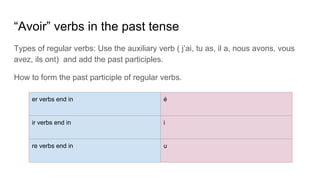
“Avoir” verbs in the past tense
Types of regular verbs: Use the auxiliary verb ( j’ai, tu as, il a, nous avons, vous
avez, ils ont) and add the past participles.
How to form the past participle of regular verbs.
er verbs end in é
ir verbs end in i
re verbs end in u
Voilà! The negation
goes around the
auxiliary verb.
So the present tense of “avoir” or
“être” + the past participle.
Il n’a pas parlé
Tu n’as pas visité.
Elles ne sont pas venues.
image courtesy wikimedia
commons.
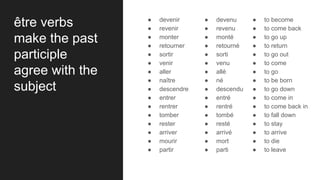
être verbs
make the past
participle
agree with the
subject
● devenir
● revenir
● monter
● retourner
● sortir
● venir
● aller
● naître
● descendre
● entrer
● rentrer
● tomber
● rester
● arriver
● mourir
● partir
● devenu
● revenu
● monté
● retourné
● sorti
● venu
● allé
● né
● descendu
● entré
● rentré
● tombé
● resté
● arrivé
● mort
● parti
● to become
● to come back
● to go up
● to return
● to go out
● to come
● to go
● to be born
● to go down
● to come in
● to come back in
● to fall down
● to stay
● to arrive
● to die
● to leave
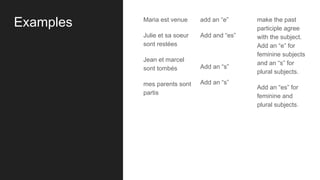
Examples Maria est venue
Julie et sa soeur
sont restées
Jean et marcel
sont tombés
mes parents sont
partis
add an “e”
Add and “es”
Add an “s”
Add an “s”
make the past
participle agree
with the subject.
Add an “e” for
feminine subjects
and an “s” for
plural subjects.
Add an “es” for
feminine and
plural subjects.
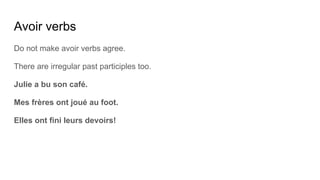
Avoir verbs
Do not make avoir verbs agree.
There are irregular past participles too.
Julie a bu son café.
Mes frères ont joué au foot.
Elles ont fini leurs devoirs!
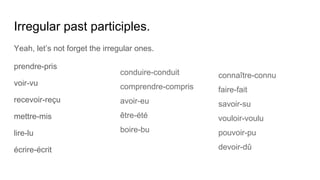
Irregular past participles.
Yeah, let’s not forget the irregular ones.
prendre-pris
voir-vu
recevoir-reçu
mettre-mis
lire-lu
écrire-écrit
conduire-conduit
comprendre-compris
avoir-eu
être-été
boire-bu
connaître-connu
faire-fait
savoir-su
vouloir-voulu
pouvoir-pu
devoir-dû
What about
direct object
pronouns?
image courtesy
pixabay.com
When you have a direct object pronoun, it will go
before the auxiliary verb and the past participle will
agree with the object pronoun.
Tu as vu les films?
Oui je les ai vus. Add an “s” to “vu” to agree with “les
films”
Non, je ne les ai pas vus.
What to do now?
Practice the formation of the passé
composé.
Memorize the past participles, regular and
irregular.
Know where the direct objects go and to
make the past participles agree with the
direct object pronoun.

Review the passé composé

  • 1.
  • 2.
    What is thepassé composé? Use this tense to talk about what you did at a certain time. He watched “Les Misérables”. We finished the assignments. They didn’t wait for their friends.
  • 3.
    Past tense Soen anglais, we use one word to talk about the past. In French, we need two words. These two components are an auxiliary verb (avoir or être) and a past participle. Il a regardé “Les Misérables”. Nous avons fini les devoirs. Ils n’ont pas attendu leurs amis.
  • 4.
    “Avoir” verbs inthe past tense Types of regular verbs: Use the auxiliary verb ( j’ai, tu as, il a, nous avons, vous avez, ils ont) and add the past participles. How to form the past participle of regular verbs. er verbs end in é ir verbs end in i re verbs end in u
  • 5.
    Voilà! The negation goesaround the auxiliary verb. So the present tense of “avoir” or “être” + the past participle. Il n’a pas parlé Tu n’as pas visité. Elles ne sont pas venues. image courtesy wikimedia commons.
  • 6.
    être verbs make thepast participle agree with the subject ● devenir ● revenir ● monter ● retourner ● sortir ● venir ● aller ● naître ● descendre ● entrer ● rentrer ● tomber ● rester ● arriver ● mourir ● partir ● devenu ● revenu ● monté ● retourné ● sorti ● venu ● allé ● né ● descendu ● entré ● rentré ● tombé ● resté ● arrivé ● mort ● parti ● to become ● to come back ● to go up ● to return ● to go out ● to come ● to go ● to be born ● to go down ● to come in ● to come back in ● to fall down ● to stay ● to arrive ● to die ● to leave
  • 7.
    Examples Maria estvenue Julie et sa soeur sont restées Jean et marcel sont tombés mes parents sont partis add an “e” Add and “es” Add an “s” Add an “s” make the past participle agree with the subject. Add an “e” for feminine subjects and an “s” for plural subjects. Add an “es” for feminine and plural subjects.
  • 8.
    Avoir verbs Do notmake avoir verbs agree. There are irregular past participles too. Julie a bu son café. Mes frères ont joué au foot. Elles ont fini leurs devoirs!
  • 9.
    Irregular past participles. Yeah,let’s not forget the irregular ones. prendre-pris voir-vu recevoir-reçu mettre-mis lire-lu écrire-écrit conduire-conduit comprendre-compris avoir-eu être-été boire-bu connaître-connu faire-fait savoir-su vouloir-voulu pouvoir-pu devoir-dû
  • 10.
    What about direct object pronouns? imagecourtesy pixabay.com When you have a direct object pronoun, it will go before the auxiliary verb and the past participle will agree with the object pronoun. Tu as vu les films? Oui je les ai vus. Add an “s” to “vu” to agree with “les films” Non, je ne les ai pas vus.
  • 11.
    What to donow? Practice the formation of the passé composé. Memorize the past participles, regular and irregular. Know where the direct objects go and to make the past participles agree with the direct object pronoun.