HALAL RESEARCH &
DEVELOPMENT
DEFINITION
• Research is an organized & systematic way of finding answers
to questions.
• Systematic is a definite set of procedures & steps which will
follow. It should be done to get the most accurate results.
• Organize is a structure or method in going about doing
research. It is a planned procedure, so it should be focused
and limited to a specific scope.
• Finding answer is the end of all research. Whether the answer
to a hypothesis or even a simple question, research is
successful when we find answers. Sometimes, the answer is no,
but still it is an answer.
• Question is a central to research. If there is no question, then
the answer is of no use. Without a question, research has no
focus, drive or purpose.
Source : Page 4, Halal Research & Science, Salmah Yusof, Faculty Science &
Technology, Universiti Sains Islam Malaysia(USIM).
CONCEPT
• Whether the consumption is prohibited by Allah.
• Whether it is obtained through Halal or Haram
means.
• Whether the material used is harmful to health.
• Preserve the purity of religion.
• Safeguard on the Islamic mentality.
• Preserve life.
• Safeguard property.
• Safeguard future generations.
• Maintain self respect & integrity.
REQUIREMENT
• Expertise of food technologists/scientists, biologists, pharmacists.
• National Fatwa Council.
• Halal Research Laboratory Synergize.
• Halal Industry Research.
• Develop skills & expertise in Shariah & science.
• Special agreement with AIM (Agensi Inovasi Malaysia) – to
conduct inquiries, survey and analysis of data, research &
development relating to innovation and the national innovation
system.
• Collaboration with International Research Institute. – to
standardize Halal R&D internationally and sharing ideas and
techniques.
• Due care step is taken to ensure the products are fully compliant.
• Guidelines for Halal industries & services.
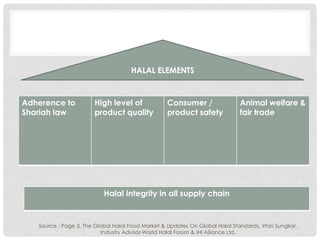
Adherence to
Shariah law
High level of
product quality
Consumer /
product safety
Animal welfare &
fair trade
HALAL ELEMENTS
Halal Integrity in all supply chain
Source : Page 3, The Global Halal Food Market & Updates On Global Halal Standards, Irfan Sungkar,
Industry Advisor-World Halal Forum & IHI Alliance Ltd.
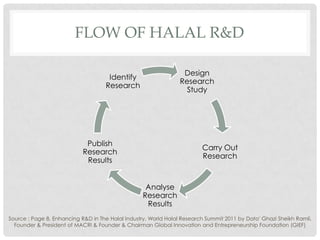
FLOW OF HALAL R&D
Design
Research
Study
Carry Out
Research
Analyse
Research
Results
Publish
Research
Results
Identify
Research
Source : Page 8, Enhancing R&D in The Halal Industry, World Halal Research Summit 2011 by Dato' Ghazi Sheikh Ramli,
Founder & President of MACRI & Founder & Chairman Global Innovation and Entrepreneurship Foundation (GIEF)
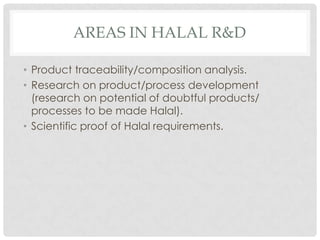
AREAS IN HALAL R&D
• Product traceability/composition analysis.
• Research on product/process development
(research on potential of doubtful products/
processes to be made Halal).
• Scientific proof of Halal requirements.
UNIVERSITY’S PROJECT ON HALAL R&D
• Swot by uitm UITM.pdf
• Studies on halal by ump UMP.pdf
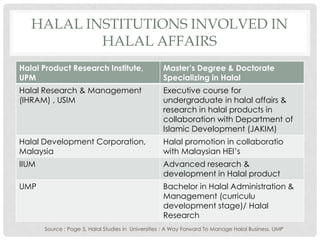
HALAL INSTITUTIONS INVOLVED IN
HALAL AFFAIRS
Halal Product Research Institute,
UPM
Master’s Degree & Doctorate
Specializing in Halal
Halal Research & Management
(IHRAM) , USIM
Executive course for
undergraduate in halal affairs &
research in halal products in
collaboration with Department of
Islamic Development (JAKIM)
Halal Development Corporation,
Malaysia
Halal promotion in collaboratio
with Malaysian HEI’s
IIUM Advanced research &
development in Halal product
UMP Bachelor in Halal Administration &
Management (curriculu
development stage)/ Halal
Research
Source : Page 5, Halal Studies in Universities : A Way Forward To Manage Halal Business, UMP
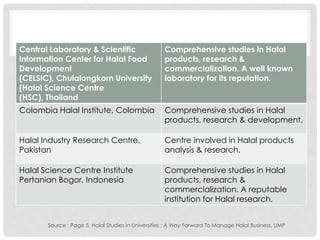
Central Laboratory & Scientific
Information Center for Halal Food
Development
(CELSIC), Chulalongkorn University
(Halal Science Centre
(HSC), Thailand
Comprehensive studies in Halal
products, research &
commercialization. A well known
laboratory for its reputation.
Colombia Halal Institute, Colombia Comprehensive studies in Halal
products, research & development.
Halal Industry Research Centre,
Pakistan
Centre involved in Halal products
analysis & research.
Halal Science Centre Institute
Pertanian Bogor, Indonesia
Comprehensive studies in Halal
products, research &
commercialization. A reputable
institution for Halal research.
Source : Page 5, Halal Studies in Universities : A Way Forward To Manage Halal Business, UMP
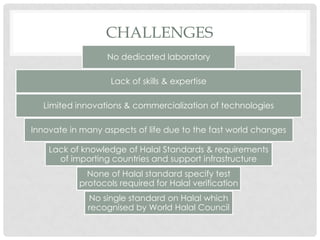
CHALLENGES
No dedicated laboratory
Lack of skills & expertise
Limited innovations & commercialization of technologies
Innovate in many aspects of life due to the fast world changes
Lack of knowledge of Halal Standards & requirements
of importing countries and support infrastructure
None of Halal standard specify test
protocols required for Halal verification
No single standard on Halal which
recognised by World Halal Council
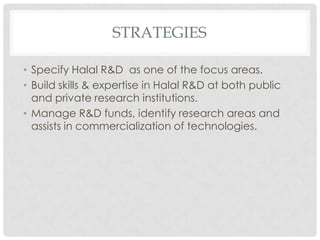
STRATEGIES
• Specify Halal R&D as one of the focus areas.
• Build skills & expertise in Halal R&D at both public
and private research institutions.
• Manage R&D funds, identify research areas and
assists in commercialization of technologies.
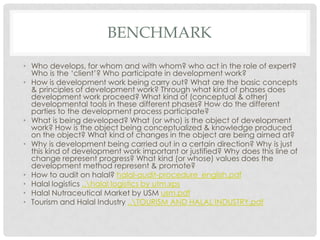
BENCHMARK
• Who develops, for whom and with whom? who act in the role of expert?
Who is the ‘client’? Who participate in development work?
• How is development work being carry out? What are the basic concepts
& principles of development work? Through what kind of phases does
development work proceed? What kind of (conceptual & other)
developmental tools in these different phases? How do the different
parties to the development process participate?
• What is being developed? What (or who) is the object of development
work? How is the object being conceptualized & knowledge produced
on the object? What kind of changes in the object are being aimed at?
• Why is development being carried out in a certain direction? Why is just
this kind of development work important or justified? Why does this line of
change represent progress? What kind (or whose) values does the
development method represent & promote?
• How to audit on halal? halal-audit-procedure_english.pdf
• Halal logistics ..halal logistics by utm.xps
• Halal Nutraceutical Market by USM usm.pdf
• Tourism and Halal Industry ..TOURISM AND HALAL INDUSTRY.pdf
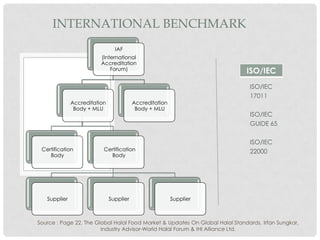
IAF
(International
Accreditation
Forum)
Accreditation
Body + MLU
Certification
Body
Certification
Body
Supplier Supplier Supplier
Accreditation
Body + MLU
ISO/IEC
17011
ISO/IEC
GUIDE 65
ISO/IEC
22000
INTERNATIONAL BENCHMARK
ISO/IEC
Source : Page 22, The Global Halal Food Market & Updates On Global Halal Standards, Irfan Sungkar,
Industry Advisor-World Halal Forum & IHI Alliance Ltd.
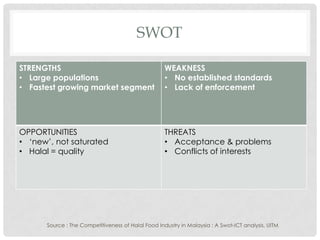
SWOT
STRENGTHS
• Large populations
• Fastest growing market segment
WEAKNESS
• No established standards
• Lack of enforcement
OPPORTUNITIES
• ‘new’, not saturated
• Halal = quality
THREATS
• Acceptance & problems
• Conflicts of interests
Source : The Competitiveness of Halal Food Industry in Malaysia : A Swot-ICT analysis, UITM

Halal research & development 2

  • 1.
  • 2.
    DEFINITION • Research isan organized & systematic way of finding answers to questions. • Systematic is a definite set of procedures & steps which will follow. It should be done to get the most accurate results. • Organize is a structure or method in going about doing research. It is a planned procedure, so it should be focused and limited to a specific scope. • Finding answer is the end of all research. Whether the answer to a hypothesis or even a simple question, research is successful when we find answers. Sometimes, the answer is no, but still it is an answer. • Question is a central to research. If there is no question, then the answer is of no use. Without a question, research has no focus, drive or purpose. Source : Page 4, Halal Research & Science, Salmah Yusof, Faculty Science & Technology, Universiti Sains Islam Malaysia(USIM).
  • 3.
    CONCEPT • Whether theconsumption is prohibited by Allah. • Whether it is obtained through Halal or Haram means. • Whether the material used is harmful to health. • Preserve the purity of religion. • Safeguard on the Islamic mentality. • Preserve life. • Safeguard property. • Safeguard future generations. • Maintain self respect & integrity.
  • 4.
    REQUIREMENT • Expertise offood technologists/scientists, biologists, pharmacists. • National Fatwa Council. • Halal Research Laboratory Synergize. • Halal Industry Research. • Develop skills & expertise in Shariah & science. • Special agreement with AIM (Agensi Inovasi Malaysia) – to conduct inquiries, survey and analysis of data, research & development relating to innovation and the national innovation system. • Collaboration with International Research Institute. – to standardize Halal R&D internationally and sharing ideas and techniques. • Due care step is taken to ensure the products are fully compliant. • Guidelines for Halal industries & services.
  • 5.
    Adherence to Shariah law Highlevel of product quality Consumer / product safety Animal welfare & fair trade HALAL ELEMENTS Halal Integrity in all supply chain Source : Page 3, The Global Halal Food Market & Updates On Global Halal Standards, Irfan Sungkar, Industry Advisor-World Halal Forum & IHI Alliance Ltd.
  • 6.
    FLOW OF HALALR&D Design Research Study Carry Out Research Analyse Research Results Publish Research Results Identify Research Source : Page 8, Enhancing R&D in The Halal Industry, World Halal Research Summit 2011 by Dato' Ghazi Sheikh Ramli, Founder & President of MACRI & Founder & Chairman Global Innovation and Entrepreneurship Foundation (GIEF)
  • 7.
    AREAS IN HALALR&D • Product traceability/composition analysis. • Research on product/process development (research on potential of doubtful products/ processes to be made Halal). • Scientific proof of Halal requirements.
  • 8.
    UNIVERSITY’S PROJECT ONHALAL R&D • Swot by uitm UITM.pdf • Studies on halal by ump UMP.pdf
  • 9.
    HALAL INSTITUTIONS INVOLVEDIN HALAL AFFAIRS Halal Product Research Institute, UPM Master’s Degree & Doctorate Specializing in Halal Halal Research & Management (IHRAM) , USIM Executive course for undergraduate in halal affairs & research in halal products in collaboration with Department of Islamic Development (JAKIM) Halal Development Corporation, Malaysia Halal promotion in collaboratio with Malaysian HEI’s IIUM Advanced research & development in Halal product UMP Bachelor in Halal Administration & Management (curriculu development stage)/ Halal Research Source : Page 5, Halal Studies in Universities : A Way Forward To Manage Halal Business, UMP
  • 10.
    Central Laboratory &Scientific Information Center for Halal Food Development (CELSIC), Chulalongkorn University (Halal Science Centre (HSC), Thailand Comprehensive studies in Halal products, research & commercialization. A well known laboratory for its reputation. Colombia Halal Institute, Colombia Comprehensive studies in Halal products, research & development. Halal Industry Research Centre, Pakistan Centre involved in Halal products analysis & research. Halal Science Centre Institute Pertanian Bogor, Indonesia Comprehensive studies in Halal products, research & commercialization. A reputable institution for Halal research. Source : Page 5, Halal Studies in Universities : A Way Forward To Manage Halal Business, UMP
  • 11.
    CHALLENGES No dedicated laboratory Lackof skills & expertise Limited innovations & commercialization of technologies Innovate in many aspects of life due to the fast world changes Lack of knowledge of Halal Standards & requirements of importing countries and support infrastructure None of Halal standard specify test protocols required for Halal verification No single standard on Halal which recognised by World Halal Council
  • 12.
    STRATEGIES • Specify HalalR&D as one of the focus areas. • Build skills & expertise in Halal R&D at both public and private research institutions. • Manage R&D funds, identify research areas and assists in commercialization of technologies.
  • 13.
    BENCHMARK • Who develops,for whom and with whom? who act in the role of expert? Who is the ‘client’? Who participate in development work? • How is development work being carry out? What are the basic concepts & principles of development work? Through what kind of phases does development work proceed? What kind of (conceptual & other) developmental tools in these different phases? How do the different parties to the development process participate? • What is being developed? What (or who) is the object of development work? How is the object being conceptualized & knowledge produced on the object? What kind of changes in the object are being aimed at? • Why is development being carried out in a certain direction? Why is just this kind of development work important or justified? Why does this line of change represent progress? What kind (or whose) values does the development method represent & promote? • How to audit on halal? halal-audit-procedure_english.pdf • Halal logistics ..halal logistics by utm.xps • Halal Nutraceutical Market by USM usm.pdf • Tourism and Halal Industry ..TOURISM AND HALAL INDUSTRY.pdf
  • 14.
    IAF (International Accreditation Forum) Accreditation Body + MLU Certification Body Certification Body SupplierSupplier Supplier Accreditation Body + MLU ISO/IEC 17011 ISO/IEC GUIDE 65 ISO/IEC 22000 INTERNATIONAL BENCHMARK ISO/IEC Source : Page 22, The Global Halal Food Market & Updates On Global Halal Standards, Irfan Sungkar, Industry Advisor-World Halal Forum & IHI Alliance Ltd.
  • 15.
    SWOT STRENGTHS • Large populations •Fastest growing market segment WEAKNESS • No established standards • Lack of enforcement OPPORTUNITIES • ‘new’, not saturated • Halal = quality THREATS • Acceptance & problems • Conflicts of interests Source : The Competitiveness of Halal Food Industry in Malaysia : A Swot-ICT analysis, UITM