Assist Prof Dragana Drakul
Dose response relationship
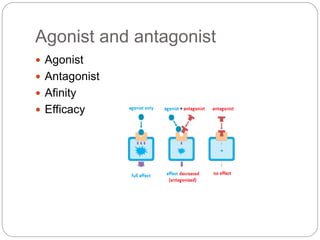
Agonist and antagonist
 Agonist
 Antagonist
 Afinity
 Efficacy
Dose response relationship
 Full description of drug effect in the function of dose
[E=f(D)]
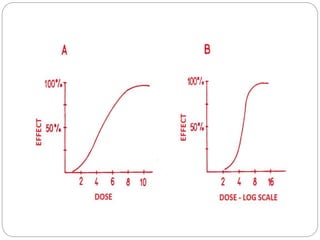
 Dose response line: dose is ploted on X-axe and the
effect is ploted on Y-axe
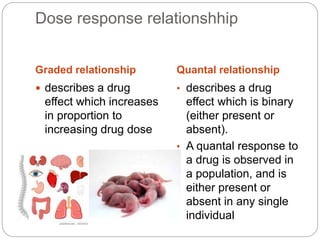
Dose response relationshhip
Graded relationship Quantal relationship
 describes a drug
effect which increases
in proportion to
increasing drug dose
• describes a drug
effect which is binary
(either present or
absent).
• A quantal response to
a drug is observed in
a population, and is
either present or
absent in any single
individual
THERAPEUTIC INDEX, SAFETY
FACTOR, THERAPEUTIC RANGE
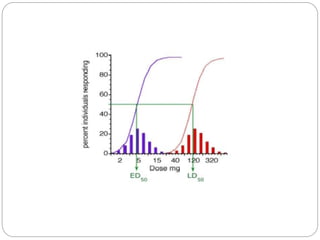
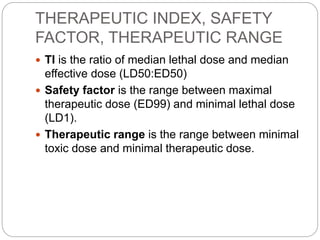
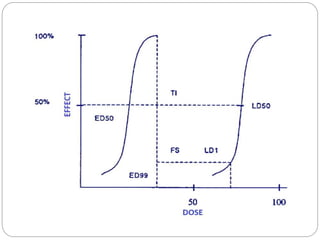
 TI is the ratio of median lethal dose and median
effective dose (LD50:ED50)
 Safety factor is the range between maximal
therapeutic dose (ED99) and minimal lethal dose
(LD1).
 Therapeutic range is the range between minimal
toxic dose and minimal therapeutic dose.
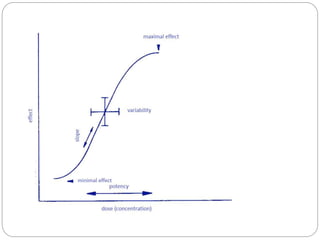
PARAMETERS
1. Potency is correlated with affinity of drug to
receptor
2. Maximal effect represents activity (efficacy) of
drug
3. Minimal effect (treshold effect) is the minimal
measurable effect, the effect of minimal
therapeutic dose
4. Biological variability–patients could have
significantly different responses to the same
dose of drug
5. Slope is dependent on mechanism of action
Different doses
 Physiological  without measurable effect,
 Therapeutical (minimal, median i maximal)
 Daily (sum of all individual doses during a day),
 Toxic (induces toxic effect),
 Lethal (death)
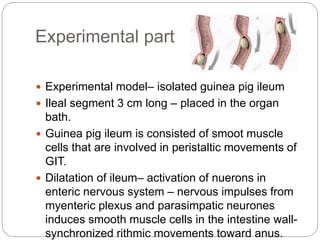
Experimental part
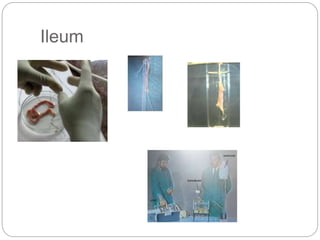
 Experimental model– isolated guinea pig ileum
 Ileal segment 3 cm long – placed in the organ
bath.
 Guinea pig ileum is consisted of smoot muscle
cells that are involved in peristaltic movements of
GIT.
 Dilatation of ileum– activation of nuerons in
enteric nervous system – nervous impulses from
myenteric plexus and parasimpatic neurones
induces smooth muscle cells in the intestine wall-
synchronized rithmic movements toward anus.
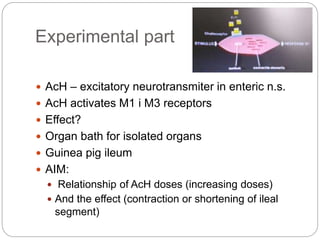
Experimental part
 AcH – excitatory neurotransmiter in enteric n.s.
 AcH activates M1 i M3 receptors
 Effect?
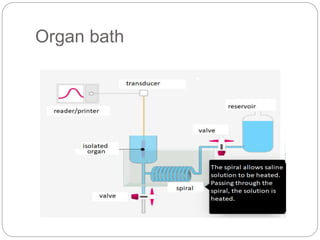
 Organ bath for isolated organs
 Guinea pig ileum
 AIM:
 Relationship of AcH doses (increasing doses)
 And the effect (contraction or shortening of ileal
segment)
Organ bath
Ileum
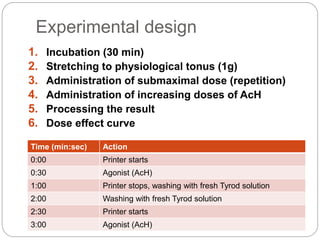
Experimental design
Time (min:sec) Action
0:00 Printer starts
0:30 Agonist (AcH)
1:00 Printer stops, washing with fresh Tyrod solution
2:00 Washing with fresh Tyrod solution
2:30 Printer starts
3:00 Agonist (AcH)
1. Incubation (30 min)
2. Stretching to physiological tonus (1g)
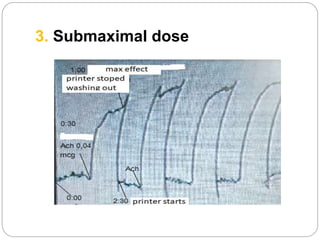
3. Administration of submaximal dose (repetition)
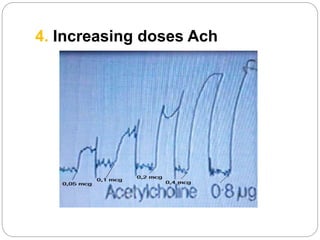
4. Administration of increasing doses of AcH
5. Processing the result
6. Dose effect curve
3. Submaximal dose
4. Increasing doses Ach
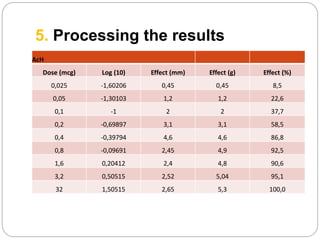
5. Processing the results
AcH
Dose (mcg) Log (10) Effect (mm) Effect (g) Effect (%)
0,025 -1,60206 0,45 0,45 8,5
0,05 -1,30103 1,2 1,2 22,6
0,1 -1 2 2 37,7
0,2 -0,69897 3,1 3,1 58,5
0,4 -0,39794 4,6 4,6 86,8
0,8 -0,09691 2,45 4,9 92,5
1,6 0,20412 2,4 4,8 90,6
3,2 0,50515 2,52 5,04 95,1
32 1,50515 2,65 5,3 100,0
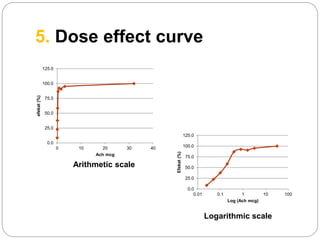
5. Dose effect curve
0.0
25.0
50.0
75.0
100.0
125.0
0 10 20 30 40
efekat
(%)
Ach mcg
Arithmetic scale
0.0
25.0
50.0
75.0
100.0
125.0
0.01 0.1 1 10 100
Efekat
(%)
Log (Ach mcg)
Logarithmic scale
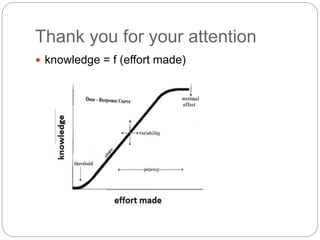
Thank you for your attention
 knowledge = f (effort made)

Dose response relationship.ppt pharmacology

  • 1.
    Assist Prof DraganaDrakul Dose response relationship
  • 2.
    Agonist and antagonist Agonist  Antagonist  Afinity  Efficacy
  • 3.
    Dose response relationship Full description of drug effect in the function of dose [E=f(D)]  Dose response line: dose is ploted on X-axe and the effect is ploted on Y-axe
  • 4.
    Dose response relationshhip Gradedrelationship Quantal relationship  describes a drug effect which increases in proportion to increasing drug dose • describes a drug effect which is binary (either present or absent). • A quantal response to a drug is observed in a population, and is either present or absent in any single individual
  • 8.
    THERAPEUTIC INDEX, SAFETY FACTOR,THERAPEUTIC RANGE  TI is the ratio of median lethal dose and median effective dose (LD50:ED50)  Safety factor is the range between maximal therapeutic dose (ED99) and minimal lethal dose (LD1).  Therapeutic range is the range between minimal toxic dose and minimal therapeutic dose.
  • 11.
    PARAMETERS 1. Potency iscorrelated with affinity of drug to receptor 2. Maximal effect represents activity (efficacy) of drug 3. Minimal effect (treshold effect) is the minimal measurable effect, the effect of minimal therapeutic dose 4. Biological variability–patients could have significantly different responses to the same dose of drug 5. Slope is dependent on mechanism of action
  • 12.
    Different doses  Physiological without measurable effect,  Therapeutical (minimal, median i maximal)  Daily (sum of all individual doses during a day),  Toxic (induces toxic effect),  Lethal (death)
  • 13.
    Experimental part  Experimentalmodel– isolated guinea pig ileum  Ileal segment 3 cm long – placed in the organ bath.  Guinea pig ileum is consisted of smoot muscle cells that are involved in peristaltic movements of GIT.  Dilatation of ileum– activation of nuerons in enteric nervous system – nervous impulses from myenteric plexus and parasimpatic neurones induces smooth muscle cells in the intestine wall- synchronized rithmic movements toward anus.
  • 14.
    Experimental part  AcH– excitatory neurotransmiter in enteric n.s.  AcH activates M1 i M3 receptors  Effect?  Organ bath for isolated organs  Guinea pig ileum  AIM:  Relationship of AcH doses (increasing doses)  And the effect (contraction or shortening of ileal segment)
  • 15.
  • 16.
  • 17.
    Experimental design Time (min:sec)Action 0:00 Printer starts 0:30 Agonist (AcH) 1:00 Printer stops, washing with fresh Tyrod solution 2:00 Washing with fresh Tyrod solution 2:30 Printer starts 3:00 Agonist (AcH) 1. Incubation (30 min) 2. Stretching to physiological tonus (1g) 3. Administration of submaximal dose (repetition) 4. Administration of increasing doses of AcH 5. Processing the result 6. Dose effect curve
  • 18.
  • 19.
  • 20.
    5. Processing theresults AcH Dose (mcg) Log (10) Effect (mm) Effect (g) Effect (%) 0,025 -1,60206 0,45 0,45 8,5 0,05 -1,30103 1,2 1,2 22,6 0,1 -1 2 2 37,7 0,2 -0,69897 3,1 3,1 58,5 0,4 -0,39794 4,6 4,6 86,8 0,8 -0,09691 2,45 4,9 92,5 1,6 0,20412 2,4 4,8 90,6 3,2 0,50515 2,52 5,04 95,1 32 1,50515 2,65 5,3 100,0
  • 21.
    5. Dose effectcurve 0.0 25.0 50.0 75.0 100.0 125.0 0 10 20 30 40 efekat (%) Ach mcg Arithmetic scale 0.0 25.0 50.0 75.0 100.0 125.0 0.01 0.1 1 10 100 Efekat (%) Log (Ach mcg) Logarithmic scale
  • 22.
    Thank you foryour attention  knowledge = f (effort made)