Department of Computer Science & Engg
College of Engineering,
Submitted by
Umme Ayesha
CONTENT
SL.NO TOPICS PAGE NO.
1 INTRODUCTION 1
2 OBJECTIVES 2
3 DEFINITIONS,MOTIVES,IMPORTANCE 3-7
5 MITIGATION OF PHISHING ATTACKS 8-12
6 DETECTION OF PHISHING ATTACKS 13-22
7 EVALUATIONOF PHISHING TECHNIQUES 23
8 CONCLUSION 24
9 REFERENCES 25
DEPT. OF COMPUTER SCIENCE
PHISHING DETECTION-A LITERATURE SURVEY
2014
INTRODUCTION
 PHISHING is a social engineering attack that aims at
exploiting the weakness found in system processes as
caused by system users.
 For eg. user leak their passwords if an attacker asked them
to update via http link.
 Due to the broad nature of the phishing problem, this
phishing detection survey was began.
DEPT.OF COMPUTER SCIENCE
PHISHING DETECTION-A LITERATURE SURVEY
20141
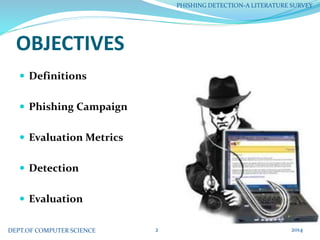
OBJECTIVES
 Definitions
 Phishing Campaign
 Evaluation Metrics
 Detection
 Evaluation
DEPT.OF COMPUTER SCIENCE
PHISHING DETECTION-A LITERATURE SURVEY
2 2014
DEFINITIONS
 “Phishing is a fraudulent attempt, usually made through
email, to steal your personal information”
 “We define a phishing page as any web page that, without
permission, alleges to act on behalf of a third party with the
intention of confusing viewers into performing an action
with which the viewer would only trust a true agent of the
third party”
 Phishing is a type of computer attack that communicates
socially engineered messages to humans via electronic
communication channels in order to persuade them to
perform certain actions for the attacker’s benefit.
DEPT.OF COMPUTER SCIENCE
PHISHING DETECTION-A LITERATURE SURVEY
3 2014
PHISHING MOTIVES
 The primary motives behind phishing attacks, from an
attacker’s perspective, are:
 Financial Gain: phishers can use stolen banking creden-
tials to their financial benefits.
 Identity Hiding: instead of using stolen identities directly,
phishers might sell the identities to others whom might be
criminals seeking ways to hide their identities and activities
 Fame and Notoriety: phishers might attack victims for the
sake of peer recognition.
DEPT.OF COMPUTER SCIENCE
PHISHING DETECTION-A LITERATURE SURVEY
4 2014
DEPT.OF COMPUTER SCIENCE
PHISHING DETECTION-A LITERATURE SURVEY
5 2014
IMPORTANCE
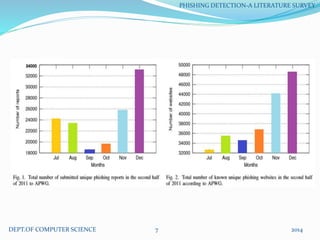
 According to APWG, phishing attacks were in a raise till
August, 2009 40,621 unique phishing reports were
submitted to APWG.
 Drop in campaign due disappearence of Avanlanche gang.
(2010-11)
 Avalanche gang from traditional phishing campaigns into
malware-based phishing campaigns. (raise)
PHISHING DETECTION-A LITERATURE SURVEY
DEPT.OF COMPUTER SCIENCE 6 2014
PHISHING DETECTION-A LITERATURE SURVEY
DEPT.OF COMPUTER SCIENCE 7 2014
MITIGATION OF PHISHING
ATTACKS
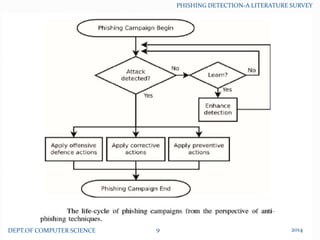
Once the phishing attack is detected, a number of actions
could be applied against the campaign. The following
categories of approaches exist:
 Detection approaches
 Offensive Defence Approach
 Correction Approach
 Prevention Approach
DEPT.OF COMPUTER SCIENCE
PHISHING DETECTION-A LITERATURE SURVEY
8 2014
PHISHING DETECTION-A LITERATURE SURVEY
DEPT.OF COMPUTER SCIENCE 20149
(1) Detection Approaches
 User Training Approaches - end-users can be educated to
better understand the nature of phishing attacks, phishing
and non-phishing messages.
 Software classification approaches — these mitigation
approaches aim at classifying phishing and legitimate
messages on behalf of the user in an attempt to bridge the
gap that is left due to the human error or ignorance.
DEPT.OF COMPUTER SCIENCE
PHISHING DETECTION-A LITERATURE SURVEY
201410
(2) Offensive Defence Approach
 Offensive defence solutions aim to render phishing cam-
pains useless for the attackers by disrupting the phishing
campaigns.
 This is often achieved by flooding phishing web- sites with
fake credentials so that the attacker would have a difficult
time to find the real credentials.
 Example, BogusBiter : A browser toolbar that submits fake
information in HTML forms whenever a phishing website
is encountered.
DEPT.OF COMPUTER SCIENCE
PHISHING DETECTION-A LITERATURE SURVEY
201411
(3)Correction Approach
Correction is the act of taking the phishing resources down.
This is often achieved by reporting attacks to Service
Providers. Phishing campaigns often rely on resources,
such as:
 Websites
 E-mail messages
 Social Networking services
In order to correct such attempts
• Removal of phishing content from websites, or suspension
of hosting services.
• Suspension of email accounts, SMTP relays, VoIP ser vices.
• Trace back and shutdown of botnets.
DEPT.OF COMPUTER SCIENCE
PHISHING DETECTION-A LITERATURE SURVEY
201412
DEPT.OF COMPUTER SCIENCE
PHISHING DETECTION-A LITERATURE SURVEY
13 2014
(4)Prevention Approaches
The “prevention” of phishing attacks can be confusing, as it
can mean different things depending on its context:
 Prevention of users from falling victim — in this case,
phishing techniques will also be considered prevention
techniques.
 Prevention of attackers from starting phishing campaigns
— law suits and penalties against attackers by Law
Enforcement Agencies (LEAs) are considered as prevention
techniques.
DEPT.OF COMPUTER SCIENCE
PHISHING DETECTION-A LITERATURE SURVEY
201414
EVALUATION METRICS
PHISHING DETECTION-A LITERATURE SURVEY
15 2014DEPT.OF COMPUTER SCIENCE
DEPT.OF COMPUTER SCIENCE
DETECTION OF PHISHING ATTACKS
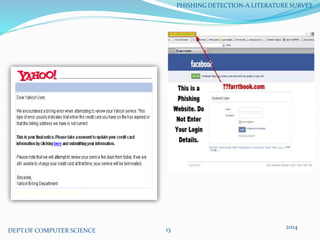
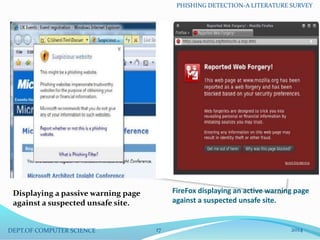
 Passive and Active Warnings
• Passive warnings — the warning does not block the
content-area and enables the user to view both the
content and the warning.
• Active warnings — the warning blocks the content-
data, which prohibits the user from viewing the content-
data while the warning is displayed
PHISHING DETECTION-A LITERATURE SURVEY
201416
FireFox displaying an active warning page
against a suspected unsafe site.
Displaying a passive warning page
against a suspected unsafe site.
DEPT.OF COMPUTER SCIENCE
PHISHING DETECTION-A LITERATURE SURVEY
201417
 Google Safe Browsing API
 Enables client applications to validate whether a given
URL exists in blacklists that are constantly updated by
Google.
 The current implementation of the protocol is provided by
Google.
 The API requires client applications to communicate with
providers through HTTP while adhering to syntax specified
in Protocolv2Spec.
DEPT.OF COMPUTER SCIENCE
PHISHING DETECTION-A LITERATURE SURVEY
201418
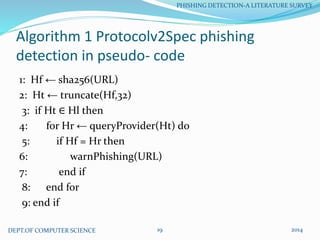
Algorithm 1 Protocolv2Spec phishing
detection in pseudo- code
1: Hf ← sha256(URL)
2: Ht ← truncate(Hf,32)
3: if Ht ∈ Hl then
4: for Hr ← queryProvider(Ht) do
5: if Hf = Hr then
6: warnPhishing(URL)
7: end if
8: end for
9: end if
DEPT.OF COMPUTER SCIENCE
PHISHING DETECTION-A LITERATURE SURVEY
201419
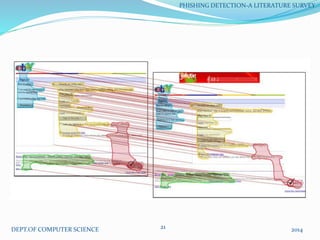
 Visual similarity
 Classification with Discriminative Keypoint Features.
 This mechanism is agnostic to the underlying code or
technology that renders the final visual output to the
users eyes.
 Mimics a website using img tag.
 Snapshot is then matched with whitelist.
PHISHING DETECTION-A LITERATURE SURVEY
DEPT.OF COMPUTER SCIENCE 20 2014
PHISHING DETECTION-A LITERATURE SURVEY
DEPT.OF COMPUTER SCIENCE 21 2014
EVALUATION
 The study concluded that user training approaches are
promising. Virtually user training approaches increased TP
rate.
 Blacklists are able to achieve low FP rates. Ineffective
against zero- hour attacks.
 The effectiveness of visual similarity techniques might not
be accurately known, but rather assumed.
DEPT.OF COMPUTER SCIENCE
PHISHING DETECTION-A LITERATURE SURVEY
201422
CONCLUSION
 Phishing is a growing crime and one that we must be
aware of. Although laws have been enacted, education is
the best defence against phishing. Being a bit suspicious of
all electronic communications and websites is
recommmended. Lookout for the common characteristics -
sense of urgency, request for verification, and grammer and
spelling errors. Also, get in the habit of comparing the
provided URL with the an independent search for the
company's website.
PHISHING DETECTION-A LITERATURE SURVEY
23 2014DEPT.OF COMPUTER SCIENCE
REFERENCES
[1] Mahmoud Khonji, Youssef Iraqi, Senior Member, IEEE, and Andrew Jones. IEEE
COMMUNICATIONS SURVEYS & TUTORIALS, VOL. 15, NO. 4, FOURTH QUARTER
2013
[2] B. Krebs, “HBGary Federal hacked by Anonymous,”
http://krebsonsecurity.com/2011/02/hbgary-federal-hacked-by-anonymous/, 2011,
accessed December 2011.
[3] B. Schneier, “Lockheed Martin hack linked to RSA’s SecurID breach,”
http://www.schneier.com/blog/archives/2011/05/lockheed martin.html, 2011, accessed
December 2011.
[4] C. Whittaker, B. Ryner, and M. Nazif, “Large-scale automatic classifi- cation of phishing
pages,” in NDSS ’10, 2010.
[5] Anti-Phishing Working Group (APWG), “Phish- ing activity trends report — second half
2010,” http://apwg.org/reports/apwg report h2 2010.pdf, 2010, accessed December 2011.
[6] Anti-Phishing Working Group (APWG), “Phish- ing activity trends report —
second half 2011,” http://apwg.org/reports/apwg trends report h2 2011.pdf, 2011,
accessed July 2012
24 2014DEPT.OF COMPUTER SCIENCE
PHISHING DETECTION-A LITERATURE SURVEY
201425DEPT.OF COMPUTER SCIENCE
PHISHING DETECTION-A LITERATURE SURVEY

PHISHING DETECTION

  • 1.
    Department of ComputerScience & Engg College of Engineering, Submitted by Umme Ayesha
  • 2.
    CONTENT SL.NO TOPICS PAGENO. 1 INTRODUCTION 1 2 OBJECTIVES 2 3 DEFINITIONS,MOTIVES,IMPORTANCE 3-7 5 MITIGATION OF PHISHING ATTACKS 8-12 6 DETECTION OF PHISHING ATTACKS 13-22 7 EVALUATIONOF PHISHING TECHNIQUES 23 8 CONCLUSION 24 9 REFERENCES 25 DEPT. OF COMPUTER SCIENCE PHISHING DETECTION-A LITERATURE SURVEY 2014
  • 3.
    INTRODUCTION  PHISHING isa social engineering attack that aims at exploiting the weakness found in system processes as caused by system users.  For eg. user leak their passwords if an attacker asked them to update via http link.  Due to the broad nature of the phishing problem, this phishing detection survey was began. DEPT.OF COMPUTER SCIENCE PHISHING DETECTION-A LITERATURE SURVEY 20141
  • 4.
    OBJECTIVES  Definitions  PhishingCampaign  Evaluation Metrics  Detection  Evaluation DEPT.OF COMPUTER SCIENCE PHISHING DETECTION-A LITERATURE SURVEY 2 2014
  • 5.
    DEFINITIONS  “Phishing isa fraudulent attempt, usually made through email, to steal your personal information”  “We define a phishing page as any web page that, without permission, alleges to act on behalf of a third party with the intention of confusing viewers into performing an action with which the viewer would only trust a true agent of the third party”  Phishing is a type of computer attack that communicates socially engineered messages to humans via electronic communication channels in order to persuade them to perform certain actions for the attacker’s benefit. DEPT.OF COMPUTER SCIENCE PHISHING DETECTION-A LITERATURE SURVEY 3 2014
  • 6.
    PHISHING MOTIVES  Theprimary motives behind phishing attacks, from an attacker’s perspective, are:  Financial Gain: phishers can use stolen banking creden- tials to their financial benefits.  Identity Hiding: instead of using stolen identities directly, phishers might sell the identities to others whom might be criminals seeking ways to hide their identities and activities  Fame and Notoriety: phishers might attack victims for the sake of peer recognition. DEPT.OF COMPUTER SCIENCE PHISHING DETECTION-A LITERATURE SURVEY 4 2014
  • 7.
    DEPT.OF COMPUTER SCIENCE PHISHINGDETECTION-A LITERATURE SURVEY 5 2014
  • 8.
    IMPORTANCE  According toAPWG, phishing attacks were in a raise till August, 2009 40,621 unique phishing reports were submitted to APWG.  Drop in campaign due disappearence of Avanlanche gang. (2010-11)  Avalanche gang from traditional phishing campaigns into malware-based phishing campaigns. (raise) PHISHING DETECTION-A LITERATURE SURVEY DEPT.OF COMPUTER SCIENCE 6 2014
  • 9.
    PHISHING DETECTION-A LITERATURESURVEY DEPT.OF COMPUTER SCIENCE 7 2014
  • 10.
    MITIGATION OF PHISHING ATTACKS Oncethe phishing attack is detected, a number of actions could be applied against the campaign. The following categories of approaches exist:  Detection approaches  Offensive Defence Approach  Correction Approach  Prevention Approach DEPT.OF COMPUTER SCIENCE PHISHING DETECTION-A LITERATURE SURVEY 8 2014
  • 11.
    PHISHING DETECTION-A LITERATURESURVEY DEPT.OF COMPUTER SCIENCE 20149
  • 12.
    (1) Detection Approaches User Training Approaches - end-users can be educated to better understand the nature of phishing attacks, phishing and non-phishing messages.  Software classification approaches — these mitigation approaches aim at classifying phishing and legitimate messages on behalf of the user in an attempt to bridge the gap that is left due to the human error or ignorance. DEPT.OF COMPUTER SCIENCE PHISHING DETECTION-A LITERATURE SURVEY 201410
  • 13.
    (2) Offensive DefenceApproach  Offensive defence solutions aim to render phishing cam- pains useless for the attackers by disrupting the phishing campaigns.  This is often achieved by flooding phishing web- sites with fake credentials so that the attacker would have a difficult time to find the real credentials.  Example, BogusBiter : A browser toolbar that submits fake information in HTML forms whenever a phishing website is encountered. DEPT.OF COMPUTER SCIENCE PHISHING DETECTION-A LITERATURE SURVEY 201411
  • 14.
    (3)Correction Approach Correction isthe act of taking the phishing resources down. This is often achieved by reporting attacks to Service Providers. Phishing campaigns often rely on resources, such as:  Websites  E-mail messages  Social Networking services In order to correct such attempts • Removal of phishing content from websites, or suspension of hosting services. • Suspension of email accounts, SMTP relays, VoIP ser vices. • Trace back and shutdown of botnets. DEPT.OF COMPUTER SCIENCE PHISHING DETECTION-A LITERATURE SURVEY 201412
  • 15.
    DEPT.OF COMPUTER SCIENCE PHISHINGDETECTION-A LITERATURE SURVEY 13 2014
  • 16.
    (4)Prevention Approaches The “prevention”of phishing attacks can be confusing, as it can mean different things depending on its context:  Prevention of users from falling victim — in this case, phishing techniques will also be considered prevention techniques.  Prevention of attackers from starting phishing campaigns — law suits and penalties against attackers by Law Enforcement Agencies (LEAs) are considered as prevention techniques. DEPT.OF COMPUTER SCIENCE PHISHING DETECTION-A LITERATURE SURVEY 201414
  • 17.
    EVALUATION METRICS PHISHING DETECTION-ALITERATURE SURVEY 15 2014DEPT.OF COMPUTER SCIENCE
  • 18.
    DEPT.OF COMPUTER SCIENCE DETECTIONOF PHISHING ATTACKS  Passive and Active Warnings • Passive warnings — the warning does not block the content-area and enables the user to view both the content and the warning. • Active warnings — the warning blocks the content- data, which prohibits the user from viewing the content- data while the warning is displayed PHISHING DETECTION-A LITERATURE SURVEY 201416
  • 19.
    FireFox displaying anactive warning page against a suspected unsafe site. Displaying a passive warning page against a suspected unsafe site. DEPT.OF COMPUTER SCIENCE PHISHING DETECTION-A LITERATURE SURVEY 201417
  • 20.
     Google SafeBrowsing API  Enables client applications to validate whether a given URL exists in blacklists that are constantly updated by Google.  The current implementation of the protocol is provided by Google.  The API requires client applications to communicate with providers through HTTP while adhering to syntax specified in Protocolv2Spec. DEPT.OF COMPUTER SCIENCE PHISHING DETECTION-A LITERATURE SURVEY 201418
  • 21.
    Algorithm 1 Protocolv2Specphishing detection in pseudo- code 1: Hf ← sha256(URL) 2: Ht ← truncate(Hf,32) 3: if Ht ∈ Hl then 4: for Hr ← queryProvider(Ht) do 5: if Hf = Hr then 6: warnPhishing(URL) 7: end if 8: end for 9: end if DEPT.OF COMPUTER SCIENCE PHISHING DETECTION-A LITERATURE SURVEY 201419
  • 22.
     Visual similarity Classification with Discriminative Keypoint Features.  This mechanism is agnostic to the underlying code or technology that renders the final visual output to the users eyes.  Mimics a website using img tag.  Snapshot is then matched with whitelist. PHISHING DETECTION-A LITERATURE SURVEY DEPT.OF COMPUTER SCIENCE 20 2014
  • 23.
    PHISHING DETECTION-A LITERATURESURVEY DEPT.OF COMPUTER SCIENCE 21 2014
  • 24.
    EVALUATION  The studyconcluded that user training approaches are promising. Virtually user training approaches increased TP rate.  Blacklists are able to achieve low FP rates. Ineffective against zero- hour attacks.  The effectiveness of visual similarity techniques might not be accurately known, but rather assumed. DEPT.OF COMPUTER SCIENCE PHISHING DETECTION-A LITERATURE SURVEY 201422
  • 26.
    CONCLUSION  Phishing isa growing crime and one that we must be aware of. Although laws have been enacted, education is the best defence against phishing. Being a bit suspicious of all electronic communications and websites is recommmended. Lookout for the common characteristics - sense of urgency, request for verification, and grammer and spelling errors. Also, get in the habit of comparing the provided URL with the an independent search for the company's website. PHISHING DETECTION-A LITERATURE SURVEY 23 2014DEPT.OF COMPUTER SCIENCE
  • 27.
    REFERENCES [1] Mahmoud Khonji,Youssef Iraqi, Senior Member, IEEE, and Andrew Jones. IEEE COMMUNICATIONS SURVEYS & TUTORIALS, VOL. 15, NO. 4, FOURTH QUARTER 2013 [2] B. Krebs, “HBGary Federal hacked by Anonymous,” http://krebsonsecurity.com/2011/02/hbgary-federal-hacked-by-anonymous/, 2011, accessed December 2011. [3] B. Schneier, “Lockheed Martin hack linked to RSA’s SecurID breach,” http://www.schneier.com/blog/archives/2011/05/lockheed martin.html, 2011, accessed December 2011. [4] C. Whittaker, B. Ryner, and M. Nazif, “Large-scale automatic classifi- cation of phishing pages,” in NDSS ’10, 2010. [5] Anti-Phishing Working Group (APWG), “Phish- ing activity trends report — second half 2010,” http://apwg.org/reports/apwg report h2 2010.pdf, 2010, accessed December 2011. [6] Anti-Phishing Working Group (APWG), “Phish- ing activity trends report — second half 2011,” http://apwg.org/reports/apwg trends report h2 2011.pdf, 2011, accessed July 2012 24 2014DEPT.OF COMPUTER SCIENCE PHISHING DETECTION-A LITERATURE SURVEY
  • 28.
    201425DEPT.OF COMPUTER SCIENCE PHISHINGDETECTION-A LITERATURE SURVEY