DOPPLER EFFECT
DOPPLER EFFECT
1. Definition
2. Explanation with four cases
3. Applications
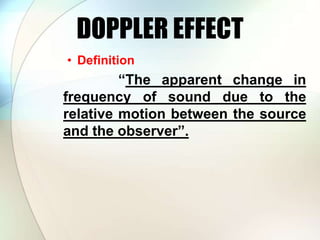
DOPPLER EFFECT
• Definition
“The apparent change in
frequency of sound due to the
relative motion between the source
and the observer”.
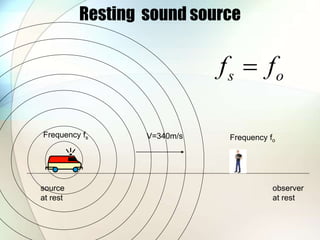
Resting sound source
source
at rest
observer
at rest
Frequency fs Frequency fo
s o
f f

V=340m/s
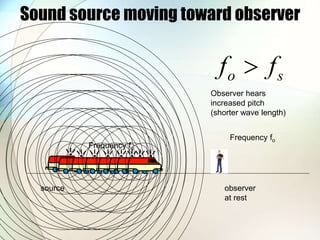
Sound source moving toward observer
source observer
at rest
Frequency fs
Frequency fo
o s
f f

Observer hears
increased pitch
(shorter wave length)
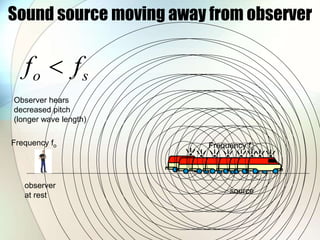
Sound source moving away from observer
source
observer
at rest
Frequency fs
Frequency fo
o s
f f

Observer hears
decreased pitch
(longer wave length)
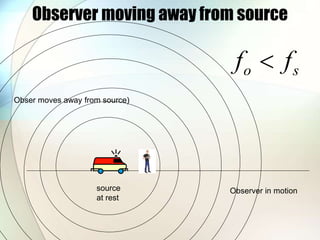
Observer moving away from source
Observer in motion
source
at rest
Obser moves away from source)
o s
f f

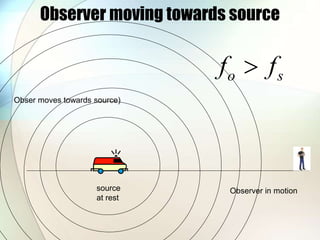
Observer moving towards source
Observer in motion
source
at rest
Obser moves towards source)
o s
f f

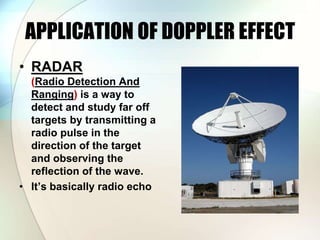
APPLICATION OF DOPPLER EFFECT
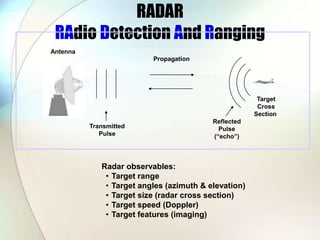
• RADAR
(Radio Detection And
Ranging) is a way to
detect and study far off
targets by transmitting a
radio pulse in the
direction of the target
and observing the
reflection of the wave.
• It’s basically radio echo
RADAR
RAdio Detection And Ranging
Radar observables:
• Target range
• Target angles (azimuth & elevation)
• Target size (radar cross section)
• Target speed (Doppler)
• Target features (imaging)
Antenna
Transmitted
Pulse
Target
Cross
Section
Propagation
Reflected
Pulse
(“echo”)
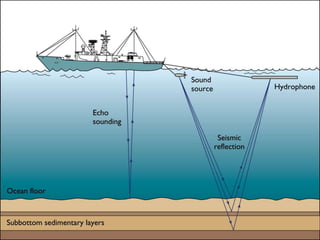
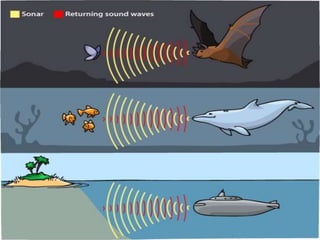
SONAR
So sound
Na navigation and
R ranging
• A sensor is used to detect objects
through the use of high or low
frequency sound waves.
pitch.ppt
pitch.ppt
pitch.ppt
pitch.ppt

pitch.ppt

  • 1.
  • 2.
    DOPPLER EFFECT 1. Definition 2.Explanation with four cases 3. Applications
  • 3.
    DOPPLER EFFECT • Definition “Theapparent change in frequency of sound due to the relative motion between the source and the observer”.
  • 4.
    Resting sound source source atrest observer at rest Frequency fs Frequency fo s o f f  V=340m/s
  • 5.
    Sound source movingtoward observer source observer at rest Frequency fs Frequency fo o s f f  Observer hears increased pitch (shorter wave length)
  • 6.
    Sound source movingaway from observer source observer at rest Frequency fs Frequency fo o s f f  Observer hears decreased pitch (longer wave length)
  • 8.
    Observer moving awayfrom source Observer in motion source at rest Obser moves away from source) o s f f 
  • 9.
    Observer moving towardssource Observer in motion source at rest Obser moves towards source) o s f f 
  • 10.
    APPLICATION OF DOPPLEREFFECT • RADAR (Radio Detection And Ranging) is a way to detect and study far off targets by transmitting a radio pulse in the direction of the target and observing the reflection of the wave. • It’s basically radio echo
  • 11.
    RADAR RAdio Detection AndRanging Radar observables: • Target range • Target angles (azimuth & elevation) • Target size (radar cross section) • Target speed (Doppler) • Target features (imaging) Antenna Transmitted Pulse Target Cross Section Propagation Reflected Pulse (“echo”)
  • 12.
    SONAR So sound Na navigationand R ranging • A sensor is used to detect objects through the use of high or low frequency sound waves.