

SEDATIVES
AND
HYPNOTICS
JASDEEP SINGH
M.Pharm(Pharmacology)
Overview
 Introduction
Historical Perspectives
Classification: Sedative / Hypnotics
Mechanism of action
Barbiturates
Benzodiazepines
Miscellaneous Hypnotics & Anxiolytics
INTRODUCTION
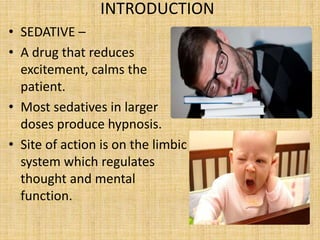
• SEDATIVE –
• A drug that reduces
excitement, calms the
patient.
• Most sedatives in larger
doses produce hypnosis.
• Site of action is on the limbic
system which regulates
thought and mental
function.
Hypnotic
• A drug which produces
sleep resembling
natural sleep.
• They are used for
initiation or
maintenance of sleep.
• Hypnotics in higher
doses produce General
anaesthesia.
• Site of action is on the
midbrain and ascending
RAS which maintain
wakefulness.
SLEEP
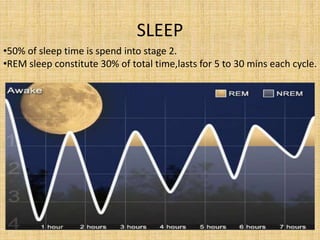
•50% of sleep time is spend into stage 2.
•REM sleep constitute 30% of total time,lasts for 5 to 30 mins each cycle.
HISTORY
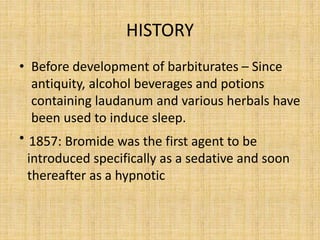
• Before development of barbiturates – Since
antiquity, alcohol beverages and potions
containing laudanum and various herbals have
been used to induce sleep.
• 1857: Bromide was the first agent to be
introduced specifically as a sedative and soon
thereafter as a hypnotic
HISTORY
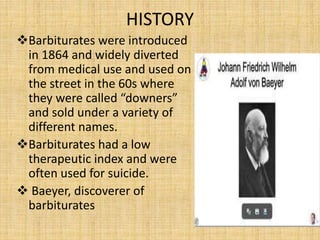
Barbiturates were introduced
in 1864 and widely diverted
from medical use and used on
the street in the 60s where
they were called “downers”
and sold under a variety of
different names.
Barbiturates had a low
therapeutic index and were
often used for suicide.
 Baeyer, discoverer of
barbiturates
History
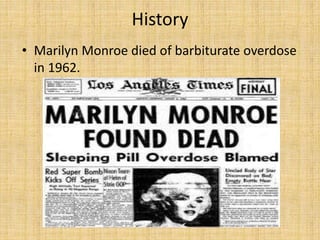
• Marilyn Monroe died of barbiturate overdose
in 1962.
HISTORY
• 20th century, barbiturates
replaced by
benzodiazepines.
• 1961:introduction of
chlordiazepoxide
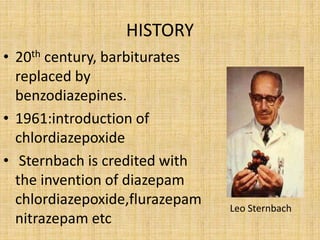
• Sternbach is credited with
the invention of diazepam
chlordiazepoxide,flurazepam
nitrazepam etc
Leo Sternbach
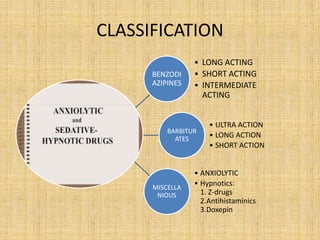
CLASSIFICATION
BENZODI
AZIPINES
• LONG ACTING
• SHORT ACTING
• INTERMEDIATE
ACTING
BARBITUR
ATES
• ULTRA ACTION
• LONG ACTION
• SHORT ACTION
MISCELLA
NIOUS
• ANXIOLYTIC
• Hypnotics:
1. Z-drugs
2.Antihistaminics
3.Doxepin
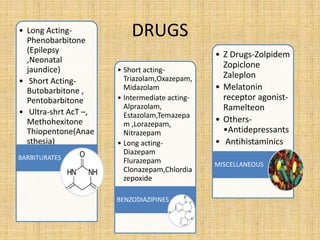
DRUGS• Long Acting-
Phenobarbitone
(Epilepsy
,Neonatal
jaundice)
• Short Acting-
Butobarbitone ,
Pentobarbitone
• Ultra-shrt AcT –,
Methohexitone
Thiopentone(Anae
sthesia)
BARBITURATES
• Short acting-
Triazolam,Oxazepam,
Midazolam
• Intermediate acting-
Alprazolam,
Estazolam,Temazepa
m ,Lorazepam,
Nitrazepam
• Long acting-
Diazepam
Flurazepam
Clonazepam,Chlordia
zepoxide
BENZODIAZIPINES
• Z Drugs-Zolpidem
Zopiclone
Zaleplon
• Melatonin
receptor agonist-
Ramelteon
• Others-
•Antidepressants
• Antihistaminics
MISCELLANEOUS
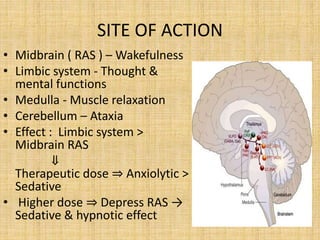
SITE OF ACTION
• Midbrain ( RAS ) – Wakefulness
• Limbic system - Thought &
mental functions
• Medulla - Muscle relaxation
• Cerebellum – Ataxia
• Effect : Limbic system >
Midbrain RAS
⇓
Therapeutic dose ⇒ Anxiolytic >
Sedative
• Higher dose ⇒ Depress RAS →
Sedative & hypnotic effect
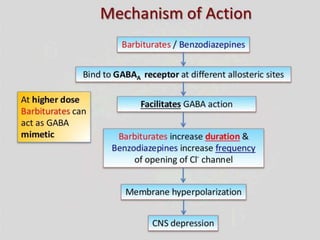
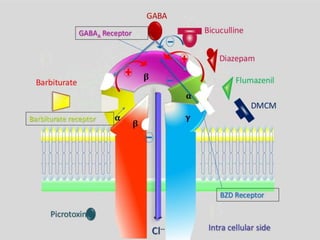
MECHANISM OF ACTION
• BENZODIAZEPINES –
- increase frequency of opening of Cl- channels induced by
GABA (GABA facilitatory action).
- increase binding of GABA to GABAA receptor .
• BARBITURATES –
- increase duration of opening of Cl- channels induced by GABA
(GABA facilitatory action)
- at high concentration can directly increase Cl- conductance
through Cl- channels (GABA mimetic action)
- inhibit Ca dependent release of neurotransmitters .
- at very high conc. (anaesthetic doses) depress voltage
sensitive Na+ & K+ channels.
BARBITURATES
• USE—
– Barbiturates have been used as
mild sedatives to relieve
anxiety, nervous tension, and
insomnia.
--Hyperbilirubinemia and
kernicterus in the neonates
BARBITURATES
• ADVERSE EFFECT—
• drowsiness, impaired concentration, and
mental and physical sluggishness
• The CNS depressant effects of barbiturates
synergize with those of ethanol.
• Hypnotic doses of barbiturates produce a
drug “hangover” that may lead to impaired
ability to function normally for many hours
after waking.
BENZODIAZIPINES
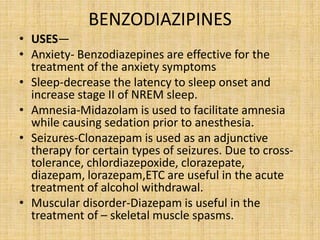
• USES—
• Anxiety- Benzodiazepines are effective for the
treatment of the anxiety symptoms
• Sleep-decrease the latency to sleep onset and
increase stage II of NREM sleep.
• Amnesia-Midazolam is used to facilitate amnesia
while causing sedation prior to anesthesia.
• Seizures-Clonazepam is used as an adjunctive
therapy for certain types of seizures. Due to cross-
tolerance, chlordiazepoxide, clorazepate,
diazepam, lorazepam,ETC are useful in the acute
treatment of alcohol withdrawal.
• Muscular disorder-Diazepam is useful in the
treatment of – skeletal muscle spasms.
BENZODIAZIPINES
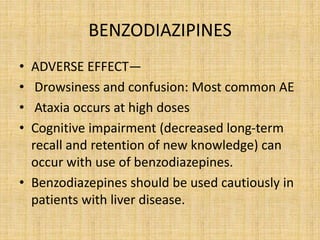
• ADVERSE EFFECT—
• Drowsiness and confusion: Most common AE
• Ataxia occurs at high doses
• Cognitive impairment (decreased long-term
recall and retention of new knowledge) can
occur with use of benzodiazepines.
• Benzodiazepines should be used cautiously in
patients with liver disease.
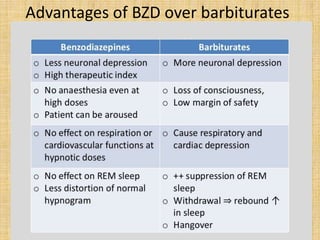
Advantages of BZD over barbiturates
WE CARE FOR YOU
THANK YOU
JASDEEP SINGH

Sedatives and hypnotics

  • 1.
  • 2.
    Overview  Introduction Historical Perspectives Classification:Sedative / Hypnotics Mechanism of action Barbiturates Benzodiazepines Miscellaneous Hypnotics & Anxiolytics
  • 3.
    INTRODUCTION • SEDATIVE – •A drug that reduces excitement, calms the patient. • Most sedatives in larger doses produce hypnosis. • Site of action is on the limbic system which regulates thought and mental function.
  • 4.
    Hypnotic • A drugwhich produces sleep resembling natural sleep. • They are used for initiation or maintenance of sleep. • Hypnotics in higher doses produce General anaesthesia. • Site of action is on the midbrain and ascending RAS which maintain wakefulness.
  • 5.
    SLEEP •50% of sleeptime is spend into stage 2. •REM sleep constitute 30% of total time,lasts for 5 to 30 mins each cycle.
  • 6.
    HISTORY • Before developmentof barbiturates – Since antiquity, alcohol beverages and potions containing laudanum and various herbals have been used to induce sleep. • 1857: Bromide was the first agent to be introduced specifically as a sedative and soon thereafter as a hypnotic
  • 7.
    HISTORY Barbiturates were introduced in1864 and widely diverted from medical use and used on the street in the 60s where they were called “downers” and sold under a variety of different names. Barbiturates had a low therapeutic index and were often used for suicide.  Baeyer, discoverer of barbiturates
  • 8.
    History • Marilyn Monroedied of barbiturate overdose in 1962.
  • 9.
    HISTORY • 20th century,barbiturates replaced by benzodiazepines. • 1961:introduction of chlordiazepoxide • Sternbach is credited with the invention of diazepam chlordiazepoxide,flurazepam nitrazepam etc Leo Sternbach
  • 10.
    CLASSIFICATION BENZODI AZIPINES • LONG ACTING •SHORT ACTING • INTERMEDIATE ACTING BARBITUR ATES • ULTRA ACTION • LONG ACTION • SHORT ACTION MISCELLA NIOUS • ANXIOLYTIC • Hypnotics: 1. Z-drugs 2.Antihistaminics 3.Doxepin
  • 11.
    DRUGS• Long Acting- Phenobarbitone (Epilepsy ,Neonatal jaundice) •Short Acting- Butobarbitone , Pentobarbitone • Ultra-shrt AcT –, Methohexitone Thiopentone(Anae sthesia) BARBITURATES • Short acting- Triazolam,Oxazepam, Midazolam • Intermediate acting- Alprazolam, Estazolam,Temazepa m ,Lorazepam, Nitrazepam • Long acting- Diazepam Flurazepam Clonazepam,Chlordia zepoxide BENZODIAZIPINES • Z Drugs-Zolpidem Zopiclone Zaleplon • Melatonin receptor agonist- Ramelteon • Others- •Antidepressants • Antihistaminics MISCELLANEOUS
  • 12.
    SITE OF ACTION •Midbrain ( RAS ) – Wakefulness • Limbic system - Thought & mental functions • Medulla - Muscle relaxation • Cerebellum – Ataxia • Effect : Limbic system > Midbrain RAS ⇓ Therapeutic dose ⇒ Anxiolytic > Sedative • Higher dose ⇒ Depress RAS → Sedative & hypnotic effect
  • 16.
    MECHANISM OF ACTION •BENZODIAZEPINES – - increase frequency of opening of Cl- channels induced by GABA (GABA facilitatory action). - increase binding of GABA to GABAA receptor . • BARBITURATES – - increase duration of opening of Cl- channels induced by GABA (GABA facilitatory action) - at high concentration can directly increase Cl- conductance through Cl- channels (GABA mimetic action) - inhibit Ca dependent release of neurotransmitters . - at very high conc. (anaesthetic doses) depress voltage sensitive Na+ & K+ channels.
  • 17.
    BARBITURATES • USE— – Barbiturateshave been used as mild sedatives to relieve anxiety, nervous tension, and insomnia. --Hyperbilirubinemia and kernicterus in the neonates
  • 18.
    BARBITURATES • ADVERSE EFFECT— •drowsiness, impaired concentration, and mental and physical sluggishness • The CNS depressant effects of barbiturates synergize with those of ethanol. • Hypnotic doses of barbiturates produce a drug “hangover” that may lead to impaired ability to function normally for many hours after waking.
  • 19.
    BENZODIAZIPINES • USES— • Anxiety-Benzodiazepines are effective for the treatment of the anxiety symptoms • Sleep-decrease the latency to sleep onset and increase stage II of NREM sleep. • Amnesia-Midazolam is used to facilitate amnesia while causing sedation prior to anesthesia. • Seizures-Clonazepam is used as an adjunctive therapy for certain types of seizures. Due to cross- tolerance, chlordiazepoxide, clorazepate, diazepam, lorazepam,ETC are useful in the acute treatment of alcohol withdrawal. • Muscular disorder-Diazepam is useful in the treatment of – skeletal muscle spasms.
  • 20.
    BENZODIAZIPINES • ADVERSE EFFECT— •Drowsiness and confusion: Most common AE • Ataxia occurs at high doses • Cognitive impairment (decreased long-term recall and retention of new knowledge) can occur with use of benzodiazepines. • Benzodiazepines should be used cautiously in patients with liver disease.
  • 21.
    Advantages of BZDover barbiturates
  • 22.
    WE CARE FORYOU THANK YOU JASDEEP SINGH