Don’t Sweat It: Exercise and
Study Time's Influence on
Academic Coping Strategies
for College Students
SUNY Oswego
Brett VanAtta
Investigated the influence exercise and study time
has on academic coping strategies.
I.V.- level of exercise & study time
D.V.- coping strategies
“Students who perform exercise in relation to the
amount of time used studying will score higher on
the survey measuring for ability in coping with
academics.”
Introduction
What we know
It is known that exercise is a method of coping
with stress (Petruzzello & Motl, 2006).
It is known that individuals use various methods of
coping that best fit them (Chartier, Gaudreau &
Fecteau, 2011).
Introduction
What we do not know
It has not been well defined in what way
performing exercise leads to the use of academic
coping strategies of college students.
Introduction
Participants were acquired using a convenience
sample
Participants consisted of 17 Psychology 290
section 860 undergrad students.
Participants consisted of 47% females and 53%
males.
Method: Participants
Preliminary questionnaire- time spent studying
and time spent exercising.
Scores were then split and categorized into
groups (2 exercise groups and 2 study groups)
Method: Measures
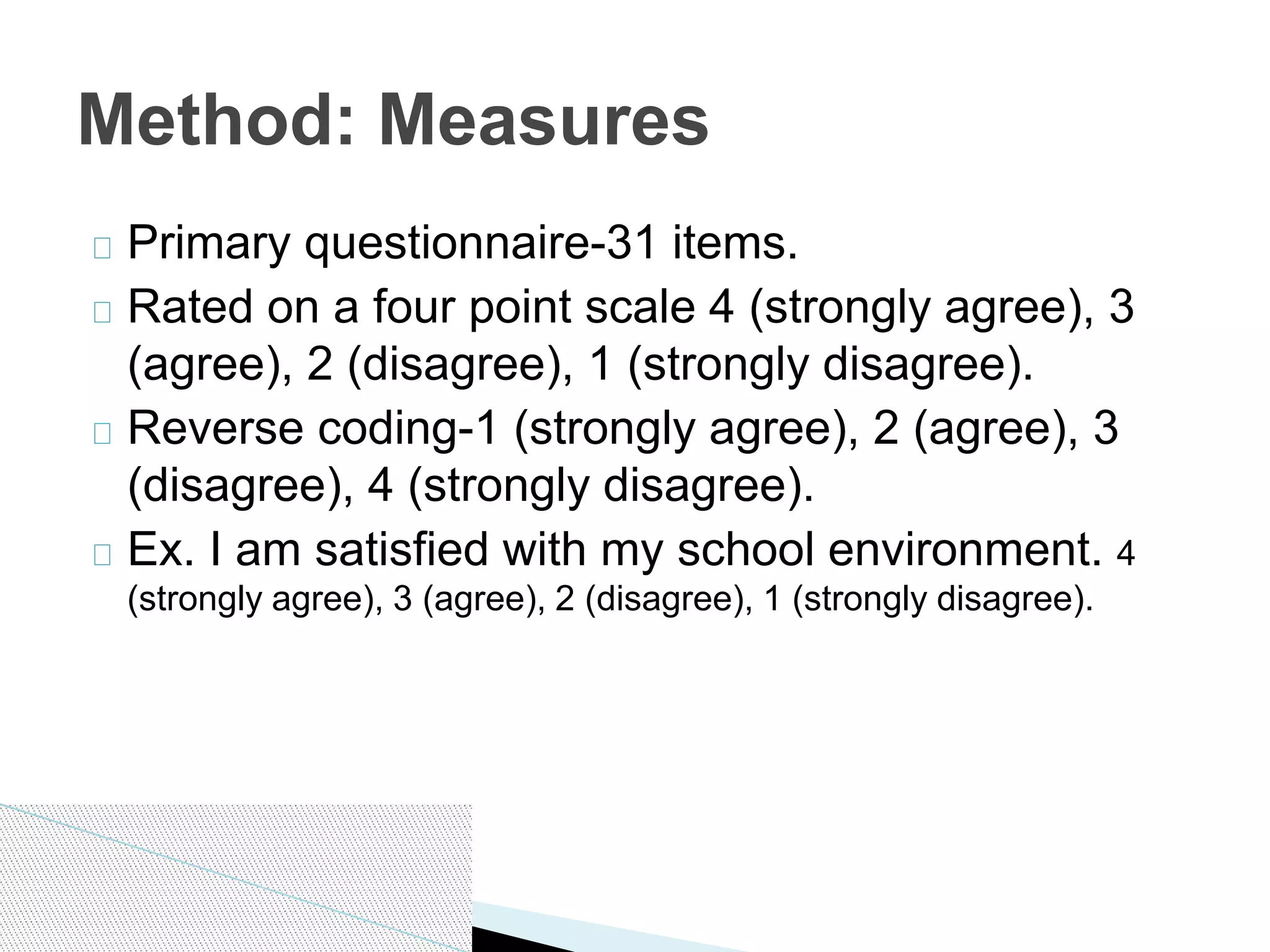
Primary questionnaire-31 items.
Rated on a four point scale 4 (strongly agree), 3
(agree), 2 (disagree), 1 (strongly disagree).
Reverse coding-1 (strongly agree), 2 (agree), 3
(disagree), 4 (strongly disagree).
Ex. I am satisfied with my school environment. 4
(strongly agree), 3 (agree), 2 (disagree), 1 (strongly disagree).
Method: Measures
Informed Consent
Asked to fill out both questionnaires
The design of the study was non-experimental
Results were entered into SPSS
Method: Procedure
Two-Way Annova
Main effect of time spent exercising on coping
strategies F (1,13) = 1.142, p =.305.
Main effect of time spent studying on coping
strategies F (1,13)= 00, p=.938.
Interaction effect between time spent exercising
and time spent studying on coping strategies, F
(1,13) = .400, p =.538.
Results
Results
Figure 1. Mean coping score as a function of time spent exercising and time spent
studying.
The figure illustrates the relationship between time spent studying and time spent
exercising on mean coping scores.
Results suggested an insignificant main effect of
both exercise on coping strategies and studying
on coping strategies.
Results showed an insignificant interaction effect
between exercise and studying on coping
strategies.
Didn’t show exercise related to coping strategies
Did show individuals used various methods of
coping when dealing with academics
Discussion
Strengths of this study were
◦ Uniqueness or design
◦ Strength of measure
Limitation of this study was convenience sample
◦ Less power
◦ Not generalizable
Discussion
For future research in the relation to this study, it
is recommended that there be a greater sample
size and that the sample be made of a more
diverse population of students.
It is also recommended that future studies
perhaps use a different second I.V. than the one
used in this study (study time).
Discussion
Chartier, I., Gaudreau, P., & Fecteau, M. (2011).From
dispositional affect to academic goal attainment: The
mediating role of coping. Anxiety, Stress & Coping: An
International Journal, 24(1), 43-58.
doi:10.1080/10615801003725360
Petruzzello, S. J., & Motl, R. W. (2006). Physical
Activity and Mental Health in College Students. In M.
V. Landow (Ed.) , College students: Mental health and
coping strategies (pp. 41-57). Hauppauge, NY US:
Nova Science Publishers.
Reference

DonGÇÖt Sweat It powerpoint

  • 1.
    Don’t Sweat It:Exercise and Study Time's Influence on Academic Coping Strategies for College Students SUNY Oswego Brett VanAtta
  • 2.
    Investigated the influenceexercise and study time has on academic coping strategies. I.V.- level of exercise & study time D.V.- coping strategies “Students who perform exercise in relation to the amount of time used studying will score higher on the survey measuring for ability in coping with academics.” Introduction
  • 3.
    What we know Itis known that exercise is a method of coping with stress (Petruzzello & Motl, 2006). It is known that individuals use various methods of coping that best fit them (Chartier, Gaudreau & Fecteau, 2011). Introduction
  • 4.
    What we donot know It has not been well defined in what way performing exercise leads to the use of academic coping strategies of college students. Introduction
  • 5.
    Participants were acquiredusing a convenience sample Participants consisted of 17 Psychology 290 section 860 undergrad students. Participants consisted of 47% females and 53% males. Method: Participants
  • 6.
    Preliminary questionnaire- timespent studying and time spent exercising. Scores were then split and categorized into groups (2 exercise groups and 2 study groups) Method: Measures
  • 7.
    Primary questionnaire-31 items. Ratedon a four point scale 4 (strongly agree), 3 (agree), 2 (disagree), 1 (strongly disagree). Reverse coding-1 (strongly agree), 2 (agree), 3 (disagree), 4 (strongly disagree). Ex. I am satisfied with my school environment. 4 (strongly agree), 3 (agree), 2 (disagree), 1 (strongly disagree). Method: Measures
  • 8.
    Informed Consent Asked tofill out both questionnaires The design of the study was non-experimental Results were entered into SPSS Method: Procedure
  • 9.
    Two-Way Annova Main effectof time spent exercising on coping strategies F (1,13) = 1.142, p =.305. Main effect of time spent studying on coping strategies F (1,13)= 00, p=.938. Interaction effect between time spent exercising and time spent studying on coping strategies, F (1,13) = .400, p =.538. Results
  • 10.
    Results Figure 1. Meancoping score as a function of time spent exercising and time spent studying. The figure illustrates the relationship between time spent studying and time spent exercising on mean coping scores.
  • 11.
    Results suggested aninsignificant main effect of both exercise on coping strategies and studying on coping strategies. Results showed an insignificant interaction effect between exercise and studying on coping strategies. Didn’t show exercise related to coping strategies Did show individuals used various methods of coping when dealing with academics Discussion
  • 12.
    Strengths of thisstudy were ◦ Uniqueness or design ◦ Strength of measure Limitation of this study was convenience sample ◦ Less power ◦ Not generalizable Discussion
  • 13.
    For future researchin the relation to this study, it is recommended that there be a greater sample size and that the sample be made of a more diverse population of students. It is also recommended that future studies perhaps use a different second I.V. than the one used in this study (study time). Discussion
  • 14.
    Chartier, I., Gaudreau,P., & Fecteau, M. (2011).From dispositional affect to academic goal attainment: The mediating role of coping. Anxiety, Stress & Coping: An International Journal, 24(1), 43-58. doi:10.1080/10615801003725360 Petruzzello, S. J., & Motl, R. W. (2006). Physical Activity and Mental Health in College Students. In M. V. Landow (Ed.) , College students: Mental health and coping strategies (pp. 41-57). Hauppauge, NY US: Nova Science Publishers. Reference