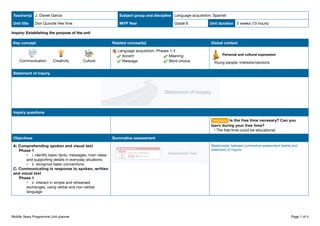
Language acquisition: Phases 1-2
Accent Meaning
Message Word choice
Teacher(s) J. Daniel Garcia Subject group and discipline Language acquisition: Spanish
Unit title Don Quixote free time MYP Year Grade 6 Unit duration 5 weeks (15 hours)
Inquiry: Establishing the purpose of the unit
Key concept Related concept(s) Global context
Communication Creativity Culture
Personal and cultural expression
Young people: interests/opinions
Statement of inquiry
Inquiry questions
Debatable Is the free time necesary? Can you
learn during your free time?
• The free time could be educational
Objectives Summative assessment
A: Comprehending spoken and visual text
Phase 1
• i. identify basic facts, messages, main ideas
and supporting details in everyday situations
• ii. recognize basic conventions
C: Communicating in response to spoken, written
and visual text
Phase 1
• ii. interact in simple and rehearsed
exchanges, using verbal and non-verbal
language
Relationship between summative assessment task(s) and
statement of inquiry:
Middle Years Programme Unit planner Page 1 of 4
• iii. use basic phrases to communicate ideas,
feelings and information on a variety of aspects
of everyday topics
• iv. communicate with a sense of audience.
D: Using language in spoken and written form
Phase 1
• i. write and speak using a basic range of
vocabulary, grammatical structures and
conventions; when speaking, use clear
pronunciation and intonation
• ii. organize basic information and use a range
of basic cohesive devices
• iii. use language to suit the context.
Approaches to learning (ATL)
Language acquisition
A: Comprehending spoken and visual text
• i. identify basic facts, messages, main ideas and supporting details in everyday situations
• ii. recognize basic conventions
C: Communicating in response to spoken, written and visual text
• ii. interact in simple and rehearsed exchanges, using verbal and non-verbal language
• iii. use basic phrases to communicate ideas, feelings and information on a variety of aspects of everyday topics
• iv. communicate with a sense of audience.
D: Using language in spoken and written form
• i. write and speak using a basic range of vocabulary, grammatical structures and conventions; when speaking, use clear pronunciation and intonation
• ii. organize basic information and use a range of basic cohesive devices
• iii. use language to suit the context.
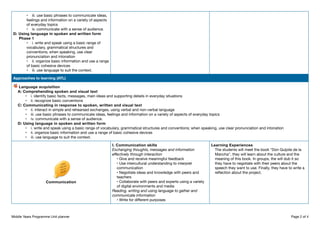
Communication
I. Communication skills
Exchanging thoughts, messages and information
effectively through interaction
• Give and receive meaningful feedback
• Use intercultural understanding to interpret
communication
• Negotiate ideas and knowledge with peers and
teachers
• Collaborate with peers and experts using a variety
of digital environments and media
Reading, writing and using language to gather and
communicate information
• Write for different purposes
Learning Experiences
The students will meet the book "Don Quijote de la
Mancha", they will learn about the culture and the
meaning of this book. In groups, the will dub it so
they have to negotiate with their peers about the
speech they want to use. Finally, they have to write a
reflection about the project.
Middle Years Programme Unit planner Page 2 of 4
• Organize and depict information logically
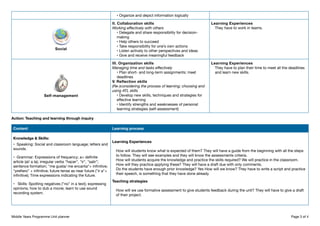
Social
II. Collaboration skills
Working effectively with others
• Delegate and share responsibility for decision-
making
• Help others to succeed
• Take responsibility for one’s own actions
• Listen actively to other perspectives and ideas
• Give and receive meaningful feedback
Learning Experiences
They have to work in teams.
Self-management
III. Organization skills
Managing time and tasks effectively
• Plan short- and long-term assignments; meet
deadlines
V. Reflection skills
(Re-)considering the process of learning; choosing and
using ATL skills
• Develop new skills, techniques and strategies for
effective learning
• Identify strengths and weaknesses of personal
learning strategies (self-assessment)
Learning Experiences
They have to plan their time to meet all the deadlines
and learn new skills.
Action: Teaching and learning through inquiry
Content Learning process
Knowledge & Skills:
• Speaking: Social and classroom language; letters and
sounds.
• Grammar: Expressions of frequency; a+ definite
article (al/ a la); irregular verbs "hacer", "ir", "salir";
sentence formation; "me gusta/ me encanta"+ infinitive;
"prefiero" + infinitive; future tense as near future ("ir a"+
infinitive); Time expressions indicating the future.
• Skills: Spotting negatives ("no" in a text); expressing
opinions; how to dub a movie; learn to use sound
recording system.
Learning Experiences
How will students know what is expected of them? They will have a guide from the beginning with all the steps
to follow. They will see examples and they will know the assessments criteria.
How will students acquire the knowledge and practice the skills required? We will practice in the classroom.
How will they practice applying these? They will have a draft due with only comments.
Do the students have enough prior knowledge? Yes How will we know? They have to write a script and practice
their speech, is something that they have done already.
Teaching strategies
How will we use formative assessment to give students feedback during the unit? They will have to give a draft
of their project.
Middle Years Programme Unit planner Page 3 of 4
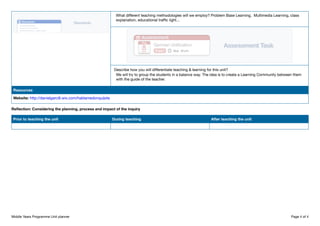
What different teaching methodologies will we employ? Problem Base Learning, Multimedia Learning, class
explanation, educational traffic light...
Describe how you will differentiate teaching & learning for this unit?
We will try to group the students in a balance way. The idea is to create a Learning Community between them
with the guide of the teacher.
Resources
Website: http://danielgarci6.wix.com/hablamedonquijote
Reflection: Considering the planning, process and impact of the inquiry
Prior to teaching the unit During teaching After teaching the unit
Middle Years Programme Unit planner Page 4 of 4

Don quixote free time- Unidad para A1

  • 1.
    Language acquisition: Phases1-2 Accent Meaning Message Word choice Teacher(s) J. Daniel Garcia Subject group and discipline Language acquisition: Spanish Unit title Don Quixote free time MYP Year Grade 6 Unit duration 5 weeks (15 hours) Inquiry: Establishing the purpose of the unit Key concept Related concept(s) Global context Communication Creativity Culture Personal and cultural expression Young people: interests/opinions Statement of inquiry Inquiry questions Debatable Is the free time necesary? Can you learn during your free time? • The free time could be educational Objectives Summative assessment A: Comprehending spoken and visual text Phase 1 • i. identify basic facts, messages, main ideas and supporting details in everyday situations • ii. recognize basic conventions C: Communicating in response to spoken, written and visual text Phase 1 • ii. interact in simple and rehearsed exchanges, using verbal and non-verbal language Relationship between summative assessment task(s) and statement of inquiry: Middle Years Programme Unit planner Page 1 of 4
  • 2.
    • iii. usebasic phrases to communicate ideas, feelings and information on a variety of aspects of everyday topics • iv. communicate with a sense of audience. D: Using language in spoken and written form Phase 1 • i. write and speak using a basic range of vocabulary, grammatical structures and conventions; when speaking, use clear pronunciation and intonation • ii. organize basic information and use a range of basic cohesive devices • iii. use language to suit the context. Approaches to learning (ATL) Language acquisition A: Comprehending spoken and visual text • i. identify basic facts, messages, main ideas and supporting details in everyday situations • ii. recognize basic conventions C: Communicating in response to spoken, written and visual text • ii. interact in simple and rehearsed exchanges, using verbal and non-verbal language • iii. use basic phrases to communicate ideas, feelings and information on a variety of aspects of everyday topics • iv. communicate with a sense of audience. D: Using language in spoken and written form • i. write and speak using a basic range of vocabulary, grammatical structures and conventions; when speaking, use clear pronunciation and intonation • ii. organize basic information and use a range of basic cohesive devices • iii. use language to suit the context. Communication I. Communication skills Exchanging thoughts, messages and information effectively through interaction • Give and receive meaningful feedback • Use intercultural understanding to interpret communication • Negotiate ideas and knowledge with peers and teachers • Collaborate with peers and experts using a variety of digital environments and media Reading, writing and using language to gather and communicate information • Write for different purposes Learning Experiences The students will meet the book "Don Quijote de la Mancha", they will learn about the culture and the meaning of this book. In groups, the will dub it so they have to negotiate with their peers about the speech they want to use. Finally, they have to write a reflection about the project. Middle Years Programme Unit planner Page 2 of 4
  • 3.
    • Organize anddepict information logically Social II. Collaboration skills Working effectively with others • Delegate and share responsibility for decision- making • Help others to succeed • Take responsibility for one’s own actions • Listen actively to other perspectives and ideas • Give and receive meaningful feedback Learning Experiences They have to work in teams. Self-management III. Organization skills Managing time and tasks effectively • Plan short- and long-term assignments; meet deadlines V. Reflection skills (Re-)considering the process of learning; choosing and using ATL skills • Develop new skills, techniques and strategies for effective learning • Identify strengths and weaknesses of personal learning strategies (self-assessment) Learning Experiences They have to plan their time to meet all the deadlines and learn new skills. Action: Teaching and learning through inquiry Content Learning process Knowledge & Skills: • Speaking: Social and classroom language; letters and sounds. • Grammar: Expressions of frequency; a+ definite article (al/ a la); irregular verbs "hacer", "ir", "salir"; sentence formation; "me gusta/ me encanta"+ infinitive; "prefiero" + infinitive; future tense as near future ("ir a"+ infinitive); Time expressions indicating the future. • Skills: Spotting negatives ("no" in a text); expressing opinions; how to dub a movie; learn to use sound recording system. Learning Experiences How will students know what is expected of them? They will have a guide from the beginning with all the steps to follow. They will see examples and they will know the assessments criteria. How will students acquire the knowledge and practice the skills required? We will practice in the classroom. How will they practice applying these? They will have a draft due with only comments. Do the students have enough prior knowledge? Yes How will we know? They have to write a script and practice their speech, is something that they have done already. Teaching strategies How will we use formative assessment to give students feedback during the unit? They will have to give a draft of their project. Middle Years Programme Unit planner Page 3 of 4
  • 4.
    What different teachingmethodologies will we employ? Problem Base Learning, Multimedia Learning, class explanation, educational traffic light... Describe how you will differentiate teaching & learning for this unit? We will try to group the students in a balance way. The idea is to create a Learning Community between them with the guide of the teacher. Resources Website: http://danielgarci6.wix.com/hablamedonquijote Reflection: Considering the planning, process and impact of the inquiry Prior to teaching the unit During teaching After teaching the unit Middle Years Programme Unit planner Page 4 of 4