The SBTDC is a business advisory service of The North Carolina University System
       operated in partnership with the U.S. Small Business Administration.


                sbtdc.org | info@sbtdc.org
Doing Business With the Government

         North Carolina Procurement
    Technical Assistance Center (NC PTAC)

              Rebecca Barbour
                919-600-5947
             rbarbour@sbtdc.org
About the NC Small Business and
   Technology Development Center (SBTDC)
• Established in 1984:
   – initiated by the US Small Business Act
   – funding through US Small Business Administration (SBA) and
     matching funds from the University of North Carolina System
• SBTDC Mission:
   – Support the growth and development of North Carolina’s economy by:
      • encouraging entrepreneurship
      • assisting in the creation and expansion of small to medium-sized
        enterprises
      • facilitating technology development and commercialization
      • supporting economic development organizations
SBTDC Programs & Services
• Confidential one-on-one counseling:
   –   Leadership & Program Development
   –   Strategy and Organization Development Services
   –   International Business Development (Export Assistance)
   –   Technology Commercialization Services
   –   Marketing & Research Services
   –   Supply Chain Services (formerly Boating Industry Services)
   –   Government Procurement Assistance
         • Procurement Technical Assistance Center (PTAC)


                                 www.sbtdc.org
About the Procurement Technical
             Assistance Center (PTAC)
• National program established in 1985:
   – Authorized by Congress
   – Funded by the Department of Defense and administered through the
     Defense Logistics Agency (DLA)
   – Provides matching funds through cooperative agreements with state
     and local governments and non-profit organizations
• PTAC Program:
   – Provides a wide range of services including classes and seminars,
     individual counseling, and easy access to information necessary to
     successfully compete for government contracts
NC PTAC Services
• Assistance selling to federal, state and local government
  entities
   –   Completing mandatory and beneficial registrations
   –   Identifying preference eligibility and applicable certifications
   –   Researching contract award history
   –   Locating specifications and standards
   –   Identifying contracting opportunities
   –   Understanding solicitations requirements and terminology
   –   Reviewing bids and proposals


                              www.nc-ptac.org
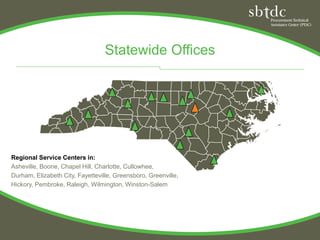
Statewide Offices


Regional Service Centers in:
Asheville, Boone, Chapel Hill, Charlotte, Cullowhee,
Durham, Elizabeth City, Fayetteville, Greensboro, Greenville,
Hickory, Pembroke, Raleigh, Wilmington, Winston-Salem
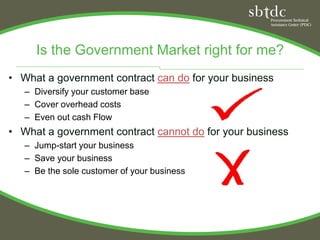
Is the Government Market right for me?
• What a government contract can do for your business
   – Diversify your customer base
   – Cover overhead costs
   – Even out cash Flow
• What a government contract cannot do for your business
   – Jump-start your business
   – Save your business
   – Be the sole customer of your business
Before Selling to the Government

•   Internet access and computer knowledge
•   Potential to sell to the government
•   Determination to sell to the government
•   Knowledge of competition and how they succeed
•   Perseverance
Who are the Federal Government Buyers?
•   Military Bases
•   General Services Administration (GSA)
•   Department of Veteran’s Affairs (VA)
•   Defense Logistics Agency (DLA)
•   Department of Homeland Security (DHS)
•   United States Department of Agriculture (USDA)
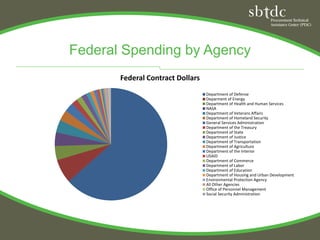
Federal Spending by Agency
       Federal Contract Dollars
                                  Department of Defense
                                  Deparment of Energy
                                  Department of Health and Human Services
                                  NASA
                                  Department of Veterans Affairs
                                  Department of Homeland Security
                                  General Services Administration
                                  Department of the Treasury
                                  Department of State
                                  Department of Justice
                                  Department of Transportation
                                  Department of Agriculture
                                  Department of the Interior
                                  USAID
                                  Department of Commerce
                                  Department of Labor
                                  Department of Education
                                  Department of Housing and Urban Development
                                  Environmental Protection Agency
                                  All Other Agencies
                                  Office of Personnel Management
                                  Social Security Administration
How Does the Federal Government Buy?
• Micro Purchases
   – FAR Part 13
• Simplified Acquisitions
   – FAR Part 13
• Sealed Bids
   – FAR Part 14
• Negotiated Procurements
   – FAR Part 15
Micro Purchases
•   Micro-purchase threshold
    – Supply purchases less than $3,000
    – Services purchases less than $2,500
    – Construction purchases less than $2,000
•   May be credit card transactions or purchase orders
•   Advertisement and competition are not required
•   Open to large and small business
•   Account for $18 billion in annual sales
•   Award is usually based on lowest price
Simplified Acquisitions
• Purchases over micro purchase threshold and up to
  $150,000
• Solicitation in form of Request for Quote (RFQ)
• Informal advertisement required for purchases over
  $10,000 and up to $25,000
• Formal advertisement in FBO required for purchases over
  $25,000
• Automatically set aside for small business
• Award is usually based on lowest price
Sealed Bids
• One of two methods used for procurements over $150,000
• Solicitation in form of Invitation for Bid (IFB)
• Formal Advertisement in FBO required
• May be set-aside for small business, 8(a), HUBZone,
  SDVOSB or WOSB firms
• Bids are publically opened and read aloud by an
  authorized person at the time set for bid opening
• Award is made to lowest cost responsive and responsible
  bidder
Negotiated Procurements
• One of two methods used for procurements over $150,000
• Formal advertisement in FBO required
• Solicitation in form of Request for Proposal (RFP)
• May be set-aside for small business, 8(a), HUBZone,
  SDVOSB, or WOSB firms
• All proposals are evaluated, and the evaluations committee
  holds discussions with “Short List” bidders
• Award is made to best value responsive and responsible
  bidder
Where do I find these Opportunities?
• Federal Business Opportunities “FedBizOpps”
  www.fbo.gov
   – Federal government procurement opportunities over $25,000
   – May register as a vendor once CCR is active
• FedBid
  www.fedbid.com
   – Reverse auction system used for informal or simplified acquisitions
• PROBID
  www.sbtdc.org/probid
   – Electronic bid matching system (fees apply)
Where do I find Subcontract Opportunities?
• SBA Subnet
  http://web.sba.gov/subnet/
• USA Spending
  www.usaspending.gov
• Federal Agency Subcontract Directories
   – Department of Energy Prime Contractor Directory
     http://energy.gov/diversity/downloads/directory-small-business-
     program-managers-december-2011
   – General Services Administration Subcontract Directory
     http://www.gsa.gov/graphics/staffoffices/subcontracting-dir.xls
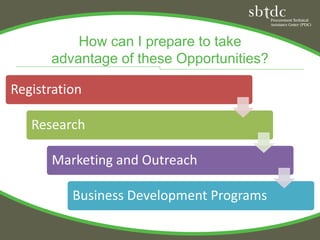
How can I prepare to take
      advantage of these Opportunities?

Registration

   Research

      Marketing and Outreach

          Business Development Programs
Federal Registration: Codes and Identifiers
• Identify your NAICS codes –
  http://www.census.gov/eos/www/naics
• Identify your FSC and PSC codes –
  http://www.usabid.com/resources/tables/pscs/
• Obtain Tax ID Number (TIN) –
  1-800-829-1040 or www.irs.gov/businesses
   – Even if Sole Proprietor
• Obtain DUNS Number –
  1-866-705-5711 or http://fedgov.dnb.com/webform
   – Required for registrations
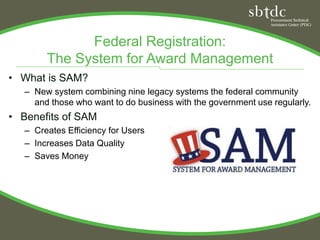
Federal Registration:
        The System for Award Management
• What is SAM?
   – New system combining nine legacy systems the federal community
     and those who want to do business with the government use regularly.
• Benefits of SAM
   – Creates Efficiency for Users
   – Increases Data Quality
   – Saves Money
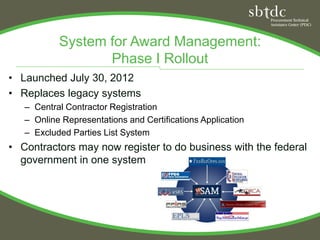
System for Award Management:
                  Phase I Rollout
• Launched July 30, 2012
• Replaces legacy systems
   – Central Contractor Registration
   – Online Representations and Certifications Application
   – Excluded Parties List System
• Contractors may now register to do business with the federal
  government in one system
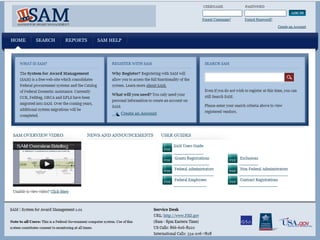
System for Award Management:
                   Registration
• Includes basic vendor information and vendor assertions
• Commercial and Government Entity Code (CAGE code)
  assigned when registration complete
• Interfaces with the SBA Firm Profile (Dynamic Small
  Business Search)
• Annual renewal required
• Training and assistance available through the Federal
  Service Desk (www.fsd.gov) and PTAC (www.nc-ptac.org)

                       www.sam.gov
Federal Registration:
         SBA Dynamic Small Business Search
•   Access through SAM once registration is complete
•   DSBS number (SBA customer number) assigned
•   Includes company information from SAM
•   Allows firms to include supplemental information
    –   Non-government certifications
    –   Capabilities narrative and keywords
    –   Quality assurance standards
    –   Export profile
    –   Performance history
                              http://dsbs.sba.gov
Federal Research:
                   Rules and Regulations
• Federal Acquisition Regulation (FAR)
  www.acquisition.gov/far
   – Codification of uniform policies for acquisition of supplies and
     services by the executive agencies
• Code of Federal Regulations (CFR)
  www.gpoaccess.gov/cfr
   – Codification of the general and permanent rules published in the
     Federal Register by the executive departments and agencies
• United States Code (USC)
  www.gpoaccess.gov/uscode
   – Codification of the general and permanent laws of the United States
Federal Research:
                  Procurement History
• USASpending.gov
  www.usaspending.gov
   – Searchable website with basic information on all federal awards
• Federal Procurement Data System (FPDS)
  www.fpds.gov/fpdsng_cms
   – Searchable website with detailed information on all federal awards
   – Users can run simple searches through ezSearch tool or create
     an account to build custom Adhoc reports
• Federal Procurement Forecasts
  www.acquisition.gov/comp/procurement_forecasts/index.html
   – Federal Agency “wish lists”
Federal Marketing and Outreach:
                     Strategy
• Complete all registrations
• Identify and target key agencies
   – Know the agency’s mission and their needs
• Identify and target key prime contractors
   – Know the prime’s current and past projects
• Prepare a Capability Statement
• Visit target agency and prime contractor contacts
• Remember that small business programs are opportunities;
  they are not entitlements
Federal Marketing and Outreach:
           Capabilities Statement
• One to two page           • Company Data
  business resume              – DUNS, CAGE, etc.
• Provides high level       • Business Description or
  overview of who you are     Value Proposition
  as a business, what you   • Core Competencies
  do, and why you are the   • Past Performance or
  best                        References
                            • Contact Information
Federal Marketing and Outreach:
                 Points of Contact
• Small Business Liaison Officer (SBLO)
   – Prime Contractor Employee (Public Law 95-507)
   – Monitors prime contractor subcontracting goals
• Small and Disadvantaged Business Utilization Specialist
  (SADBU) and Small Business Specialist (SBS)
   – Acts as liaison between you and buyers
• Procurement Contract Representative (PCR) and
  Commercial Marketing Representative (CMR)
   – SBA Resources for small businesses
Federal Marketing and Outreach:
                  Points of Contact
• Contracting Officer (CO)
   – Only person that can obligate the government
   – Enters into, administers, and terminates federal contracts
• Contract Administrator
   – Assistant to contracting officer
• Contracting Officers Technical Representative (COTR)
   – Designated technical expert that monitors contract performance
• End User
   – Person that knows requirement the best
Federal Business Development Programs
• Self Certifications:
   – Small Business Certification
   – Small Disadvantaged Business Certification


• Formal Certifications:
   –   Veteran Owned Small Business Certification
   –   Women Owned Small Business Certification
   –   8(a) Business Development Program
   –   HUBZone Empowerment Contracting Program


                      www.sba.gov/contracting
Small Business Certification and
  Small Disadvantaged Business Certification
• Small Business Certification
   – Firms may self certify through SAM
   – Must meet small business size standard for NAICS code
   – May be small in some NAICS codes, and not others
• Small Disadvantaged Business Certification
   – Firms may self certify through SAM
   – Must be small in primary industry and be owned and controlled by
     socially and economically disadvantaged individual(s)
   – Formal SBA certification program discontinued October 2008
Veteran Owned Small Business Certification
• Formal verification through the Department of Veterans
  Affairs Center for Veterans Enterprise
• Eligible firms must:
   – Be 51% owned and controlled by veterans (VOSB) or service disabled
     veterans (SDVOSB)
   – Be small in primary industry
• Set aside and sole source opportunities for VOSBs and
  SDVOSBs through the VA Veterans First program
• Government-wide set aside opportunities for SDVOSBs
Woman Owned Small Business Certification
• Formal certification procedures through the SBA
• Eligible firms must:
   – Be 51% owned and controlled by women (WOSB) or economically
     disadvantaged women (EDWOSB)
   – Be small in primary industry
• Firms may choose between self certification and third party
  certification procedures
• Set aside opportunities available for WOSBs and EDWOSBs
  in designated NAICS codes
8(a) Business Development Program
• Formal certification through the SBA
• The applicant firm must:
   – Be 51% owned and controlled by one or more socially and
     economically disadvantaged individuals
   – Be a small business in primary industry
   – Demonstrate good character and reasonable potential for success
   – Have been in business at least two years
• Nine year program with development and transition stages
• Government-wide set aside and sole source opportunities
HUBZone Empowerment Program
• Formal certification through the SBA
• The applicant firm must
   –   Be 51% owned and controlled by US Citizens
   –   Be a small business in primary industry
   –   Have a principal office located in a HUBZone
   –   Have at least 35% of employees that reside in a HUBZone
• HUBZones determined by US Census data
• Price evaluation preference in full and open competitions
• Government-wide set aside and sole source opportunities
Federal Small Business Contracting Goals
• Government wide statutory goals:
   –   23% of prime contracts to small businesses
   –   5% of prime and subcontracts to SDBs
   –   5% of prime and subcontracts to WOSBs
   –   3% of prime and subcontracts to SDVOSBs
   –   3% of prime and subcontracts to HUBZone businesses
• Agency goals negotiated and monitored by the SBA
• Small Business Procurement Scorecards published annually
                   www.sba.gov/goaling
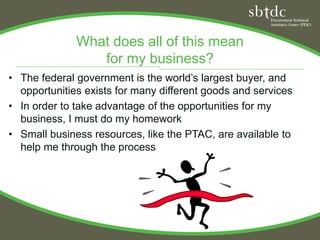
What does all of this mean
                 for my business?
• The federal government is the world’s largest buyer, and
  opportunities exists for many different goods and services
• In order to take advantage of the opportunities for my
  business, I must do my homework
• Small business resources, like the PTAC, are available to
  help me through the process
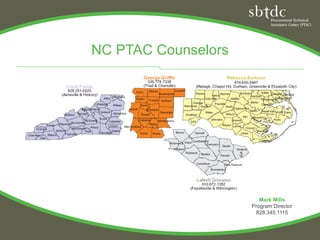
NC PTAC Counselors


                        Mark Mills
                     Program Director
                      828.345.1115
Stay Connected!
• NC PTAC Events
  www.nc-ptac.org/events
• Selling to the Government Newsletter
  www.nc-ptac.org/newsletter
• SBTDC Events
  www.sbtdc.org
QUESTIONS?

Doing Business with the Govt, PTAC

  • 1.
    The SBTDC isa business advisory service of The North Carolina University System operated in partnership with the U.S. Small Business Administration. sbtdc.org | info@sbtdc.org
  • 2.
    Doing Business Withthe Government North Carolina Procurement Technical Assistance Center (NC PTAC) Rebecca Barbour 919-600-5947 rbarbour@sbtdc.org
  • 3.
    About the NCSmall Business and Technology Development Center (SBTDC) • Established in 1984: – initiated by the US Small Business Act – funding through US Small Business Administration (SBA) and matching funds from the University of North Carolina System • SBTDC Mission: – Support the growth and development of North Carolina’s economy by: • encouraging entrepreneurship • assisting in the creation and expansion of small to medium-sized enterprises • facilitating technology development and commercialization • supporting economic development organizations
  • 4.
    SBTDC Programs &Services • Confidential one-on-one counseling: – Leadership & Program Development – Strategy and Organization Development Services – International Business Development (Export Assistance) – Technology Commercialization Services – Marketing & Research Services – Supply Chain Services (formerly Boating Industry Services) – Government Procurement Assistance • Procurement Technical Assistance Center (PTAC) www.sbtdc.org
  • 5.
    About the ProcurementTechnical Assistance Center (PTAC) • National program established in 1985: – Authorized by Congress – Funded by the Department of Defense and administered through the Defense Logistics Agency (DLA) – Provides matching funds through cooperative agreements with state and local governments and non-profit organizations • PTAC Program: – Provides a wide range of services including classes and seminars, individual counseling, and easy access to information necessary to successfully compete for government contracts
  • 6.
    NC PTAC Services •Assistance selling to federal, state and local government entities – Completing mandatory and beneficial registrations – Identifying preference eligibility and applicable certifications – Researching contract award history – Locating specifications and standards – Identifying contracting opportunities – Understanding solicitations requirements and terminology – Reviewing bids and proposals www.nc-ptac.org
  • 7.
    Statewide Offices Regional ServiceCenters in: Asheville, Boone, Chapel Hill, Charlotte, Cullowhee, Durham, Elizabeth City, Fayetteville, Greensboro, Greenville, Hickory, Pembroke, Raleigh, Wilmington, Winston-Salem
  • 8.
    Is the GovernmentMarket right for me? • What a government contract can do for your business – Diversify your customer base – Cover overhead costs – Even out cash Flow • What a government contract cannot do for your business – Jump-start your business – Save your business – Be the sole customer of your business
  • 9.
    Before Selling tothe Government • Internet access and computer knowledge • Potential to sell to the government • Determination to sell to the government • Knowledge of competition and how they succeed • Perseverance
  • 10.
    Who are theFederal Government Buyers? • Military Bases • General Services Administration (GSA) • Department of Veteran’s Affairs (VA) • Defense Logistics Agency (DLA) • Department of Homeland Security (DHS) • United States Department of Agriculture (USDA)
  • 11.
    Federal Spending byAgency Federal Contract Dollars Department of Defense Deparment of Energy Department of Health and Human Services NASA Department of Veterans Affairs Department of Homeland Security General Services Administration Department of the Treasury Department of State Department of Justice Department of Transportation Department of Agriculture Department of the Interior USAID Department of Commerce Department of Labor Department of Education Department of Housing and Urban Development Environmental Protection Agency All Other Agencies Office of Personnel Management Social Security Administration
  • 12.
    How Does theFederal Government Buy? • Micro Purchases – FAR Part 13 • Simplified Acquisitions – FAR Part 13 • Sealed Bids – FAR Part 14 • Negotiated Procurements – FAR Part 15
  • 13.
    Micro Purchases • Micro-purchase threshold – Supply purchases less than $3,000 – Services purchases less than $2,500 – Construction purchases less than $2,000 • May be credit card transactions or purchase orders • Advertisement and competition are not required • Open to large and small business • Account for $18 billion in annual sales • Award is usually based on lowest price
  • 14.
    Simplified Acquisitions • Purchasesover micro purchase threshold and up to $150,000 • Solicitation in form of Request for Quote (RFQ) • Informal advertisement required for purchases over $10,000 and up to $25,000 • Formal advertisement in FBO required for purchases over $25,000 • Automatically set aside for small business • Award is usually based on lowest price
  • 15.
    Sealed Bids • Oneof two methods used for procurements over $150,000 • Solicitation in form of Invitation for Bid (IFB) • Formal Advertisement in FBO required • May be set-aside for small business, 8(a), HUBZone, SDVOSB or WOSB firms • Bids are publically opened and read aloud by an authorized person at the time set for bid opening • Award is made to lowest cost responsive and responsible bidder
  • 16.
    Negotiated Procurements • Oneof two methods used for procurements over $150,000 • Formal advertisement in FBO required • Solicitation in form of Request for Proposal (RFP) • May be set-aside for small business, 8(a), HUBZone, SDVOSB, or WOSB firms • All proposals are evaluated, and the evaluations committee holds discussions with “Short List” bidders • Award is made to best value responsive and responsible bidder
  • 17.
    Where do Ifind these Opportunities? • Federal Business Opportunities “FedBizOpps” www.fbo.gov – Federal government procurement opportunities over $25,000 – May register as a vendor once CCR is active • FedBid www.fedbid.com – Reverse auction system used for informal or simplified acquisitions • PROBID www.sbtdc.org/probid – Electronic bid matching system (fees apply)
  • 18.
    Where do Ifind Subcontract Opportunities? • SBA Subnet http://web.sba.gov/subnet/ • USA Spending www.usaspending.gov • Federal Agency Subcontract Directories – Department of Energy Prime Contractor Directory http://energy.gov/diversity/downloads/directory-small-business- program-managers-december-2011 – General Services Administration Subcontract Directory http://www.gsa.gov/graphics/staffoffices/subcontracting-dir.xls
  • 19.
    How can Iprepare to take advantage of these Opportunities? Registration Research Marketing and Outreach Business Development Programs
  • 20.
    Federal Registration: Codesand Identifiers • Identify your NAICS codes – http://www.census.gov/eos/www/naics • Identify your FSC and PSC codes – http://www.usabid.com/resources/tables/pscs/ • Obtain Tax ID Number (TIN) – 1-800-829-1040 or www.irs.gov/businesses – Even if Sole Proprietor • Obtain DUNS Number – 1-866-705-5711 or http://fedgov.dnb.com/webform – Required for registrations
  • 21.
    Federal Registration: The System for Award Management • What is SAM? – New system combining nine legacy systems the federal community and those who want to do business with the government use regularly. • Benefits of SAM – Creates Efficiency for Users – Increases Data Quality – Saves Money
  • 22.
    System for AwardManagement: Phase I Rollout • Launched July 30, 2012 • Replaces legacy systems – Central Contractor Registration – Online Representations and Certifications Application – Excluded Parties List System • Contractors may now register to do business with the federal government in one system
  • 24.
    System for AwardManagement: Registration • Includes basic vendor information and vendor assertions • Commercial and Government Entity Code (CAGE code) assigned when registration complete • Interfaces with the SBA Firm Profile (Dynamic Small Business Search) • Annual renewal required • Training and assistance available through the Federal Service Desk (www.fsd.gov) and PTAC (www.nc-ptac.org) www.sam.gov
  • 25.
    Federal Registration: SBA Dynamic Small Business Search • Access through SAM once registration is complete • DSBS number (SBA customer number) assigned • Includes company information from SAM • Allows firms to include supplemental information – Non-government certifications – Capabilities narrative and keywords – Quality assurance standards – Export profile – Performance history http://dsbs.sba.gov
  • 26.
    Federal Research: Rules and Regulations • Federal Acquisition Regulation (FAR) www.acquisition.gov/far – Codification of uniform policies for acquisition of supplies and services by the executive agencies • Code of Federal Regulations (CFR) www.gpoaccess.gov/cfr – Codification of the general and permanent rules published in the Federal Register by the executive departments and agencies • United States Code (USC) www.gpoaccess.gov/uscode – Codification of the general and permanent laws of the United States
  • 27.
    Federal Research: Procurement History • USASpending.gov www.usaspending.gov – Searchable website with basic information on all federal awards • Federal Procurement Data System (FPDS) www.fpds.gov/fpdsng_cms – Searchable website with detailed information on all federal awards – Users can run simple searches through ezSearch tool or create an account to build custom Adhoc reports • Federal Procurement Forecasts www.acquisition.gov/comp/procurement_forecasts/index.html – Federal Agency “wish lists”
  • 28.
    Federal Marketing andOutreach: Strategy • Complete all registrations • Identify and target key agencies – Know the agency’s mission and their needs • Identify and target key prime contractors – Know the prime’s current and past projects • Prepare a Capability Statement • Visit target agency and prime contractor contacts • Remember that small business programs are opportunities; they are not entitlements
  • 29.
    Federal Marketing andOutreach: Capabilities Statement • One to two page • Company Data business resume – DUNS, CAGE, etc. • Provides high level • Business Description or overview of who you are Value Proposition as a business, what you • Core Competencies do, and why you are the • Past Performance or best References • Contact Information
  • 30.
    Federal Marketing andOutreach: Points of Contact • Small Business Liaison Officer (SBLO) – Prime Contractor Employee (Public Law 95-507) – Monitors prime contractor subcontracting goals • Small and Disadvantaged Business Utilization Specialist (SADBU) and Small Business Specialist (SBS) – Acts as liaison between you and buyers • Procurement Contract Representative (PCR) and Commercial Marketing Representative (CMR) – SBA Resources for small businesses
  • 31.
    Federal Marketing andOutreach: Points of Contact • Contracting Officer (CO) – Only person that can obligate the government – Enters into, administers, and terminates federal contracts • Contract Administrator – Assistant to contracting officer • Contracting Officers Technical Representative (COTR) – Designated technical expert that monitors contract performance • End User – Person that knows requirement the best
  • 32.
    Federal Business DevelopmentPrograms • Self Certifications: – Small Business Certification – Small Disadvantaged Business Certification • Formal Certifications: – Veteran Owned Small Business Certification – Women Owned Small Business Certification – 8(a) Business Development Program – HUBZone Empowerment Contracting Program www.sba.gov/contracting
  • 33.
    Small Business Certificationand Small Disadvantaged Business Certification • Small Business Certification – Firms may self certify through SAM – Must meet small business size standard for NAICS code – May be small in some NAICS codes, and not others • Small Disadvantaged Business Certification – Firms may self certify through SAM – Must be small in primary industry and be owned and controlled by socially and economically disadvantaged individual(s) – Formal SBA certification program discontinued October 2008
  • 34.
    Veteran Owned SmallBusiness Certification • Formal verification through the Department of Veterans Affairs Center for Veterans Enterprise • Eligible firms must: – Be 51% owned and controlled by veterans (VOSB) or service disabled veterans (SDVOSB) – Be small in primary industry • Set aside and sole source opportunities for VOSBs and SDVOSBs through the VA Veterans First program • Government-wide set aside opportunities for SDVOSBs
  • 35.
    Woman Owned SmallBusiness Certification • Formal certification procedures through the SBA • Eligible firms must: – Be 51% owned and controlled by women (WOSB) or economically disadvantaged women (EDWOSB) – Be small in primary industry • Firms may choose between self certification and third party certification procedures • Set aside opportunities available for WOSBs and EDWOSBs in designated NAICS codes
  • 36.
    8(a) Business DevelopmentProgram • Formal certification through the SBA • The applicant firm must: – Be 51% owned and controlled by one or more socially and economically disadvantaged individuals – Be a small business in primary industry – Demonstrate good character and reasonable potential for success – Have been in business at least two years • Nine year program with development and transition stages • Government-wide set aside and sole source opportunities
  • 37.
    HUBZone Empowerment Program •Formal certification through the SBA • The applicant firm must – Be 51% owned and controlled by US Citizens – Be a small business in primary industry – Have a principal office located in a HUBZone – Have at least 35% of employees that reside in a HUBZone • HUBZones determined by US Census data • Price evaluation preference in full and open competitions • Government-wide set aside and sole source opportunities
  • 38.
    Federal Small BusinessContracting Goals • Government wide statutory goals: – 23% of prime contracts to small businesses – 5% of prime and subcontracts to SDBs – 5% of prime and subcontracts to WOSBs – 3% of prime and subcontracts to SDVOSBs – 3% of prime and subcontracts to HUBZone businesses • Agency goals negotiated and monitored by the SBA • Small Business Procurement Scorecards published annually www.sba.gov/goaling
  • 39.
    What does allof this mean for my business? • The federal government is the world’s largest buyer, and opportunities exists for many different goods and services • In order to take advantage of the opportunities for my business, I must do my homework • Small business resources, like the PTAC, are available to help me through the process
  • 40.
    NC PTAC Counselors Mark Mills Program Director 828.345.1115
  • 41.
    Stay Connected! • NCPTAC Events www.nc-ptac.org/events • Selling to the Government Newsletter www.nc-ptac.org/newsletter • SBTDC Events www.sbtdc.org
  • 42.