Presented By:
Group 1
Anjana Joshi
Ashrit Maskey
Asik Basel
Bandana Khadka
Bijay Pandey
Bindu Panta
 Set of rules and regulations that are intended to change international
trade flows, particularly to restrict import.
 The basis for this trade policy is the Trade policy of 2009 .
 It has taken into consideration how the neighboring and other
similar country has benefited from the international trade.
 This new trade policy 2072 has been formulated to take benefit from
bilateral, regional and multilateral trading arrangements.
 After 2046 our country moved forward to an open and liberalized
economy.
 Prior trade policies include trade policy 2049, trade policy 2065.
 The 13th annual 3 year plan also focused on the importance of trade.
 Nepal Trade Integration Strategy, NTIS 2010 includes framework
for the development of trade.
 It aims to :
 promote domestic industries
 Manage growing imports
 Boost exports
 So that trade becomes an engine for the economic development of
the country.
 Nepal became the member of WTO on April 23,2004 in order to take
benefit from the opportunities provided to LDC.
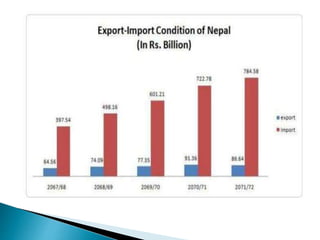
 Nepal faces a huge trade deficit, due to high imports and minimal
exports.
The major cause of this problem are:
 Insufficient infrastructural development
 poor labor relations
 weak institutional framework
 Poor investment-friendly environment
 Low FDI
 No match between population growth and production
 High remittance leading to consumption of imported goods
 Post impact of earthquake and blockade (more widening trade
deficit)
 Reduction of trade deficit
 Export is mainly comprised of low value added manufactured and
agricultural products.
 Overall decline in production and productivity.
 Unable to capitalize on products and services as per NTIS,2010.
 Weak quality testing, authentication, labeling and packaging.
 Poor infrastructure that is not conducive to do business.
 Lag in the implementation of Special Economic Zone (SEZ).
 Insufficient power supply i.e. energy crisis.
 According to the 13th Annual Year Plan:
 Nepal will become developing country from LDC category by 2079
B.S. (2022).
 Reduce poverty line to 18 percent.
 Trade policy provides an impetus to do so with an appropriate
vision, strategies, objectives and working procedures.
 To enhance the capacity of export-oriented service firms:
(Engineering, Tourism, IT, Business process outsourcing, Health
and Human Resource Development)
 To increase the competitiveness of the domestic product.
 To align the policy with other related policies that have larger
impact on trade.
 To boost production by reducing supply side constraints.
 To reduce the trade deficits through promotion of high value added
exports.
 To promote and protect IPR rights at regional and international
level.
 Government plays the role of facilitator, guardian and regulator
increasing the participation of private sector.
 Reduce trade deficit by reducing the import.
 Goods with comparative and competitive advantage will be identified
and promoted in export.
 Improve the competitiveness of export-oriented service area.
 Decrease transaction costs through procedural simplification and
institutional consolidation.
 Expand market by utilizing bilateral, regional, multilateral
opportunities with economic diplomacy for trade expansion.
 Improving both the goods and service competitiveness as
complementary to each other in terms of regional and international
production network.
 Promoting and increasing trade expansion related to IPR in global
market.
 Enhancing the role and professional capacity of government and
private sector entities.
 Promoting export oriented products of firms having competitive and
comparative advantage.
 Reducing import to reduce trade deficit.
 Increasing competitiveness of export-oriented firms (service).
 Reducing transaction costs through procedural simplification and
institutional strengthening.
 Establishing business as mainstream of the economy.
 Expand market by utilizing bilateral, regional, multilateral opportunities
with economic diplomacy for trade expansion.
 Improving both the goods and service competitiveness as
complementary to each other in terms of regional and international
production network.
 Promoting and increasing trade expansion related to IPR in global
market.
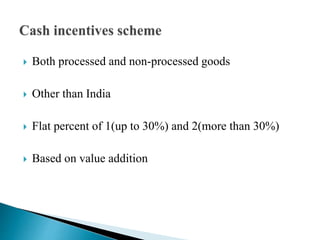
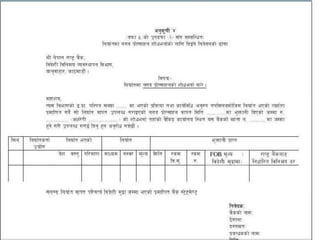
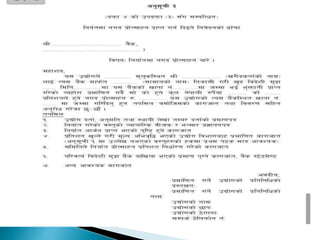
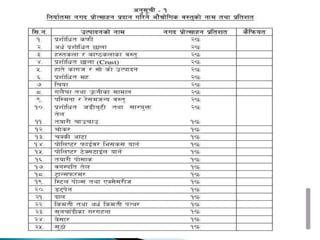
 Both processed and non-processed goods
 Other than India
 Flat percent of 1(up to 30%) and 2(more than 30%)
 Based on value addition
The policy has made provision for the following institutions
i) Board of Trade: It consists of 23 members. Its functions are:
Assist in trade-related policy formulation
Coordinate implementation of trade policy
Recommend amendments in trade policy
Give suggestions to the government to remove obstacles to open and
liberalize trade.
Carry out other activities related to trade facilitation
ii) Trade promotion institute: Concert trade and export promotion
centre into an autonomous Trade Promotion Institute
iii) Special economic zones and Processing zones
Help Nepal to export

Presentation on Trade policy 2072 Nepal

  • 1.
    Presented By: Group 1 AnjanaJoshi Ashrit Maskey Asik Basel Bandana Khadka Bijay Pandey Bindu Panta
  • 2.
     Set ofrules and regulations that are intended to change international trade flows, particularly to restrict import.  The basis for this trade policy is the Trade policy of 2009 .  It has taken into consideration how the neighboring and other similar country has benefited from the international trade.  This new trade policy 2072 has been formulated to take benefit from bilateral, regional and multilateral trading arrangements.
  • 3.
     After 2046our country moved forward to an open and liberalized economy.  Prior trade policies include trade policy 2049, trade policy 2065.  The 13th annual 3 year plan also focused on the importance of trade.  Nepal Trade Integration Strategy, NTIS 2010 includes framework for the development of trade.
  • 4.
     It aimsto :  promote domestic industries  Manage growing imports  Boost exports  So that trade becomes an engine for the economic development of the country.
  • 5.
     Nepal becamethe member of WTO on April 23,2004 in order to take benefit from the opportunities provided to LDC.  Nepal faces a huge trade deficit, due to high imports and minimal exports. The major cause of this problem are:  Insufficient infrastructural development  poor labor relations  weak institutional framework
  • 6.
     Poor investment-friendlyenvironment  Low FDI  No match between population growth and production  High remittance leading to consumption of imported goods  Post impact of earthquake and blockade (more widening trade deficit)
  • 7.
     Reduction oftrade deficit  Export is mainly comprised of low value added manufactured and agricultural products.  Overall decline in production and productivity.  Unable to capitalize on products and services as per NTIS,2010.
  • 8.
     Weak qualitytesting, authentication, labeling and packaging.  Poor infrastructure that is not conducive to do business.  Lag in the implementation of Special Economic Zone (SEZ).  Insufficient power supply i.e. energy crisis.
  • 9.
     According tothe 13th Annual Year Plan:  Nepal will become developing country from LDC category by 2079 B.S. (2022).  Reduce poverty line to 18 percent.  Trade policy provides an impetus to do so with an appropriate vision, strategies, objectives and working procedures.
  • 10.
     To enhancethe capacity of export-oriented service firms: (Engineering, Tourism, IT, Business process outsourcing, Health and Human Resource Development)  To increase the competitiveness of the domestic product.  To align the policy with other related policies that have larger impact on trade.
  • 11.
     To boostproduction by reducing supply side constraints.  To reduce the trade deficits through promotion of high value added exports.  To promote and protect IPR rights at regional and international level.
  • 12.
     Government playsthe role of facilitator, guardian and regulator increasing the participation of private sector.  Reduce trade deficit by reducing the import.  Goods with comparative and competitive advantage will be identified and promoted in export.  Improve the competitiveness of export-oriented service area.  Decrease transaction costs through procedural simplification and institutional consolidation.
  • 13.
     Expand marketby utilizing bilateral, regional, multilateral opportunities with economic diplomacy for trade expansion.  Improving both the goods and service competitiveness as complementary to each other in terms of regional and international production network.  Promoting and increasing trade expansion related to IPR in global market.
  • 14.
     Enhancing therole and professional capacity of government and private sector entities.  Promoting export oriented products of firms having competitive and comparative advantage.  Reducing import to reduce trade deficit.  Increasing competitiveness of export-oriented firms (service).  Reducing transaction costs through procedural simplification and institutional strengthening.
  • 15.
     Establishing businessas mainstream of the economy.  Expand market by utilizing bilateral, regional, multilateral opportunities with economic diplomacy for trade expansion.  Improving both the goods and service competitiveness as complementary to each other in terms of regional and international production network.  Promoting and increasing trade expansion related to IPR in global market.
  • 16.
     Both processedand non-processed goods  Other than India  Flat percent of 1(up to 30%) and 2(more than 30%)  Based on value addition
  • 21.
    The policy hasmade provision for the following institutions i) Board of Trade: It consists of 23 members. Its functions are: Assist in trade-related policy formulation Coordinate implementation of trade policy Recommend amendments in trade policy Give suggestions to the government to remove obstacles to open and liberalize trade. Carry out other activities related to trade facilitation
  • 22.
    ii) Trade promotioninstitute: Concert trade and export promotion centre into an autonomous Trade Promotion Institute iii) Special economic zones and Processing zones
  • 23.

Editor's Notes

  • #15 Working policy: 1.Govt to play role of guardain, regulator and facilitator to make export trade competitve. Re-evaluating the NTIS to benefit from intll trade Impoverishing the policies related with export( with changing environment Enhancing export capacity of both the private sector n Ngo Giving priority for csr in business and coprotae houses Providing land on lease facilities for agriculture and forest products Reinforcing the forwared and backward linkage for creating environmnt oportnites and economic growth 2.Enhancing the product competitiveness by price series development as identified under NTIS providing capital training skil for enhancing the prodction, capacity and quality of exportable goods. Will help to the firm affected from earthquake in case oof backward and forward linkage being broken 3.Developing infrastructure for trade expansion Organizing program for enhancing the productivity and reducing the supply constraints Focusing on product branding, quality testing at custom point 4. Identifying service related areas which can be exported Enhancing the capacity of ministry of suplies and commerce To make our certificate intlly accepted and recognized in terms of academic qualification 5.Making master plan for above policy Making custom process in line with international one in its process Whole process of import and export to be made simple quick and cost effectivve Making effective in information collection related to intll trade Proper infrastructure near border point 6.national regional and local development plan policies program and project analysis implementation and evalauation