DOI


Paul Walk
p.walk@ukoln.ac.uk

                                 UKOLN is supported by:


     www.ukoln.ac.uk
     A centre of expertise in digital information management
DOI is a business
  proposition


                    2
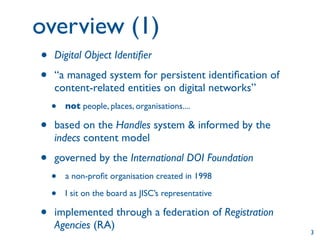
overview (1)
•   Digital Object Identifier

•   “a managed system for persistent identification of
    content-related entities on digital networks”
    •   not people, places, organisations....

•   based on the Handles system & informed by the
    indecs content model

•   governed by the International DOI Foundation
    •   a non-profit organisation created in 1998

    •   I sit on the board as JISC’s representative

•   implemented through a federation of Registration
    Agencies (RA)
                                                        3
overview (2)
•   Handles = a system for minting, managing &
    resolving persistent identifiers

•   indecs = interoperability of data in e-commerce
    systems
    •   (it’s trendily lowercase, so you realise immediately that it
        won’t be at all boring)

•   RAs: supporting DOI ‘registrants’ - allocating
    prefixes, registering DOI names and supporting the
    management of associated metadata


                                                                       4
overview (3)
•   DOI is a syntax

•   DOI = a name (identifier)

•   DOI is a system


                               5
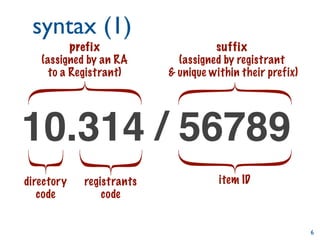
syntax (1)
          prefix                    suffix
   (assigned by an RA       (assigned by registrant
     to a Registrant)     & unique within their prefix)


10.314 / 56789
directory   registrants              item ID
   code         code


                                                          6
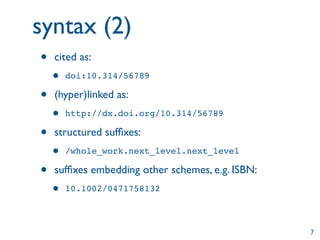
syntax (2)
•   cited as:
    •   doi:10.314/56789

•   (hyper)linked as:
    •   http://dx.doi.org/10.314/56789

•   structured suffixes:
    •   /whole_work.next_level.next_level

•   suffixes embedding other schemes, e.g. ISBN:
    •   10.1002/0471758132


                                                  7
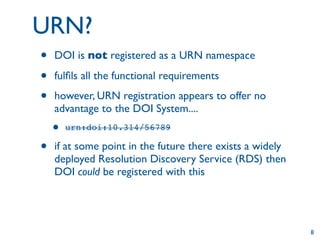
URN?
•   DOI is not registered as a URN namespace

•   fulfils all the functional requirements

•   however, URN registration appears to offer no
    advantage to the DOI System....
    •   urn:doi:10.314/56789

•   if at some point in the future there exists a widely
    deployed Resolution Discovery Service (RDS) then
    DOI could be registered with this


                                                           8
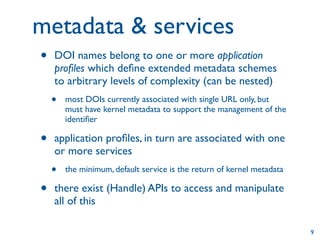
metadata & services
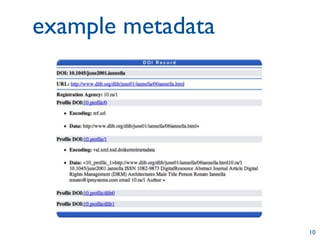
•   DOI names belong to one or more application
    profiles which define extended metadata schemes
    to arbitrary levels of complexity (can be nested)
    •   most DOIs currently associated with single URL only, but
        must have kernel metadata to support the management of the
        identifier

•   application profiles, in turn are associated with one
    or more services
    •   the minimum, default service is the return of kernel metadata

•   there exist (Handle) APIs to access and manipulate
    all of this

                                                                        9
example metadata


                   10
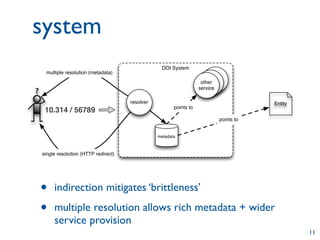
system
                                                    DOI System
     multiple resolution (metadata)
                                                                           other
                                                                         other
                                                                       other
                                                                          service
                                                                        service
                                                                      service
?
                                        resolver                                           Entity
                                                          points to
     10.314 / 56789
                                                                               points to


                                                   metadata


    single resolution (HTTP redirect)


    •    indirection mitigates ‘brittleness’

    •    multiple resolution allows rich metadata + wider
         service provision
                                                                                                    11
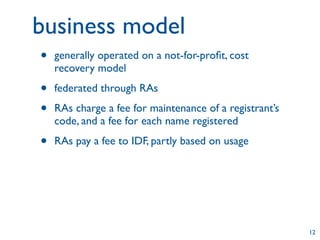
business model
•   generally operated on a not-for-profit, cost
    recovery model

•   federated through RAs

•   RAs charge a fee for maintenance of a registrant’s
    code, and a fee for each name registered

•   RAs pay a fee to IDF, partly based on usage


                                                         12
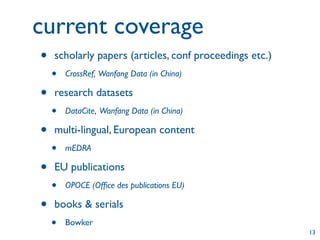
current coverage
•   scholarly papers (articles, conf proceedings etc.)
    •   CrossRef, Wanfang Data (in China)

•   research datasets
    •   DataCite, Wanfang Data (in China)

•   multi-lingual, European content
    •   mEDRA

•   EU publications
    •   OPOCE (Office des publications EU)

•   books & serials
    •   Bowker
                                                         13
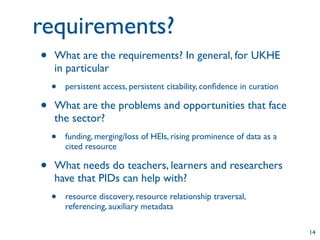
requirements?
•   What are the requirements? In general, for UKHE
    in particular
    •   persistent access, persistent citability, confidence in curation

•   What are the problems and opportunities that face
    the sector?
    •   funding, merging/loss of HEIs, rising prominence of data as a
        cited resource

•   What needs do teachers, learners and researchers
    have that PIDs can help with?
    •   resource discovery, resource relationship traversal,
        referencing, auxiliary metadata

                                                                          14
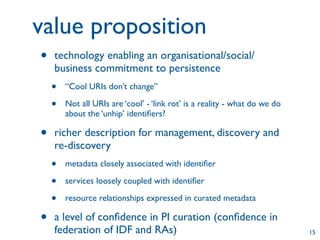
value proposition
•   technology enabling an organisational/social/
    business commitment to persistence
    •   “Cool URIs don’t change”

    •   Not all URIs are ‘cool’ - ‘link rot’ is a reality - what do we do
        about the ‘unhip’ identifiers?

•   richer description for management, discovery and
    re-discovery
    •   metadata closely associated with identifier

    •   services loosely coupled with identifier

    •   resource relationships expressed in curated metadata

•   a level of confidence in PI curation (confidence in
    federation of IDF and RAs)                                              15
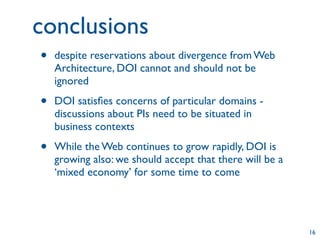
conclusions
•   despite reservations about divergence from Web
    Architecture, DOI cannot and should not be
    ignored

•   DOI satisfies concerns of particular domains -
    discussions about PIs need to be situated in
    business contexts

•   While the Web continues to grow rapidly, DOI is
    growing also: we should accept that there will be a
    ‘mixed economy’ for some time to come


                                                          16
the persistent identifier
system which refused to
        DOI....
    (said in a Brummie accent!)


                                  17

DOI in HE

  • 1.
    DOI Paul Walk p.walk@ukoln.ac.uk UKOLN is supported by: www.ukoln.ac.uk A centre of expertise in digital information management
  • 2.
    DOI is abusiness proposition 2
  • 3.
    overview (1) • Digital Object Identifier • “a managed system for persistent identification of content-related entities on digital networks” • not people, places, organisations.... • based on the Handles system & informed by the indecs content model • governed by the International DOI Foundation • a non-profit organisation created in 1998 • I sit on the board as JISC’s representative • implemented through a federation of Registration Agencies (RA) 3
  • 4.
    overview (2) • Handles = a system for minting, managing & resolving persistent identifiers • indecs = interoperability of data in e-commerce systems • (it’s trendily lowercase, so you realise immediately that it won’t be at all boring) • RAs: supporting DOI ‘registrants’ - allocating prefixes, registering DOI names and supporting the management of associated metadata 4
  • 5.
    overview (3) • DOI is a syntax • DOI = a name (identifier) • DOI is a system 5
  • 6.
    syntax (1) prefix suffix (assigned by an RA (assigned by registrant to a Registrant) & unique within their prefix) 10.314 / 56789 directory registrants item ID code code 6
  • 7.
    syntax (2) • cited as: • doi:10.314/56789 • (hyper)linked as: • http://dx.doi.org/10.314/56789 • structured suffixes: • /whole_work.next_level.next_level • suffixes embedding other schemes, e.g. ISBN: • 10.1002/0471758132 7
  • 8.
    URN? • DOI is not registered as a URN namespace • fulfils all the functional requirements • however, URN registration appears to offer no advantage to the DOI System.... • urn:doi:10.314/56789 • if at some point in the future there exists a widely deployed Resolution Discovery Service (RDS) then DOI could be registered with this 8
  • 9.
    metadata & services • DOI names belong to one or more application profiles which define extended metadata schemes to arbitrary levels of complexity (can be nested) • most DOIs currently associated with single URL only, but must have kernel metadata to support the management of the identifier • application profiles, in turn are associated with one or more services • the minimum, default service is the return of kernel metadata • there exist (Handle) APIs to access and manipulate all of this 9
  • 10.
  • 11.
    system DOI System multiple resolution (metadata) other other other service service service ? resolver Entity points to 10.314 / 56789 points to metadata single resolution (HTTP redirect) • indirection mitigates ‘brittleness’ • multiple resolution allows rich metadata + wider service provision 11
  • 12.
    business model • generally operated on a not-for-profit, cost recovery model • federated through RAs • RAs charge a fee for maintenance of a registrant’s code, and a fee for each name registered • RAs pay a fee to IDF, partly based on usage 12
  • 13.
    current coverage • scholarly papers (articles, conf proceedings etc.) • CrossRef, Wanfang Data (in China) • research datasets • DataCite, Wanfang Data (in China) • multi-lingual, European content • mEDRA • EU publications • OPOCE (Office des publications EU) • books & serials • Bowker 13
  • 14.
    requirements? • What are the requirements? In general, for UKHE in particular • persistent access, persistent citability, confidence in curation • What are the problems and opportunities that face the sector? • funding, merging/loss of HEIs, rising prominence of data as a cited resource • What needs do teachers, learners and researchers have that PIDs can help with? • resource discovery, resource relationship traversal, referencing, auxiliary metadata 14
  • 15.
    value proposition • technology enabling an organisational/social/ business commitment to persistence • “Cool URIs don’t change” • Not all URIs are ‘cool’ - ‘link rot’ is a reality - what do we do about the ‘unhip’ identifiers? • richer description for management, discovery and re-discovery • metadata closely associated with identifier • services loosely coupled with identifier • resource relationships expressed in curated metadata • a level of confidence in PI curation (confidence in federation of IDF and RAs) 15
  • 16.
    conclusions • despite reservations about divergence from Web Architecture, DOI cannot and should not be ignored • DOI satisfies concerns of particular domains - discussions about PIs need to be situated in business contexts • While the Web continues to grow rapidly, DOI is growing also: we should accept that there will be a ‘mixed economy’ for some time to come 16
  • 17.
    the persistent identifier systemwhich refused to DOI.... (said in a Brummie accent!) 17