WORD BORROWING FROM VARIOUS LANGUAGE
(Scandinavian, French, Latin, Greek)
Word Borrowing(Scandinavian, French, Latin and Greek)
★ English has borrowed words from many languages, including Scandinavian, French,
Latin, and Greek.
★ English language is a world language, but many of its users are not familiar with its
origin. It is mostly of West Germanic origin.
★ However, since it is comprised of almost 250 000 words, only a small number of those
are of Germanic origin.
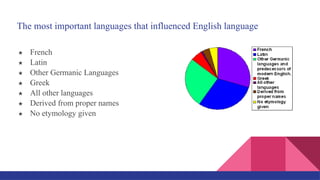
★ Namely, English language contains a lot of borrowings from almost 50 other languages
(data about other languages which influenced English can be found in Figure 1).
★ Looking at the frequency of words used in English, it can be noticed that German words
play an important role in English, i.e. constitute basic English vocabulary. These are
mostly one-syllable words such as man, house, go, see, in, and, good, etc.
The most important languages that influenced English language
★ French
★ Latin
★ Other Germanic Languages
★ Greek
★ All other languages
★ Derived from proper names
★ No etymology given
Word Borrowing
★ Scandinavians
After the Danish conquest many scandinavian words entered the english
Including Ball, Call, Egg, get, knife,mistake, skirt and take.
★ French
After the Norman invasion of england many french words entered the english including
legal terms, fashion, food and adornment.
★ Latin
Latin has been a common source of scientific terms in english. Many latin words have
entered english. Such as Conspiracy, custody, frustrate, genius, infinite, intellect, and limbo
★ Greek
The Romans who spoke Latin, borrowed by many greek terms due to their fascination with
Makers of English
★ William Shakespeare, John Milton, and bible translators have all contributed to the
english language in significant ways.
★ William Shakespeare: Inventing new words and commonly used expressions,
Creating compound words, adjectives, adverbs from verbs.
★ John Milton: Writing the doctrine and Discipline of Divorce (1643), The judgement
of Martin Bucer Concerning Divorce (1644), Colestarian(1645)
★ Bible Translators: The translation of the bible contributed to the transformation of
modern english.
English spelling and spelling reforms
★ The recording of spoken language in written form is a very important additional
Social technology, supplementary to spoken language itself. The defining aspects
of
this additional technology for the recording and conveying of information are the
script and the spelling system used.
★ There are numerous ways in which human beings can create, record, and convey
information. These include through body language, music (or noise), pictorial and
diagrammatic representations, machine language, and so on.
★ The most pervasive method of conveying information between individuals,
however, is ordinary spoken language, in both its oral and written forms. Ordinary
spoken language may be called ‘the language of qualities’ to indicate its different
emphasis from mathematics, described as ‘the language of quantities’.

WORD BORROWING FROM VARIOUS LANGUAGE (1).pptx

  • 1.
    WORD BORROWING FROMVARIOUS LANGUAGE (Scandinavian, French, Latin, Greek)
  • 2.
    Word Borrowing(Scandinavian, French,Latin and Greek) ★ English has borrowed words from many languages, including Scandinavian, French, Latin, and Greek. ★ English language is a world language, but many of its users are not familiar with its origin. It is mostly of West Germanic origin. ★ However, since it is comprised of almost 250 000 words, only a small number of those are of Germanic origin. ★ Namely, English language contains a lot of borrowings from almost 50 other languages (data about other languages which influenced English can be found in Figure 1). ★ Looking at the frequency of words used in English, it can be noticed that German words play an important role in English, i.e. constitute basic English vocabulary. These are mostly one-syllable words such as man, house, go, see, in, and, good, etc.
  • 3.
    The most importantlanguages that influenced English language ★ French ★ Latin ★ Other Germanic Languages ★ Greek ★ All other languages ★ Derived from proper names ★ No etymology given
  • 4.
    Word Borrowing ★ Scandinavians Afterthe Danish conquest many scandinavian words entered the english Including Ball, Call, Egg, get, knife,mistake, skirt and take. ★ French After the Norman invasion of england many french words entered the english including legal terms, fashion, food and adornment. ★ Latin Latin has been a common source of scientific terms in english. Many latin words have entered english. Such as Conspiracy, custody, frustrate, genius, infinite, intellect, and limbo ★ Greek The Romans who spoke Latin, borrowed by many greek terms due to their fascination with
  • 5.
    Makers of English ★William Shakespeare, John Milton, and bible translators have all contributed to the english language in significant ways. ★ William Shakespeare: Inventing new words and commonly used expressions, Creating compound words, adjectives, adverbs from verbs. ★ John Milton: Writing the doctrine and Discipline of Divorce (1643), The judgement of Martin Bucer Concerning Divorce (1644), Colestarian(1645) ★ Bible Translators: The translation of the bible contributed to the transformation of modern english.
  • 6.
    English spelling andspelling reforms ★ The recording of spoken language in written form is a very important additional Social technology, supplementary to spoken language itself. The defining aspects of this additional technology for the recording and conveying of information are the script and the spelling system used. ★ There are numerous ways in which human beings can create, record, and convey information. These include through body language, music (or noise), pictorial and diagrammatic representations, machine language, and so on. ★ The most pervasive method of conveying information between individuals, however, is ordinary spoken language, in both its oral and written forms. Ordinary spoken language may be called ‘the language of qualities’ to indicate its different emphasis from mathematics, described as ‘the language of quantities’.