NOURISH TO FLOURISH :
WAYS TO TACKLE MALNUTRITION
MADE BY-
AAKANKSHA PATHAK
AISHWARYA PRASANNAN
ANURAG DUTTA CHAUDHURY
TRIPTI KHUTE
HAMZA RAZA ZAIDI
1
zaidi.hamza@gmail.com
(Team Coordinator)
SOME FACTS -
 The World Bank estimates
that India is one of the highest
ranking countries in the world
for the number of children
suffering from malnutrition.
 The prevalence of underweight
children in India is among the
highest in the world, and is
nearly double that of Sub-
Saharan Africa with dire
consequences for mobility,
mortality, productivity and
economic growth
 The 2011 Global Hunger
Index (GHI) Report ranked
India 15th, amongst leading
countries with hunger situation.
 It also places India amongst the
three countries where the GHI
between 1996 and 2011 went
up from 22.9 to 23.7, while 78
out of the 81 developing
countries studied, including
Pakistan, Nepal, Bangladesh
and Zimbabwe succeeded in
improving hunger condition.
 25% of all hungry people
worldwide live in India.
 Malnutrition causes 45 per cent
of deaths of under-five children
 The UN ranks India in the
bottom quartile of countries by
under-1 infant mortality (the
53rd highest), and under-5 child
mortality (78 deaths per 1000
live births).
 According to the 2008 CIA fact
book, 32 babies out of every
1,000 born alive die before
their first birthday.
2
A MULTI CASUAL PROBLEM :
PhysicalCauses
Hunger.
Calorie/Protein
Micronutrient
Deficit.
Infection And
Diseases. Socio-economicand
HistoricCauses
Poverty/Low
Income.
Illiteracy/lack of
skills.
Gender
Discrimination
embedded in social
custom.
Lack of information
and Awareness.
Attitudinal/Behavioral
Causes
Gender
Discrimination.
Low status of
Women.
Negative
child/Mother care
practices.
Early marriage of
girls.
Early & frequent
pregnancies.
Lack of information
& awareness.
GovernanceRelated
Causes
No national
Programme with
specific objective of
reducing
malnutrition.
Inadequate, health
care services for
women and children.
Low access to safe
drinking water and
sanitation.
Poor coverage.
Programmatic gaps.
No action based
Nutrition
Monitoring.
Lack of
accountability.
3
Photo : RupsaCPhoto : Chaurahha…The Crossroad
FUNDAMENTAL CAUSES OF MALNUTRITION IN INDIA NOT YET
ADDRESSED PROGRAMMATICALLY :
 Malnutrition in India is deeply rooted
in the inter-generational cycle of low
birth weight babies, underweight
children, malnourished, anemic
adolescent girl sand pregnant women.
 However, current policies and
programmes do not address the issue
inter-generationally.
 More than 30% population of India
suffers from a Calorie-Protein,
Micronutrient Deficit, (CMPD)*
 This factor not yet acknowledged or
addressed specifically in any
programme(except in general through
the TPDS*, whose out reach to the
lowest percentile of poverty is poor).
 Besides, TPDS even if working
efficiently only provides for cereals,
(and in some cases pulses and sugar,) a
subsistence diet for the poor.
 TPDS does not provide adequate
calories, protein or micronutrients
for a healthy life. *(NNMB repeat surveys, 1988-90, 1996-97, NNMB Technical Reports No.20, 21, 22, 2000-03)
 There is inadequate awareness and
information regarding proper
nutritional practices amongst the
population, even with in existing
purchasing power.
 At least 10-15% of the population
suffer from malnutrition not because of
poverty/lack of purchasing power but
because of lack of awareness and
information
 In spite of the 11th Plan
recommendation for initiating a
nutrition awareness generation
campaign, it has not yet happened.
1 2 3
*TPDS : Targeted Public Distribution System
4
Photo:RupsaC
PROVIDE MICRO-NUTRIENT SUPPLEMENTS FOR FREE TO
MALNUTRITIOUS CHILDREN AND PREGNANT WOMEN'S
 Macronutrients
(carbohydrates, lipids,
proteins & water) are
needed for energy and
cell multiplication &
repair.
 Micronutrients are trace
elements & vitamins,
which are essential for
metabolic processes.
 Resolves diseases caused
by Iron, Zinc, Iodine and
Vitamin A deficiency.
What are Micronutrient ?
 The majority of world’s
children live in developing
countries.
 Lack of food & clean
water, poor sanitation,
infection & social unrest
lead to LBW & PEM.
 Malnutrition is implicated
in more that 50% of deaths
of less than 5 years of
children (5 million per
year).
28%
29%
26%
10%
7%
CHILD MORTALITY
Diarrhea ARI Perintal causes Measles Malaria
55 % of total have malnutrition
Proposed Solution -
LBW : Low Body Weight
PEM : Protein Energy Malnutrition
5
Malnutrition
ANC : Antenatal Care
EBF : Exclusive Breast Feeding
Conceptual Interpretation - 6
 ICDS
 Mid Day Meal
Programme
 Kishori Shakti Yojana
 Immunization
Programmes
 Vitamin A
Supplementation
Programme
 National Nutritional
Anaemia Control
Programme
 National Iodine
Deficiency Disorder
Control Programme.
 National Rural Drinking
Water Programme
 Total Sanitation
Campaign
Current Nutrition Related
Programmes :
 These programmes
address some causes
of Malnutrition but
not all of them and
have several
programmatic and
coverage gaps.
 In the absence of
seamless and
simultaneous
interventions, gains
accruing from
existing, dispersed
and often isolated
interventions are lost
on account of
absence of other
critical interventions.
Proposed Micro-Nutrient Nutrition
Programme :
AIM-
“To provide multiple vitamin and mineral supplements for
pregnant and lactating women, and for children aged 6 to 59
months.”
 Introduce nutrition and micro-nutrient interventions for the
three critical links of malnutrition viz. children 6 months to 6
years, adolescent girls, and pregnant and lactating women
to be prepared by Collaborations of Scientists, based on
research of the past and present.
 Several Formula’s of these Micro-Nutrients are already been
made and used in emergencies(Natural Disasters) by WHO.
 Introduce nutrition and micro-nutrient interventions for the
general population to bridge the protein-calorie gap by making
available in the market, protein-energy dense foods for free.
 Structure and monitor tightly integrated multi-sectoral
interventions to address all or majority of the direct and indirect
causes of malnutrition simultaneously.
 Initiate a sustained general public awareness campaign
regarding proper nutritional practices within existing
family budgets, and to create demand. SHG : Self Help Group
7
ROADMAP OF SOLUTION PROVIDED -
Micro-Nutrient
food prepared
by Team of
Scientists.
Team of
Specialists and
Political leaders
look for
required budget
and feasibility
of the MN Food.
MN Food
Distributed to
different
Government
Agencies.
Government
Agencies
Distribute these
Micro-Nutrient to
Population
Currently suffering
from Malnutrition.
Micro-Nutrient food
available at different
government stores such
as TPDS for free.
Form an effective
monitoring system(through
external agency) for
measuring outcomes,
effective changes & mid
course corrections.
Initiate a Public
awareness campaign, to
reach and inform about
MN Food and proper
nutritious practices.
Since, this is a Research Based Project, estimated budget for this project
would depend upon time and material consumed during research and its
mass production and feasibility for the poor.
8
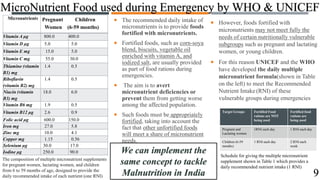
Micronutrients Pregnant Children
Women (6-59 months)
Vitamin A µg 800.0 400.0
Vitamin D µg 5.0 5.0
Vitamin E mg 15.0 5.0
Vitamin C mg 55.0 30.0
Thiamine (vitamin
B1) mg
1.4 0.5
Riboflavin
(vitamin B2) mg
1.4 0.5
Niacin (vitamin
B3) mg
18.0 6.0
Vitamin B6 mg 1.9 0.5
Vitamin B12 µg 2.6 0.9
Folic acid µg 600.0 150.0
Iron mg 27.0 5.8
Zinc mg 10.0 4.1
Copper mg 1.15 0.56
Selenium µg 30.0 17.0
Iodine µg 250.0 90.0
The composition of multiple micronutrient supplements
for pregnant women, lactating women, and children
from 6 to 59 months of age, designed to provide the
daily recommended intake of each nutrient (one RNI)
MicroNutrient Food used during Emergency by WHO & UNICEF
 The recommended daily intake of
micronutrients is to provide foods
fortified with micronutrients.
 Fortified foods, such as corn-soya
blend, biscuits, vegetable oil
enriched with vitamin A, and
iodized salt, are usually provided
as part of food rations during
emergencies.
 The aim is to avert
micronutrient deficiencies or
prevent them from getting worse
among the affected population.
 Such foods must be appropriately
fortified, taking into account the
fact that other unfortified foods
will meet a share of micronutrient
needs.
We can implement the
same concept to tackle
Malnutrition in India
 However, foods fortified with
micronutrients may not meet fully the
needs of certain nutritionally vulnerable
subgroups such as pregnant and lactating
women, or young children.
 For this reason UNICEF and the WHO
have developed the daily multiple
micronutrient formula(shown in Table
on the left) to meet the Recommended
Nutrient Intake (RNI) of these
vulnerable groups during emergencies
Target Groups Fortified Food
rations are NOT
being used
Fortified food
rations are
being used
Pregnant and
Lactating women
1RNI each day 1 RNI each day
Children (6-59
months)
1 RNI each day 2 RNI each
week
Schedule for giving the multiple micronutrient
supplement shown in Table 1 which provides a
daily recommended nutrient intake (1 RNI)
9
Essential Interventions to Combat Malnutrition
(A) Direct interventions–
“Related to the consumption and absorption of
adequate protein calorie/micro-nutrient rich foods
essential to combat malnutrition”, namely:
 Weightment of child within 6 hours of birth and thereafter at
monthly intervals.
 Timely initiation of breastfeeding within one hour of birth, and
feeding of colostrum to the infant.
 Timely introduction of complementary foods at six months and
adequate intake of the same, in terms of quantity, quality and
frequency for children between 6-24 months.
 Dietary supplements of all children between 6 months –72
months through energy dense foods made by SHGs from locally
available food material to bridge the protein calorie gap.
 Fortification of common foods.
 Dietary supplements of iron–rich, energy dense foods made
from locally available food material prepared by women SHGs for
adolescent girls and women, especially during growth periods and
pregnancy to fill the protein calorie gap and ensure optimal
weight gain during pregnancy.
(B) Indirect Interventions –
“Related to issues of health, safe drinking water,
hygienic sanitation and socio-cultural factors such as early
marriage and pregnancy of girls, female literacy and poverty
reduction, to eradicate malnutrition on a long term, sustainable
basis.”
 Access to safe drinking water (treatment, storage, handling and
transport), sanitation and hygiene.
 Increased female education and completion of secondary schooling
for the girl child, delayed age of marriage and pregnancy.
 Increased access of basic health services to women.
 Expanded and improved nutrition education and involvement at
Panchayat and community level to create demand.
 Increased gender equity.
 Linking Agriculture/Horticulture and Nutrition.
10
Challenges and Implementation
risks :
 Since at least 4% of India’s GDP
($29 Billion) annually is lost on
account of malnutrition, the cost of
addressing malnutrition is far
below the cost of not addressing it.
 Investing in human resources
development for the future – in the
shape of healthy children, adolescents
and adults with higher cognitive and
productive capacity, is an
investment that will pay for itself
several times over
 The project will eradicate the curse of
malnutrition in the shortest possible
time, so that every Indian is able to
reach his or her full physical and
cognitive potential, enhance income
generation capacity and contribute
to the country's progress.
 Government
 Scientific Community/Academia
 Private Sector
Stakeholders :
Positive Aspects of Project :
 Bridge the Protein-calorie-micro
nutrient deficit which affects at least
50 % of the population.
 This project formulate a tightly
integrated multi-sectoral strategy to
address all or majority of direct and
indirect causes of malnutrition
simultaneously, many of which exist in
on going programmes.
 Community based nutrition
monitoring and surveillance through
ICDS infrastructure could help
growth monitoring of infants and
children and weight monitoring of
adolescent girls and women.
 Civil Society/NGOs/People’s
Organizations
 Development Organization
Conclusion :
 Government is not interested in any
research funding project
 Processing cost of micro-nutrition
food can not be easily predicted.
 Difficulty in convincing
malnutricious population about the
project i.e. to take MN Food.
 Time taken for extensive scientific
research will make this project slow
just in initial phase, but once its done,
government can help process MN
food at a faster rate.
11
THANK YOU FOR PAYING ATTENTION !!
References :
 India’s Malnutrition: A Multi-Sectoral Solution : Report by Veena S Rao
 The Micronutrient Report by John. B. Mason, Mahshid Lotfi, Nita Dalmiya, Kavita Sethuraman and Megan Deitchler
 Child malnutrition in India: Why does it persist? : Report by Sam Mendelson with input from Dr. Samir Chaudhuri (CINI)
 Children in India 2012 - A Statistical Appraisal : Report by Ministry of statistics and Programme Implementation, Government of India
 India’s Undernourished Children - A Call for Reform and Action : Report by Michele Gragnolati, Meera Shekar, Monica Das Gupta,
Caryn Bredenkamp and Yi-Kyoung Lee August 2005
 Preventing and controlling micronutrient deficiencies in populations affected by an emergency : Report by Joint statement by the World
Health Organization, the World Food Programme and the United Nations Children’s Fund
 Why malnutrition in shining India persists by Peter Svedberg
 WHO Database
 Wikipedia
12Appendix -

Doers

  • 1.
    NOURISH TO FLOURISH: WAYS TO TACKLE MALNUTRITION MADE BY- AAKANKSHA PATHAK AISHWARYA PRASANNAN ANURAG DUTTA CHAUDHURY TRIPTI KHUTE HAMZA RAZA ZAIDI 1 zaidi.hamza@gmail.com (Team Coordinator)
  • 2.
    SOME FACTS - The World Bank estimates that India is one of the highest ranking countries in the world for the number of children suffering from malnutrition.  The prevalence of underweight children in India is among the highest in the world, and is nearly double that of Sub- Saharan Africa with dire consequences for mobility, mortality, productivity and economic growth  The 2011 Global Hunger Index (GHI) Report ranked India 15th, amongst leading countries with hunger situation.  It also places India amongst the three countries where the GHI between 1996 and 2011 went up from 22.9 to 23.7, while 78 out of the 81 developing countries studied, including Pakistan, Nepal, Bangladesh and Zimbabwe succeeded in improving hunger condition.  25% of all hungry people worldwide live in India.  Malnutrition causes 45 per cent of deaths of under-five children  The UN ranks India in the bottom quartile of countries by under-1 infant mortality (the 53rd highest), and under-5 child mortality (78 deaths per 1000 live births).  According to the 2008 CIA fact book, 32 babies out of every 1,000 born alive die before their first birthday. 2
  • 3.
    A MULTI CASUALPROBLEM : PhysicalCauses Hunger. Calorie/Protein Micronutrient Deficit. Infection And Diseases. Socio-economicand HistoricCauses Poverty/Low Income. Illiteracy/lack of skills. Gender Discrimination embedded in social custom. Lack of information and Awareness. Attitudinal/Behavioral Causes Gender Discrimination. Low status of Women. Negative child/Mother care practices. Early marriage of girls. Early & frequent pregnancies. Lack of information & awareness. GovernanceRelated Causes No national Programme with specific objective of reducing malnutrition. Inadequate, health care services for women and children. Low access to safe drinking water and sanitation. Poor coverage. Programmatic gaps. No action based Nutrition Monitoring. Lack of accountability. 3 Photo : RupsaCPhoto : Chaurahha…The Crossroad
  • 4.
    FUNDAMENTAL CAUSES OFMALNUTRITION IN INDIA NOT YET ADDRESSED PROGRAMMATICALLY :  Malnutrition in India is deeply rooted in the inter-generational cycle of low birth weight babies, underweight children, malnourished, anemic adolescent girl sand pregnant women.  However, current policies and programmes do not address the issue inter-generationally.  More than 30% population of India suffers from a Calorie-Protein, Micronutrient Deficit, (CMPD)*  This factor not yet acknowledged or addressed specifically in any programme(except in general through the TPDS*, whose out reach to the lowest percentile of poverty is poor).  Besides, TPDS even if working efficiently only provides for cereals, (and in some cases pulses and sugar,) a subsistence diet for the poor.  TPDS does not provide adequate calories, protein or micronutrients for a healthy life. *(NNMB repeat surveys, 1988-90, 1996-97, NNMB Technical Reports No.20, 21, 22, 2000-03)  There is inadequate awareness and information regarding proper nutritional practices amongst the population, even with in existing purchasing power.  At least 10-15% of the population suffer from malnutrition not because of poverty/lack of purchasing power but because of lack of awareness and information  In spite of the 11th Plan recommendation for initiating a nutrition awareness generation campaign, it has not yet happened. 1 2 3 *TPDS : Targeted Public Distribution System 4 Photo:RupsaC
  • 5.
    PROVIDE MICRO-NUTRIENT SUPPLEMENTSFOR FREE TO MALNUTRITIOUS CHILDREN AND PREGNANT WOMEN'S  Macronutrients (carbohydrates, lipids, proteins & water) are needed for energy and cell multiplication & repair.  Micronutrients are trace elements & vitamins, which are essential for metabolic processes.  Resolves diseases caused by Iron, Zinc, Iodine and Vitamin A deficiency. What are Micronutrient ?  The majority of world’s children live in developing countries.  Lack of food & clean water, poor sanitation, infection & social unrest lead to LBW & PEM.  Malnutrition is implicated in more that 50% of deaths of less than 5 years of children (5 million per year). 28% 29% 26% 10% 7% CHILD MORTALITY Diarrhea ARI Perintal causes Measles Malaria 55 % of total have malnutrition Proposed Solution - LBW : Low Body Weight PEM : Protein Energy Malnutrition 5
  • 6.
    Malnutrition ANC : AntenatalCare EBF : Exclusive Breast Feeding Conceptual Interpretation - 6
  • 7.
     ICDS  MidDay Meal Programme  Kishori Shakti Yojana  Immunization Programmes  Vitamin A Supplementation Programme  National Nutritional Anaemia Control Programme  National Iodine Deficiency Disorder Control Programme.  National Rural Drinking Water Programme  Total Sanitation Campaign Current Nutrition Related Programmes :  These programmes address some causes of Malnutrition but not all of them and have several programmatic and coverage gaps.  In the absence of seamless and simultaneous interventions, gains accruing from existing, dispersed and often isolated interventions are lost on account of absence of other critical interventions. Proposed Micro-Nutrient Nutrition Programme : AIM- “To provide multiple vitamin and mineral supplements for pregnant and lactating women, and for children aged 6 to 59 months.”  Introduce nutrition and micro-nutrient interventions for the three critical links of malnutrition viz. children 6 months to 6 years, adolescent girls, and pregnant and lactating women to be prepared by Collaborations of Scientists, based on research of the past and present.  Several Formula’s of these Micro-Nutrients are already been made and used in emergencies(Natural Disasters) by WHO.  Introduce nutrition and micro-nutrient interventions for the general population to bridge the protein-calorie gap by making available in the market, protein-energy dense foods for free.  Structure and monitor tightly integrated multi-sectoral interventions to address all or majority of the direct and indirect causes of malnutrition simultaneously.  Initiate a sustained general public awareness campaign regarding proper nutritional practices within existing family budgets, and to create demand. SHG : Self Help Group 7
  • 8.
    ROADMAP OF SOLUTIONPROVIDED - Micro-Nutrient food prepared by Team of Scientists. Team of Specialists and Political leaders look for required budget and feasibility of the MN Food. MN Food Distributed to different Government Agencies. Government Agencies Distribute these Micro-Nutrient to Population Currently suffering from Malnutrition. Micro-Nutrient food available at different government stores such as TPDS for free. Form an effective monitoring system(through external agency) for measuring outcomes, effective changes & mid course corrections. Initiate a Public awareness campaign, to reach and inform about MN Food and proper nutritious practices. Since, this is a Research Based Project, estimated budget for this project would depend upon time and material consumed during research and its mass production and feasibility for the poor. 8
  • 9.
    Micronutrients Pregnant Children Women(6-59 months) Vitamin A µg 800.0 400.0 Vitamin D µg 5.0 5.0 Vitamin E mg 15.0 5.0 Vitamin C mg 55.0 30.0 Thiamine (vitamin B1) mg 1.4 0.5 Riboflavin (vitamin B2) mg 1.4 0.5 Niacin (vitamin B3) mg 18.0 6.0 Vitamin B6 mg 1.9 0.5 Vitamin B12 µg 2.6 0.9 Folic acid µg 600.0 150.0 Iron mg 27.0 5.8 Zinc mg 10.0 4.1 Copper mg 1.15 0.56 Selenium µg 30.0 17.0 Iodine µg 250.0 90.0 The composition of multiple micronutrient supplements for pregnant women, lactating women, and children from 6 to 59 months of age, designed to provide the daily recommended intake of each nutrient (one RNI) MicroNutrient Food used during Emergency by WHO & UNICEF  The recommended daily intake of micronutrients is to provide foods fortified with micronutrients.  Fortified foods, such as corn-soya blend, biscuits, vegetable oil enriched with vitamin A, and iodized salt, are usually provided as part of food rations during emergencies.  The aim is to avert micronutrient deficiencies or prevent them from getting worse among the affected population.  Such foods must be appropriately fortified, taking into account the fact that other unfortified foods will meet a share of micronutrient needs. We can implement the same concept to tackle Malnutrition in India  However, foods fortified with micronutrients may not meet fully the needs of certain nutritionally vulnerable subgroups such as pregnant and lactating women, or young children.  For this reason UNICEF and the WHO have developed the daily multiple micronutrient formula(shown in Table on the left) to meet the Recommended Nutrient Intake (RNI) of these vulnerable groups during emergencies Target Groups Fortified Food rations are NOT being used Fortified food rations are being used Pregnant and Lactating women 1RNI each day 1 RNI each day Children (6-59 months) 1 RNI each day 2 RNI each week Schedule for giving the multiple micronutrient supplement shown in Table 1 which provides a daily recommended nutrient intake (1 RNI) 9
  • 10.
    Essential Interventions toCombat Malnutrition (A) Direct interventions– “Related to the consumption and absorption of adequate protein calorie/micro-nutrient rich foods essential to combat malnutrition”, namely:  Weightment of child within 6 hours of birth and thereafter at monthly intervals.  Timely initiation of breastfeeding within one hour of birth, and feeding of colostrum to the infant.  Timely introduction of complementary foods at six months and adequate intake of the same, in terms of quantity, quality and frequency for children between 6-24 months.  Dietary supplements of all children between 6 months –72 months through energy dense foods made by SHGs from locally available food material to bridge the protein calorie gap.  Fortification of common foods.  Dietary supplements of iron–rich, energy dense foods made from locally available food material prepared by women SHGs for adolescent girls and women, especially during growth periods and pregnancy to fill the protein calorie gap and ensure optimal weight gain during pregnancy. (B) Indirect Interventions – “Related to issues of health, safe drinking water, hygienic sanitation and socio-cultural factors such as early marriage and pregnancy of girls, female literacy and poverty reduction, to eradicate malnutrition on a long term, sustainable basis.”  Access to safe drinking water (treatment, storage, handling and transport), sanitation and hygiene.  Increased female education and completion of secondary schooling for the girl child, delayed age of marriage and pregnancy.  Increased access of basic health services to women.  Expanded and improved nutrition education and involvement at Panchayat and community level to create demand.  Increased gender equity.  Linking Agriculture/Horticulture and Nutrition. 10
  • 11.
    Challenges and Implementation risks:  Since at least 4% of India’s GDP ($29 Billion) annually is lost on account of malnutrition, the cost of addressing malnutrition is far below the cost of not addressing it.  Investing in human resources development for the future – in the shape of healthy children, adolescents and adults with higher cognitive and productive capacity, is an investment that will pay for itself several times over  The project will eradicate the curse of malnutrition in the shortest possible time, so that every Indian is able to reach his or her full physical and cognitive potential, enhance income generation capacity and contribute to the country's progress.  Government  Scientific Community/Academia  Private Sector Stakeholders : Positive Aspects of Project :  Bridge the Protein-calorie-micro nutrient deficit which affects at least 50 % of the population.  This project formulate a tightly integrated multi-sectoral strategy to address all or majority of direct and indirect causes of malnutrition simultaneously, many of which exist in on going programmes.  Community based nutrition monitoring and surveillance through ICDS infrastructure could help growth monitoring of infants and children and weight monitoring of adolescent girls and women.  Civil Society/NGOs/People’s Organizations  Development Organization Conclusion :  Government is not interested in any research funding project  Processing cost of micro-nutrition food can not be easily predicted.  Difficulty in convincing malnutricious population about the project i.e. to take MN Food.  Time taken for extensive scientific research will make this project slow just in initial phase, but once its done, government can help process MN food at a faster rate. 11
  • 12.
    THANK YOU FORPAYING ATTENTION !! References :  India’s Malnutrition: A Multi-Sectoral Solution : Report by Veena S Rao  The Micronutrient Report by John. B. Mason, Mahshid Lotfi, Nita Dalmiya, Kavita Sethuraman and Megan Deitchler  Child malnutrition in India: Why does it persist? : Report by Sam Mendelson with input from Dr. Samir Chaudhuri (CINI)  Children in India 2012 - A Statistical Appraisal : Report by Ministry of statistics and Programme Implementation, Government of India  India’s Undernourished Children - A Call for Reform and Action : Report by Michele Gragnolati, Meera Shekar, Monica Das Gupta, Caryn Bredenkamp and Yi-Kyoung Lee August 2005  Preventing and controlling micronutrient deficiencies in populations affected by an emergency : Report by Joint statement by the World Health Organization, the World Food Programme and the United Nations Children’s Fund  Why malnutrition in shining India persists by Peter Svedberg  WHO Database  Wikipedia 12Appendix -