Nutrition
Prepared By: Pratibha Oli
MPH 21st Batch
Roll No: 384
Better Nutrition Better Life
Introduction
• Nutrition is the intake of food, considered in relation to the
body’s dietary needs.
• Good nutrition – an adequate, well balanced diet combined
with regular physical activity – is a cornerstone of good
health.
• Poor nutrition can lead to reduced immunity, increased
susceptibility to disease, impaired physical and mental
development, and reduced productivity.
Source: https://www.who.int/topics/nutrition/en/
2
Terms
• Nutrients: The components in foods that an organism uses
to survive and grow. E.g. carbohydrate, protein
• Macronutrients: are consumed in relatively large quantities
and include proteins, carbohydrates, and fats and fatty acids.
• Micronutrients: vitamins and minerals – are consumed in
relatively smaller quantities, but are essential to body
processes
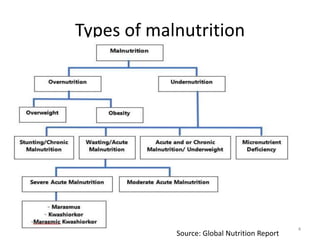
• Malnutrition, in all its forms, includes under nutrition
(wasting, stunting, underweight), inadequate vitamins or
minerals, overweight, obesity, and resulting diet-related non
communicable diseases.
Source: WHO 2019
3
Types of malnutrition
Source: Global Nutrition Report
4
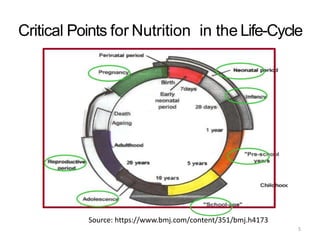
Critical Points for Nutrition in the Life-Cycle
5
Source: https://www.bmj.com/content/351/bmj.h4173
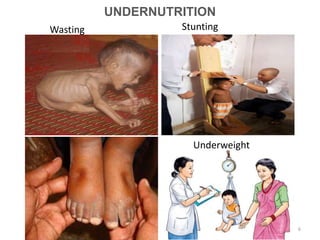
UNDERNUTRITION
StuntingWasting
Underweight
6
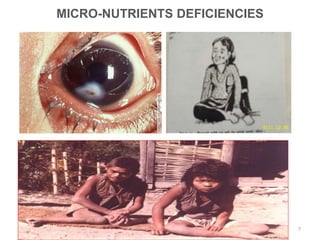
MICRO-NUTRIENTS DEFICIENCIES
7
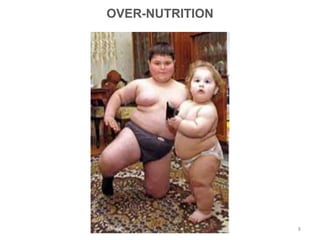
OVER-NUTRITION
8
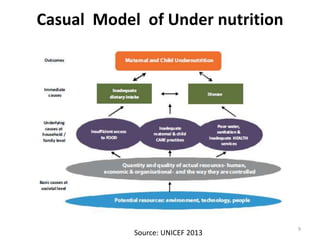
Casual Model of Under nutrition
Source: UNICEF 2013
9
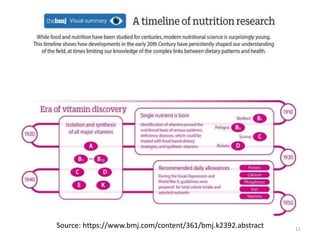
HISTORY OF NUTRITION
10
11
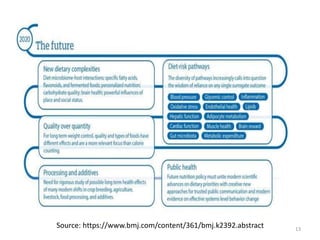
Source: https://www.bmj.com/content/361/bmj.k2392.abstract
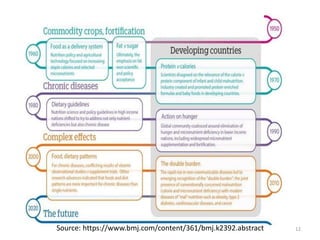
12Source: https://www.bmj.com/content/361/bmj.k2392.abstract
13
Source: https://www.bmj.com/content/361/bmj.k2392.abstract
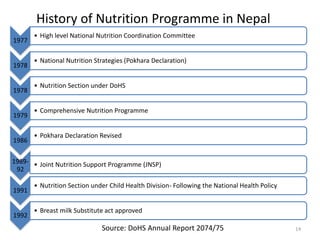
History of Nutrition Programme in Nepal
1977
• High level National Nutrition Coordination Committee
1978
• National Nutrition Strategies (Pokhara Declaration)
1978
• Nutrition Section under DoHS
1979
• Comprehensive Nutrition Programme
1986
• Pokhara Declaration Revised
1989-
92
• Joint Nutrition Support Programme (JNSP)
1991
• Nutrition Section under Child Health Division- Following the National Health Policy
1992
• Breast milk Substitute act approved
14Source: DoHS Annual Report 2074/75
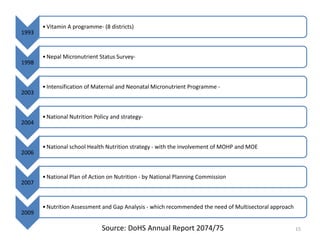
1993
•Vitamin A programme- (8 districts)
1998
•Nepal Micronutrient Status Survey-
2003
•Intensification of Maternal and Neonatal Micronutrient Programme -
2004
•National Nutrition Policy and strategy-
2006
•National school Health Nutrition strategy - with the involvement of MOHP and MOE
2007
•National Plan of Action on Nutrition - by National Planning Commission
2009
•Nutrition Assessment and Gap Analysis - which recommended the need of Multisectoral approach
15Source: DoHS Annual Report 2074/75
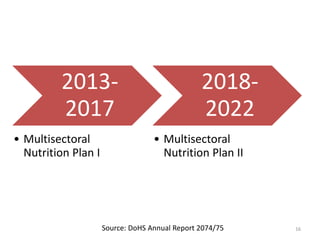
2013-
2017
• Multisectoral
Nutrition Plan I
2018-
2022
• Multisectoral
Nutrition Plan II
16Source: DoHS Annual Report 2074/75
GLOBAL SCENARIO
17
GLOBAL SCENARIO
• 820 million people did not have enough to eat in 2018, up
from 811 million in the previous year
• Number of hungry people in the world in 2018: 821.6 million
(or 1 in 9 people)
– in Asia: 513.9 million
– in Africa: 256.1million
– in Latin America and the Caribbean: 42.5 million
• Number of moderately or severely food insecure: 2 billion
(26.4%)
Source : UN report 2019
18
GLOBAL SCENARIO
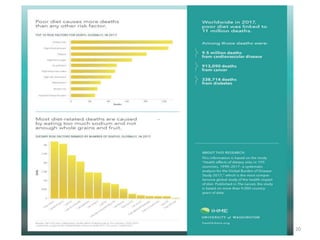
• Poor diets were responsible for 10.9 million deaths, or 22% of
all deaths among adults in 2017, with cardiovascular disease
as the leading cause, followed by cancers and diabetes.
• Poor diet represents 16% of all DALYs among adults globally.
• In comparison tobacco was associated with 8.0 million deaths,
and high blood pressure was linked to 10.4 million deaths.
Source: https://www.thelancet.com/journals/lancet/article/PIIS0140-
6736(18)32822-8/fulltext?dgcid=raven_jbs_etoc_email
19
20
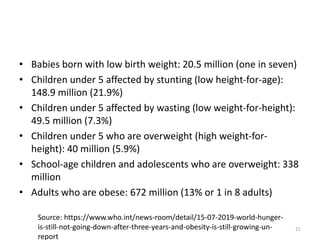
• Babies born with low birth weight: 20.5 million (one in seven)
• Children under 5 affected by stunting (low height-for-age):
148.9 million (21.9%)
• Children under 5 affected by wasting (low weight-for-height):
49.5 million (7.3%)
• Children under 5 who are overweight (high weight-for-
height): 40 million (5.9%)
• School-age children and adolescents who are overweight: 338
million
• Adults who are obese: 672 million (13% or 1 in 8 adults)
Source: https://www.who.int/news-room/detail/15-07-2019-world-hunger-
is-still-not-going-down-after-three-years-and-obesity-is-still-growing-un-
report
21
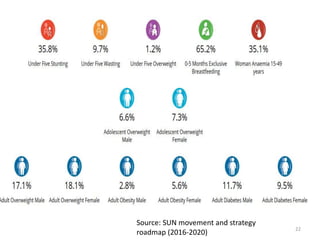
Source: SUN movement and strategy
roadmap (2016-2020)
22
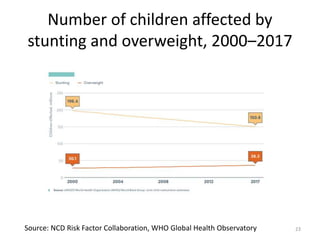
Number of children affected by
stunting and overweight, 2000–2017
23Source: NCD Risk Factor Collaboration, WHO Global Health Observatory
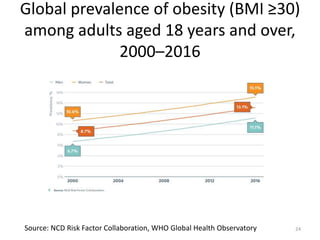
Global prevalence of obesity (BMI ≥30)
among adults aged 18 years and over,
2000–2016
24Source: NCD Risk Factor Collaboration, WHO Global Health Observatory
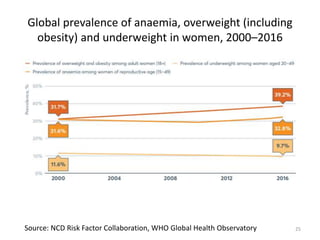
Global prevalence of anaemia, overweight (including
obesity) and underweight in women, 2000–2016
Source: NCD Risk Factor Collaboration, WHO Global Health Observatory 25
Malnutrition: an invisible emergency
Malnutrition has a million faces:
• A child who never reaches full height due to poverty, poor
sanitation, lack of breastfeeding and limited access to
nutritious foods
• A young woman who becomes anaemic during her pregnancy
and gives birth to an underweight baby who later faces
developmental delays
• A child rendered blind by vitamin A deficiency
Source: https://www.unicef.org/nutrition/index_faces-of-malnutrition.html
26
Malnutrition: an invisible emergency
• A child who becomes obese through overconsumption of low
quality food
• A desperately thin and wasted child, at imminent risk of death
• Nearly half of all deaths in children under 5 can be attributed
to under nutrition.
Source: https://www.unicef.org/nutrition/index_faces-of-malnutrition.html
27
Double burden of malnutrition
28
What is double burden??
Source: WHO infographics 29
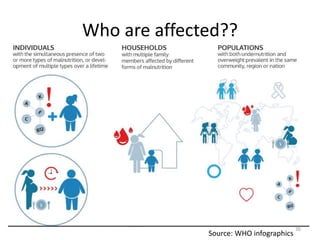
Who are affected??
Source: WHO infographics
30
• Many countries are now facing an overlapping
‘triple burden’ of malnutrition: under
nutrition and micronutrient deficiencies on
the one hand, and overweight and obesity on
the other.
31
NATIONAL SCENARIO
32
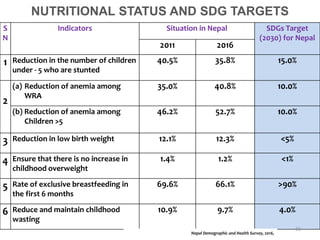
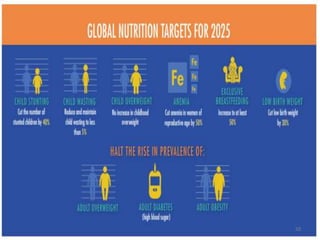
NUTRITIONAL STATUS AND SDG TARGETS
S
N
Indicators Situation in Nepal SDGs Target
(2030) for Nepal
2011 2016
1 Reduction in the number of children
under - 5 who are stunted
40.5% 35.8% 15.0%
2
(a) Reduction of anemia among
WRA
35.0% 40.8% 10.0%
(b) Reduction of anemia among
Children >5
46.2% 52.7% 10.0%
3 Reduction in low birth weight 12.1% 12.3% <5%
4 Ensure that there is no increase in
childhood overweight
1.4% 1.2% <1%
5 Rate of exclusive breastfeeding in
the first 6 months
69.6% 66.1% >90%
6 Reduce and maintain childhood
wasting
10.9% 9.7% 4.0%
Nepal Demographic and Health Survey, 2016,
33
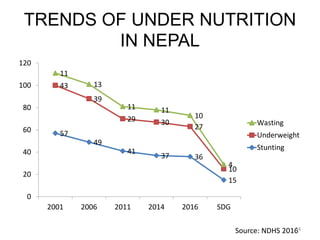
TRENDS OF UNDER NUTRITION
IN NEPAL
57
49
41
37 36
15
43
39
29 30
27
10
11
13
11 11
10
4
0
20
40
60
80
100
120
2001 2006 2011 2014 2016 SDG
Wasting
Underweight
Stunting
Source: NDHS 201634
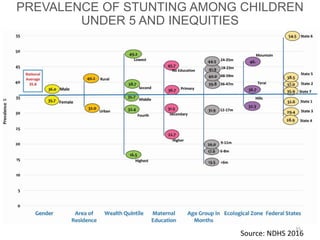
PREVALENCE OF STUNTING AMONG CHILDREN
UNDER 5 AND INEQUITIES
Source: NDHS 2016
35
Minimum acceptable diet according to
age
17
26
38
45
35
0
5
10
15
20
25
30
35
40
45
50
6-8 months 9-11 months 12-17 months 18-23 months Total 6-23
months
Percentage
Source: NDHS 2016
36
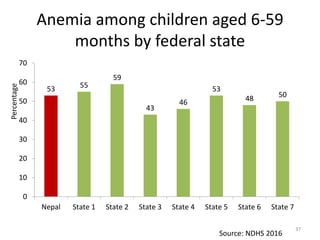
Anemia among children aged 6-59
months by federal state
53 55
59
43
46
53
48 50
0
10
20
30
40
50
60
70
Nepal State 1 State 2 State 3 State 4 State 5 State 6 State 7
Percentage
Source: NDHS 2016
37
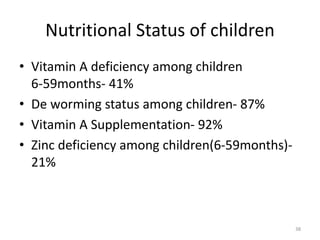
Nutritional Status of children
• Vitamin A deficiency among children
6-59months- 41%
• De worming status among children- 87%
• Vitamin A Supplementation- 92%
• Zinc deficiency among children(6-59months)-
21%
38
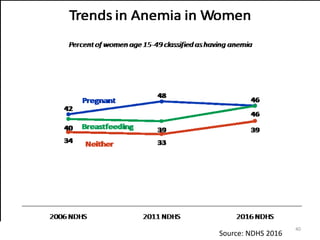
Nutritional status of women
39
Source: NDHS 2016
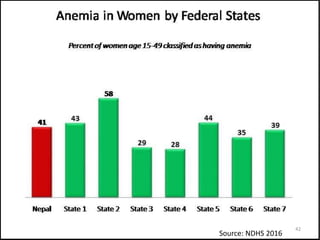
40
Indicators
NDHS
2001
NDHS
2006
NDHS
2011
NDHS
2016
MSN
P
2022
WHA
2025
SDG 2030
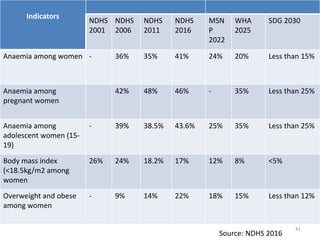
Anaemia among women - 36% 35% 41% 24% 20% Less than 15%
Anaemia among
pregnant women
42% 48% 46% - 35% Less than 25%
Anaemia among
adolescent women (15-
19)
- 39% 38.5% 43.6% 25% 35% Less than 25%
Body mass index
(<18.5kg/m2 among
women
26% 24% 18.2% 17% 12% 8% <5%
Overweight and obese
among women
- 9% 14% 22% 18% 15% Less than 12%
Source: NDHS 2016
41
Source: NDHS 2016
42
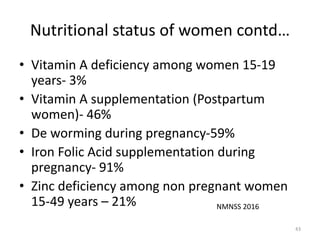
Nutritional status of women contd…
• Vitamin A deficiency among women 15-19
years- 3%
• Vitamin A supplementation (Postpartum
women)- 46%
• De worming during pregnancy-59%
• Iron Folic Acid supplementation during
pregnancy- 91%
• Zinc deficiency among non pregnant women
15-49 years – 21%
43
NMNSS 2016
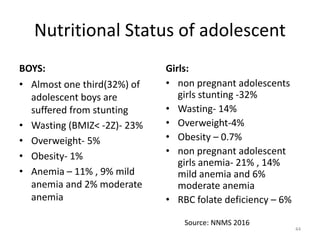
Nutritional Status of adolescent
BOYS:
• Almost one third(32%) of
adolescent boys are
suffered from stunting
• Wasting (BMIZ< -2Z)- 23%
• Overweight- 5%
• Obesity- 1%
• Anemia – 11% , 9% mild
anemia and 2% moderate
anemia
Girls:
• non pregnant adolescents
girls stunting -32%
• Wasting- 14%
• Overweight-4%
• Obesity – 0.7%
• non pregnant adolescent
girls anemia- 21% , 14%
mild anemia and 6%
moderate anemia
• RBC folate deficiency – 6%
Source: NNMS 2016
44
Global response on Nutrition
46
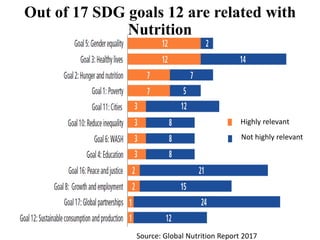
Highly relevant
Not highly relevant
Out of 17 SDG goals 12 are related with
Nutrition
Source: Global Nutrition Report 2017
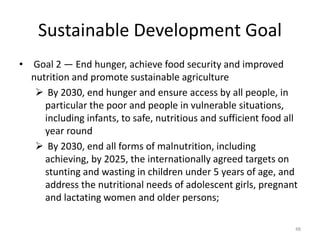
Sustainable Development Goal
• Goal 2 — End hunger, achieve food security and improved
nutrition and promote sustainable agriculture
 By 2030, end hunger and ensure access by all people, in
particular the poor and people in vulnerable situations,
including infants, to safe, nutritious and sufficient food all
year round
 By 2030, end all forms of malnutrition, including
achieving, by 2025, the internationally agreed targets on
stunting and wasting in children under 5 years of age, and
address the nutritional needs of adolescent girls, pregnant
and lactating women and older persons;
48
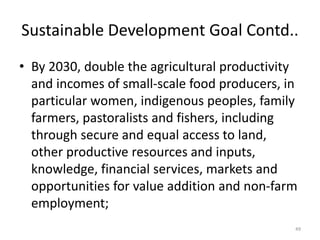
Sustainable Development Goal Contd..
• By 2030, double the agricultural productivity
and incomes of small-scale food producers, in
particular women, indigenous peoples, family
farmers, pastoralists and fishers, including
through secure and equal access to land,
other productive resources and inputs,
knowledge, financial services, markets and
opportunities for value addition and non-farm
employment;
49
50
SUN Movement
VISION:
• By 2030, a world free from malnutrition in all its forms. Led by
governments, supported by organisations and individuals –
collective action ensures every child, adolescent, mother and
family can realise their right to food and nutrition, reach their
full potential and shape sustainable and prosperous societies.
51
NATIONAL RESPONSE
52
Constitution of Nepal 2015
• wf/f#^ vfB ;DaGwLxs
-!_ k|To]s gful/snfO{vfB ;DaGwL xs x'g]5 .
-@_ k|To]s gful/snfO{vfBj:t'sf]cefjdf hLjghf]lvddf kg]{ cj:yfaf6
;'/lIftx'g]xs x'g]5 .
• wf/f-#(_ afnaflnsfsf]xs
-@_ k|To]s afnaflnsfnfO{kl/jf/ tyf /fHoaf6 lzIff,:jf:Yo, kfng
kf]if0f,plrt :ofxf/, v]ns"b, dgf]/~hg tyf ;jf{ËL0fJolQmTjljsf;sf]
xs x'g]5.
53
k|hgg :jf:Yosf]clwsf/;DaGwdf Joj:yfug{ag]sf]
ljw]os
• k|;"lt labfsf] clwsf/ -bkmf !#_ M (* lbg tnaL ljbf tyf ck'u ePdf
:jf:YosdL{sf]k/fdz{adf]lhdyk Psdlxgftna;lxtsf]k|;'ltljbf
• ;/sf/L, u}/ ;/sf/L jf lghL ;+3 ;+:yfn] cfkmgf] sfo{nosf sfo{/t
dlxnfnfO{ lzz' hGd]sf] b'O{ jif{;Dd sfo{fno ;dodf cfdfsf] b'w v'jfpgsf
nflu cfjZosJoj:yfldnfpg'kg]{5.
• ;/sf/L, u}/ ;/sf/L jf lghL ;+3 ;+:yfdf sfo{/t k'?if sd{r/Lsf] kTgL ;'Ts]/L
x'g] ePdf To:tf] sd{rf/Ln] ;'Ts]/L x'g' cl3 jf kl5 kfl/>lds ;lxtsf] kGw|
lbgk|;'lt:ofxf/ljbfkfpg]5.
54
Priority objective of Nutrition
Programme
• Overall Objective:
 To reduce child and maternal mortality through
nutritional interventions
• Objective
Reduce general malnutrition among children and women,
i.e. stunting, underweight, wasting, low BMI
Reduce Iron Deficiency Anemia among children, children
under age 2 year and pregnant women
 Maintain and sustain Iodine Deficiency Disorders and
Vitamin A Deficiency control activities.
 Improve maternal nutrition
55
Priority objective of Nutrition
Programme
Align with multi-sectoral nutrition initiative.
Improve Nutrition related behavior change and
communication
Improve Monitoring and Evaluation for Nutrition related
Programmes/Activities
56
National Nutrition Policy and Strategy
2004
• To address all forms of malnutrition including
under-nutrition and over-nutrition.
• Provides the strategic and programmatic
directions in the health sector while the MSNP
provides a broader policy framework within
and beyond the health sector
57
Nepal Health Sector Strategy (NHSS
2015-2020)
• NHSS emphasizes the better implementation of the
nutrition interventions included in MSNP and other
plan, policies and strategies.
• NHSS Target by 2020
• Goal 2: Reduce under-five mortality to below 28%
(undernutrition contributes to for 45% of U5 mortality)
• Goal 5: Reduce stunting among children under 5 to at
least below 31%.
• Goal 6: Reduce prevalence of chronic energy deficiency
or thinness among women aged 15-49 years, [BMI less
than 18.5] to below 12%
58
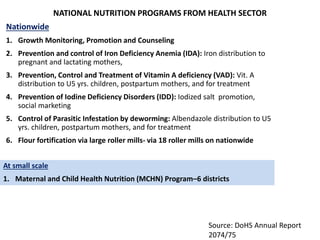
Nationwide
1. Growth Monitoring, Promotion and Counseling
2. Prevention and control of Iron Deficiency Anemia (IDA): Iron distribution to
pregnant and lactating mothers,
3. Prevention, Control and Treatment of Vitamin A deficiency (VAD): Vit. A
distribution to U5 yrs. children, postpartum mothers, and for treatment
4. Prevention of Iodine Deficiency Disorders (IDD): Iodized salt promotion,
social marketing
5. Control of Parasitic Infestation by deworming: Albendazole distribution to U5
yrs. children, postpartum mothers, and for treatment
6. Flour fortification via large roller mills- via 18 roller mills on nationwide
At small scale
1. Maternal and Child Health Nutrition (MCHN) Program–6 districts
NATIONAL NUTRITION PROGRAMS FROM HEALTH SECTOR
Source: DoHS Annual Report
2074/75
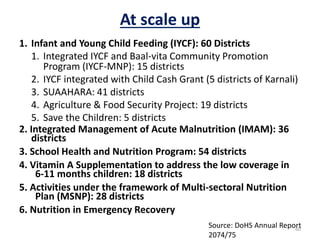
At scale up
1. Infant and Young Child Feeding (IYCF): 60 Districts
1. Integrated IYCF and Baal-vita Community Promotion
Program (IYCF-MNP): 15 districts
2. IYCF integrated with Child Cash Grant (5 districts of Karnali)
3. SUAAHARA: 41 districts
4. Agriculture & Food Security Project: 19 districts
5. Save the Children: 5 districts
2. Integrated Management of Acute Malnutrition (IMAM): 36
districts
3. School Health and Nutrition Program: 54 districts
4. Vitamin A Supplementation to address the low coverage in
6-11 months children: 18 districts
5. Activities under the framework of Multi-sectoral Nutrition
Plan (MSNP): 28 districts
6. Nutrition in Emergency Recovery
60
Source: DoHS Annual Report
2074/75
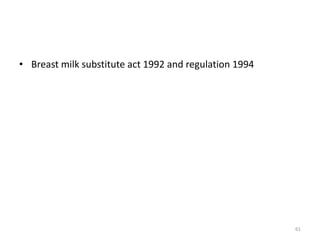
• Breast milk substitute act 1992 and regulation 1994
61
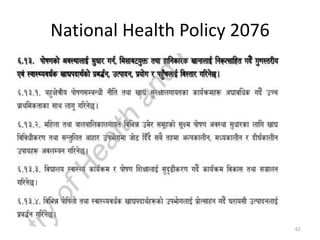
National Health Policy 2076
62
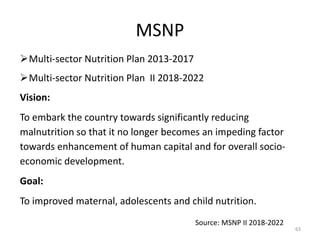
MSNP
Multi-sector Nutrition Plan 2013-2017
Multi-sector Nutrition Plan II 2018-2022
Vision:
To embark the country towards significantly reducing
malnutrition so that it no longer becomes an impeding factor
towards enhancement of human capital and for overall socio-
economic development.
Goal:
To improved maternal, adolescents and child nutrition.
Source: MSNP II 2018-2022
63
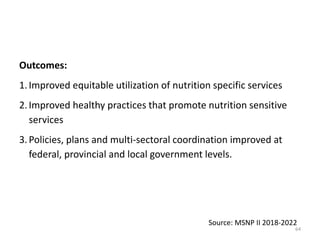
Outcomes:
1.Improved equitable utilization of nutrition specific services
2.Improved healthy practices that promote nutrition sensitive
services
3.Policies, plans and multi-sectoral coordination improved at
federal, provincial and local government levels.
Source: MSNP II 2018-2022
64
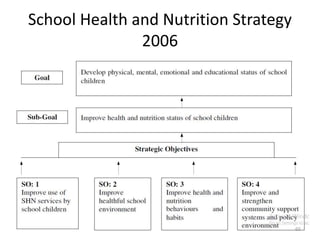
School Health and Nutrition Strategy
2006
65
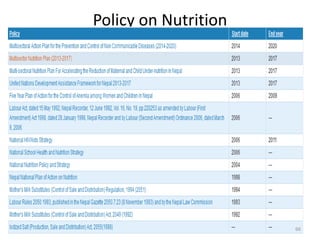
Policy on Nutrition
66
• MoHP conducted an Organization and Management Survey
towards establishing a National Nutrition Centre for
implementing MSNP in the health sector as recommended by
NAGA and guided by MSNP
Source: DoHS Annual Report
2074/75
67
Challenges
• We still lack key evidence for tackling micronutrient
deficiencies
• Though worldwide over 2 billion people suffer from a chronic
deficiency of micronutrients, a condition known as hidden
hunger
• Yet we don’t know the state of micronutrient deficiences in
nutritionally vulnerable populations, such as children under
five year of age, women and adolescents girls
• High prevalence of undernutrition, i.e., stunting, underweight,
wasting and anemia but with marked inequity ecologically and
among wealth quintiles
• Double burden of Malnutrition
Source: https://www.unicef.org/nutrition/index_faces-of-malnutrition.html 68
WHY INVESTMENT IN NUTRITION
• Malnutrition increases the risk of child and maternal
mortality by up to 45 per cent.
• Nepal is on Track to meeting WHA targets for stunting
but NOT in underweight, wasting and anemia
• Malnutrition and poor diets constitute the number one
driver of the global burden of disease.
• It diminishes learning capacity, lowers economic
productivity and ultimately reduces GDP up to 11% for
Asian and African Countries.
69
Source:https://scalingupnutrition.org/nutrition/the-importance-of-good-
nutrition/why-invest-in-nutrition/
WHY INVESTMENT IN NUTRITION
• Every $1 investment in prevention delivers a $16 return,
so should be the top priority investment for policymakers.
• Stunting at the age of 2 is an indicator for the overall
human capital
(https://www.ncbi.nlm.nih.gov/pmc/articles/PMC5084763/)
• More financial commitments are needed. Government to
allocate more budget for Nutrition.
70
Source:https://scalingupnutrition.org/nutrition/the-importance-of-
good-nutrition/why-invest-in-nutrition/
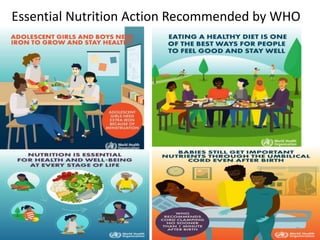
Essential Nutrition Action Recommended by WHO
71
References
• https://www.who.int/news-room/detail/15-07-2019-world-hunger-is-still-
not-going-down-after-three-years-and-obesity-is-still-growing-un-report
• https://www.thelancet.com/journals/lancet/article/PIIS0140-
6736(18)32822-8/fulltext?dgcid=raven_jbs_etoc_email
• https://www.who.int/news-room/detail/15-07-2019-world-hunger-is-still-
not-going-down-after-three-years-and-obesity-is-still-growing-un-report
• (https://www.ncbi.nlm.nih.gov/pmc/articles/PMC5084763/)
• https://www.unicef.org/nutrition/index_faces-of-malnutrition.html
• https://www.mohp.gov.np/eng/program/child-health-services/nutrition
• Source: https://www.bmj.com/content/351/bmj.h4173
72
THANK YOU
73
• Better eating could prevent one in five deaths
worldwide
• Low amount of healthy foods, including whole grains
and fruits, more significant than high levels of
unhealthy foods
• Dietary risks, such as high sodium intake, are an
‘equal opportunity killer’
74

Nutrition final

  • 1.
    Nutrition Prepared By: PratibhaOli MPH 21st Batch Roll No: 384 Better Nutrition Better Life
  • 2.
    Introduction • Nutrition isthe intake of food, considered in relation to the body’s dietary needs. • Good nutrition – an adequate, well balanced diet combined with regular physical activity – is a cornerstone of good health. • Poor nutrition can lead to reduced immunity, increased susceptibility to disease, impaired physical and mental development, and reduced productivity. Source: https://www.who.int/topics/nutrition/en/ 2
  • 3.
    Terms • Nutrients: Thecomponents in foods that an organism uses to survive and grow. E.g. carbohydrate, protein • Macronutrients: are consumed in relatively large quantities and include proteins, carbohydrates, and fats and fatty acids. • Micronutrients: vitamins and minerals – are consumed in relatively smaller quantities, but are essential to body processes • Malnutrition, in all its forms, includes under nutrition (wasting, stunting, underweight), inadequate vitamins or minerals, overweight, obesity, and resulting diet-related non communicable diseases. Source: WHO 2019 3
  • 4.
    Types of malnutrition Source:Global Nutrition Report 4
  • 5.
    Critical Points forNutrition in the Life-Cycle 5 Source: https://www.bmj.com/content/351/bmj.h4173
  • 6.
  • 7.
  • 8.
  • 9.
    Casual Model ofUnder nutrition Source: UNICEF 2013 9
  • 10.
  • 11.
  • 12.
  • 13.
  • 14.
    History of NutritionProgramme in Nepal 1977 • High level National Nutrition Coordination Committee 1978 • National Nutrition Strategies (Pokhara Declaration) 1978 • Nutrition Section under DoHS 1979 • Comprehensive Nutrition Programme 1986 • Pokhara Declaration Revised 1989- 92 • Joint Nutrition Support Programme (JNSP) 1991 • Nutrition Section under Child Health Division- Following the National Health Policy 1992 • Breast milk Substitute act approved 14Source: DoHS Annual Report 2074/75
  • 15.
    1993 •Vitamin A programme-(8 districts) 1998 •Nepal Micronutrient Status Survey- 2003 •Intensification of Maternal and Neonatal Micronutrient Programme - 2004 •National Nutrition Policy and strategy- 2006 •National school Health Nutrition strategy - with the involvement of MOHP and MOE 2007 •National Plan of Action on Nutrition - by National Planning Commission 2009 •Nutrition Assessment and Gap Analysis - which recommended the need of Multisectoral approach 15Source: DoHS Annual Report 2074/75
  • 16.
    2013- 2017 • Multisectoral Nutrition PlanI 2018- 2022 • Multisectoral Nutrition Plan II 16Source: DoHS Annual Report 2074/75
  • 17.
  • 18.
    GLOBAL SCENARIO • 820million people did not have enough to eat in 2018, up from 811 million in the previous year • Number of hungry people in the world in 2018: 821.6 million (or 1 in 9 people) – in Asia: 513.9 million – in Africa: 256.1million – in Latin America and the Caribbean: 42.5 million • Number of moderately or severely food insecure: 2 billion (26.4%) Source : UN report 2019 18
  • 19.
    GLOBAL SCENARIO • Poordiets were responsible for 10.9 million deaths, or 22% of all deaths among adults in 2017, with cardiovascular disease as the leading cause, followed by cancers and diabetes. • Poor diet represents 16% of all DALYs among adults globally. • In comparison tobacco was associated with 8.0 million deaths, and high blood pressure was linked to 10.4 million deaths. Source: https://www.thelancet.com/journals/lancet/article/PIIS0140- 6736(18)32822-8/fulltext?dgcid=raven_jbs_etoc_email 19
  • 20.
  • 21.
    • Babies bornwith low birth weight: 20.5 million (one in seven) • Children under 5 affected by stunting (low height-for-age): 148.9 million (21.9%) • Children under 5 affected by wasting (low weight-for-height): 49.5 million (7.3%) • Children under 5 who are overweight (high weight-for- height): 40 million (5.9%) • School-age children and adolescents who are overweight: 338 million • Adults who are obese: 672 million (13% or 1 in 8 adults) Source: https://www.who.int/news-room/detail/15-07-2019-world-hunger- is-still-not-going-down-after-three-years-and-obesity-is-still-growing-un- report 21
  • 22.
    Source: SUN movementand strategy roadmap (2016-2020) 22
  • 23.
    Number of childrenaffected by stunting and overweight, 2000–2017 23Source: NCD Risk Factor Collaboration, WHO Global Health Observatory
  • 24.
    Global prevalence ofobesity (BMI ≥30) among adults aged 18 years and over, 2000–2016 24Source: NCD Risk Factor Collaboration, WHO Global Health Observatory
  • 25.
    Global prevalence ofanaemia, overweight (including obesity) and underweight in women, 2000–2016 Source: NCD Risk Factor Collaboration, WHO Global Health Observatory 25
  • 26.
    Malnutrition: an invisibleemergency Malnutrition has a million faces: • A child who never reaches full height due to poverty, poor sanitation, lack of breastfeeding and limited access to nutritious foods • A young woman who becomes anaemic during her pregnancy and gives birth to an underweight baby who later faces developmental delays • A child rendered blind by vitamin A deficiency Source: https://www.unicef.org/nutrition/index_faces-of-malnutrition.html 26
  • 27.
    Malnutrition: an invisibleemergency • A child who becomes obese through overconsumption of low quality food • A desperately thin and wasted child, at imminent risk of death • Nearly half of all deaths in children under 5 can be attributed to under nutrition. Source: https://www.unicef.org/nutrition/index_faces-of-malnutrition.html 27
  • 28.
    Double burden ofmalnutrition 28
  • 29.
    What is doubleburden?? Source: WHO infographics 29
  • 30.
    Who are affected?? Source:WHO infographics 30
  • 31.
    • Many countriesare now facing an overlapping ‘triple burden’ of malnutrition: under nutrition and micronutrient deficiencies on the one hand, and overweight and obesity on the other. 31
  • 32.
  • 33.
    NUTRITIONAL STATUS ANDSDG TARGETS S N Indicators Situation in Nepal SDGs Target (2030) for Nepal 2011 2016 1 Reduction in the number of children under - 5 who are stunted 40.5% 35.8% 15.0% 2 (a) Reduction of anemia among WRA 35.0% 40.8% 10.0% (b) Reduction of anemia among Children >5 46.2% 52.7% 10.0% 3 Reduction in low birth weight 12.1% 12.3% <5% 4 Ensure that there is no increase in childhood overweight 1.4% 1.2% <1% 5 Rate of exclusive breastfeeding in the first 6 months 69.6% 66.1% >90% 6 Reduce and maintain childhood wasting 10.9% 9.7% 4.0% Nepal Demographic and Health Survey, 2016, 33
  • 34.
    TRENDS OF UNDERNUTRITION IN NEPAL 57 49 41 37 36 15 43 39 29 30 27 10 11 13 11 11 10 4 0 20 40 60 80 100 120 2001 2006 2011 2014 2016 SDG Wasting Underweight Stunting Source: NDHS 201634
  • 35.
    PREVALENCE OF STUNTINGAMONG CHILDREN UNDER 5 AND INEQUITIES Source: NDHS 2016 35
  • 36.
    Minimum acceptable dietaccording to age 17 26 38 45 35 0 5 10 15 20 25 30 35 40 45 50 6-8 months 9-11 months 12-17 months 18-23 months Total 6-23 months Percentage Source: NDHS 2016 36
  • 37.
    Anemia among childrenaged 6-59 months by federal state 53 55 59 43 46 53 48 50 0 10 20 30 40 50 60 70 Nepal State 1 State 2 State 3 State 4 State 5 State 6 State 7 Percentage Source: NDHS 2016 37
  • 38.
    Nutritional Status ofchildren • Vitamin A deficiency among children 6-59months- 41% • De worming status among children- 87% • Vitamin A Supplementation- 92% • Zinc deficiency among children(6-59months)- 21% 38
  • 39.
  • 40.
  • 41.
    Indicators NDHS 2001 NDHS 2006 NDHS 2011 NDHS 2016 MSN P 2022 WHA 2025 SDG 2030 Anaemia amongwomen - 36% 35% 41% 24% 20% Less than 15% Anaemia among pregnant women 42% 48% 46% - 35% Less than 25% Anaemia among adolescent women (15- 19) - 39% 38.5% 43.6% 25% 35% Less than 25% Body mass index (<18.5kg/m2 among women 26% 24% 18.2% 17% 12% 8% <5% Overweight and obese among women - 9% 14% 22% 18% 15% Less than 12% Source: NDHS 2016 41
  • 42.
  • 43.
    Nutritional status ofwomen contd… • Vitamin A deficiency among women 15-19 years- 3% • Vitamin A supplementation (Postpartum women)- 46% • De worming during pregnancy-59% • Iron Folic Acid supplementation during pregnancy- 91% • Zinc deficiency among non pregnant women 15-49 years – 21% 43 NMNSS 2016
  • 44.
    Nutritional Status ofadolescent BOYS: • Almost one third(32%) of adolescent boys are suffered from stunting • Wasting (BMIZ< -2Z)- 23% • Overweight- 5% • Obesity- 1% • Anemia – 11% , 9% mild anemia and 2% moderate anemia Girls: • non pregnant adolescents girls stunting -32% • Wasting- 14% • Overweight-4% • Obesity – 0.7% • non pregnant adolescent girls anemia- 21% , 14% mild anemia and 6% moderate anemia • RBC folate deficiency – 6% Source: NNMS 2016 44
  • 45.
    Global response onNutrition 46
  • 46.
    Highly relevant Not highlyrelevant Out of 17 SDG goals 12 are related with Nutrition Source: Global Nutrition Report 2017
  • 47.
    Sustainable Development Goal •Goal 2 — End hunger, achieve food security and improved nutrition and promote sustainable agriculture  By 2030, end hunger and ensure access by all people, in particular the poor and people in vulnerable situations, including infants, to safe, nutritious and sufficient food all year round  By 2030, end all forms of malnutrition, including achieving, by 2025, the internationally agreed targets on stunting and wasting in children under 5 years of age, and address the nutritional needs of adolescent girls, pregnant and lactating women and older persons; 48
  • 48.
    Sustainable Development GoalContd.. • By 2030, double the agricultural productivity and incomes of small-scale food producers, in particular women, indigenous peoples, family farmers, pastoralists and fishers, including through secure and equal access to land, other productive resources and inputs, knowledge, financial services, markets and opportunities for value addition and non-farm employment; 49
  • 49.
  • 50.
    SUN Movement VISION: • By2030, a world free from malnutrition in all its forms. Led by governments, supported by organisations and individuals – collective action ensures every child, adolescent, mother and family can realise their right to food and nutrition, reach their full potential and shape sustainable and prosperous societies. 51
  • 51.
  • 52.
    Constitution of Nepal2015 • wf/f#^ vfB ;DaGwLxs -!_ k|To]s gful/snfO{vfB ;DaGwL xs x'g]5 . -@_ k|To]s gful/snfO{vfBj:t'sf]cefjdf hLjghf]lvddf kg]{ cj:yfaf6 ;'/lIftx'g]xs x'g]5 . • wf/f-#(_ afnaflnsfsf]xs -@_ k|To]s afnaflnsfnfO{kl/jf/ tyf /fHoaf6 lzIff,:jf:Yo, kfng kf]if0f,plrt :ofxf/, v]ns"b, dgf]/~hg tyf ;jf{ËL0fJolQmTjljsf;sf] xs x'g]5. 53
  • 53.
    k|hgg :jf:Yosf]clwsf/;DaGwdf Joj:yfug{ag]sf] ljw]os •k|;"lt labfsf] clwsf/ -bkmf !#_ M (* lbg tnaL ljbf tyf ck'u ePdf :jf:YosdL{sf]k/fdz{adf]lhdyk Psdlxgftna;lxtsf]k|;'ltljbf • ;/sf/L, u}/ ;/sf/L jf lghL ;+3 ;+:yfn] cfkmgf] sfo{nosf sfo{/t dlxnfnfO{ lzz' hGd]sf] b'O{ jif{;Dd sfo{fno ;dodf cfdfsf] b'w v'jfpgsf nflu cfjZosJoj:yfldnfpg'kg]{5. • ;/sf/L, u}/ ;/sf/L jf lghL ;+3 ;+:yfdf sfo{/t k'?if sd{r/Lsf] kTgL ;'Ts]/L x'g] ePdf To:tf] sd{rf/Ln] ;'Ts]/L x'g' cl3 jf kl5 kfl/>lds ;lxtsf] kGw| lbgk|;'lt:ofxf/ljbfkfpg]5. 54
  • 54.
    Priority objective ofNutrition Programme • Overall Objective:  To reduce child and maternal mortality through nutritional interventions • Objective Reduce general malnutrition among children and women, i.e. stunting, underweight, wasting, low BMI Reduce Iron Deficiency Anemia among children, children under age 2 year and pregnant women  Maintain and sustain Iodine Deficiency Disorders and Vitamin A Deficiency control activities.  Improve maternal nutrition 55
  • 55.
    Priority objective ofNutrition Programme Align with multi-sectoral nutrition initiative. Improve Nutrition related behavior change and communication Improve Monitoring and Evaluation for Nutrition related Programmes/Activities 56
  • 56.
    National Nutrition Policyand Strategy 2004 • To address all forms of malnutrition including under-nutrition and over-nutrition. • Provides the strategic and programmatic directions in the health sector while the MSNP provides a broader policy framework within and beyond the health sector 57
  • 57.
    Nepal Health SectorStrategy (NHSS 2015-2020) • NHSS emphasizes the better implementation of the nutrition interventions included in MSNP and other plan, policies and strategies. • NHSS Target by 2020 • Goal 2: Reduce under-five mortality to below 28% (undernutrition contributes to for 45% of U5 mortality) • Goal 5: Reduce stunting among children under 5 to at least below 31%. • Goal 6: Reduce prevalence of chronic energy deficiency or thinness among women aged 15-49 years, [BMI less than 18.5] to below 12% 58
  • 58.
    Nationwide 1. Growth Monitoring,Promotion and Counseling 2. Prevention and control of Iron Deficiency Anemia (IDA): Iron distribution to pregnant and lactating mothers, 3. Prevention, Control and Treatment of Vitamin A deficiency (VAD): Vit. A distribution to U5 yrs. children, postpartum mothers, and for treatment 4. Prevention of Iodine Deficiency Disorders (IDD): Iodized salt promotion, social marketing 5. Control of Parasitic Infestation by deworming: Albendazole distribution to U5 yrs. children, postpartum mothers, and for treatment 6. Flour fortification via large roller mills- via 18 roller mills on nationwide At small scale 1. Maternal and Child Health Nutrition (MCHN) Program–6 districts NATIONAL NUTRITION PROGRAMS FROM HEALTH SECTOR Source: DoHS Annual Report 2074/75
  • 59.
    At scale up 1.Infant and Young Child Feeding (IYCF): 60 Districts 1. Integrated IYCF and Baal-vita Community Promotion Program (IYCF-MNP): 15 districts 2. IYCF integrated with Child Cash Grant (5 districts of Karnali) 3. SUAAHARA: 41 districts 4. Agriculture & Food Security Project: 19 districts 5. Save the Children: 5 districts 2. Integrated Management of Acute Malnutrition (IMAM): 36 districts 3. School Health and Nutrition Program: 54 districts 4. Vitamin A Supplementation to address the low coverage in 6-11 months children: 18 districts 5. Activities under the framework of Multi-sectoral Nutrition Plan (MSNP): 28 districts 6. Nutrition in Emergency Recovery 60 Source: DoHS Annual Report 2074/75
  • 60.
    • Breast milksubstitute act 1992 and regulation 1994 61
  • 61.
  • 62.
    MSNP Multi-sector Nutrition Plan2013-2017 Multi-sector Nutrition Plan II 2018-2022 Vision: To embark the country towards significantly reducing malnutrition so that it no longer becomes an impeding factor towards enhancement of human capital and for overall socio- economic development. Goal: To improved maternal, adolescents and child nutrition. Source: MSNP II 2018-2022 63
  • 63.
    Outcomes: 1.Improved equitable utilizationof nutrition specific services 2.Improved healthy practices that promote nutrition sensitive services 3.Policies, plans and multi-sectoral coordination improved at federal, provincial and local government levels. Source: MSNP II 2018-2022 64
  • 64.
    School Health andNutrition Strategy 2006 65
  • 65.
  • 66.
    • MoHP conductedan Organization and Management Survey towards establishing a National Nutrition Centre for implementing MSNP in the health sector as recommended by NAGA and guided by MSNP Source: DoHS Annual Report 2074/75 67
  • 67.
    Challenges • We stilllack key evidence for tackling micronutrient deficiencies • Though worldwide over 2 billion people suffer from a chronic deficiency of micronutrients, a condition known as hidden hunger • Yet we don’t know the state of micronutrient deficiences in nutritionally vulnerable populations, such as children under five year of age, women and adolescents girls • High prevalence of undernutrition, i.e., stunting, underweight, wasting and anemia but with marked inequity ecologically and among wealth quintiles • Double burden of Malnutrition Source: https://www.unicef.org/nutrition/index_faces-of-malnutrition.html 68
  • 68.
    WHY INVESTMENT INNUTRITION • Malnutrition increases the risk of child and maternal mortality by up to 45 per cent. • Nepal is on Track to meeting WHA targets for stunting but NOT in underweight, wasting and anemia • Malnutrition and poor diets constitute the number one driver of the global burden of disease. • It diminishes learning capacity, lowers economic productivity and ultimately reduces GDP up to 11% for Asian and African Countries. 69 Source:https://scalingupnutrition.org/nutrition/the-importance-of-good- nutrition/why-invest-in-nutrition/
  • 69.
    WHY INVESTMENT INNUTRITION • Every $1 investment in prevention delivers a $16 return, so should be the top priority investment for policymakers. • Stunting at the age of 2 is an indicator for the overall human capital (https://www.ncbi.nlm.nih.gov/pmc/articles/PMC5084763/) • More financial commitments are needed. Government to allocate more budget for Nutrition. 70 Source:https://scalingupnutrition.org/nutrition/the-importance-of- good-nutrition/why-invest-in-nutrition/
  • 70.
    Essential Nutrition ActionRecommended by WHO 71
  • 71.
    References • https://www.who.int/news-room/detail/15-07-2019-world-hunger-is-still- not-going-down-after-three-years-and-obesity-is-still-growing-un-report • https://www.thelancet.com/journals/lancet/article/PIIS0140- 6736(18)32822-8/fulltext?dgcid=raven_jbs_etoc_email •https://www.who.int/news-room/detail/15-07-2019-world-hunger-is-still- not-going-down-after-three-years-and-obesity-is-still-growing-un-report • (https://www.ncbi.nlm.nih.gov/pmc/articles/PMC5084763/) • https://www.unicef.org/nutrition/index_faces-of-malnutrition.html • https://www.mohp.gov.np/eng/program/child-health-services/nutrition • Source: https://www.bmj.com/content/351/bmj.h4173 72
  • 72.
  • 73.
    • Better eatingcould prevent one in five deaths worldwide • Low amount of healthy foods, including whole grains and fruits, more significant than high levels of unhealthy foods • Dietary risks, such as high sodium intake, are an ‘equal opportunity killer’ 74

Editor's Notes

  • #48 This chart from the report Reviews all 242 indicators that the UN have designated to track the 17 SGDs and concludes that 56 are highly relevant for nutrition (as determinants and outcomes) Of course we could choose more if we relaxed the definition of highly relevant, but we wanted to be cautious. Even so, 56 indicators! Key point: more indicators outside Goal 2 than inside it (49 indicators are outside goal 2) Key point: at least 12 SDGs provide indicators that we need to track for nutrition