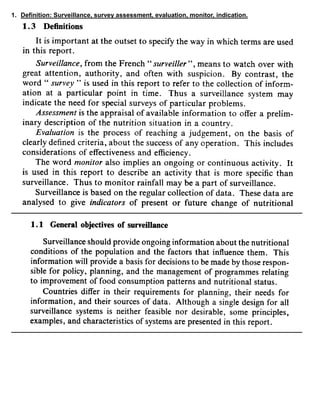
1. Definition: Surveillance, survey assessment, evaluation, monitor, indication.
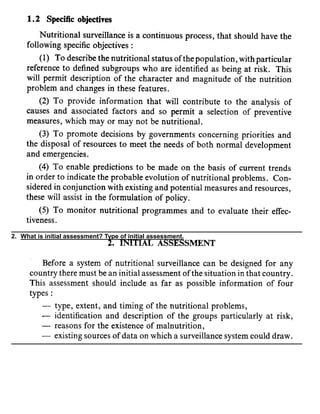
2. What is initial assessment? Type of initial assessment.
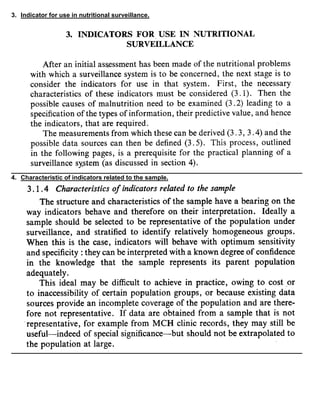
3. Indicator for use in nutritional surveillance.
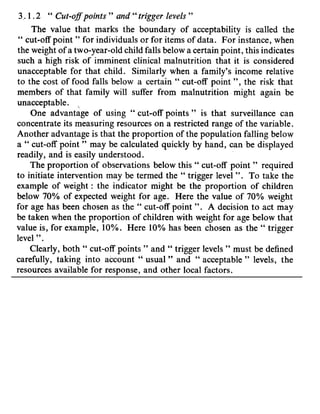
4. Characteristic of indicators related to the sample.
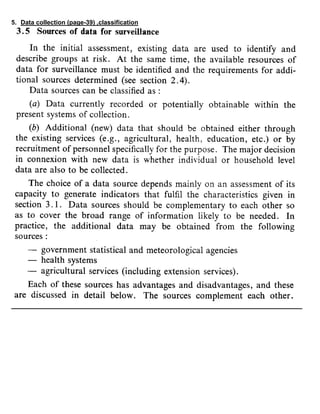
5. Data collection (page-39) ,classification
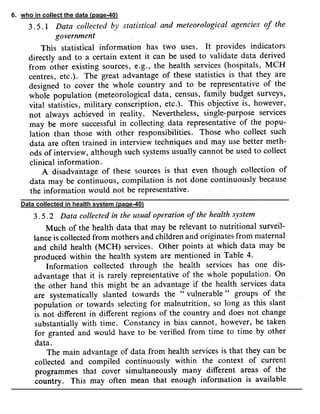
6. who in collect the data (page-40)
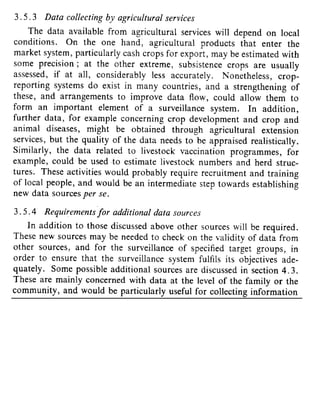
Data collected in health system (page-40)
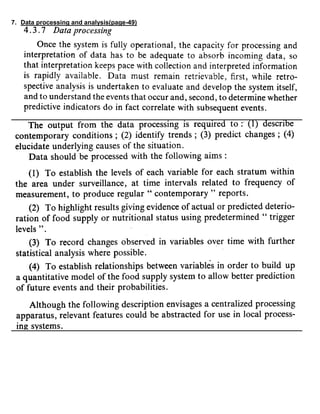
7. Data processing and analysis(page-49)
8. pattern of malnutrition problem (page - 5, 2nd note)
Maternal and child under nutrition Children and women in Bangladesh suffer most from under
nutrition. Children 6-23 months have the highest risk of wasting, stunting and underweight. Contrary to
common understanding, there is no significant difference in under nutrition rates between boys and girls
under five years of age.
In Bangladesh, the prevalence of chronic under nutrition (stunting) in children is alarming4, with nearly
half of children less than five years (7.8 million) stunted. The prevalence of chronic under nutrition of
children under five has reduced over the past fifteen years, but progress has been mixed due in part to
natural disasters, food price fluctuations and ongoing poor feeding and caring practices.
About 2 million, or some 14 percent of children under five, are estimated to be suffering from acute
under nutrition (wasting)6, close to the World Health Organization’s (WHO) “critical” threshold of 15
percent. The rate of wasting has not significantly improved in the past fifteen years. During lean seasons
and other shocks, rates of wasting in children under five increase significantly. This was particularly
heightened when the high food price crisis impacted Bangladesh in 2007-2008
leading to rates of global wasting in children under five at over 25 percent in some regions.
Maternal undernutrition is also of great importance as it is strongly related to the delivery of low birth
weight babies. More than one in five newborns (22 percent8) has a low birth weight in Bangladesh.
The overall global acute rate for maternal undernutrition is 18 percent with statistically significant
regional variations and disparities between rural and urban areas.
Early pregnancy in Bangladesh exacerbates this intergenerational cycle of undernutrition. With more
than two in three girls married before age 18, the risk of an early pregnancy and resulting low birth
weight baby is very high. The most effective means of improving birth weights of babies born to
adolescent mothers is by delaying pregnancy11; however, this remains an ongoing challenge with one
in three girls becoming either a mother or pregnant by age 20.
9. Micronutrient deficiencies (page -6)
Micronutrient deficiencies
In Bangladesh, micronutrient deficiencies – particularly iron deficiency anemia and iodine deficiency –
are widespread and multiple deficiencies are common. Iron deficiency anemia among children, women
and adolescent girls is a serious nutrition challenge, with almost two in three children 6-23 months and
one in two pregnant women being anemic.
Anemia is most common during periods of life when iron requirements are high due to rapid growth,
menstruation and reproduction. The high risk periods are during infancy, early childhood, adolescence
and pregnancy. In addition, more than one in five primary school-aged children in Bangladesh suffers
from iron deficiency anemia. This affects their ability to learn and fight diseases.
The prevalence of iodine deficiency is also a significant public health concern. This can lead to a range
of iodine deficiency disorders, such as goiter (swollen thyroid gland) and cretinism (mental defect).
The latest survey (from 2004) revealed the prevalence of iodine deficiency for women and girls of
reproductive age (15-44 years) at 39 percent and pregnant women at 56 percent.
Prevalence in rural areas was found to be higher than in urban areas. Other micronutrient deficiencies
are also prevalent. Rickets (caused by calcium and/or vitamin D deficiency) is an emerging public health
problem, currently affecting over half a million children in Bangladesh16. However, Vitamin A deficiency,
which can cause night blindness, is not as widely prevalent as other micronutrient deficiencies and is
assessed as likely to be under the WHO threshold of 1 percent
10.childcare practices in Bangladesh (page-12)
Inadequate maternal and child care practices
Ensuring adequate nutrition in the first 1000 days remains an ongoing challenge in Bangladesh. High
levels of gender disparities in household food allocation. where women usually eat last and less, as well
as cultural practices, such as avoiding certain foods during pregnancy, contribute to under nutrition on
among women and children. There is also a lack of knowledge on appropriate infant and young child
feeding practices which contribute to lower levels of care. Breast feeding is a relatively common
practice, with 93 percent of women breast feeding at one year and 89 percent up to two years. However,
exclusive breast feeding in the first six months, which is optimal for the health of the infant and mother,
remains a challenge with less than half of mothers practicing it. In addition, indications are that 43
percent of children also have complementary foods introduced later than the recommended six months
of age. For children under five, only one in two receive the minimum number of meals per day; one in
three have the minimum diet diversity; and only one in five consume a minimum acceptable diet.
11.Nutrition interventions implemented in Bangladesh and gap analysis
In Bangladesh the most important intervention has been the government’s former National Nutrition
Programme (NNP) which provided food supplementation and counseling for improved feeding of infants
and young children. In addition, a number of smaller interventions have been implemented mainly
through public and private health care providers. However, implementation has faced substantial
challenges.
Growth monitoring
Growth monitoring is not done in health and family welfare clinics but will be introduced under the
National Nutrition Service. The now defunct NNP was the largest programme covering 97 percent of
children in the programme; however, the effectiveness of growth monitoring was never evaluated and
the data lacked regular or sufficient analysis.
Micronutrient supplementation
Multiple micronutrient powder (MNP), often referred to as ‘sprinkles’ administered as a home
fortification, has been found to be effective in controlling and preventing anaemia in children. UNICEF
promotes and uses five element MNP33. NGOs, such as Action Contre La Faim, Brac and Concern
Worldwide, are other promoters of MNPs and use sprinkles in their projects. The five elements MNP is
locally produced and available in the market. WFP has used MNP during and after emergency situations
to women and children 6-23 months to prevent and control anemia. Iron Folic Acid supplementation is a
part of antenatal care for pregnancy by the health and family welfare services, but coverage is
inadequate. Other high risk groups are not covered by anemia prevention activities, including children
under two years and adolescent grls. Medium risk groups, including children 24-59 months, primary
school children and non-pregnant women are also not included. Similarly postnatal Vitamin A
supplementation is part of the prescribed postnatal care, but coverage is very low since only about 21
percent of pregnant women attend a postnatal visit.
Behaviour change communication in nutrition
Most of the stakeholders in the nutrition arena have interventions that cover nutrition education mainly in
infant and young child feeding and diet diversification. Nutrition education is provided as a part of school
health, primary health, food security and livelihood programmes. There are key players who have been
instrumental in the development of information, education communication materials and modules for
nutrition education and have supported the government in strategy development for nutrition education
communication. Despite this, materials and messages are not adequately harmonized and nutrition
counseling is not done in the health sector where most contact is expected.
Community management of acute undernutrition (CMAM) and supplementary feeding
CMAM has been endorsed globally by WHO and other agencies, including WFP, as best practice in
nutrition programming because it achieves greater coverage through decentralised outpatient treatment
of the severely undernourished rather than the traditional inpatient model34. There is ongoing advocacy
to integrate the CMAM components (inpatient therapeutic treatment, out-patient therapeutic feeding, and
supplementary feeding) into local health systems and national guidelines are under development with
the support of various nutrition stakeholders.
National coverage of supplementary feeding activities targeting the moderately undernourished has
been low (two percent). The government’s NNP, which phased out in mid 2011, was the main provider
of supplementary feeding where pregnant and lactating women, adolescent girls and children 6-23
months from poor households were provided with a locally produced product made of rice, lentil powder
and molasses known as a “pushti-packet”.
However, the “pushti-packet” was found to be nutritionally inadequate lacking in both essential
micronutrients and calories.
Management of severe acute undernutrition is restricted to only inpatient treatment and is inadequately
Implemented with no training on inpatient guidelines. In addition, the inability of caretakers or mothers
to stay at the inpatient facilities has likely resulted in inconsistent care, the low coverage (10 percent)
and early discharge. Management of moderate acute undernutrition is not covered under government
services and NGO programmes are very limited. CMAM is only implemented on a small-scale.
12.Community management of acute undernutrition
Community management of acute undernutrition (CMAM) is an innovative community-led public health
model to address acute undernutrition. The approach engages the community to actively look for
children, women and others with signs of severe and moderate undernutrition and then treat those
without medical complications with ready-to-use or nutrient-dense foods at home. In tandem, there are
community outreach activities aimed at preventing undernutrition.
The CMAM approach combines three treatment modalities: inpatient therapeutic, outpatient therapeutic
and take home supplementary feeding. This is based on the clinical and anthropometric characteristics
of the person at presentation.
CMAM can maximise treatment and prevention by improving coverage, access, and cost-effectiveness
of the services delivered.
13. The government’s National Nutrition Service
The government has introduced the National Nutrition Service (NNS) with the goal to “reduce the
prevalence of malnutrition among the people of Bangladesh with special emphasis on the children,
women, adolescents and underprivileged section of the society”. As part of the NNS, the government
will:
 Implement a mainstreamed, comprehensive package of nutrition services to reduce maternal and
child malnutrition and ensure universal access;
 Develop and strengthen coordination mechanisms with key relevant sectors (especially Ministry of
Health and Family Welfare, Ministry of Food and Disaster Management, Ministry of Agriculture,
Ministry of Women and Children Affairs, Ministry of Information, Ministry of Education, Ministry of
Livestock and Fisheries, Ministry of Local Government, Rural Development and Cooperative, and
others) to ensure a multi-sectoral response to malnutrition;
 Strengthen the human resource capacity to manage, supervise and deliver nutrition services at the
different levels of the health and family planning services; and
 Strengthen nutrition management information systems and operations research to ensure an
evidence based response.
 This will involve mainstreaming the implementation of nutrition interventions into health and family
planning services, scaling-up provision of area-based community nutrition, implementing community
management of acute undernutrition (CMAM), amongst other important priority actions.
END

5011 Q sir_7&8 chapter,OK

  • 1.
    1. Definition: Surveillance,survey assessment, evaluation, monitor, indication.
  • 2.
    2. What isinitial assessment? Type of initial assessment.
  • 3.
    3. Indicator foruse in nutritional surveillance. 4. Characteristic of indicators related to the sample.
  • 5.
    5. Data collection(page-39) ,classification
  • 6.
    6. who incollect the data (page-40) Data collected in health system (page-40)
  • 8.
    7. Data processingand analysis(page-49)
  • 9.
    8. pattern ofmalnutrition problem (page - 5, 2nd note) Maternal and child under nutrition Children and women in Bangladesh suffer most from under nutrition. Children 6-23 months have the highest risk of wasting, stunting and underweight. Contrary to common understanding, there is no significant difference in under nutrition rates between boys and girls under five years of age. In Bangladesh, the prevalence of chronic under nutrition (stunting) in children is alarming4, with nearly half of children less than five years (7.8 million) stunted. The prevalence of chronic under nutrition of children under five has reduced over the past fifteen years, but progress has been mixed due in part to natural disasters, food price fluctuations and ongoing poor feeding and caring practices. About 2 million, or some 14 percent of children under five, are estimated to be suffering from acute under nutrition (wasting)6, close to the World Health Organization’s (WHO) “critical” threshold of 15 percent. The rate of wasting has not significantly improved in the past fifteen years. During lean seasons and other shocks, rates of wasting in children under five increase significantly. This was particularly heightened when the high food price crisis impacted Bangladesh in 2007-2008 leading to rates of global wasting in children under five at over 25 percent in some regions. Maternal undernutrition is also of great importance as it is strongly related to the delivery of low birth weight babies. More than one in five newborns (22 percent8) has a low birth weight in Bangladesh. The overall global acute rate for maternal undernutrition is 18 percent with statistically significant regional variations and disparities between rural and urban areas. Early pregnancy in Bangladesh exacerbates this intergenerational cycle of undernutrition. With more than two in three girls married before age 18, the risk of an early pregnancy and resulting low birth weight baby is very high. The most effective means of improving birth weights of babies born to adolescent mothers is by delaying pregnancy11; however, this remains an ongoing challenge with one in three girls becoming either a mother or pregnant by age 20. 9. Micronutrient deficiencies (page -6) Micronutrient deficiencies In Bangladesh, micronutrient deficiencies – particularly iron deficiency anemia and iodine deficiency – are widespread and multiple deficiencies are common. Iron deficiency anemia among children, women and adolescent girls is a serious nutrition challenge, with almost two in three children 6-23 months and one in two pregnant women being anemic. Anemia is most common during periods of life when iron requirements are high due to rapid growth, menstruation and reproduction. The high risk periods are during infancy, early childhood, adolescence and pregnancy. In addition, more than one in five primary school-aged children in Bangladesh suffers from iron deficiency anemia. This affects their ability to learn and fight diseases. The prevalence of iodine deficiency is also a significant public health concern. This can lead to a range of iodine deficiency disorders, such as goiter (swollen thyroid gland) and cretinism (mental defect). The latest survey (from 2004) revealed the prevalence of iodine deficiency for women and girls of reproductive age (15-44 years) at 39 percent and pregnant women at 56 percent. Prevalence in rural areas was found to be higher than in urban areas. Other micronutrient deficiencies are also prevalent. Rickets (caused by calcium and/or vitamin D deficiency) is an emerging public health problem, currently affecting over half a million children in Bangladesh16. However, Vitamin A deficiency, which can cause night blindness, is not as widely prevalent as other micronutrient deficiencies and is assessed as likely to be under the WHO threshold of 1 percent
  • 10.
    10.childcare practices inBangladesh (page-12) Inadequate maternal and child care practices Ensuring adequate nutrition in the first 1000 days remains an ongoing challenge in Bangladesh. High levels of gender disparities in household food allocation. where women usually eat last and less, as well as cultural practices, such as avoiding certain foods during pregnancy, contribute to under nutrition on among women and children. There is also a lack of knowledge on appropriate infant and young child feeding practices which contribute to lower levels of care. Breast feeding is a relatively common practice, with 93 percent of women breast feeding at one year and 89 percent up to two years. However, exclusive breast feeding in the first six months, which is optimal for the health of the infant and mother, remains a challenge with less than half of mothers practicing it. In addition, indications are that 43 percent of children also have complementary foods introduced later than the recommended six months of age. For children under five, only one in two receive the minimum number of meals per day; one in three have the minimum diet diversity; and only one in five consume a minimum acceptable diet. 11.Nutrition interventions implemented in Bangladesh and gap analysis In Bangladesh the most important intervention has been the government’s former National Nutrition Programme (NNP) which provided food supplementation and counseling for improved feeding of infants and young children. In addition, a number of smaller interventions have been implemented mainly through public and private health care providers. However, implementation has faced substantial challenges. Growth monitoring Growth monitoring is not done in health and family welfare clinics but will be introduced under the National Nutrition Service. The now defunct NNP was the largest programme covering 97 percent of children in the programme; however, the effectiveness of growth monitoring was never evaluated and the data lacked regular or sufficient analysis. Micronutrient supplementation Multiple micronutrient powder (MNP), often referred to as ‘sprinkles’ administered as a home fortification, has been found to be effective in controlling and preventing anaemia in children. UNICEF promotes and uses five element MNP33. NGOs, such as Action Contre La Faim, Brac and Concern Worldwide, are other promoters of MNPs and use sprinkles in their projects. The five elements MNP is locally produced and available in the market. WFP has used MNP during and after emergency situations to women and children 6-23 months to prevent and control anemia. Iron Folic Acid supplementation is a part of antenatal care for pregnancy by the health and family welfare services, but coverage is inadequate. Other high risk groups are not covered by anemia prevention activities, including children under two years and adolescent grls. Medium risk groups, including children 24-59 months, primary school children and non-pregnant women are also not included. Similarly postnatal Vitamin A supplementation is part of the prescribed postnatal care, but coverage is very low since only about 21 percent of pregnant women attend a postnatal visit. Behaviour change communication in nutrition Most of the stakeholders in the nutrition arena have interventions that cover nutrition education mainly in infant and young child feeding and diet diversification. Nutrition education is provided as a part of school health, primary health, food security and livelihood programmes. There are key players who have been instrumental in the development of information, education communication materials and modules for nutrition education and have supported the government in strategy development for nutrition education communication. Despite this, materials and messages are not adequately harmonized and nutrition counseling is not done in the health sector where most contact is expected. Community management of acute undernutrition (CMAM) and supplementary feeding CMAM has been endorsed globally by WHO and other agencies, including WFP, as best practice in nutrition programming because it achieves greater coverage through decentralised outpatient treatment of the severely undernourished rather than the traditional inpatient model34. There is ongoing advocacy to integrate the CMAM components (inpatient therapeutic treatment, out-patient therapeutic feeding, and supplementary feeding) into local health systems and national guidelines are under development with the support of various nutrition stakeholders.
  • 11.
    National coverage ofsupplementary feeding activities targeting the moderately undernourished has been low (two percent). The government’s NNP, which phased out in mid 2011, was the main provider of supplementary feeding where pregnant and lactating women, adolescent girls and children 6-23 months from poor households were provided with a locally produced product made of rice, lentil powder and molasses known as a “pushti-packet”. However, the “pushti-packet” was found to be nutritionally inadequate lacking in both essential micronutrients and calories. Management of severe acute undernutrition is restricted to only inpatient treatment and is inadequately Implemented with no training on inpatient guidelines. In addition, the inability of caretakers or mothers to stay at the inpatient facilities has likely resulted in inconsistent care, the low coverage (10 percent) and early discharge. Management of moderate acute undernutrition is not covered under government services and NGO programmes are very limited. CMAM is only implemented on a small-scale. 12.Community management of acute undernutrition Community management of acute undernutrition (CMAM) is an innovative community-led public health model to address acute undernutrition. The approach engages the community to actively look for children, women and others with signs of severe and moderate undernutrition and then treat those without medical complications with ready-to-use or nutrient-dense foods at home. In tandem, there are community outreach activities aimed at preventing undernutrition. The CMAM approach combines three treatment modalities: inpatient therapeutic, outpatient therapeutic and take home supplementary feeding. This is based on the clinical and anthropometric characteristics of the person at presentation. CMAM can maximise treatment and prevention by improving coverage, access, and cost-effectiveness of the services delivered. 13. The government’s National Nutrition Service The government has introduced the National Nutrition Service (NNS) with the goal to “reduce the prevalence of malnutrition among the people of Bangladesh with special emphasis on the children, women, adolescents and underprivileged section of the society”. As part of the NNS, the government will:  Implement a mainstreamed, comprehensive package of nutrition services to reduce maternal and child malnutrition and ensure universal access;  Develop and strengthen coordination mechanisms with key relevant sectors (especially Ministry of Health and Family Welfare, Ministry of Food and Disaster Management, Ministry of Agriculture, Ministry of Women and Children Affairs, Ministry of Information, Ministry of Education, Ministry of Livestock and Fisheries, Ministry of Local Government, Rural Development and Cooperative, and others) to ensure a multi-sectoral response to malnutrition;  Strengthen the human resource capacity to manage, supervise and deliver nutrition services at the different levels of the health and family planning services; and  Strengthen nutrition management information systems and operations research to ensure an evidence based response.  This will involve mainstreaming the implementation of nutrition interventions into health and family planning services, scaling-up provision of area-based community nutrition, implementing community management of acute undernutrition (CMAM), amongst other important priority actions. END