What is “Documentary”
John Grierson (1966)
“The creative treatment of actuality”
Paul Rotha(1963)
“ The instruction for the awakening of civic
consciousness among the public”
Documentary Mode Theory
(Bill Nichols)
Expository Mode
Observational Mode
Participatory Mode
Performative Mode
Reflexive Mode
Poetic Mode
Remember
• Some documentaries have elements of more
than 1 mode (subgenre/hybrid)
• “The characteristics of a given mode function
as a dominant in a given film…but they do not
dictate or determine every aspect of its
organisation” (Nichols, 2001)
Expository Mode (Voice of God)
• Often using a narrator to address audience directly to present exposition or explanation,
interpreting what they are seeing on screen
• Assumes logical argument which ‘right’ or ‘proper’ answers are revealed by direct address
• Preferred meaning (meaning that a media producer wants the audience to receive (and this
meaning is likely received by audience)
• Whether there is visual narrator or not we trust the narration as a definitive narration or anchor of
the visual material (and accept it has authoritative on subject matter)
• TV news is similar
• One of oldest conventions of documentary – still used today, even in Big Brother as the narrator
interprets to audience what we are watching
• The narrator often represents target audience for the programme, will address as group a set of
implied values of text (preferred meaning) (ex. Who narrates blue planet? How relate to TA?)
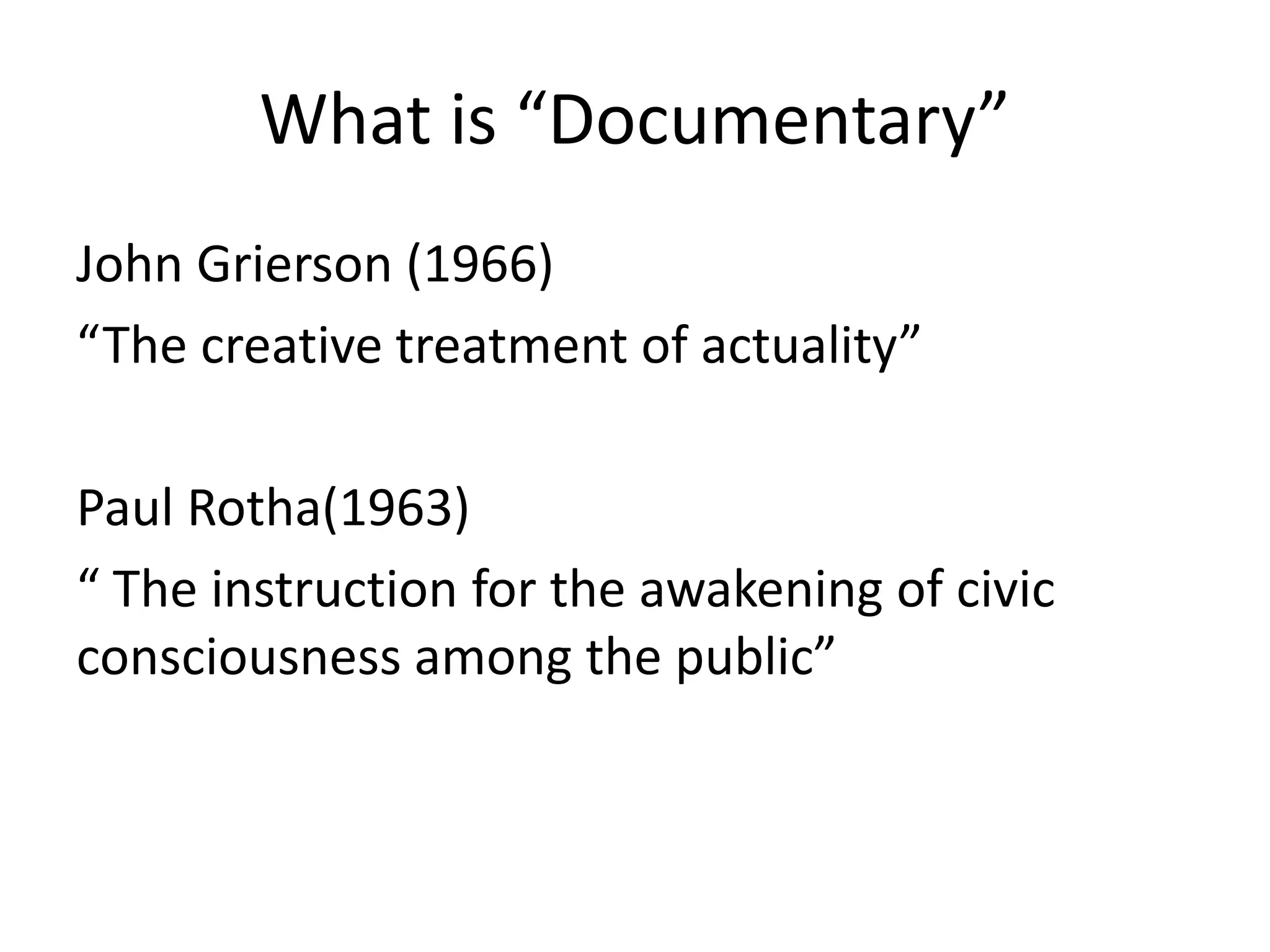
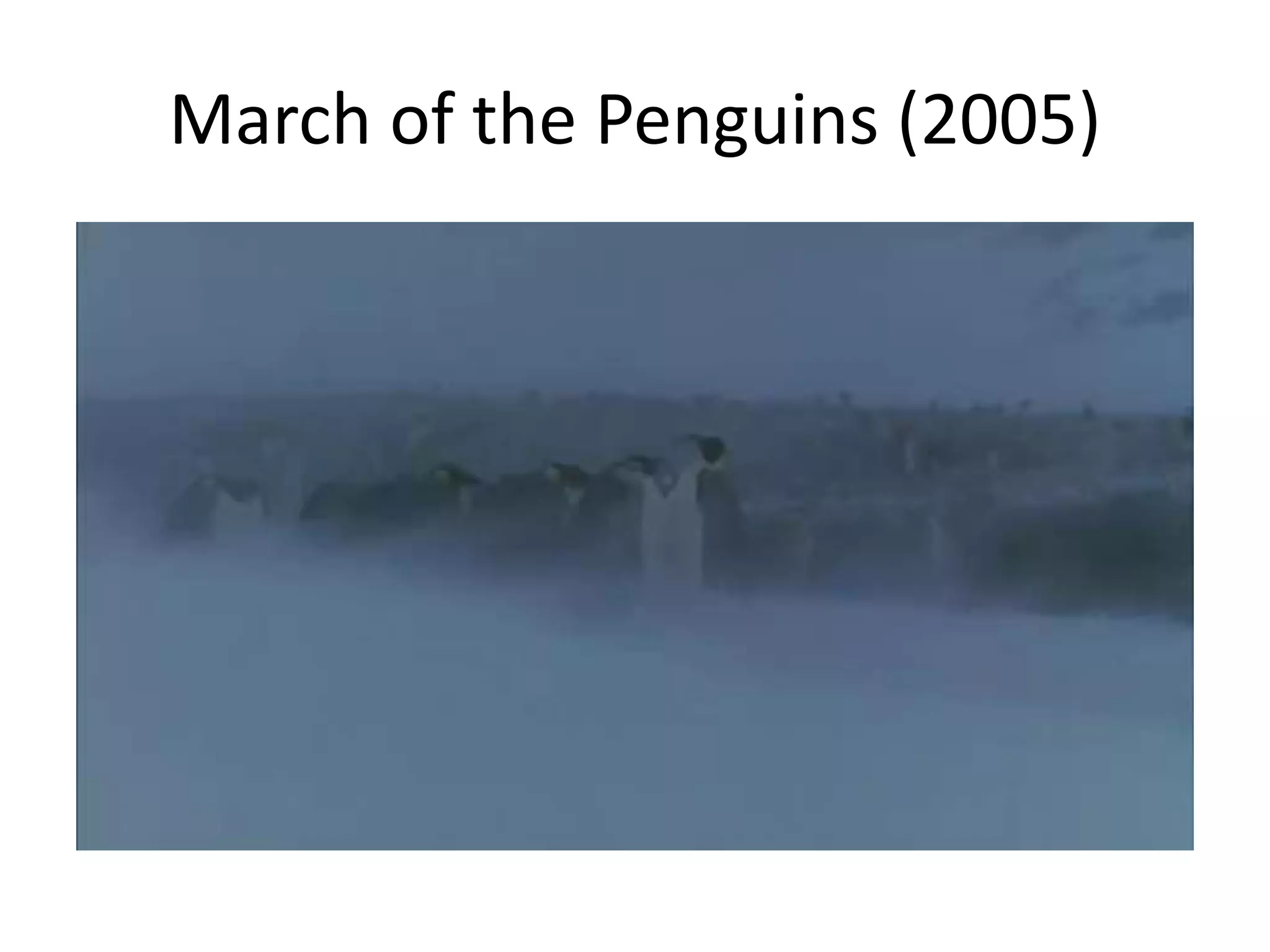
• Examples: Nature Documentaries
Blue Planet, Frozen Planet, March of Penguins
March of the Penguins (2005)
Observational Mode
(window of the world)
(fly on the wall, Verite, Direct Cinema)
• Objective reality with filmmaker as neutral observer
• Similar to ‘fly on the wall’ documentary
• Filmmaker remains hidden behind camera, ignored by surrounding environment (they will not affect changes or
influence actions/events)
• Because nothing is staged by camera, camera rushes to keep up with action (resulting in rough/shaky footage)
• Consider that after 60’s technology advanced and cameras became lighter (therefore able to move around and
document reality more easily, the filmmakers could film the social actors more freely )
• Examples:
• Kim Longinotto
• Paul Watson (The Family)
• D.A Pennebaker
Kim Longinotto (Shinjuku Boys 1995)
Kim Longinotto
Participatory Mode (present filmmaker)
• Unlike observational mode as filmmaker is present
• Direct engagement between filmmaker and subject
• Filmmaker part of filming (on camera)
• Filmmaker’s impact on the events is recorded,
acknowledged and is often celebrated
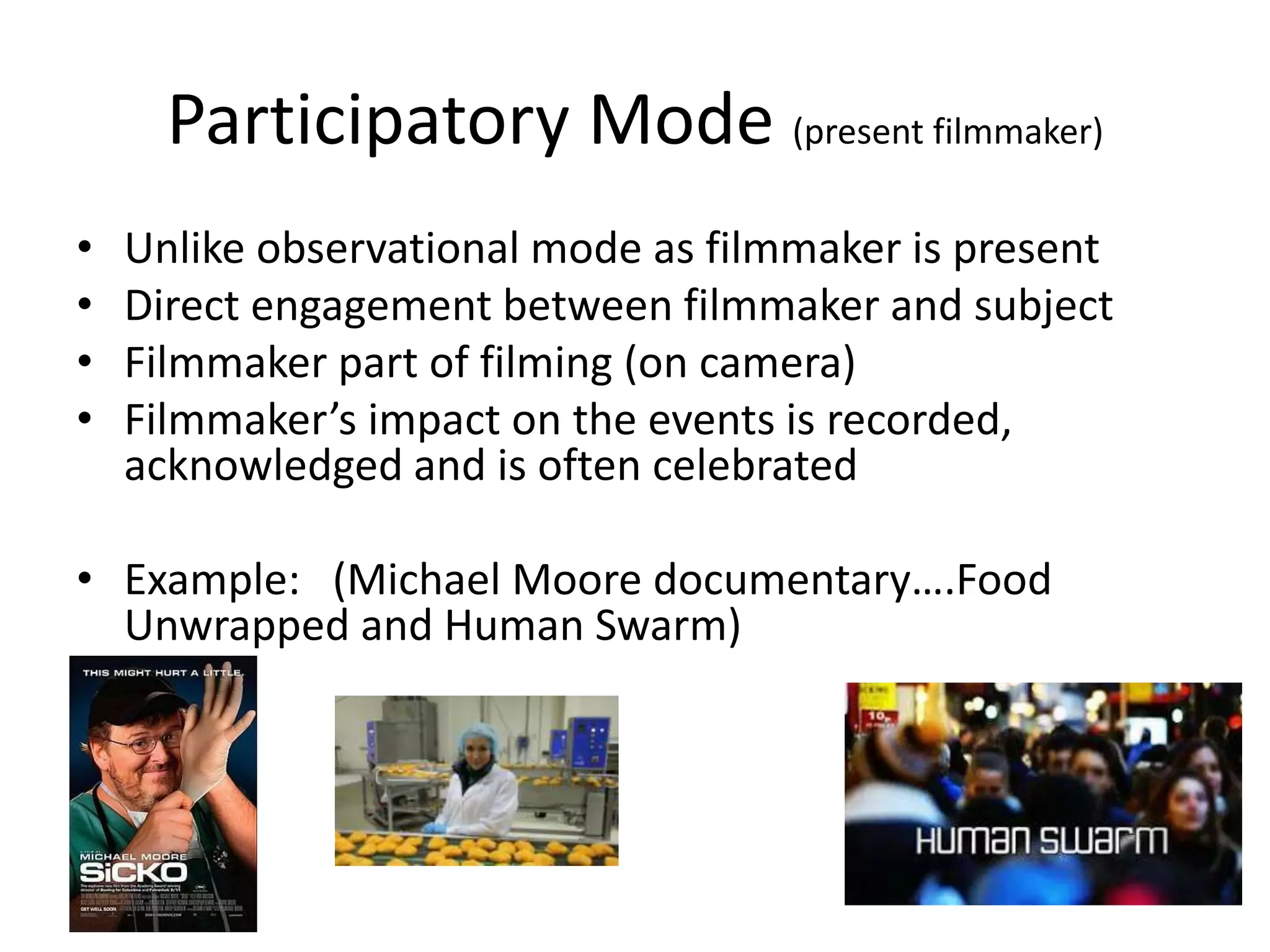
• Example: (Michael Moore documentary….Food
Unwrapped and Human Swarm)
Ross Kemp: Extreme World
Reflexive Mode (awareness of process)
• Acknowledges construction of documentary
• This conveys it’s not necessarily ‘truth’ but a reconstruction of it
(‘a’ truth, not ‘the’ truth)
• Construction of documentary is exposed – audience are made
aware of editing, sound, recording etc.
• Example:
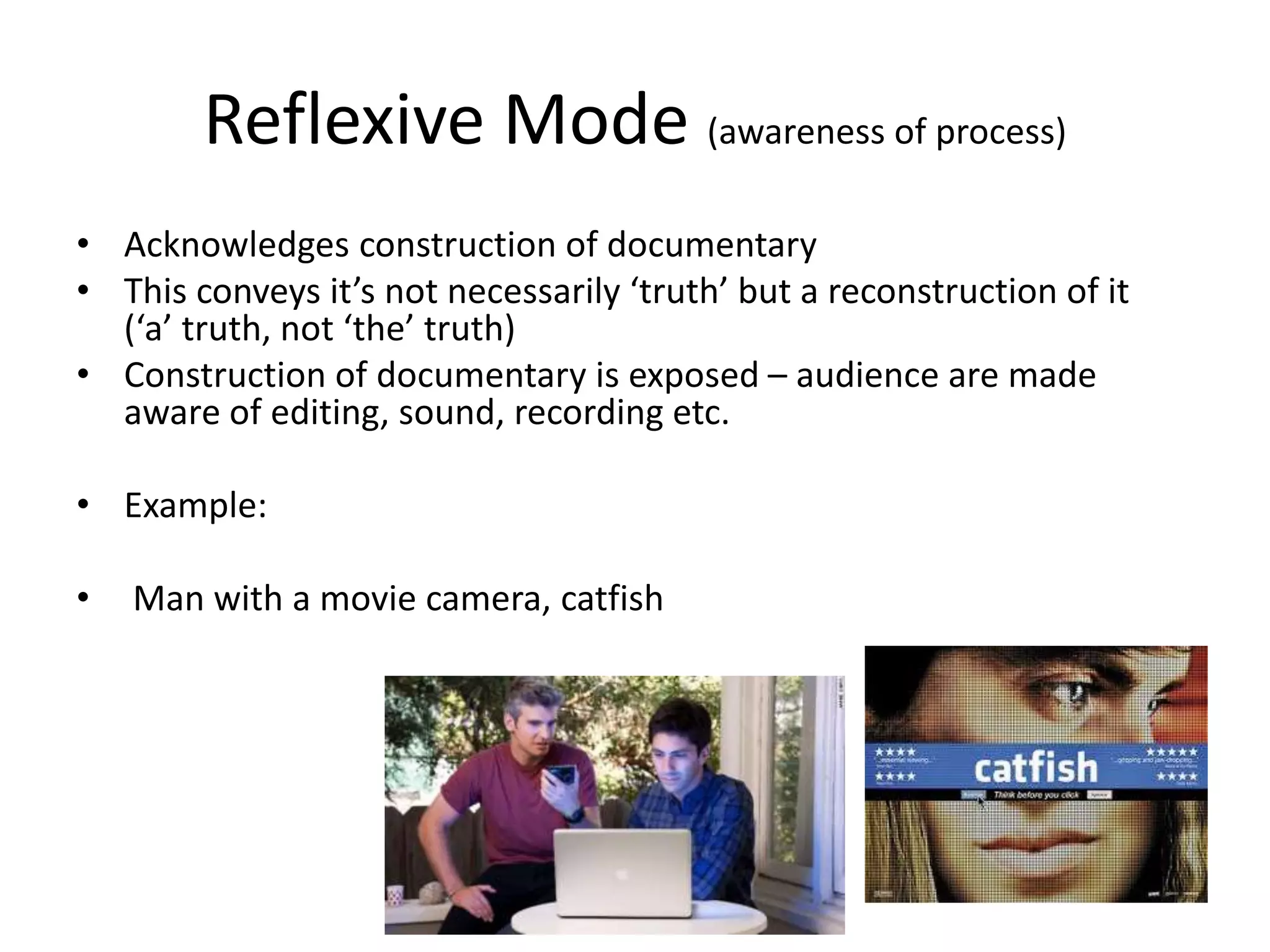
• Man with a movie camera, catfish
Catfish (MTV)
Performative Mode (filmmaker as performer)
• Emphasizes subjective nature of the maker
• Filmmaker is participant (perhaps participating in
something he/she might be wanting to prove) (subjective
nature)
• Emphasizes emotional and social impact on the audience
Examples:
• Nick Broomfield
Nick Broomfield : Kurt and Courtney
Poetic Mode (subjective, artistic expression)
• Not typical of narrative structure
• Subjective, not objective…. moves away from the ‘objective’ reality
• Not rhetoric
• More about artistic expression (not necessarily preferred meaning but oppositional/negotiated
meaning is ok) – therefore things may be left unresolved
• Grasp ‘inner truth’ grasped by poetical manipulation (express inner meaning of a subject)
• This is particularly noticeable in the editing of poetic documentaries, where continuity is of virtually
no consequence at all. Rather, poetic editing explores “associations and patterns that involve
chronological rhythms and spatial juxtapositions.
• Particular mood/tone is created (enhanced by music)
• Montage style editing – unrelated shots edited together (perhaps linked by music/mood though)
• -perceived as Avant-garde (innovative, experimental, pushes boundaries)
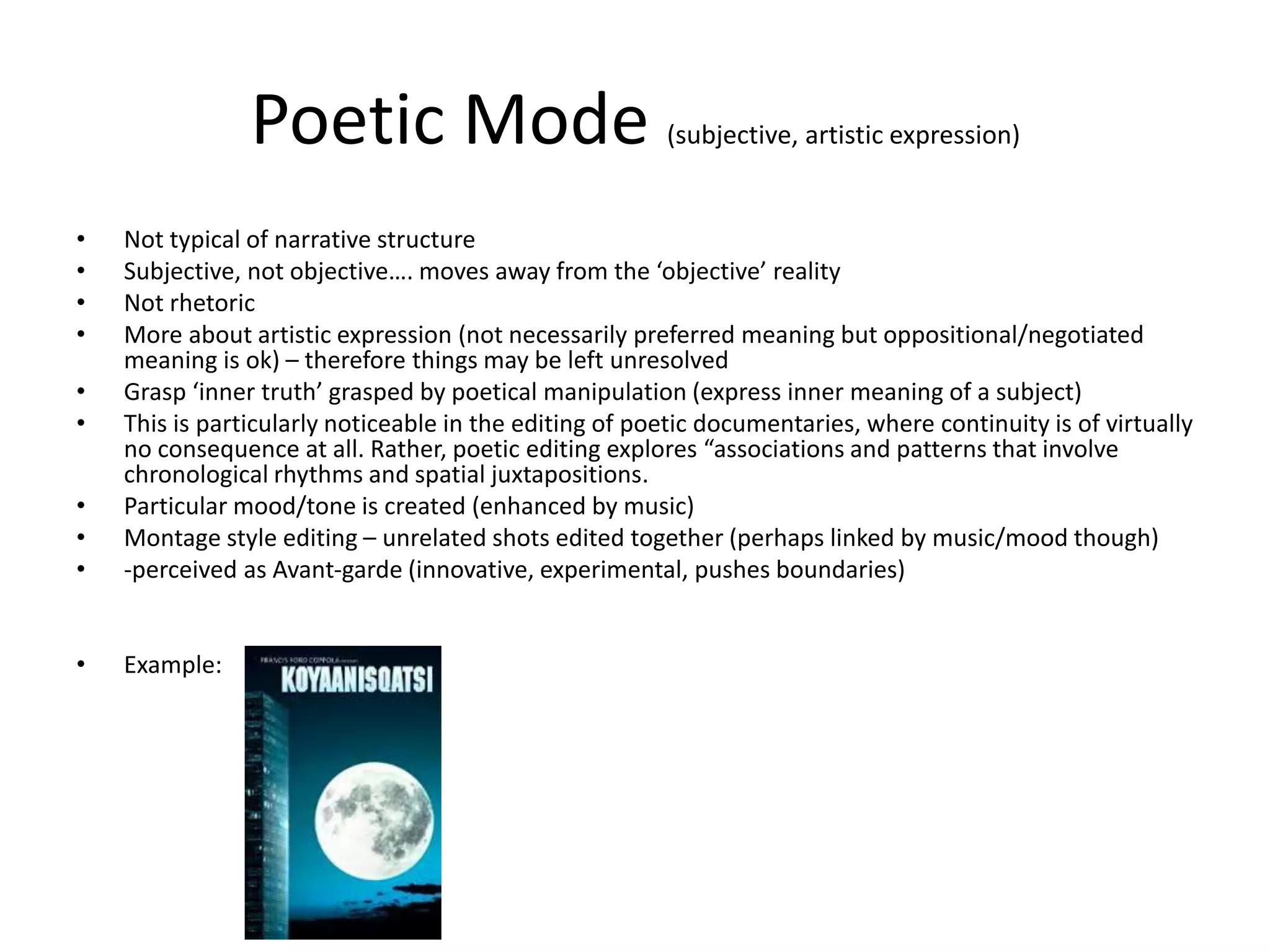
• Example:
Julien Temple: Oil City Confidential
Alternative conceptual frameworks
• Toni de Bromhead (1996) Criticized Nichols
Nichols focuses on the Journalistic-
• Doc as a rational exercise?
• Key principal ‘Informative’
• Her position:
• Move away from ‘objectivity and truth’ to
issues of narrative and filmic pleasure
De Bromhead’s documentary modes
• Linear mode
• Classic or Hollywood storytelling; character-based, follows standard three-act structure, based around conflict
and resolution as a storytelling arc.Examples: Primary (1960) - Drew and Leacock.
Detective storytelling; the story is based around the process of an investigation and the obstacles faced by the
filmmaker. In some cases the failure to make the film becomes the story of the film. Examples: Films by Michael
Moore & Nick Broomfield.
• Discursive mode
• Discursive storytelling; gives priority to information, facts and logic, typical of current affairs documentaries,
political documentaries, may give more space to cinematic concerns than purely journalistic filmmaking, often
utilises archive footage to illustrate the story. Examples: The War On Democracy (2007) - John Pilger & Rosie the
Riveter (1980) – Connie Field.
• Episodic mode
• Episodic storytelling; which juxtaposes situations that have no narrative or causal relations, meaning is produced
by the juxtaposition of the episodes, often ordered around one dominant theme or idea (e.g. the
seasons). Examples: Nannook of the North (1922) - Robert Flaherty & Hospital (1970) - Frederick Wiseman.
• Poetic mode
• Poetic storytelling; is built up around audio visual poetic associations, films avoid following a specific storyline or
conventional narrative logic, utilizes similar structures to poetry such as metaphor and disjunction. Examples:
Listen to Britain (1942) - Humphrey Jennings & Rain (1929) - Joris Ivans.
• Hybrid mode
• The Diary Film; the linear logic of passing time is used to structure the narrative in either linear or episodic
form. Examples: Tarnation (2003) - Jonathan Caouette.
The Road Movie; the linear logic of a physical journey is used to structure the narrative in either linear or episodic
form. Examples: Don’t Look Back (1966) - D.A. Pennebaker.
Things to consider
• History ( Context)
• Style
• Technology (Do I have the skills, crew?)
• Practice (Planning and deadlines)
Where to start?
• Which mode(s) are you interested in?
• What is the story?
• Access?
• Ethical considerations
• Legal issues
• Skill set (Crew)
• Scheduling
• Researching the field
Reading
• Representing Reality: Bill Nichols
• Imagining Reality: Kevin MacDonald and Marc
Cousins
• The Art of Record: John Corner
• New Documentary : Stella Bruzzi

Documentary for prp

  • 1.
    What is “Documentary” JohnGrierson (1966) “The creative treatment of actuality” Paul Rotha(1963) “ The instruction for the awakening of civic consciousness among the public”
  • 2.
    Documentary Mode Theory (BillNichols) Expository Mode Observational Mode Participatory Mode Performative Mode Reflexive Mode Poetic Mode
  • 3.
    Remember • Some documentarieshave elements of more than 1 mode (subgenre/hybrid) • “The characteristics of a given mode function as a dominant in a given film…but they do not dictate or determine every aspect of its organisation” (Nichols, 2001)
  • 4.
    Expository Mode (Voiceof God) • Often using a narrator to address audience directly to present exposition or explanation, interpreting what they are seeing on screen • Assumes logical argument which ‘right’ or ‘proper’ answers are revealed by direct address • Preferred meaning (meaning that a media producer wants the audience to receive (and this meaning is likely received by audience) • Whether there is visual narrator or not we trust the narration as a definitive narration or anchor of the visual material (and accept it has authoritative on subject matter) • TV news is similar • One of oldest conventions of documentary – still used today, even in Big Brother as the narrator interprets to audience what we are watching • The narrator often represents target audience for the programme, will address as group a set of implied values of text (preferred meaning) (ex. Who narrates blue planet? How relate to TA?) • Examples: Nature Documentaries Blue Planet, Frozen Planet, March of Penguins
  • 5.
    March of thePenguins (2005)
  • 6.
    Observational Mode (window ofthe world) (fly on the wall, Verite, Direct Cinema) • Objective reality with filmmaker as neutral observer • Similar to ‘fly on the wall’ documentary • Filmmaker remains hidden behind camera, ignored by surrounding environment (they will not affect changes or influence actions/events) • Because nothing is staged by camera, camera rushes to keep up with action (resulting in rough/shaky footage) • Consider that after 60’s technology advanced and cameras became lighter (therefore able to move around and document reality more easily, the filmmakers could film the social actors more freely ) • Examples: • Kim Longinotto • Paul Watson (The Family) • D.A Pennebaker
  • 7.
  • 8.
  • 9.
    Participatory Mode (presentfilmmaker) • Unlike observational mode as filmmaker is present • Direct engagement between filmmaker and subject • Filmmaker part of filming (on camera) • Filmmaker’s impact on the events is recorded, acknowledged and is often celebrated • Example: (Michael Moore documentary….Food Unwrapped and Human Swarm)
  • 10.
  • 11.
    Reflexive Mode (awarenessof process) • Acknowledges construction of documentary • This conveys it’s not necessarily ‘truth’ but a reconstruction of it (‘a’ truth, not ‘the’ truth) • Construction of documentary is exposed – audience are made aware of editing, sound, recording etc. • Example: • Man with a movie camera, catfish
  • 12.
  • 13.
    Performative Mode (filmmakeras performer) • Emphasizes subjective nature of the maker • Filmmaker is participant (perhaps participating in something he/she might be wanting to prove) (subjective nature) • Emphasizes emotional and social impact on the audience Examples: • Nick Broomfield
  • 14.
    Nick Broomfield :Kurt and Courtney
  • 15.
    Poetic Mode (subjective,artistic expression) • Not typical of narrative structure • Subjective, not objective…. moves away from the ‘objective’ reality • Not rhetoric • More about artistic expression (not necessarily preferred meaning but oppositional/negotiated meaning is ok) – therefore things may be left unresolved • Grasp ‘inner truth’ grasped by poetical manipulation (express inner meaning of a subject) • This is particularly noticeable in the editing of poetic documentaries, where continuity is of virtually no consequence at all. Rather, poetic editing explores “associations and patterns that involve chronological rhythms and spatial juxtapositions. • Particular mood/tone is created (enhanced by music) • Montage style editing – unrelated shots edited together (perhaps linked by music/mood though) • -perceived as Avant-garde (innovative, experimental, pushes boundaries) • Example:
  • 16.
    Julien Temple: OilCity Confidential
  • 17.
    Alternative conceptual frameworks •Toni de Bromhead (1996) Criticized Nichols Nichols focuses on the Journalistic- • Doc as a rational exercise? • Key principal ‘Informative’ • Her position: • Move away from ‘objectivity and truth’ to issues of narrative and filmic pleasure
  • 18.
    De Bromhead’s documentarymodes • Linear mode • Classic or Hollywood storytelling; character-based, follows standard three-act structure, based around conflict and resolution as a storytelling arc.Examples: Primary (1960) - Drew and Leacock. Detective storytelling; the story is based around the process of an investigation and the obstacles faced by the filmmaker. In some cases the failure to make the film becomes the story of the film. Examples: Films by Michael Moore & Nick Broomfield. • Discursive mode • Discursive storytelling; gives priority to information, facts and logic, typical of current affairs documentaries, political documentaries, may give more space to cinematic concerns than purely journalistic filmmaking, often utilises archive footage to illustrate the story. Examples: The War On Democracy (2007) - John Pilger & Rosie the Riveter (1980) – Connie Field. • Episodic mode • Episodic storytelling; which juxtaposes situations that have no narrative or causal relations, meaning is produced by the juxtaposition of the episodes, often ordered around one dominant theme or idea (e.g. the seasons). Examples: Nannook of the North (1922) - Robert Flaherty & Hospital (1970) - Frederick Wiseman. • Poetic mode • Poetic storytelling; is built up around audio visual poetic associations, films avoid following a specific storyline or conventional narrative logic, utilizes similar structures to poetry such as metaphor and disjunction. Examples: Listen to Britain (1942) - Humphrey Jennings & Rain (1929) - Joris Ivans. • Hybrid mode • The Diary Film; the linear logic of passing time is used to structure the narrative in either linear or episodic form. Examples: Tarnation (2003) - Jonathan Caouette. The Road Movie; the linear logic of a physical journey is used to structure the narrative in either linear or episodic form. Examples: Don’t Look Back (1966) - D.A. Pennebaker.
  • 19.
    Things to consider •History ( Context) • Style • Technology (Do I have the skills, crew?) • Practice (Planning and deadlines)
  • 20.
    Where to start? •Which mode(s) are you interested in? • What is the story? • Access? • Ethical considerations • Legal issues • Skill set (Crew) • Scheduling • Researching the field
  • 21.
    Reading • Representing Reality:Bill Nichols • Imagining Reality: Kevin MacDonald and Marc Cousins • The Art of Record: John Corner • New Documentary : Stella Bruzzi

Editor's Notes

  • #2 It was in the Uk that John Greirson and later Paul Rotha who set up the framework of documentary theory. They both emphasise creativity, artistic and political possibilities of the form. Later theorist such as De Bromhead have focused more on its narrative structures, cinematic pleasure and elliciting a desired emotional response from its target audience.
  • #3 Bill Nichols is one of the most influential theorists of documentary. His 1991 book, Representing Reality was one of the first books to theorise documentary- to provide us with a conceptual framework or understanding of the different types of documentary. I will also discuss a more recent theorist, Toni De Bromhead who uses his work as a point of refeernce and departure into her own framework for understanding documentaries.
  • #6 Voice of god narration- explains the phenomena in a commonsense way- often not really disguising a certain kind of truth. The truth of the matter- The voices tend to be white, middle class, middle age which should provide some clue as to the kind of world view that is being proliferated. The advantages are that complex information can be given in a simple way. The narration can anchor the images and sounds – Political aspects.
  • #11 This mode also allows archive and interview material-experts and witnesses as well as observational style footage. It is about building a brand for the presenter perhaps- Notice that events are unfolding not all have already unfolded. Often students will try this style but are actually trying to make a retrospective which can be dull. The audience are interested in storytelling- what will happen?
  • #15 Performative mode- Very successful since the 1980’s- Nick Broomfield, Louis Theroux and Michael Moore. They perform different roles to provoke, elicit, persuade, cajole or seduce their subjects into revealing feelings or information. It relies on the abilities of the subjects to deal with the approach (performance) of the filmmaker. This requires a inetrviewer with strong interpersonal and performance skills.
  • #17 Creatively treats found footage and uses it in a new and intersting way. Multi-media performance projections, animations, effects – all bring the artistic nature of this mode to the foreground.