Chapter 10
DNA Sequencing
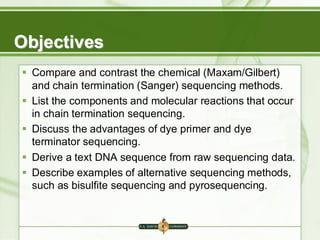
Objectives
▪ Compare and contrast the chemical (Maxam/Gilbert)
and chain termination (Sanger) sequencing methods.
▪ List the components and molecular reactions that occur
in chain termination sequencing.
▪ Discuss the advantages of dye primer and dye
terminator sequencing.
▪ Derive a text DNA sequence from raw sequencing data.
▪ Describe examples of alternative sequencing methods,
such as bisulfite sequencing and pyrosequencing.
Sequencing Methods
▪ Maxam/Gilbert chemical sequencing
▪ Sanger chain termination sequencing
▪ Pyrosequencing
▪ Array sequencing
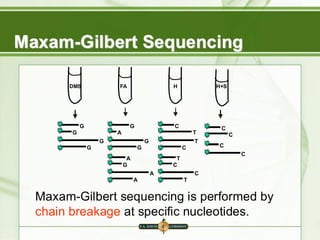
Maxam-Gilbert sequencing is performed by
chain breakage at specific nucleotides.
DMS
G
G
G
G
FA
G
A
G
G
A
G
A
A
H
C
T
T
C
T
C
C
T
H+S
C
C
C
C
Maxam-Gilbert Sequencing
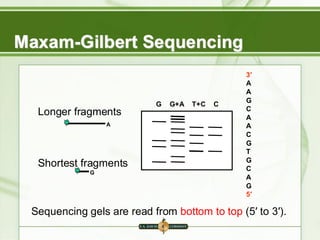
Sequencing gels are read from bottom to top (5′ to 3′).
G G+A T+C C
3′
A
A
G
C
A
A
C
G
T
G
C
A
G
5′
Longer fragments
Shortest fragments
G
A
Maxam-Gilbert Sequencing
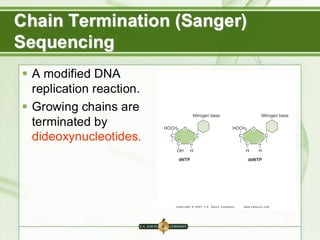
Chain Termination (Sanger)
Sequencing
▪ A modified DNA
replication reaction.
▪ Growing chains are
terminated by
dideoxynucleotides.
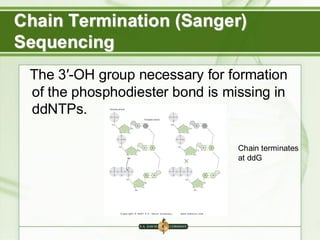
Chain terminates
at ddG
Chain Termination (Sanger)
Sequencing
The 3′-OH group necessary for formation
of the phosphodiester bond is missing in
ddNTPs.
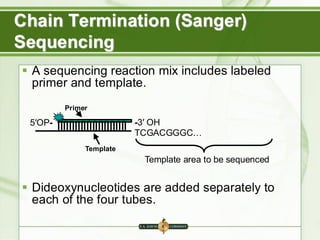
Template area to be sequenced
-3′ OH
TCGACGGGC…
5′OP-
Primer
Template
Chain Termination (Sanger)
Sequencing
▪ A sequencing reaction mix includes labeled
primer and template.
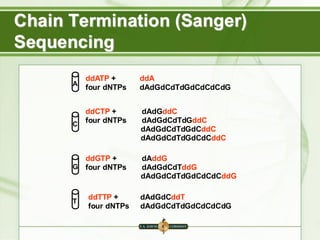
▪ Dideoxynucleotides are added separately to
each of the four tubes.
ddATP + ddA
four dNTPs dAdGdCdTdGdCdCdCdG
ddCTP + dAdGddC
four dNTPs dAdGdCdTdGddC
dAdGdCdTdGdCddC
dAdGdCdTdGdCdCddC
ddGTP + dAddG
four dNTPs dAdGdCdTddG
dAdGdCdTdGdCdCdCddG
ddTTP + dAdGdCddT
four dNTPs dAdGdCdTdGdCdCdCdG
A
C
G
T
Chain Termination (Sanger)
Sequencing
Chain Termination (Sanger)
Sequencing
▪ With addition of enzyme (DNA polymerase), the
primer is extended until a ddNTP is
encountered.
▪ The chain will end with the incorporation of the
ddNTP.
▪ With the proper dNTP:ddNTP ratio, the chain
will terminate throughout the length of the
template.
▪ All terminated chains will end in the ddNTP
added to that reaction.
Chain Termination (Sanger)
Sequencing
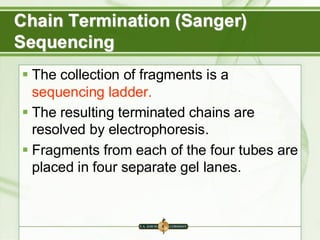
▪ The collection of fragments is a
sequencing ladder.
▪ The resulting terminated chains are
resolved by electrophoresis.
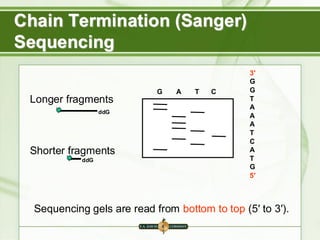
▪ Fragments from each of the four tubes are
placed in four separate gel lanes.
Sequencing gels are read from bottom to top (5′ to 3′).
G A T C
3′
G
G
T
A
A
A
T
C
A
T
G
5′
Longer fragments
Shorter fragments
ddG
ddG
Chain Termination (Sanger)
Sequencing
Cycle Sequencing
▪ Cycle sequencing is chain termination
sequencing performed in a thermal cycler.
▪ Cycle sequencing requires a heat-stable
DNA polymerase.
Fluorescent Dyes
▪ Fluorescent dyes are multicyclic
molecules that absorb and emit
fluorescent light at specific wavelengths.
▪ Examples are fluorescein and rhodamine
derivatives.
▪ For sequencing applications, these
molecules can be covalently attached to
nucleotides.
Fluorescent Dyes
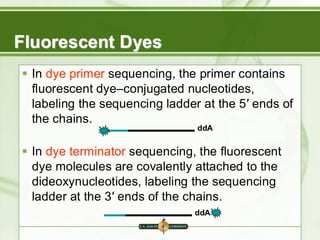
▪ In dye primer sequencing, the primer contains
fluorescent dye–conjugated nucleotides,
labeling the sequencing ladder at the 5′ ends of
the chains.
▪ In dye terminator sequencing, the fluorescent
dye molecules are covalently attached to the
dideoxynucleotides, labeling the sequencing
ladder at the 3′ ends of the chains.
ddA
ddA
AC
GT
The fragments are
distinguished by size and
“color.”
Dye Terminator Sequencing
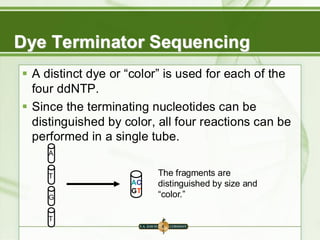
▪ A distinct dye or “color” is used for each of the
four ddNTP.
▪ Since the terminating nucleotides can be
distinguished by color, all four reactions can be
performed in a single tube.
A
T
G
T
Capillary
G
T
C
T
G
A
Slab gel
GA
TC
G A T C
Dye Terminator Sequencing
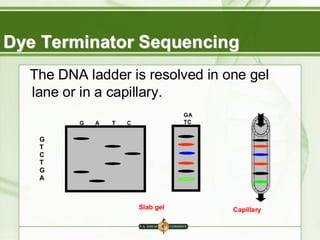
The DNA ladder is resolved in one gel
lane or in a capillary.
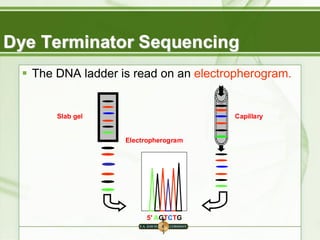
▪ The DNA ladder is read on an electropherogram.
Capillary
Slab gel
5′ AGTCTG
Electropherogram
Dye Terminator Sequencing
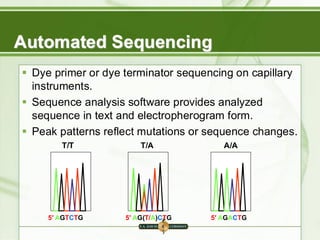
5′ AGTCTG 5′ AG(T/A)CTG 5′ AGACTG
T/T T/A A/A
Automated Sequencing
▪ Dye primer or dye terminator sequencing on capillary
instruments.
▪ Sequence analysis software provides analyzed
sequence in text and electropherogram form.
▪ Peak patterns reflect mutations or sequence changes.
Summary
▪ Genetic information is stored in the order or
sequence of nucleotides in DNA.
▪ Chain termination sequencing is the standard
method for the determination of nucleotide
sequence.
▪ Dideoxy-chain termination sequencing has been
facilitated by the development of cycle sequencing
and the use of fluorescent dye detection.
▪ Alternative methods are used for special
applications, such as pyrosequencing (for
resequencing and polymorphism detection) or
bisulfite sequencing (to analyze methylated DNA).
DNAsequencing method to sequence nucleotide sequence base pairs DNA coding

  • 1.
  • 2.
    Objectives ▪ Compare andcontrast the chemical (Maxam/Gilbert) and chain termination (Sanger) sequencing methods. ▪ List the components and molecular reactions that occur in chain termination sequencing. ▪ Discuss the advantages of dye primer and dye terminator sequencing. ▪ Derive a text DNA sequence from raw sequencing data. ▪ Describe examples of alternative sequencing methods, such as bisulfite sequencing and pyrosequencing.
  • 3.
    Sequencing Methods ▪ Maxam/Gilbertchemical sequencing ▪ Sanger chain termination sequencing ▪ Pyrosequencing ▪ Array sequencing
  • 4.
    Maxam-Gilbert sequencing isperformed by chain breakage at specific nucleotides. DMS G G G G FA G A G G A G A A H C T T C T C C T H+S C C C C Maxam-Gilbert Sequencing
  • 5.
    Sequencing gels areread from bottom to top (5′ to 3′). G G+A T+C C 3′ A A G C A A C G T G C A G 5′ Longer fragments Shortest fragments G A Maxam-Gilbert Sequencing
  • 6.
    Chain Termination (Sanger) Sequencing ▪A modified DNA replication reaction. ▪ Growing chains are terminated by dideoxynucleotides.
  • 7.
    Chain terminates at ddG ChainTermination (Sanger) Sequencing The 3′-OH group necessary for formation of the phosphodiester bond is missing in ddNTPs.
  • 8.
    Template area tobe sequenced -3′ OH TCGACGGGC… 5′OP- Primer Template Chain Termination (Sanger) Sequencing ▪ A sequencing reaction mix includes labeled primer and template. ▪ Dideoxynucleotides are added separately to each of the four tubes.
  • 9.
    ddATP + ddA fourdNTPs dAdGdCdTdGdCdCdCdG ddCTP + dAdGddC four dNTPs dAdGdCdTdGddC dAdGdCdTdGdCddC dAdGdCdTdGdCdCddC ddGTP + dAddG four dNTPs dAdGdCdTddG dAdGdCdTdGdCdCdCddG ddTTP + dAdGdCddT four dNTPs dAdGdCdTdGdCdCdCdG A C G T Chain Termination (Sanger) Sequencing
  • 10.
    Chain Termination (Sanger) Sequencing ▪With addition of enzyme (DNA polymerase), the primer is extended until a ddNTP is encountered. ▪ The chain will end with the incorporation of the ddNTP. ▪ With the proper dNTP:ddNTP ratio, the chain will terminate throughout the length of the template. ▪ All terminated chains will end in the ddNTP added to that reaction.
  • 11.
    Chain Termination (Sanger) Sequencing ▪The collection of fragments is a sequencing ladder. ▪ The resulting terminated chains are resolved by electrophoresis. ▪ Fragments from each of the four tubes are placed in four separate gel lanes.
  • 12.
    Sequencing gels areread from bottom to top (5′ to 3′). G A T C 3′ G G T A A A T C A T G 5′ Longer fragments Shorter fragments ddG ddG Chain Termination (Sanger) Sequencing
  • 13.
    Cycle Sequencing ▪ Cyclesequencing is chain termination sequencing performed in a thermal cycler. ▪ Cycle sequencing requires a heat-stable DNA polymerase.
  • 14.
    Fluorescent Dyes ▪ Fluorescentdyes are multicyclic molecules that absorb and emit fluorescent light at specific wavelengths. ▪ Examples are fluorescein and rhodamine derivatives. ▪ For sequencing applications, these molecules can be covalently attached to nucleotides.
  • 15.
    Fluorescent Dyes ▪ Indye primer sequencing, the primer contains fluorescent dye–conjugated nucleotides, labeling the sequencing ladder at the 5′ ends of the chains. ▪ In dye terminator sequencing, the fluorescent dye molecules are covalently attached to the dideoxynucleotides, labeling the sequencing ladder at the 3′ ends of the chains. ddA ddA
  • 16.
    AC GT The fragments are distinguishedby size and “color.” Dye Terminator Sequencing ▪ A distinct dye or “color” is used for each of the four ddNTP. ▪ Since the terminating nucleotides can be distinguished by color, all four reactions can be performed in a single tube. A T G T
  • 17.
    Capillary G T C T G A Slab gel GA TC G AT C Dye Terminator Sequencing The DNA ladder is resolved in one gel lane or in a capillary.
  • 18.
    ▪ The DNAladder is read on an electropherogram. Capillary Slab gel 5′ AGTCTG Electropherogram Dye Terminator Sequencing
  • 19.
    5′ AGTCTG 5′AG(T/A)CTG 5′ AGACTG T/T T/A A/A Automated Sequencing ▪ Dye primer or dye terminator sequencing on capillary instruments. ▪ Sequence analysis software provides analyzed sequence in text and electropherogram form. ▪ Peak patterns reflect mutations or sequence changes.
  • 20.
    Summary ▪ Genetic informationis stored in the order or sequence of nucleotides in DNA. ▪ Chain termination sequencing is the standard method for the determination of nucleotide sequence. ▪ Dideoxy-chain termination sequencing has been facilitated by the development of cycle sequencing and the use of fluorescent dye detection. ▪ Alternative methods are used for special applications, such as pyrosequencing (for resequencing and polymorphism detection) or bisulfite sequencing (to analyze methylated DNA).