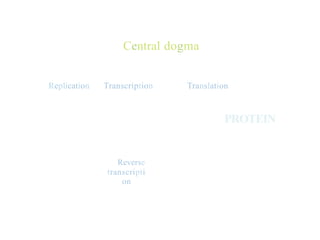
Central dogma
Replication Transcription Translation
PROTEIN
Reverse
transcripti
on
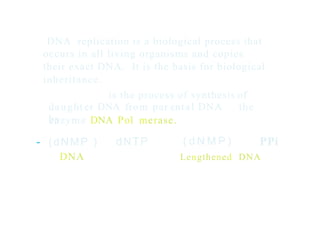
DNA replication is a biological process that
occurs in all living organisms and copies
their exact DNA. It is the basis for biological
inheritance.
is the process of synthesis
daught er DNA from par ental DNA
by
of
the
enzyme DNA Pol merase.
PPi
( d N M P )
dNTP
- (dNMP )
DNA Lengthened DNA
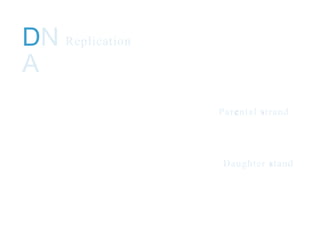
DN
A
Replication
Parental strand
Daughter stand
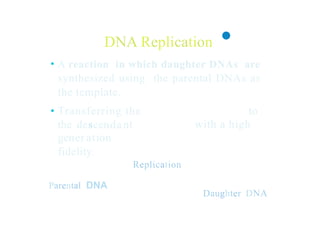
DNA Replication •
A reaction in which daughter DNAs are
synthesized using the parental DNAs as
the template.
•
• Transferring the
the descendant
gener ation
fidelity.
Replication
to
with a high
Parental DNA
Daughter DNA
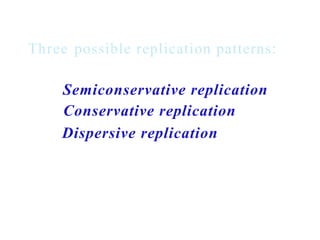
Three possible replication patterns:
Semiconservative replication
Conservative replication
Dispersive replication
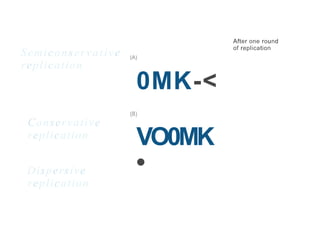
After one round
of replication
Semiconservative
replication
(A)
0MK-<
(8)
Conservative
replication
VO0MK
•
Dispersive
replication
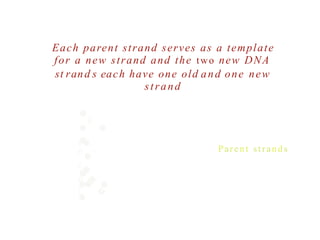
Each parent strand serves as a template
for a new strand and the two new DNA
st rand s each have one old
strand
and one new
•€
•
€
•
••
• •
e
•-
-
•�
Parent strands
€
•
•
e
• •
C �
•
•
•
•
Semi-conservative replication
Bidirectional replication
Semi-continuous replication
High fidelity
[1958]
demonstrated Semiconservative
replication
DNA o rtreted an d cen t ri fu g ed
to u t i t r u r n n € C T d n a t t y
g r a d i n t
o
r
i
g
i
n
8a
lp a r e n t
t
n o . c u l
Mytr@ DNA
M N I4N»
ct»
t o r t i - o n
d u g h t r r o e l o
3t
l
c
o
#nd
e
3t
e
n
8t
i
o
n
L e
D N A ( ' N
t e H y b r i d D N A
» Semiconservative
Replication
Half of the parental DNA molecule
is conserved in each new double helix,
paired with a newly synthesized
complementary strand. This is called
semiconservative replication.
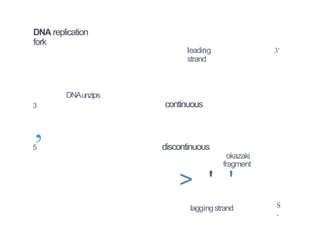
Bidirectional Replication
• Replication starts from unwinding the
dsDNA at a particular point (called
), followed by the
synthesis on each
strand.
The parental dsDNA and two newly
formed dsDNA form a Y-shape
structure called
•
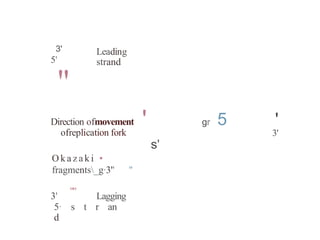
3'
5'
"
Leading
strand
' gr 5 '
3'
Direction ofmovement
ofreplication fork
s'
O k a z a k i •
fragments_g·3'' "
""
3' Lagging
5· s t r an
d
Replication Enzymes & Proteins
•DNA Polymerase - Matches the correct
nucleotides then joins / polymerizes
adjacent nucleotides to each other.
• Helicase - Unwinds the DNA and melts
.
1t.
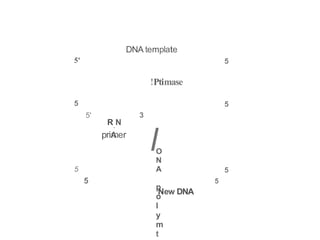
• Primase - Provides
an
start polymerization.
A primer to
�
Single Strand Binding Proteins -Keep the
DNA single stranded after it has been melted
by helicase
• Gyrase - A topisomerase that Relieves
torsional strain in the DNA molecule.
• Ligase - Joins adjacent DNA strands
together (fixes "n icks")
• Telomerase - Finishes off the ends of
strands in Eukaryotes
DNA
DNA Polymerases of Prokaryotes
DNA Pol merase-1
• The first
(DNA Pol -I ) was
discovered in 1958 by Arthur
Kornberg who received Nobel
Prize in physiology & medicine
1959.
in
• DNA Polymerase is considered
as Kornber g Enzvme.
•Later,
were identified.
and
• All of them possess the
biological activity.
following
1.5'-)3' Polymerse activity
2. Exonuclease activity
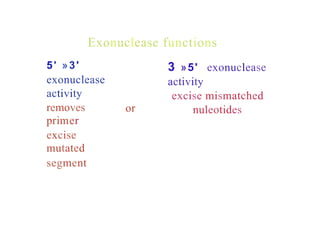
Exonuclease functions
3 »5' exonuclease
activity
excise mismatched
nuleotides
5' »3'
exonuclease
activity
removes
primer
excise
mutated
segment
or
DNA Polmerase - I
•Mainly
responsible for
repairing DNA
damage
DNA Polymerase-I I
•T emporarily functional when DNA-
pol
and DNA-pol III are not functional.
• Still capable for doing
I
• Participates in process.
DNA Polymerase - III
• A heter odimer enzyme composed of
ten different subunits
• Having the polymerization
activity (10 nt/min)
• The tr ue enzyme responsible for
the pr ocess
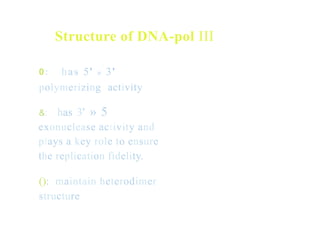
Structure of DNA-pol III
has 5' » 3'
0:
polymerizing activity
&: has 3' » 5
exonuclease activity and
plays a key role to ensure
the replication fidelity.
(): maintain heterodimer
structure
DNA Replication, like all biological
polymerization processes, proceeds in
three enzymatically catalyzed and
coordinated steps:
initiation
elongation
and
termination
DNA Replication
DNA replication includes:
--initiation -- replication begins at an
ori gin of replication
- elongation - new strands of DNA are
synthesized by DNA polymerase
t e r m i n a t i o n replication is terminated
differently in prokaryotes and
eukaryotes
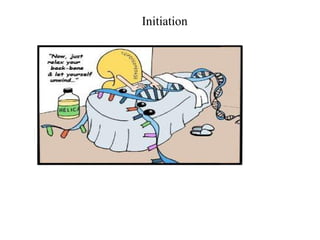
Initiation
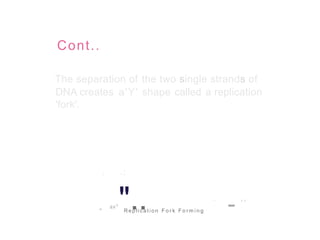
Cont..
The separation of the two single strands of
DNA creates
'fork'.
a'Y' shape called a replication
• • F
t a
$
as°".. -
• d d
" Rep lica t io n F o r k F o r m i n g
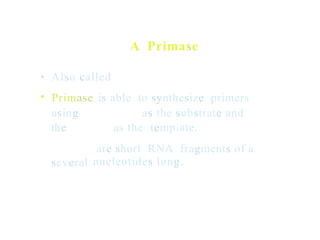
A Primase
•
•
Also called
Primase
using
the
is able to synthesize primers
as the substrate and
as the template.
are short RNA fragments of a
nucleotides long.
several
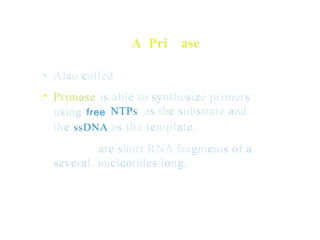
A Pri ase
•
•
Also called
Primase is able to synthesize primers
NTPs as the substrate and
using free
the ssDNA as the template.
are short RNA fragments of a
several nucleotides long.
l
primer
5 5
5 5
New DNA
DNA template
5'
5
5
5
!Ptimase
5' 3
R.N
A
O
N
A
p
o
l
y
m
t
DNA replication
fork
leading
strand
3'
DNAunzips
continuous
3
,
5 discontinuous
okazaki
fragment
> ' '
laggingstrand s
·
3
5' 5
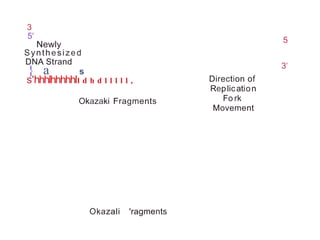
Newly
Synthesized
DNA Strand 3'
} a s
s'hhhlhhhhhll d h d l l l l l , Direction of
Replication
Fo rk
Movement
Okazaki Fragments
Okazali 'ragments
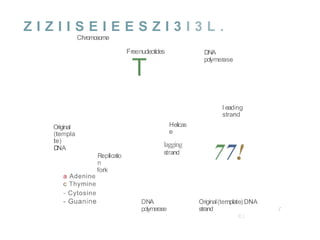
Z I Z I I S E I E E S Z I 3 I 3 L .
Chromosome
Freenucleotides
T
DNA
polymerase
l eading
strand
Helicas
e
lagging
strand
Original
(templa
te)
DNA
77!
Replicatio
n
fork
a Adenine
c Thymine
- Cytosine
- Guanine DNA
polymerase
Original(template) DNA
strand
C )
r
Once all of the bases are matched up (A with
T, C with G), an enzyme called exonuclease
strips away the primer(s).
The gaps where the primer(s) were are then
filled by yet more complementary
nucleotides.
DNA synthesis molec DNA-replication.pptx

DNA synthesis molec DNA-replication.pptx

  • 1.
    Central dogma Replication TranscriptionTranslation PROTEIN Reverse transcripti on
  • 2.
    DNA replication isa biological process that occurs in all living organisms and copies their exact DNA. It is the basis for biological inheritance. is the process of synthesis daught er DNA from par ental DNA by of the enzyme DNA Pol merase. PPi ( d N M P ) dNTP - (dNMP ) DNA Lengthened DNA
  • 3.
  • 4.
    DNA Replication • Areaction in which daughter DNAs are synthesized using the parental DNAs as the template. • • Transferring the the descendant gener ation fidelity. Replication to with a high Parental DNA Daughter DNA
  • 5.
    Three possible replicationpatterns: Semiconservative replication Conservative replication Dispersive replication
  • 6.
    After one round ofreplication Semiconservative replication (A) 0MK-< (8) Conservative replication VO0MK • Dispersive replication
  • 7.
    Each parent strandserves as a template for a new strand and the two new DNA st rand s each have one old strand and one new •€ • € • •• • • e •- - •� Parent strands € • • e • • C �
  • 8.
  • 9.
    [1958] demonstrated Semiconservative replication DNA ortreted an d cen t ri fu g ed to u t i t r u r n n € C T d n a t t y g r a d i n t o r i g i n 8a lp a r e n t t n o . c u l Mytr@ DNA M N I4N» ct» t o r t i - o n d u g h t r r o e l o 3t l c o #nd e 3t e n 8t i o n L e D N A ( ' N t e H y b r i d D N A
  • 10.
    » Semiconservative Replication Half ofthe parental DNA molecule is conserved in each new double helix, paired with a newly synthesized complementary strand. This is called semiconservative replication.
  • 11.
    Bidirectional Replication • Replicationstarts from unwinding the dsDNA at a particular point (called ), followed by the synthesis on each strand. The parental dsDNA and two newly formed dsDNA form a Y-shape structure called •
  • 12.
    3' 5' " Leading strand ' gr 5' 3' Direction ofmovement ofreplication fork s' O k a z a k i • fragments_g·3'' " "" 3' Lagging 5· s t r an d
  • 13.
    Replication Enzymes &Proteins •DNA Polymerase - Matches the correct nucleotides then joins / polymerizes adjacent nucleotides to each other. • Helicase - Unwinds the DNA and melts . 1t. • Primase - Provides an start polymerization. A primer to
  • 14.
    � Single Strand BindingProteins -Keep the DNA single stranded after it has been melted by helicase • Gyrase - A topisomerase that Relieves torsional strain in the DNA molecule. • Ligase - Joins adjacent DNA strands together (fixes "n icks") • Telomerase - Finishes off the ends of strands in Eukaryotes DNA
  • 15.
    DNA Polymerases ofProkaryotes DNA Pol merase-1 • The first (DNA Pol -I ) was discovered in 1958 by Arthur Kornberg who received Nobel Prize in physiology & medicine 1959. in • DNA Polymerase is considered as Kornber g Enzvme.
  • 16.
    •Later, were identified. and • Allof them possess the biological activity. following 1.5'-)3' Polymerse activity 2. Exonuclease activity
  • 17.
    Exonuclease functions 3 »5'exonuclease activity excise mismatched nuleotides 5' »3' exonuclease activity removes primer excise mutated segment or
  • 18.
    DNA Polmerase -I •Mainly responsible for repairing DNA damage
  • 19.
    DNA Polymerase-I I •Temporarily functional when DNA- pol and DNA-pol III are not functional. • Still capable for doing I • Participates in process.
  • 20.
    DNA Polymerase -III • A heter odimer enzyme composed of ten different subunits • Having the polymerization activity (10 nt/min) • The tr ue enzyme responsible for the pr ocess
  • 21.
    Structure of DNA-polIII has 5' » 3' 0: polymerizing activity &: has 3' » 5 exonuclease activity and plays a key role to ensure the replication fidelity. (): maintain heterodimer structure
  • 22.
    DNA Replication, likeall biological polymerization processes, proceeds in three enzymatically catalyzed and coordinated steps: initiation elongation and termination
  • 23.
    DNA Replication DNA replicationincludes: --initiation -- replication begins at an ori gin of replication - elongation - new strands of DNA are synthesized by DNA polymerase t e r m i n a t i o n replication is terminated differently in prokaryotes and eukaryotes
  • 24.
  • 25.
    Cont.. The separation ofthe two single strands of DNA creates 'fork'. a'Y' shape called a replication • • F t a $ as°".. - • d d " Rep lica t io n F o r k F o r m i n g
  • 26.
    A Primase • • Also called Primase using the isable to synthesize primers as the substrate and as the template. are short RNA fragments of a nucleotides long. several
  • 27.
    A Pri ase • • Alsocalled Primase is able to synthesize primers NTPs as the substrate and using free the ssDNA as the template. are short RNA fragments of a several nucleotides long.
  • 28.
    l primer 5 5 5 5 NewDNA DNA template 5' 5 5 5 !Ptimase 5' 3 R.N A O N A p o l y m t
  • 29.
  • 30.
    3 5' 5 Newly Synthesized DNA Strand3' } a s s'hhhlhhhhhll d h d l l l l l , Direction of Replication Fo rk Movement Okazaki Fragments Okazali 'ragments
  • 31.
    Z I ZI I S E I E E S Z I 3 I 3 L . Chromosome Freenucleotides T DNA polymerase l eading strand Helicas e lagging strand Original (templa te) DNA 77! Replicatio n fork a Adenine c Thymine - Cytosine - Guanine DNA polymerase Original(template) DNA strand C ) r
  • 32.
    Once all ofthe bases are matched up (A with T, C with G), an enzyme called exonuclease strips away the primer(s). The gaps where the primer(s) were are then filled by yet more complementary nucleotides.