All genes are made of the same molecule that is chemically quite
homogeneous (DNA – all As,Cs, Gs and Ts)
There is a huge amount of genetic material
E. coli >1000 genes (4,600,000 bp)
Humans – perhaps 100,000 genes
Single genes only make a tiny fraction of the whole genome
In E. coli, each gene is app. 0.05 % of the genome
In humans, each gene is app. .000005% of the genome
Finding a gene is not like like looking for a needle in a haystack, it is more
like looking for one particular piece of hay in a haystack! In this case all
the hay looks the same, and you can only tell the difference by analyzing
the chemistry of each piece!
What’s the trouble with isolating a gene?
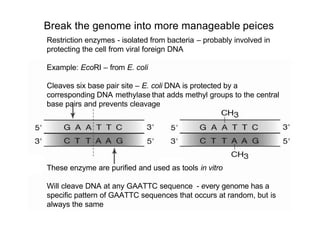
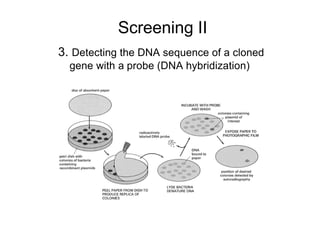
Restriction enzymes - isolated from bacteria – probably involved in
protecting the cell from viral foreign DNA
Example: EcoRI – from E. coli
Cleaves six base pair site – E. coli DNA is protected by a
corresponding DNA methylase that adds methyl groups to the central
base pairs and prevents cleavage
These enzyme are purified and used as tools in vitro
Will cleave DNA at any GAATTC sequence - every genome has a
specific pattern of GAATTC sequences that occurs at random, but is
always the same
Break the genome into more manageable peices
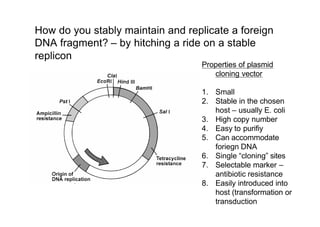
Properties of plasmid
cloning vector
1. Small
2. Stable in the chosen
host – usually E. coli
3. High copy number
4. Easy to purifiy
5. Can accommodate
foriegn DNA
6. Single “cloning” sites
7. Selectable marker –
antibiotic resistance
8. Easily introduced into
host (transformation or
transduction
How do you stably maintain and replicate a foreign
DNA fragment? – by hitching a ride on a stable
replicon
α−complementation
LacZ+ - blue colony
LacZ- - while colony
-of you interrupt the lacZ
gene, the colony is white
α−complementation – relies on modular structure of β-
galactosidase
- basic idea is often used with cloning vectors – called insertional inactivation
Brock Biology of
Microorganisms,
vol. 9, Chapter 10
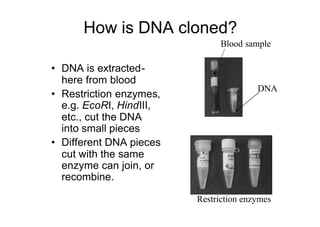
How is DNA cloned?
• DNA is extracted-
here from blood
• Restriction enzymes,
e.g. EcoRI, HindIII,
etc., cut the DNA
into small pieces
• Different DNA pieces
cut with the same
enzyme can join, or
recombine.
Blood sample
DNA
Restriction enzymes
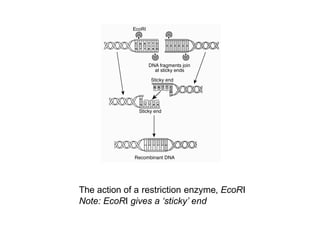
The action of a restriction enzyme, EcoRI
Note: EcoRI gives a ‘sticky’ end
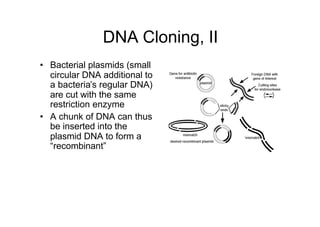
DNA Cloning, II
• Bacterial plasmids (small
circular DNA additional to
a bacteria’s regular DNA)
are cut with the same
restriction enzyme
• A chunk of DNA can thus
be inserted into the
plasmid DNA to form a
“recombinant”
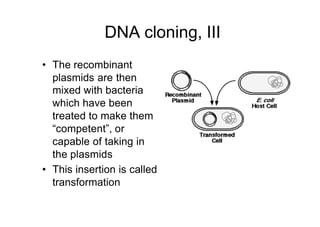
DNA cloning, III
• The recombinant
plasmids are then
mixed with bacteria
which have been
treated to make them
“competent”, or
capable of taking in
the plasmids
• This insertion is called
transformation
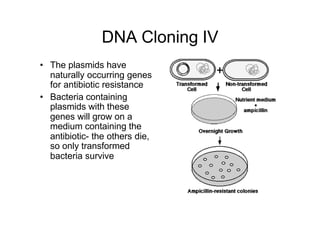
DNA Cloning IV
• The plasmids have
naturally occurring genes
for antibiotic resistance
• Bacteria containing
plasmids with these
genes will grow on a
medium containing the
antibiotic- the others die,
so only transformed
bacteria survive
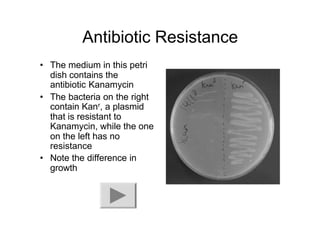
Antibiotic Resistance
• The medium in this petri
dish contains the
antibiotic Kanamycin
• The bacteria on the right
contain Kanr, a plasmid
that is resistant to
Kanamycin, while the one
on the left has no
resistance
• Note the difference in
growth
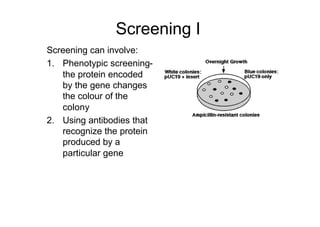
Screening I
Screening can involve:
1. Phenotypic screening-
the protein encoded
by the gene changes
the colour of the
colony
2. Using antibodies that
recognize the protein
produced by a
particular gene
Screening II
3. Detecting the DNA sequence of a cloned
gene with a probe (DNA hybridization)
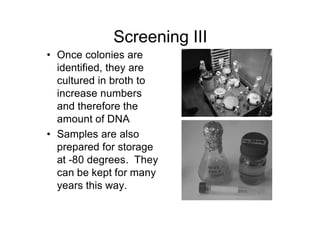
Screening III
• Once colonies are
identified, they are
cultured in broth to
increase numbers
and therefore the
amount of DNA
• Samples are also
prepared for storage
at -80 degrees. They
can be kept for many
years this way.
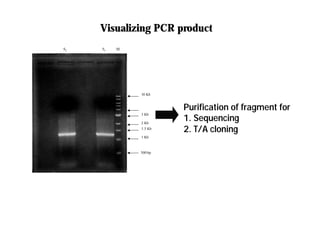
500 bp
1 Kb
1.5 Kb
2 Kb
3 Kb
10 Kb
M
S1
S2
Purification of fragment for
1. Sequencing
1. Sequencing
2. T/A cloning
2. T/A cloning
Visualizing PCR product
NY-lipA 1 MGSSIIIIITAAAWCRGHHMMKGCR-VMFVLLGLWLVFGLSVPGGRAEAATSRANDAPIVLLHGFTGWGREEMFGFKYWG 79
B. stearothermophilus1 1 -------------------MMKGCR-VMVVLLGLCFVFGLSVPGGRTEAASLRANDAPIVLLHGFTGWGREEMFGFKYWG 60
B. stearothermophilus2 1 -------------------MMKGCR-VMVVLLGLWFVFGLSVPGGRTEAASPRANDAPIVLLHGFTGWGREEMLGFKYWG 60
B. thermoleovorans 1 --------------------MKCCR-VMFVLLGLWLVFGLSVSGGRAEAAASRANDAPIVLLHGFTGWGREEMFGFKYWG 59
B. thermocatenulatus 1 -------------------MMKGCR-VMVVLLGLWFVFGLSVPGGRTEAASPRANDAPIVLLHGFTGWGREEMLGFKYWG 60
Bacillus sp. TP10A.1 1 -------------------MMKCCRRVALVLLGLWLVFCLSVPGGRAEAAASRANDAPIVLLHGFTGWGREEMFGFKYWG 61
NY-lipA 80 GVRGDIEQWLNDNGYRTYTLAVGPLSSNWDRACEAYAQLVGGTVDYGAAHAAKHGHARFGRTYPGLLPELKRGGRIHIIA 159
B. stearothermophilus1 61 GVRGDIEQWLNDNGYRTYTLAVGPLSSNWDRACEAYAQLVGGTVDYGAAHAAKHGHARFGRTYPGLLPELKRGGRIHIIA 140
B. stearothermophilus2 61 GVRGDIEQWLNDNGYRTYTLAVGPLSSNWDRACEAYAQLVGGTVDYGAAHAANDGHARFGRTYPGLLPELKRGGRVHIIA 140
B. thermoleovorans 60 GVRGDIEQWLNDNGYRTYTLAVGPLSSNWDRACEAYAQLVGGTVDYGAAHAAKHGHARFGRTYPGLLPELKRGGRIHIIA 139
B. thermocatenulatus 61 GVRGDIEQWLNDNGYRTYTLAVGPLSSNWDRACEAYAQLVGGTVDYGAAHAAKHGHARFGRTYPGLLPELKRGGRVHIIA 140
Bacillus sp. TP10A.1 62 GVRGDIEQLLNAQGYRTYTLAVGPLSSNWDRACEAYAQLVGGTVDYGAAHAAKHGHARFGRTYPGLLPELKRGGRVHIIA 141
NY-lipA 160 HSQGGQTARMLVSLLENGSQEEREYAKAHNVSLSPLFEGGHHFVLSVTTIATPHDGTTLVNMVDFTDRFFDLQKAVLEAA 239
B. stearothermophilus1 141 HSQGGQTARMLVSLLENGSQEEREYAKAHNVSLSPLFEGGHHFVLSVTTIATPHDGTTLVNMVDFTDRFFDLQKAVLEAA 220
B. stearothermophilus2 141 HSQGGQTARMLVSLLENGSQEEREYAKEHNVSLSPLFEGGHRFVLSVTTIATPHDGTTLVNMVDFTDRFFDLQKAVLEAA 220
B. thermoleovorans 140 HSQGGQTARMLVSLLENGSQEEREYAKAHNVSLSPLFEGGHHFVLSVTTIATPHDGTTLVNMVDFTDRFFDLQKAVLEAA 219
B. thermocatenulatus 141 HSQGGQTARMLVSLLENGSQEEREYAKAHNVSLSPLFEGGHHFVLSVTTIATPHDGTTLVNMVDFTDRFFDLQKAVLKAA 220
Bacillus sp. TP10A.1 142 HSQGGQTARMLVSLLENGSKEEREYAKAHNVSLSPLFEGGHNFVLSVTTIATPHDGTTLVNMVDFTDRFFDLQKAVLKAA 221
NY-lipA 240 AVASNAPYTSEIYDFKLDQWGLRREPGESFDHYFERLKRSPVWTSTDTARYDLSVPGAETLNRWVKASPNTYYLSFSTER 319
B. stearothermophilus1 221 AVASNVPYTSQVYDFKLDQWGLRRQPGESFDHYFERLKRSPVWTSTDTARYDLSVSGAEKLNQWVQASPNTYYLSFSTER 300
B. stearothermophilus2 221 AVASNAPYTSEIYDFKLDQWGLRREPGESFDHYFERLKRSPVWTSTDTARYDLSVPGAETLNRWVKASPNTYYLSFSTER 300
B. thermoleovorans 220 AVASNVPYTSQVYDFKLDQWGLRRQPGESFDHYFERLKRSPVWTSTDTARYDLSVSGAEKLNQWVQASPNTYYLSFATER 299
B. thermocatenulatus 221 AVASNVPYTSQVYDFKLDQWGLRRQPGESFDHYFERLKRSPVWTSTDTARYDLSIPGAEKLNQWVQASPNTYYLSFSTER 300
Bacillus sp. TP10A.1 222 AVASNVPYTSQVYDFKLDQWGLRRQPGESFDQYFERLKQSPVWTSADTARYDLSVPGAEALNQWVQASPNTYYLSFATER 301
NY-lipA 320 TYRGALTGNYYPELGMNAFSAIVCAPFLGSYRNAALGIDSHWLENDGIVNTISMNGPKRGSSDRIVPYDGALKKGVWNDM 399
B. stearothermophilus1 301 TYRGALTGNHYPELGMNAFSAVVCAPFLGSYRNPTLGIDSHWLENDGIVNTISMNGPKRGSNDRIVPYDGTLKKGVWNDM 380
B. stearothermophilus2 301 TYRGALTGNYYPELGMNAFSAIVCAPFLGSYRNAALGIDSHWLGNDGIVNTISMNGPKRGSNDRIVPYDGTLKKGVWNDM 380
B. thermoleovorans 300 TYRGALTGNYYPELGMNAFSAVVCAPFLGSYRNPTLGIDDRWLENDGIVNTVSMNGPKRGSSDRIVPYDGALKKGVWNDM 379
B. thermocatenulatus 301 THRGALTGNYYPELGMNAFSAVVCAPFLGSYRNEALGIDDRWLENDGIVNTVSMNGPKRGSSDRIVPYDGTLKKGVWNDM 380
Bacillus sp. TP10A.1 302 TYRGALTGNYYPELGMNVFSAAVCAPFLGSYRNAALGIDDRWLENDGIVNTFSMNGPKRGSTDRIVPYDGTLKKGVWNDM 381
NY-lipA 400 GTYNVDHLEIIGVDPNPSFDIRAFYLRLAEQLASFGP 436
B. stearothermophilus1 381 GTYNVDHLEIIGVDPNPSFDIRAFYLRLAEQLASLQP 417
B. stearothermophilus2 381 GTYKVDHLEVIGVDPNPSFNIRAFYLRLAEQLASLRP 417
B. thermoleovorans 380 GTYNVDHLEIIGVDPNPSFDIRAFYLRLAEQLASLRP 416
B. thermocatenulatus 381 GTCNVDHLEVIGVDPNPSFDIRAFYLRLAEQLASLRP 417
Bacillus sp. TP10A.1 382 GTYNVDHLEVIGVDPNPLFDIHAFYLRLAEQLASLRP 418
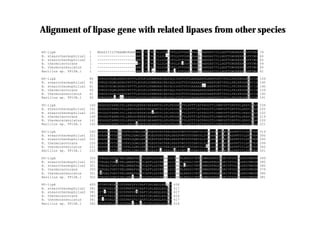
Alignment of lipase gene with related lipases from other species
Cloning into expression vector
Cloning into expression vector pET
pET 15b
15b
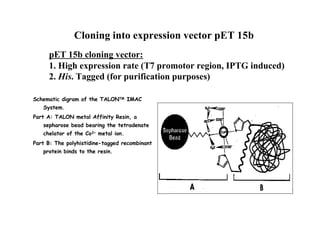
pET 15b cloning vector:
1. High expression rate (T7 promotor region, IPTG induced)
2. His. Tagged (for purification purposes)
Schematic digram of the TALON
Schematic digram of the TALONTM
TM IMAC
IMAC
System.
System.
Part A: TALON metal Affinity Resin, a
sepharose bead bearing the tetradenate
chelator of the Co
chelator of the Co2+
2+ metal ion.
metal ion.
Part B: The polyhistidine
Part B: The polyhistidine-
-tagged recombinant
tagged recombinant
protein binds to the resin.
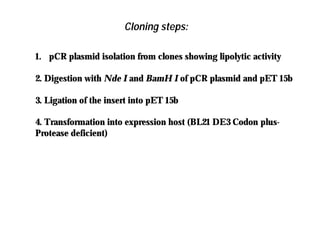
1.
1. pCR
pCR plasmid isolation from clones showing
plasmid isolation from clones showing lipolytic
lipolytic activity
activity
2. Digestion with
2. Digestion with Nde
Nde I
I and
and BamH
BamH I
I of
of pCR
pCR plasmid and
plasmid and pET
pET 15b
15b
3.
3. Ligation
Ligation of the insert into
of the insert into pET
pET 15b
15b
4. Transformation into expression host (BL21 DE3
4. Transformation into expression host (BL21 DE3 Codon
Codon plus
plus-
-
Protease deficient)
Protease deficient)
Cloning steps:
Cloning steps:
Expression of the Lipase Encoded by
ORF1
ORF1
kD M 1 2 3 4 1 2 3 4
In its native form: [using ORF1]
97
66
45
31
22
14
97
66
45
31
22
14
kD M 1 2 3 4 1 2 3 4
F Expression was
observed in all
fractions:
supernatant,
periplasm, soluble
cytoplasm and
insoluble
cytoplasm.
Characterization of the Lipase:
Effect of T and pH on the Activity
0
20
40
60
80
100
120
30 40 50 60 70 80 90 100 110
Temperature °C
Residual
activity
[%]
Optimum
temperature
Thermostability
(A)
0
20
40
60
80
100
120
5 6 7 8 9 10 11
pH
Residual
activity
[%]
(A)
PNP-palmitate, 60°C
PNP-palmitate, T 60°C, pH 7.5
PNP-palmitate, 60°C,pH 7.5
0
50
100
150
0 20 40 60 80 100 120
Time (min)
Relative
activity
[%]
pH 5.0
pH 10.5
(B)
0
20
40
60
80
100
120
0 10 20 30 40 50 60 70
Time (min)
Residual
activity
[%]
70 °C
(B)
PNP-palmitate, 60°C, pH 9.5
PNP-palmitate, pH 7.5 PNP-palmitate, T 60°C
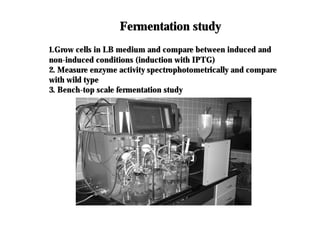
1.Grow cells in LB medium and compare between induced and
non
non-
-induced conditions (induction with IPTG)
induced conditions (induction with IPTG)
2. Measure enzyme activity
2. Measure enzyme activity spectrophotometrically
spectrophotometrically and compare
and compare
with wild type
with wild type
3. Bench
3. Bench-
-top scale fermentation study
top scale fermentation study
Fermentation study
Fermentation study
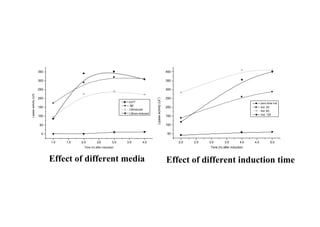
1.0 1.5 2.0 2.5 3.0 3.5 4.0
0
50
100
150
200
250
300
350
2xYT
SB
LBinduced
LBnon-induced
Lipase
activity
(U/l)
Time (h) after induction
Effect of different media
2.0 2.5 3.0 3.5 4.0 4.5 5.0
50
100
150
200
250
300
350
400
zero time Ind
Ind.30
Ind.60
Ind. 120
Lipase
activity
(Ul
-1
)
Time (h) after induction
Effect of different induction time

dna cloning.pdf

  • 2.
    All genes aremade of the same molecule that is chemically quite homogeneous (DNA – all As,Cs, Gs and Ts) There is a huge amount of genetic material E. coli >1000 genes (4,600,000 bp) Humans – perhaps 100,000 genes Single genes only make a tiny fraction of the whole genome In E. coli, each gene is app. 0.05 % of the genome In humans, each gene is app. .000005% of the genome Finding a gene is not like like looking for a needle in a haystack, it is more like looking for one particular piece of hay in a haystack! In this case all the hay looks the same, and you can only tell the difference by analyzing the chemistry of each piece! What’s the trouble with isolating a gene?
  • 3.
    Restriction enzymes -isolated from bacteria – probably involved in protecting the cell from viral foreign DNA Example: EcoRI – from E. coli Cleaves six base pair site – E. coli DNA is protected by a corresponding DNA methylase that adds methyl groups to the central base pairs and prevents cleavage These enzyme are purified and used as tools in vitro Will cleave DNA at any GAATTC sequence - every genome has a specific pattern of GAATTC sequences that occurs at random, but is always the same Break the genome into more manageable peices
  • 4.
    Properties of plasmid cloningvector 1. Small 2. Stable in the chosen host – usually E. coli 3. High copy number 4. Easy to purifiy 5. Can accommodate foriegn DNA 6. Single “cloning” sites 7. Selectable marker – antibiotic resistance 8. Easily introduced into host (transformation or transduction How do you stably maintain and replicate a foreign DNA fragment? – by hitching a ride on a stable replicon
  • 5.
    α−complementation LacZ+ - bluecolony LacZ- - while colony -of you interrupt the lacZ gene, the colony is white α−complementation – relies on modular structure of β- galactosidase - basic idea is often used with cloning vectors – called insertional inactivation Brock Biology of Microorganisms, vol. 9, Chapter 10
  • 6.
    How is DNAcloned? • DNA is extracted- here from blood • Restriction enzymes, e.g. EcoRI, HindIII, etc., cut the DNA into small pieces • Different DNA pieces cut with the same enzyme can join, or recombine. Blood sample DNA Restriction enzymes
  • 7.
    The action ofa restriction enzyme, EcoRI Note: EcoRI gives a ‘sticky’ end
  • 8.
    DNA Cloning, II •Bacterial plasmids (small circular DNA additional to a bacteria’s regular DNA) are cut with the same restriction enzyme • A chunk of DNA can thus be inserted into the plasmid DNA to form a “recombinant”
  • 9.
    DNA cloning, III •The recombinant plasmids are then mixed with bacteria which have been treated to make them “competent”, or capable of taking in the plasmids • This insertion is called transformation
  • 10.
    DNA Cloning IV •The plasmids have naturally occurring genes for antibiotic resistance • Bacteria containing plasmids with these genes will grow on a medium containing the antibiotic- the others die, so only transformed bacteria survive
  • 11.
    Antibiotic Resistance • Themedium in this petri dish contains the antibiotic Kanamycin • The bacteria on the right contain Kanr, a plasmid that is resistant to Kanamycin, while the one on the left has no resistance • Note the difference in growth
  • 12.
    Screening I Screening caninvolve: 1. Phenotypic screening- the protein encoded by the gene changes the colour of the colony 2. Using antibodies that recognize the protein produced by a particular gene
  • 13.
    Screening II 3. Detectingthe DNA sequence of a cloned gene with a probe (DNA hybridization)
  • 14.
    Screening III • Oncecolonies are identified, they are cultured in broth to increase numbers and therefore the amount of DNA • Samples are also prepared for storage at -80 degrees. They can be kept for many years this way.
  • 15.
    500 bp 1 Kb 1.5Kb 2 Kb 3 Kb 10 Kb M S1 S2 Purification of fragment for Purification of fragment for 1. Sequencing 1. Sequencing 2. T/A cloning 2. T/A cloning Visualizing PCR product Visualizing PCR product
  • 16.
    NY-lipA 1 MGSSIIIIITAAAWCRGHHMMKGCR-VMFVLLGLWLVFGLSVPGGRAEAATSRANDAPIVLLHGFTGWGREEMFGFKYWG79 B. stearothermophilus1 1 -------------------MMKGCR-VMVVLLGLCFVFGLSVPGGRTEAASLRANDAPIVLLHGFTGWGREEMFGFKYWG 60 B. stearothermophilus2 1 -------------------MMKGCR-VMVVLLGLWFVFGLSVPGGRTEAASPRANDAPIVLLHGFTGWGREEMLGFKYWG 60 B. thermoleovorans 1 --------------------MKCCR-VMFVLLGLWLVFGLSVSGGRAEAAASRANDAPIVLLHGFTGWGREEMFGFKYWG 59 B. thermocatenulatus 1 -------------------MMKGCR-VMVVLLGLWFVFGLSVPGGRTEAASPRANDAPIVLLHGFTGWGREEMLGFKYWG 60 Bacillus sp. TP10A.1 1 -------------------MMKCCRRVALVLLGLWLVFCLSVPGGRAEAAASRANDAPIVLLHGFTGWGREEMFGFKYWG 61 NY-lipA 80 GVRGDIEQWLNDNGYRTYTLAVGPLSSNWDRACEAYAQLVGGTVDYGAAHAAKHGHARFGRTYPGLLPELKRGGRIHIIA 159 B. stearothermophilus1 61 GVRGDIEQWLNDNGYRTYTLAVGPLSSNWDRACEAYAQLVGGTVDYGAAHAAKHGHARFGRTYPGLLPELKRGGRIHIIA 140 B. stearothermophilus2 61 GVRGDIEQWLNDNGYRTYTLAVGPLSSNWDRACEAYAQLVGGTVDYGAAHAANDGHARFGRTYPGLLPELKRGGRVHIIA 140 B. thermoleovorans 60 GVRGDIEQWLNDNGYRTYTLAVGPLSSNWDRACEAYAQLVGGTVDYGAAHAAKHGHARFGRTYPGLLPELKRGGRIHIIA 139 B. thermocatenulatus 61 GVRGDIEQWLNDNGYRTYTLAVGPLSSNWDRACEAYAQLVGGTVDYGAAHAAKHGHARFGRTYPGLLPELKRGGRVHIIA 140 Bacillus sp. TP10A.1 62 GVRGDIEQLLNAQGYRTYTLAVGPLSSNWDRACEAYAQLVGGTVDYGAAHAAKHGHARFGRTYPGLLPELKRGGRVHIIA 141 NY-lipA 160 HSQGGQTARMLVSLLENGSQEEREYAKAHNVSLSPLFEGGHHFVLSVTTIATPHDGTTLVNMVDFTDRFFDLQKAVLEAA 239 B. stearothermophilus1 141 HSQGGQTARMLVSLLENGSQEEREYAKAHNVSLSPLFEGGHHFVLSVTTIATPHDGTTLVNMVDFTDRFFDLQKAVLEAA 220 B. stearothermophilus2 141 HSQGGQTARMLVSLLENGSQEEREYAKEHNVSLSPLFEGGHRFVLSVTTIATPHDGTTLVNMVDFTDRFFDLQKAVLEAA 220 B. thermoleovorans 140 HSQGGQTARMLVSLLENGSQEEREYAKAHNVSLSPLFEGGHHFVLSVTTIATPHDGTTLVNMVDFTDRFFDLQKAVLEAA 219 B. thermocatenulatus 141 HSQGGQTARMLVSLLENGSQEEREYAKAHNVSLSPLFEGGHHFVLSVTTIATPHDGTTLVNMVDFTDRFFDLQKAVLKAA 220 Bacillus sp. TP10A.1 142 HSQGGQTARMLVSLLENGSKEEREYAKAHNVSLSPLFEGGHNFVLSVTTIATPHDGTTLVNMVDFTDRFFDLQKAVLKAA 221 NY-lipA 240 AVASNAPYTSEIYDFKLDQWGLRREPGESFDHYFERLKRSPVWTSTDTARYDLSVPGAETLNRWVKASPNTYYLSFSTER 319 B. stearothermophilus1 221 AVASNVPYTSQVYDFKLDQWGLRRQPGESFDHYFERLKRSPVWTSTDTARYDLSVSGAEKLNQWVQASPNTYYLSFSTER 300 B. stearothermophilus2 221 AVASNAPYTSEIYDFKLDQWGLRREPGESFDHYFERLKRSPVWTSTDTARYDLSVPGAETLNRWVKASPNTYYLSFSTER 300 B. thermoleovorans 220 AVASNVPYTSQVYDFKLDQWGLRRQPGESFDHYFERLKRSPVWTSTDTARYDLSVSGAEKLNQWVQASPNTYYLSFATER 299 B. thermocatenulatus 221 AVASNVPYTSQVYDFKLDQWGLRRQPGESFDHYFERLKRSPVWTSTDTARYDLSIPGAEKLNQWVQASPNTYYLSFSTER 300 Bacillus sp. TP10A.1 222 AVASNVPYTSQVYDFKLDQWGLRRQPGESFDQYFERLKQSPVWTSADTARYDLSVPGAEALNQWVQASPNTYYLSFATER 301 NY-lipA 320 TYRGALTGNYYPELGMNAFSAIVCAPFLGSYRNAALGIDSHWLENDGIVNTISMNGPKRGSSDRIVPYDGALKKGVWNDM 399 B. stearothermophilus1 301 TYRGALTGNHYPELGMNAFSAVVCAPFLGSYRNPTLGIDSHWLENDGIVNTISMNGPKRGSNDRIVPYDGTLKKGVWNDM 380 B. stearothermophilus2 301 TYRGALTGNYYPELGMNAFSAIVCAPFLGSYRNAALGIDSHWLGNDGIVNTISMNGPKRGSNDRIVPYDGTLKKGVWNDM 380 B. thermoleovorans 300 TYRGALTGNYYPELGMNAFSAVVCAPFLGSYRNPTLGIDDRWLENDGIVNTVSMNGPKRGSSDRIVPYDGALKKGVWNDM 379 B. thermocatenulatus 301 THRGALTGNYYPELGMNAFSAVVCAPFLGSYRNEALGIDDRWLENDGIVNTVSMNGPKRGSSDRIVPYDGTLKKGVWNDM 380 Bacillus sp. TP10A.1 302 TYRGALTGNYYPELGMNVFSAAVCAPFLGSYRNAALGIDDRWLENDGIVNTFSMNGPKRGSTDRIVPYDGTLKKGVWNDM 381 NY-lipA 400 GTYNVDHLEIIGVDPNPSFDIRAFYLRLAEQLASFGP 436 B. stearothermophilus1 381 GTYNVDHLEIIGVDPNPSFDIRAFYLRLAEQLASLQP 417 B. stearothermophilus2 381 GTYKVDHLEVIGVDPNPSFNIRAFYLRLAEQLASLRP 417 B. thermoleovorans 380 GTYNVDHLEIIGVDPNPSFDIRAFYLRLAEQLASLRP 416 B. thermocatenulatus 381 GTCNVDHLEVIGVDPNPSFDIRAFYLRLAEQLASLRP 417 Bacillus sp. TP10A.1 382 GTYNVDHLEVIGVDPNPLFDIHAFYLRLAEQLASLRP 418 Alignment of lipase gene with related lipases from other species Alignment of lipase gene with related lipases from other species
  • 17.
    Cloning into expressionvector Cloning into expression vector pET pET 15b 15b pET 15b cloning vector: 1. High expression rate (T7 promotor region, IPTG induced) 2. His. Tagged (for purification purposes) Schematic digram of the TALON Schematic digram of the TALONTM TM IMAC IMAC System. System. Part A: TALON metal Affinity Resin, a Part A: TALON metal Affinity Resin, a sepharose bead bearing the tetradenate sepharose bead bearing the tetradenate chelator of the Co chelator of the Co2+ 2+ metal ion. metal ion. Part B: The polyhistidine Part B: The polyhistidine- -tagged recombinant tagged recombinant protein binds to the resin. protein binds to the resin.
  • 18.
    1. 1. pCR pCR plasmidisolation from clones showing plasmid isolation from clones showing lipolytic lipolytic activity activity 2. Digestion with 2. Digestion with Nde Nde I I and and BamH BamH I I of of pCR pCR plasmid and plasmid and pET pET 15b 15b 3. 3. Ligation Ligation of the insert into of the insert into pET pET 15b 15b 4. Transformation into expression host (BL21 DE3 4. Transformation into expression host (BL21 DE3 Codon Codon plus plus- - Protease deficient) Protease deficient) Cloning steps: Cloning steps:
  • 19.
    Expression of theLipase Encoded by Expression of the Lipase Encoded by ORF1 ORF1 kD M 1 2 3 4 1 2 3 4 In its native form: [using ORF1] 97 66 45 31 22 14 97 66 45 31 22 14 kD M 1 2 3 4 1 2 3 4 F Expression was observed in all fractions: supernatant, periplasm, soluble cytoplasm and insoluble cytoplasm.
  • 20.
    Characterization of theLipase: Characterization of the Lipase: Effect of T and pH on the Activity Effect of T and pH on the Activity 0 20 40 60 80 100 120 30 40 50 60 70 80 90 100 110 Temperature °C Residual activity [%] Optimum temperature Thermostability (A) 0 20 40 60 80 100 120 5 6 7 8 9 10 11 pH Residual activity [%] (A) PNP-palmitate, 60°C PNP-palmitate, T 60°C, pH 7.5 PNP-palmitate, 60°C,pH 7.5 0 50 100 150 0 20 40 60 80 100 120 Time (min) Relative activity [%] pH 5.0 pH 10.5 (B) 0 20 40 60 80 100 120 0 10 20 30 40 50 60 70 Time (min) Residual activity [%] 70 °C (B) PNP-palmitate, 60°C, pH 9.5 PNP-palmitate, pH 7.5 PNP-palmitate, T 60°C
  • 21.
    1.Grow cells inLB medium and compare between induced and 1.Grow cells in LB medium and compare between induced and non non- -induced conditions (induction with IPTG) induced conditions (induction with IPTG) 2. Measure enzyme activity 2. Measure enzyme activity spectrophotometrically spectrophotometrically and compare and compare with wild type with wild type 3. Bench 3. Bench- -top scale fermentation study top scale fermentation study Fermentation study Fermentation study
  • 22.
    1.0 1.5 2.02.5 3.0 3.5 4.0 0 50 100 150 200 250 300 350 2xYT SB LBinduced LBnon-induced Lipase activity (U/l) Time (h) after induction Effect of different media Effect of different media 2.0 2.5 3.0 3.5 4.0 4.5 5.0 50 100 150 200 250 300 350 400 zero time Ind Ind.30 Ind.60 Ind. 120 Lipase activity (Ul -1 ) Time (h) after induction Effect of different induction time Effect of different induction time