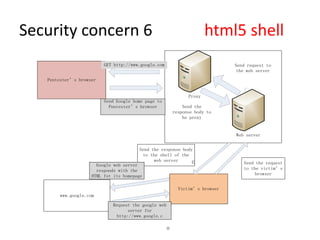
HTML5 introduces new security risks due to features like client-side storage, geolocation, web sockets, and cross-origin resource sharing. Attackers could exploit these to launch cross-site scripting attacks, SQL injection, poison application caches, perform clickjacking, and more. While HTML5 aims to improve security with features like sandboxing, current implementations remain vulnerable. As HTML5 adds functionality, more security issues are likely to emerge that require ongoing investigation and remediation.






![Reference
[1]HTML5 Security CheatSheet ‐ http://code.google.com/p/html5security/
[2]Shell of the Future ‐ http://www.andlabs.org/tools.html#sotf
[3] Next Generation Clickjacking ‐
http://www.contextis.co.uk/resources/white‐papers/clickjacking/Context‐Clic
kjacking_white_paper.pdf
[4]OWASP ClickJacking Guide ‐ http://www.owasp.org/index.php/Clickjacking
[5]http://html5sec.org/
[6]Hacking Facebook with HTML5 ‐ http://m‐austin.com/blog/?p=19
[7]http://html5demos.com
[8] https://www.owasp.org/index.php/Clickjacking
[9] http://www.andlabs.org/](https://image.slidesharecdn.com/html5security-120704010032-phpapp02/85/Html5-security-26-320.jpg)


