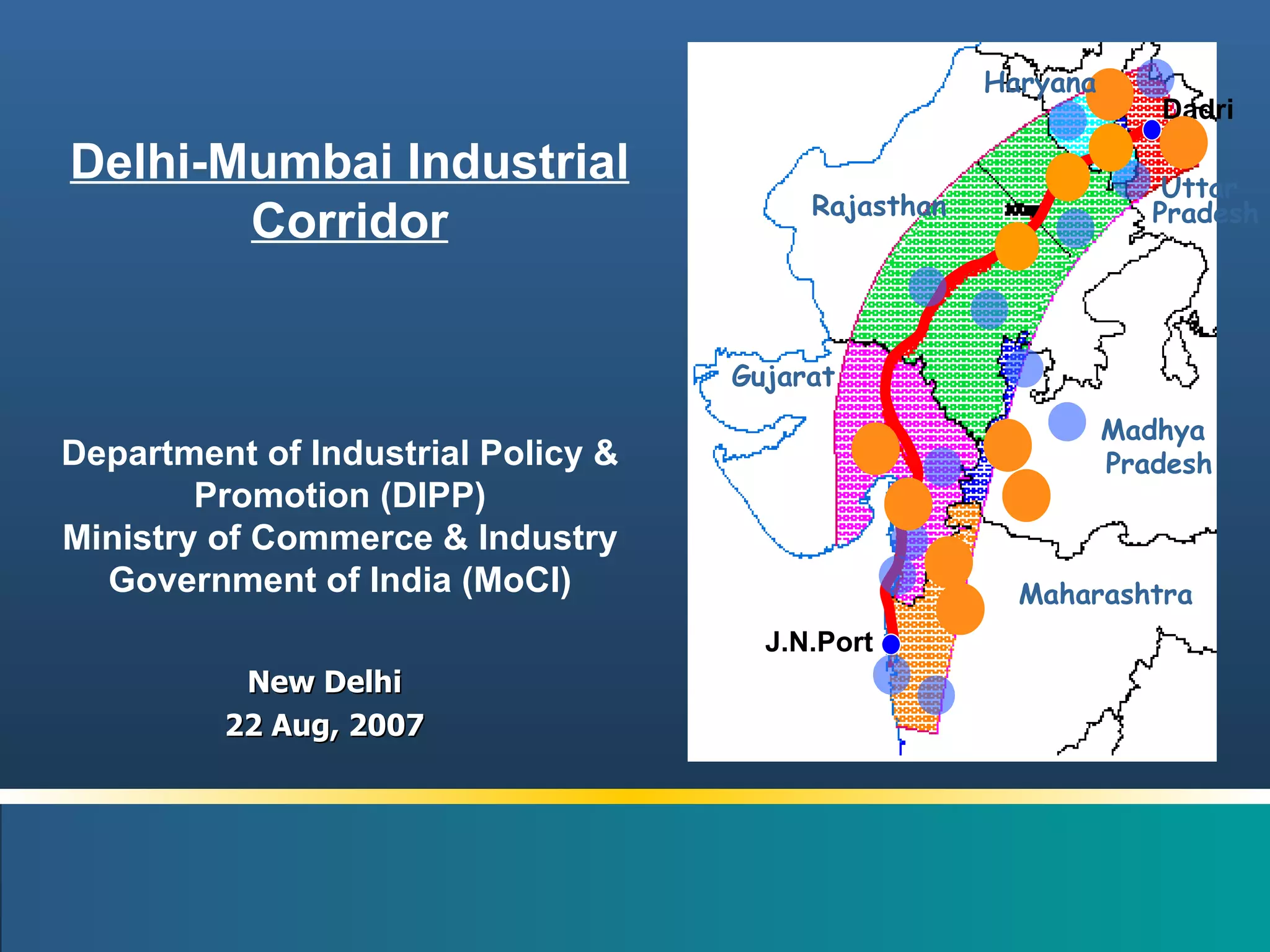

New Delhi 22 Aug, 2007 Department of Industrial Policy & Promotion (DIPP) Ministry of Commerce & Industry Government of India (MoCI) Delhi-Mumbai Industrial Corridor Haryana Dadri J.N.Port Rajasthan Maharashtra Gujarat Madhya  Pradesh Haryana Uttar  Pradesh
Government of India initiated the development of DMIC along the Dedicated Freight Corridor (DFC) to optimize on the connectivity offered MOU relating to the project was signed between MoCI and METI, Japan in December, 2006 to create the framework for mutual cooperation At the instance of the MoCI, an Inter-Ministerial Group was formed to evolve the Project Outline : MoCI appointed IL&FS Infrastructure Development Corporation in March, 2007 to detail the project concept Pursuant to discussions with Central & State Government agencies, IL&FS have since submitted their Report First Taskforce Meeting held at Tokyo on 25th May, 2007 Second Task Force Meeting held at New Delhi on July 02, 2007 Third and Final Task Force Meeting held at Tokyo on July 23, 2007 to finalize the Concept Paper Overview
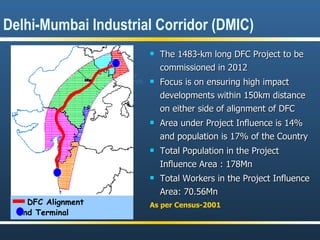
Delhi-Mumbai Industrial Corridor (DMIC)  The 1483-km long DFC Project to be commissioned in 2012 Focus is on ensuring high impact developments within 150km distance on either side of alignment of DFC  Area under Project Influence is 14% and population is 17% of the Country Total Population in the Project Influence Area : 178Mn Total Workers in the Project Influence Area: 70.56Mn   As per Census-2001 DFC Alignment End Terminal Haryana Dadri J.N.Port Rajasthan Maharashtra Gujarat Madhya  Pradesh Haryana Uttar  Pradesh
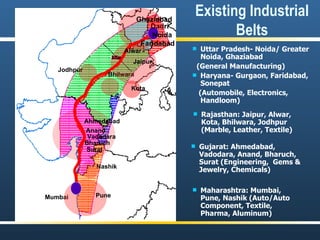
Existing Industrial Belts Uttar Pradesh- Noida/ Greater Noida, Ghaziabad (General Manufacturing) Haryana- Gurgaon, Faridabad, Sonepat (Automobile, Electronics, Handloom) Dadri Noida Ghaziabad Faridabad Gujarat: Ahmedabad, Vadodara, Anand, Bharuch, Surat (Engineering,  Gems & Jewelry, Chemicals) Ahmedabad Vadodara Bharuch Surat Anand Bhilwara Jodhpur Kota Rajasthan: Jaipur, Alwar, Kota, Bhilwara, Jodhpur (Marble, Leather, Textile) Jaipur Alwar Maharashtra: Mumbai, Pune, Nashik (Auto/Auto Component, Textile, Pharma, Aluminum) Nashik Mumbai Pune
“ To create strong economic base with globally competitive environment and state-of-the-art infrastructure to activate local commerce, enhance foreign investments and attain sustainable development” Delhi-Mumbai Industrial Corridor is conceived to be developed as “Global Manufacturing and Trading Hub” supported by world class infrastructure and enabling policy framework Project Goals Double employment potential in five years (14.87% CAGR) Triple industrial output in five years (24.57% CAGR)  Quadruple exports from the region in five years (31.95% CAGR) Vision for DMIC
Industrial Infrastructure Developing new industrial clusters  Upgradation of existing industrial estates/clusters in the corridor Developing Modern Integrated Agro-Processing Zones with allied infrastructure Development of  IT/ITeS Hubs and other allied infrastructure Providing efficient logistics chain with multi-modal logistic hubs Physical Infrastructure Development of ‘Knowledge Hubs’ with integrated approach Feeder Road/Rail connectivity to ports, hinterlands and markets;  Development of existing Port infrastructure and Greenfield Ports;  Upgradation/ Modernization of Airports; Setting up Power Generation Plants with transmission facilities; Ensuring effective environment protection mechanism  Development of integrated townships Project Objectives
Infrastructure development- key to DMIC instead of additional fiscal or financial incentives Units coming up would have the advantage of improved infrastructure A Regional development approach instead of isolated pockets Brownfield areas rather than greenfield in Phase-1 to ensure better cost effectiveness Make development more harmonious by emphasizing local skill and agri development  Approach to Development of DMIC
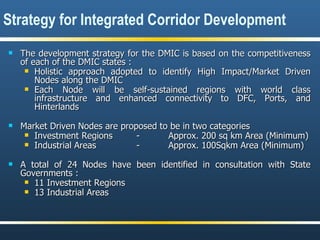
The development strategy for the DMIC is based on the competitiveness of each of the DMIC states : Holistic approach adopted to identify High Impact/Market Driven Nodes along the DMIC Each Node will be self-sustained regions with world class infrastructure and enhanced connectivity to DFC, Ports, and Hinterlands  Market Driven Nodes are proposed to be in two categories Investment Regions -  Approx. 200 sq km Area (Minimum) Industrial Areas -  Approx. 100Sqkm Area (Minimum) A total of 24 Nodes have been identified in consultation with State Governments : 11 Investment Regions 13 Industrial Areas Strategy for Integrated Corridor Development
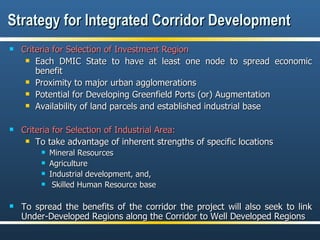
Strategy for Integrated Corridor Development Criteria for Selection of Investment Region Each DMIC State to have at least one node to spread economic benefit Proximity to major urban agglomerations  Potential for Developing Greenfield Ports (or) Augmentation Availability of land parcels and established industrial base Criteria for Selection of Industrial Area: To take advantage of inherent strengths of specific locations Mineral Resources Agriculture  Industrial development, and, Skilled Human Resource base To spread the benefits of the corridor the project will also seek to link Under-Developed Regions along the Corridor to Well Developed Regions
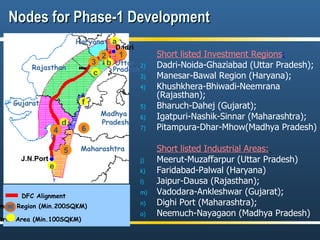
Nodes for Phase-1 Development Short listed Investment Regions :   Dadri-Noida-Ghaziabad (Uttar Pradesh); Manesar-Bawal Region (Haryana); Khushkhera-Bhiwadi-Neemrana (Rajasthan); Bharuch-Dahej (Gujarat); Igatpuri-Nashik-Sinnar (Maharashtra); Pitampura-Dhar-Mhow(Madhya Pradesh) Short listed Industrial Areas:   Meerut-Muzaffarpur (Uttar Pradesh) Faridabad-Palwal (Haryana) Jaipur-Dausa (Rajasthan); Vadodara-Ankleshwar (Gujarat); Dighi Port (Maharashtra); Neemuch-Nayagaon (Madhya Pradesh) DFC Alignment Investment Region (Min.200SQKM) Industrial Area (Min.100SQKM) Haryana Dadri J.N.Port 1 c d 5 4 Rajasthan Maharashtra Gujarat b e Madhya  Pradesh 3 2 a f 6 Haryana Uttar  Pradesh
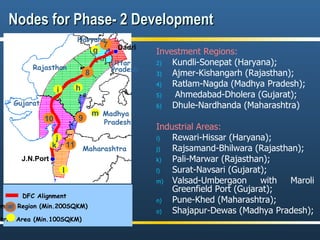
Nodes for Phase- 2 Development Investment Regions:  Kundli-Sonepat (Haryana); Ajmer-Kishangarh (Rajasthan); Ratlam-Nagda (Madhya Pradesh); Ahmedabad-Dholera (Gujarat); Dhule-Nardhanda (Maharashtra) Industrial Areas:   Rewari-Hissar (Haryana); Rajsamand-Bhilwara (Rajasthan);  Pali-Marwar (Rajasthan); Surat-Navsari (Gujarat); Valsad-Umbergaon with Maroli Greenfield Port (Gujarat); Pune-Khed (Maharashtra); Shajapur-Dewas (Madhya Pradesh); DFC Alignment Investment Region (Min.200SQKM) Industrial Area (Min.100SQKM) Haryana Dadri J.N.Port h l k 10 j 7 g i Rajasthan Maharashtra Gujarat Madhya  Pradesh 9 m Haryana Uttar  Pradesh 11 8
Components of Each Industrial Node Industrial Infrastructure New Industrial Clusters/ Parks/ SEZs Upgradation of existing industrial estates/clusters Modern Integrated Agro-Processing Zones with allied infrastructure IT/ITES Hubs and other allied infrastructure Efficient logistics chain with integrated multi-modal logistic hubs Physical Infrastructure Knowledge Cities / Skill Development Centers with integrated approach Augmentation of Existing Port infrastructure & Greenfield Port Development;  Upgradation/ Modernization of Airports; Power Generation Plants with transmission facilities; Feeder Road/Rail connectivity to ports, hinterlands and markets;  Dovetailed integrated townships catering to investor countries Effective Environment Protection Mechanism
Soft Infrastructure for DMIC Initiatives for Skill Enhancement Skill Development Centers/ Centers of Excellence planned through out the investment regions/ industrial areas Streamlined Administrative Procedures Each Node will contain one or more Special Economic Zones, which are empowered by the Act to provide necessary clearances themselves Each State Government will constitute an empowered authority for each of the investment region/ industrial area These authorities to have delegated powers, from State Government, to take decisions locally Policy Regime for DMIC Movement of Goods through roads is proposed to be facilitated without interruption by use of IT A Dialogue to be started with State Transport Ministers for a Unified Policy Regime for uninterrupted and low cost movement of material and efficient  Government of India has already announced Road Map for ‘Goods and Service Tax’ to adopt by 2010 which replaces central and state taxes into a unified tax regime
Key Issues in Project Implementation The complexity of implementing the DMIC will require rigorous detailing of all aspects of the project prior to implementation : Engineering Environmental  Social  Financial Contractual, etc The size of the project also emphasizes the need for implementation of project in phases. This will be critical in ensuring its sustainability  Given the involvement of multiple Ministries and multiple state governments an effective framework for co-ordination is critical The DMIC Project involves an investment of US$ 90 bn with 60-70 different projects. An a priori strategy for the mobilization of finances to cover each phase of the project will also be critical
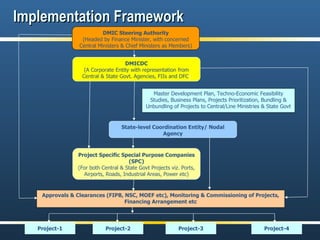
Four-Tier Implementation Structure An Apex Authority, Headed by the Finance Minister with concerned Central Ministers and Chief Ministers of respective DMIC States as Members; A Corporate Entity, referred as DMIC Development Corporation (DMICDC),  to coordinate Project Development, Finance and Implementation; A Program Management Consultant (Joint Consultant) will work under DMICDC for overall planning, monitoring and financial advisory services State-level Coordination Entity for coordination between DMICDC, various State Govt. Entities and Special Purpose Vehicles (SPVs); Project specific Special Purpose Vehicles (SPVs)  to implement individual project components viz. Industrial Areas/SEZs, Roads, Power, Ports, Airports etc
Implementation Framework DMIC Steering Authority (Headed by Finance Minister, with concerned Central Ministers & Chief Ministers as Members) DMICDC (A Corporate Entity with representation from Central & State Govt. Agencies, FIIs and DFC ) Master Development Plan, Techno-Economic Feasibility Studies, Business Plans, Projects Prioritization, Bundling & Unbundling of Projects to Central/Line Ministries & State Govt State-level Coordination Entity/ Nodal Agency Project Specific Special Purpose Companies (SPC) (For both Central & State Govt Projects viz. Ports, Airports, Roads, Industrial Areas, Power etc) Approvals & Clearances (FIPB, NSC, MOEF etc), Monitoring & Commissioning of Projects, Financing Arrangement etc Project-1 Project-2 Project-3 Project-4
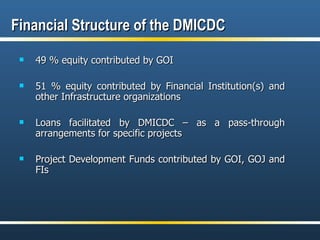
Financial Structure of the DMICDC 49 % equity contributed by GOI  51 % equity contributed by Financial Institution(s) and other Infrastructure organizations Loans facilitated by DMICDC – as a pass-through arrangements for specific projects Project Development Funds contributed by GOI, GOJ and FIs
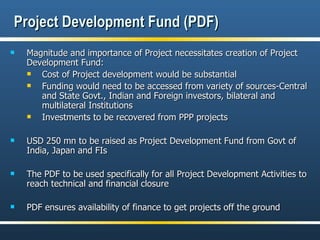
Project Development Fund (PDF) Magnitude and importance of Project necessitates creation of Project Development Fund: Cost of Project development would be substantial Funding would need to be accessed from variety of sources-Central and State Govt., Indian and Foreign investors, bilateral and multilateral Institutions Investments to be recovered from PPP projects USD 250 mn to be raised as Project Development Fund from Govt of India, Japan and FIs The PDF to be used specifically for all Project Development Activities to reach technical and financial closure PDF ensures availability of finance to get projects off the ground
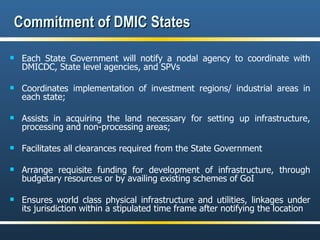
Commitment of DMIC States Each State Government will notify a nodal agency to coordinate with DMICDC, State level agencies, and SPVs Coordinates implementation of investment regions/ industrial areas in each state; Assists in acquiring the land necessary for setting up infrastructure, processing and non-processing areas; Facilitates all clearances required from the State Government Arrange requisite funding for development of infrastructure, through budgetary resources or by availing existing schemes of GoI Ensures world class physical infrastructure and utilities, linkages under its jurisdiction within a stipulated time frame after notifying the location
Project Specific SPVs Implementation of specific components of industrial nodes  Projects to be awarded to operators with all relevant clearances and through a transparent bidding process Project Operators to raise finances, implement and operate the project Independent Board of Directors for each SPV Debts to be raised domestically and externally Debts could also be raised by DMICDC and passed on to SPVs
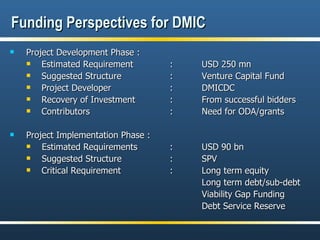
Funding Perspectives for DMIC Project Development Phase : Estimated Requirement : USD 250 mn Suggested Structure : Venture Capital Fund Project Developer : DMICDC Recovery of Investment : From successful bidders Contributors : Need for ODA/grants Project Implementation Phase : Estimated Requirements : USD 90 bn Suggested Structure : SPV Critical Requirement : Long term equity Long term debt/sub-debt Viability Gap Funding Debt Service Reserve
Opportunities in DMIC EPC/O&M Contracts Project promotion & equity participation in various implementing SPVs Providing long-term debt Industrial Investment (manufacturing & services)  Contribution to PDF on commercial basis
Summary-  Infrastructure   Development Initiatives in DMIC Development of 10,000MW Power Generation Capacity Development of Three Greenfield Ports  Dholera & Maroli in Gujarat, Dighi Port in Maharashtra; Augmentation of Two Ports (Dahej and Hazira) in Gujarat  Augmentation of Six/Seven Airports Greater Noida (Uttar Pradesh); Udaipur/ Jodhpur (Rajasthan); Indore (Madhya Pradesh); Vadodara and Surat (Gujarat); Nashik & Pune (Maharashtra); Air Strips at Dholera & Neemrana Construction/ Augmentation of 2500km long feeder rail linkages
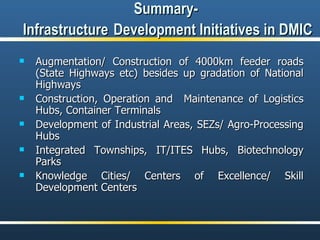
Summary-  Infrastructure   Development Initiatives in DMIC Augmentation/ Construction of 4000km feeder roads (State Highways etc) besides up gradation of National Highways  Construction, Operation and  Maintenance of Logistics Hubs, Container Terminals Development of Industrial Areas, SEZs/ Agro-Processing Hubs Integrated Townships, IT/ITES Hubs, Biotechnology Parks Knowledge Cities/ Centers of Excellence/ Skill Development Centers
Thank You

Dmic presentation

  • 1.
    New Delhi 22Aug, 2007 Department of Industrial Policy & Promotion (DIPP) Ministry of Commerce & Industry Government of India (MoCI) Delhi-Mumbai Industrial Corridor Haryana Dadri J.N.Port Rajasthan Maharashtra Gujarat Madhya Pradesh Haryana Uttar Pradesh
  • 2.
    Government of Indiainitiated the development of DMIC along the Dedicated Freight Corridor (DFC) to optimize on the connectivity offered MOU relating to the project was signed between MoCI and METI, Japan in December, 2006 to create the framework for mutual cooperation At the instance of the MoCI, an Inter-Ministerial Group was formed to evolve the Project Outline : MoCI appointed IL&FS Infrastructure Development Corporation in March, 2007 to detail the project concept Pursuant to discussions with Central & State Government agencies, IL&FS have since submitted their Report First Taskforce Meeting held at Tokyo on 25th May, 2007 Second Task Force Meeting held at New Delhi on July 02, 2007 Third and Final Task Force Meeting held at Tokyo on July 23, 2007 to finalize the Concept Paper Overview
  • 3.
    Delhi-Mumbai Industrial Corridor(DMIC) The 1483-km long DFC Project to be commissioned in 2012 Focus is on ensuring high impact developments within 150km distance on either side of alignment of DFC Area under Project Influence is 14% and population is 17% of the Country Total Population in the Project Influence Area : 178Mn Total Workers in the Project Influence Area: 70.56Mn As per Census-2001 DFC Alignment End Terminal Haryana Dadri J.N.Port Rajasthan Maharashtra Gujarat Madhya Pradesh Haryana Uttar Pradesh
  • 4.
    Existing Industrial BeltsUttar Pradesh- Noida/ Greater Noida, Ghaziabad (General Manufacturing) Haryana- Gurgaon, Faridabad, Sonepat (Automobile, Electronics, Handloom) Dadri Noida Ghaziabad Faridabad Gujarat: Ahmedabad, Vadodara, Anand, Bharuch, Surat (Engineering, Gems & Jewelry, Chemicals) Ahmedabad Vadodara Bharuch Surat Anand Bhilwara Jodhpur Kota Rajasthan: Jaipur, Alwar, Kota, Bhilwara, Jodhpur (Marble, Leather, Textile) Jaipur Alwar Maharashtra: Mumbai, Pune, Nashik (Auto/Auto Component, Textile, Pharma, Aluminum) Nashik Mumbai Pune
  • 5.
    “ To createstrong economic base with globally competitive environment and state-of-the-art infrastructure to activate local commerce, enhance foreign investments and attain sustainable development” Delhi-Mumbai Industrial Corridor is conceived to be developed as “Global Manufacturing and Trading Hub” supported by world class infrastructure and enabling policy framework Project Goals Double employment potential in five years (14.87% CAGR) Triple industrial output in five years (24.57% CAGR) Quadruple exports from the region in five years (31.95% CAGR) Vision for DMIC
  • 6.
    Industrial Infrastructure Developingnew industrial clusters Upgradation of existing industrial estates/clusters in the corridor Developing Modern Integrated Agro-Processing Zones with allied infrastructure Development of IT/ITeS Hubs and other allied infrastructure Providing efficient logistics chain with multi-modal logistic hubs Physical Infrastructure Development of ‘Knowledge Hubs’ with integrated approach Feeder Road/Rail connectivity to ports, hinterlands and markets; Development of existing Port infrastructure and Greenfield Ports; Upgradation/ Modernization of Airports; Setting up Power Generation Plants with transmission facilities; Ensuring effective environment protection mechanism Development of integrated townships Project Objectives
  • 7.
    Infrastructure development- keyto DMIC instead of additional fiscal or financial incentives Units coming up would have the advantage of improved infrastructure A Regional development approach instead of isolated pockets Brownfield areas rather than greenfield in Phase-1 to ensure better cost effectiveness Make development more harmonious by emphasizing local skill and agri development Approach to Development of DMIC
  • 8.
    The development strategyfor the DMIC is based on the competitiveness of each of the DMIC states : Holistic approach adopted to identify High Impact/Market Driven Nodes along the DMIC Each Node will be self-sustained regions with world class infrastructure and enhanced connectivity to DFC, Ports, and Hinterlands Market Driven Nodes are proposed to be in two categories Investment Regions - Approx. 200 sq km Area (Minimum) Industrial Areas - Approx. 100Sqkm Area (Minimum) A total of 24 Nodes have been identified in consultation with State Governments : 11 Investment Regions 13 Industrial Areas Strategy for Integrated Corridor Development
  • 9.
    Strategy for IntegratedCorridor Development Criteria for Selection of Investment Region Each DMIC State to have at least one node to spread economic benefit Proximity to major urban agglomerations Potential for Developing Greenfield Ports (or) Augmentation Availability of land parcels and established industrial base Criteria for Selection of Industrial Area: To take advantage of inherent strengths of specific locations Mineral Resources Agriculture Industrial development, and, Skilled Human Resource base To spread the benefits of the corridor the project will also seek to link Under-Developed Regions along the Corridor to Well Developed Regions
  • 10.
    Nodes for Phase-1Development Short listed Investment Regions : Dadri-Noida-Ghaziabad (Uttar Pradesh); Manesar-Bawal Region (Haryana); Khushkhera-Bhiwadi-Neemrana (Rajasthan); Bharuch-Dahej (Gujarat); Igatpuri-Nashik-Sinnar (Maharashtra); Pitampura-Dhar-Mhow(Madhya Pradesh) Short listed Industrial Areas: Meerut-Muzaffarpur (Uttar Pradesh) Faridabad-Palwal (Haryana) Jaipur-Dausa (Rajasthan); Vadodara-Ankleshwar (Gujarat); Dighi Port (Maharashtra); Neemuch-Nayagaon (Madhya Pradesh) DFC Alignment Investment Region (Min.200SQKM) Industrial Area (Min.100SQKM) Haryana Dadri J.N.Port 1 c d 5 4 Rajasthan Maharashtra Gujarat b e Madhya Pradesh 3 2 a f 6 Haryana Uttar Pradesh
  • 11.
    Nodes for Phase-2 Development Investment Regions: Kundli-Sonepat (Haryana); Ajmer-Kishangarh (Rajasthan); Ratlam-Nagda (Madhya Pradesh); Ahmedabad-Dholera (Gujarat); Dhule-Nardhanda (Maharashtra) Industrial Areas: Rewari-Hissar (Haryana); Rajsamand-Bhilwara (Rajasthan); Pali-Marwar (Rajasthan); Surat-Navsari (Gujarat); Valsad-Umbergaon with Maroli Greenfield Port (Gujarat); Pune-Khed (Maharashtra); Shajapur-Dewas (Madhya Pradesh); DFC Alignment Investment Region (Min.200SQKM) Industrial Area (Min.100SQKM) Haryana Dadri J.N.Port h l k 10 j 7 g i Rajasthan Maharashtra Gujarat Madhya Pradesh 9 m Haryana Uttar Pradesh 11 8
  • 12.
    Components of EachIndustrial Node Industrial Infrastructure New Industrial Clusters/ Parks/ SEZs Upgradation of existing industrial estates/clusters Modern Integrated Agro-Processing Zones with allied infrastructure IT/ITES Hubs and other allied infrastructure Efficient logistics chain with integrated multi-modal logistic hubs Physical Infrastructure Knowledge Cities / Skill Development Centers with integrated approach Augmentation of Existing Port infrastructure & Greenfield Port Development; Upgradation/ Modernization of Airports; Power Generation Plants with transmission facilities; Feeder Road/Rail connectivity to ports, hinterlands and markets; Dovetailed integrated townships catering to investor countries Effective Environment Protection Mechanism
  • 13.
    Soft Infrastructure forDMIC Initiatives for Skill Enhancement Skill Development Centers/ Centers of Excellence planned through out the investment regions/ industrial areas Streamlined Administrative Procedures Each Node will contain one or more Special Economic Zones, which are empowered by the Act to provide necessary clearances themselves Each State Government will constitute an empowered authority for each of the investment region/ industrial area These authorities to have delegated powers, from State Government, to take decisions locally Policy Regime for DMIC Movement of Goods through roads is proposed to be facilitated without interruption by use of IT A Dialogue to be started with State Transport Ministers for a Unified Policy Regime for uninterrupted and low cost movement of material and efficient Government of India has already announced Road Map for ‘Goods and Service Tax’ to adopt by 2010 which replaces central and state taxes into a unified tax regime
  • 14.
    Key Issues inProject Implementation The complexity of implementing the DMIC will require rigorous detailing of all aspects of the project prior to implementation : Engineering Environmental Social Financial Contractual, etc The size of the project also emphasizes the need for implementation of project in phases. This will be critical in ensuring its sustainability Given the involvement of multiple Ministries and multiple state governments an effective framework for co-ordination is critical The DMIC Project involves an investment of US$ 90 bn with 60-70 different projects. An a priori strategy for the mobilization of finances to cover each phase of the project will also be critical
  • 15.
    Four-Tier Implementation StructureAn Apex Authority, Headed by the Finance Minister with concerned Central Ministers and Chief Ministers of respective DMIC States as Members; A Corporate Entity, referred as DMIC Development Corporation (DMICDC), to coordinate Project Development, Finance and Implementation; A Program Management Consultant (Joint Consultant) will work under DMICDC for overall planning, monitoring and financial advisory services State-level Coordination Entity for coordination between DMICDC, various State Govt. Entities and Special Purpose Vehicles (SPVs); Project specific Special Purpose Vehicles (SPVs) to implement individual project components viz. Industrial Areas/SEZs, Roads, Power, Ports, Airports etc
  • 16.
    Implementation Framework DMICSteering Authority (Headed by Finance Minister, with concerned Central Ministers & Chief Ministers as Members) DMICDC (A Corporate Entity with representation from Central & State Govt. Agencies, FIIs and DFC ) Master Development Plan, Techno-Economic Feasibility Studies, Business Plans, Projects Prioritization, Bundling & Unbundling of Projects to Central/Line Ministries & State Govt State-level Coordination Entity/ Nodal Agency Project Specific Special Purpose Companies (SPC) (For both Central & State Govt Projects viz. Ports, Airports, Roads, Industrial Areas, Power etc) Approvals & Clearances (FIPB, NSC, MOEF etc), Monitoring & Commissioning of Projects, Financing Arrangement etc Project-1 Project-2 Project-3 Project-4
  • 17.
    Financial Structure ofthe DMICDC 49 % equity contributed by GOI 51 % equity contributed by Financial Institution(s) and other Infrastructure organizations Loans facilitated by DMICDC – as a pass-through arrangements for specific projects Project Development Funds contributed by GOI, GOJ and FIs
  • 18.
    Project Development Fund(PDF) Magnitude and importance of Project necessitates creation of Project Development Fund: Cost of Project development would be substantial Funding would need to be accessed from variety of sources-Central and State Govt., Indian and Foreign investors, bilateral and multilateral Institutions Investments to be recovered from PPP projects USD 250 mn to be raised as Project Development Fund from Govt of India, Japan and FIs The PDF to be used specifically for all Project Development Activities to reach technical and financial closure PDF ensures availability of finance to get projects off the ground
  • 19.
    Commitment of DMICStates Each State Government will notify a nodal agency to coordinate with DMICDC, State level agencies, and SPVs Coordinates implementation of investment regions/ industrial areas in each state; Assists in acquiring the land necessary for setting up infrastructure, processing and non-processing areas; Facilitates all clearances required from the State Government Arrange requisite funding for development of infrastructure, through budgetary resources or by availing existing schemes of GoI Ensures world class physical infrastructure and utilities, linkages under its jurisdiction within a stipulated time frame after notifying the location
  • 20.
    Project Specific SPVsImplementation of specific components of industrial nodes Projects to be awarded to operators with all relevant clearances and through a transparent bidding process Project Operators to raise finances, implement and operate the project Independent Board of Directors for each SPV Debts to be raised domestically and externally Debts could also be raised by DMICDC and passed on to SPVs
  • 21.
    Funding Perspectives forDMIC Project Development Phase : Estimated Requirement : USD 250 mn Suggested Structure : Venture Capital Fund Project Developer : DMICDC Recovery of Investment : From successful bidders Contributors : Need for ODA/grants Project Implementation Phase : Estimated Requirements : USD 90 bn Suggested Structure : SPV Critical Requirement : Long term equity Long term debt/sub-debt Viability Gap Funding Debt Service Reserve
  • 22.
    Opportunities in DMICEPC/O&M Contracts Project promotion & equity participation in various implementing SPVs Providing long-term debt Industrial Investment (manufacturing & services) Contribution to PDF on commercial basis
  • 23.
    Summary- Infrastructure Development Initiatives in DMIC Development of 10,000MW Power Generation Capacity Development of Three Greenfield Ports Dholera & Maroli in Gujarat, Dighi Port in Maharashtra; Augmentation of Two Ports (Dahej and Hazira) in Gujarat Augmentation of Six/Seven Airports Greater Noida (Uttar Pradesh); Udaipur/ Jodhpur (Rajasthan); Indore (Madhya Pradesh); Vadodara and Surat (Gujarat); Nashik & Pune (Maharashtra); Air Strips at Dholera & Neemrana Construction/ Augmentation of 2500km long feeder rail linkages
  • 24.
    Summary- Infrastructure Development Initiatives in DMIC Augmentation/ Construction of 4000km feeder roads (State Highways etc) besides up gradation of National Highways Construction, Operation and Maintenance of Logistics Hubs, Container Terminals Development of Industrial Areas, SEZs/ Agro-Processing Hubs Integrated Townships, IT/ITES Hubs, Biotechnology Parks Knowledge Cities/ Centers of Excellence/ Skill Development Centers
  • 25.