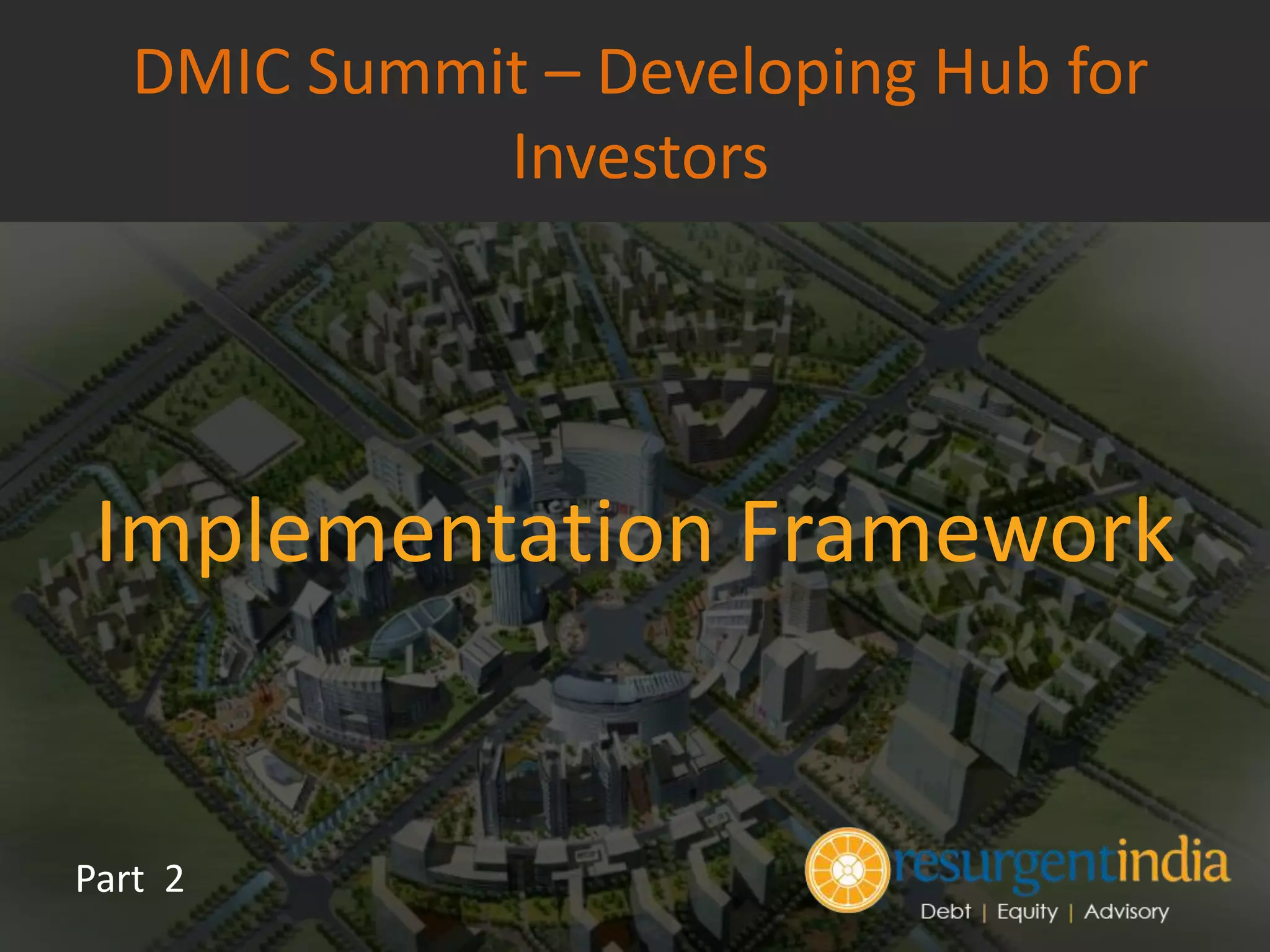
Implementation Framework
Part 2
DMIC Summit – Developing Hub for
Investors
Implementation and Institutional
Framework
The effective implementation of such large and complex project, involving
multiple states and agencies calls for immaculate planning and a robust
administrative structure. In order to ensure that the traditional pitfalls of
project implementation are overcome, it is proposed that a Project
Development approach be adopted, wherein each facet of the project is
rigorously developed from an engineering, financial, contractual,
environmental and social perspective, along with interlinkages, on
prioritization and selective basis and prior to commencement of
implementation
The project will include number of sub-projects, some of which will be
amenable for PPP and others will have to be implemented departmentally by
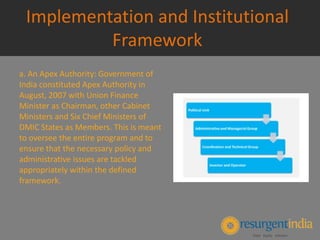
the government. Accordingly, a four tier institutional structure has been put in
place, to enable an effective framework development:
Implementation and Institutional
Framework
a. An Apex Authority: Government of
India constituted Apex Authority in
August, 2007 with Union Finance
Minister as Chairman, other Cabinet
Ministers and Six Chief Ministers of
DMIC States as Members. This is meant
to oversee the entire program and to
ensure that the necessary policy and
administrative issues are tackled
appropriately within the defined
framework.
Implementation and Institutional
Framework
b. Dedicated Corporate Entity: Delhi Mumbai Industrial Corridor Development
Corporation Ltd. (DMICDC), a special purpose company, works as a servicing
agency for the Apex body. It undertakes project development services for
investment regions / industrial areas / economic regions / industrial nodes and
townships, for various central government agencies and also assists state
governments.
c. State Level Nodal Agencies : An existing institution was nominated by state
govt. for coordination between DMICDC, various State Govt. Entities;
d. Special Purpose Vehicles: Established for individual projects like, airport, port,
industrial area, road, power etc, to mobilize financial resources through
appropriate consortia and undertake actual implementation, operation and
maintenance
Implementation and Institutional
Framework
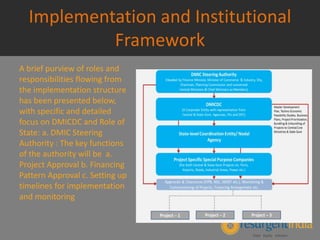
A brief purview of roles and
responsibilities flowing from
the implementation structure
has been presented below,
with specific and detailed
focus on DMICDC and Role of
State: a. DMIC Steering
Authority : The key functions
of the authority will be a.
Project Approval b. Financing
Pattern Approval c. Setting up
timelines for implementation
and monitoring
Implementation and Institutional
Framework
b. DMICDC : The corporate entity was formed with a view of providing :
a. A dedicated corporate entity, that has..
b. Support of government, but can work..
c. With the flexibility of a corporate environment, and is
d. Authorized to channelize funds from various sources to intended output
areas
Implementation and Institutional
Framework
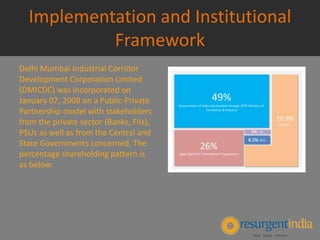
Delhi Mumbai Industrial Corridor
Development Corporation Limited
(DMICDC) was incorporated on
January 07, 2008 on a Public-Private
Partnership model with stakeholders
from the private sector (Banks, FIIs),
PSUs as well as from the Central and
State Governments concerned. The
percentage shareholding pattern is
as below:
Implementation and Institutional
Framework
The key functions of the entity are :
a. Detailed project preparation and obtaining various clearances
b. b. Evolving financing patterns for different components including
arranging finances, where required, on the basis of a sovereign
guarantee;
c. c. Co-ordination with various Union Ministries and State Governments,
Financial Institutions, and Infrastructure development agencies;
d. d. Monitoring the implementation of various components &
subcomponents and facilitating in their execution;
Implementation and Institutional
Framework
e. Introducing ‘state-of-the-art’ implementation methodologies and know-
how for quicker implementation of infrastructure projects;
f. Undertake project development services for various central government
projects and also help in assisting state governments (where desired);
g. Secretariat of the Steering Authority
Implementation and Institutional
Framework
c. Special Purpose Vehicle: It is envisaged most of the projects in DMIC region
would be implemented through Public Private Partnership. Special Purpose
Companies are thus to be established for project implementation, operation,
maintenance and management of such facilities. The financial structure of
SPVs will include:
a. Own equity specific to each project,
b. b. Initial small equities could be of DMICDC, which would then be sold to
operators selected for implementation.
c. c. Debts raised domestically and externally. Debts could also be raised by
DMICDC and passed on to SPVs.
Implementation and Institutional
Framework
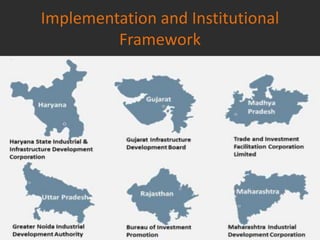
d. State level Nodal Agencies: State governments have the lead role in setting up
of various Investment regions and industrial areas in the DMIC. As part of this,
each state is meant to notify a nodal agency that will coordinate with DMICDC in
implementation of investment regions / industrial areas. The agencies as
notified, have been mentioned below:
Implementation and Institutional
Framework
The corridor passes through multiple states and cities, each at a different
level of industrial development, natural endowment, human talent etc. The
project acknowledges and proposes to address this bottleneck through a
holistic approach while benefiting from the inherent strengths and
competitiveness of each of the DMIC states.
Given the above, high impact/ market driven nodes identified across the
corridor under which integrated Investment Region (IRs) and Industrial Areas
(IAs) would be set up.
Role of States
The role of state governments start from the point of notifying a nodal agency
to coordinate with DMICDC, State level agencies and SPVs. The agencies in
turn, in close coordination with the multiple agencies, and with the support
of the state governments work towards:
a. Facilitating all clearances required from the State Government
b. Acquiring/ assisting in acquiring the land necessary for setting up of the
infrastructure, processing and non-processing areas. The acquisition of
land if any must be in accordance with law and must provide for
rehabilitation as per the laid down norms. As far as possible acquisition
of agricultural land may be avoided.
Role of States
c. Ensuring the availability of world-class physical and social infrastructure,
utilities and linkages under its jurisdiction within a stipulated time frame. It
includes:
a. Power connectivity and availability of reliable and good quality power.
The units may also seek open access as per the regulations of the State
Electricity Regulatory Commission;
b. Provision of bulk requirements of water;
c. o Road connectivity (State roads);
d. Sewerage and effluent treatment linkages;
e. Appropriate infrastructure to address the health, safety and
environmental concerns.
Role of States
f. Arrange requisite funding for development of infrastructure, through
budgetary resources, by availing existing schemes of Government of India
as VGF and IIFCL etc. or through loans from multilateral agencies
THANK YOU
Email: jyoti.gadia@resurgentindia.com Call Us: +91 124 4754550
www.resurgentindia.com
Read full report on: http://blog.resurgentindia.com/empowering-msmes-role-of-banks-
financial-institutions-it-skill-development-rating-agencies/

DMIC Summit - Implementation and Institutional Framework - Part - 2

  • 1.
    Implementation Framework Part 2 DMICSummit – Developing Hub for Investors
  • 2.
    Implementation and Institutional Framework Theeffective implementation of such large and complex project, involving multiple states and agencies calls for immaculate planning and a robust administrative structure. In order to ensure that the traditional pitfalls of project implementation are overcome, it is proposed that a Project Development approach be adopted, wherein each facet of the project is rigorously developed from an engineering, financial, contractual, environmental and social perspective, along with interlinkages, on prioritization and selective basis and prior to commencement of implementation The project will include number of sub-projects, some of which will be amenable for PPP and others will have to be implemented departmentally by the government. Accordingly, a four tier institutional structure has been put in place, to enable an effective framework development:
  • 3.
    Implementation and Institutional Framework a.An Apex Authority: Government of India constituted Apex Authority in August, 2007 with Union Finance Minister as Chairman, other Cabinet Ministers and Six Chief Ministers of DMIC States as Members. This is meant to oversee the entire program and to ensure that the necessary policy and administrative issues are tackled appropriately within the defined framework.
  • 4.
    Implementation and Institutional Framework b.Dedicated Corporate Entity: Delhi Mumbai Industrial Corridor Development Corporation Ltd. (DMICDC), a special purpose company, works as a servicing agency for the Apex body. It undertakes project development services for investment regions / industrial areas / economic regions / industrial nodes and townships, for various central government agencies and also assists state governments. c. State Level Nodal Agencies : An existing institution was nominated by state govt. for coordination between DMICDC, various State Govt. Entities; d. Special Purpose Vehicles: Established for individual projects like, airport, port, industrial area, road, power etc, to mobilize financial resources through appropriate consortia and undertake actual implementation, operation and maintenance
  • 5.
    Implementation and Institutional Framework Abrief purview of roles and responsibilities flowing from the implementation structure has been presented below, with specific and detailed focus on DMICDC and Role of State: a. DMIC Steering Authority : The key functions of the authority will be a. Project Approval b. Financing Pattern Approval c. Setting up timelines for implementation and monitoring
  • 6.
    Implementation and Institutional Framework b.DMICDC : The corporate entity was formed with a view of providing : a. A dedicated corporate entity, that has.. b. Support of government, but can work.. c. With the flexibility of a corporate environment, and is d. Authorized to channelize funds from various sources to intended output areas
  • 7.
    Implementation and Institutional Framework DelhiMumbai Industrial Corridor Development Corporation Limited (DMICDC) was incorporated on January 07, 2008 on a Public-Private Partnership model with stakeholders from the private sector (Banks, FIIs), PSUs as well as from the Central and State Governments concerned. The percentage shareholding pattern is as below:
  • 8.
    Implementation and Institutional Framework Thekey functions of the entity are : a. Detailed project preparation and obtaining various clearances b. b. Evolving financing patterns for different components including arranging finances, where required, on the basis of a sovereign guarantee; c. c. Co-ordination with various Union Ministries and State Governments, Financial Institutions, and Infrastructure development agencies; d. d. Monitoring the implementation of various components & subcomponents and facilitating in their execution;
  • 9.
    Implementation and Institutional Framework e.Introducing ‘state-of-the-art’ implementation methodologies and know- how for quicker implementation of infrastructure projects; f. Undertake project development services for various central government projects and also help in assisting state governments (where desired); g. Secretariat of the Steering Authority
  • 10.
    Implementation and Institutional Framework c.Special Purpose Vehicle: It is envisaged most of the projects in DMIC region would be implemented through Public Private Partnership. Special Purpose Companies are thus to be established for project implementation, operation, maintenance and management of such facilities. The financial structure of SPVs will include: a. Own equity specific to each project, b. b. Initial small equities could be of DMICDC, which would then be sold to operators selected for implementation. c. c. Debts raised domestically and externally. Debts could also be raised by DMICDC and passed on to SPVs.
  • 11.
    Implementation and Institutional Framework d.State level Nodal Agencies: State governments have the lead role in setting up of various Investment regions and industrial areas in the DMIC. As part of this, each state is meant to notify a nodal agency that will coordinate with DMICDC in implementation of investment regions / industrial areas. The agencies as notified, have been mentioned below:
  • 12.
    Implementation and Institutional Framework Thecorridor passes through multiple states and cities, each at a different level of industrial development, natural endowment, human talent etc. The project acknowledges and proposes to address this bottleneck through a holistic approach while benefiting from the inherent strengths and competitiveness of each of the DMIC states. Given the above, high impact/ market driven nodes identified across the corridor under which integrated Investment Region (IRs) and Industrial Areas (IAs) would be set up.
  • 13.
    Role of States Therole of state governments start from the point of notifying a nodal agency to coordinate with DMICDC, State level agencies and SPVs. The agencies in turn, in close coordination with the multiple agencies, and with the support of the state governments work towards: a. Facilitating all clearances required from the State Government b. Acquiring/ assisting in acquiring the land necessary for setting up of the infrastructure, processing and non-processing areas. The acquisition of land if any must be in accordance with law and must provide for rehabilitation as per the laid down norms. As far as possible acquisition of agricultural land may be avoided.
  • 14.
    Role of States c.Ensuring the availability of world-class physical and social infrastructure, utilities and linkages under its jurisdiction within a stipulated time frame. It includes: a. Power connectivity and availability of reliable and good quality power. The units may also seek open access as per the regulations of the State Electricity Regulatory Commission; b. Provision of bulk requirements of water; c. o Road connectivity (State roads); d. Sewerage and effluent treatment linkages; e. Appropriate infrastructure to address the health, safety and environmental concerns.
  • 15.
    Role of States f.Arrange requisite funding for development of infrastructure, through budgetary resources, by availing existing schemes of Government of India as VGF and IIFCL etc. or through loans from multilateral agencies
  • 16.
    THANK YOU Email: jyoti.gadia@resurgentindia.comCall Us: +91 124 4754550 www.resurgentindia.com Read full report on: http://blog.resurgentindia.com/empowering-msmes-role-of-banks- financial-institutions-it-skill-development-rating-agencies/