Critical Appreciation on poems
“The Second Coming”
&
“The Unknown Citizen”
Made by: Divya Dama
Roll no.:560 (TYBA Sem VI)
Subject: History of English Literature
Guided by: Dr. Yagnesh Dhoriya
Critical Appreciation
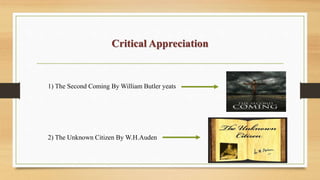
1) The Second Coming By William Butler yeats
2) The Unknown Citizen By W.H.Auden
The Second Coming
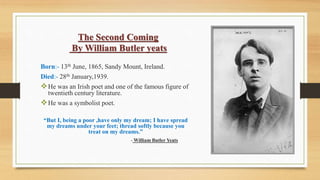
By William Butler yeats
Born:- 13th June, 1865, Sandy Mount, Ireland.
Died:- 28th January,1939.
He was an Irish poet and one of the famous figure of
twentieth century literature.
He was a symbolist poet.
“But I, being a poor ,have only my dream; I have spread
my dreams under your feet; thread softly because you
treat on my dreams.”
- William Butler Yeats
The Second Coming
• “ The second coming” is a poem composed by the Irish poet William Butler Yeats in
1919, first printed in The Dial in November 1920, and afterwards included in his 1921
collection of verses Michael Roberts and the dancer.
• The poem uses Christian imagery regarding the apocalypse and second coming
allegorically to describe the atmosphere of post-war Europe.
• The 'second coming' refers back to the 'first' coming of the beastly aspect of the divine in
the form of the swan.
Divine
Evil
The second
coming
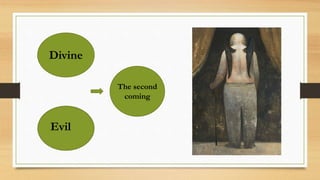
 The second coming in this poem is the return of the beastly civilization,
metaphorically and symbolically, as the poet could feel and envision in the
face of the growing hostility worldwide after world war.
• The second coming here is not really a second coming of Christ himself but
of a new figure- in this case of a cruel, bestial, pitiless being which will
represent the new era as Christ symbolized the old spiritual one.
• The first image of the falcon loosing control of its master summarizes all
this. Instead, Things are flying away, falling apart, our new civilization is
disintegrating.
• Human beings are becoming more like animals because of this losing of
control by driver on the moving vehicle.
• The body of lion with head of human beings seen coming out of some
distant desert and advancing slowly with clumsy movement towards
Bethlehem, the birth place of Christ.
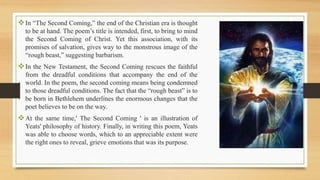
In “The Second Coming,” the end of the Christian era is thought
to be at hand. The poem’s title is intended, first, to bring to mind
the Second Coming of Christ. Yet this association, with its
promises of salvation, gives way to the monstrous image of the
“rough beast,” suggesting barbarism.
In the New Testament, the Second Coming rescues the faithful
from the dreadful conditions that accompany the end of the
world. In the poem, the second coming means being condemned
to those dreadful conditions. The fact that the “rough beast” is to
be born in Bethlehem underlines the enormous changes that the
poet believes to be on the way.
At the same time,' The Second Coming ' is an illustration of
Yeats' philosophy of history. Finally, in writing this poem, Yeats
was able to choose words, which to an appreciable extent were
the right ones to reveal, grieve emotions that was its purpose.
The Unknown Citizen
By Wystan Hugh Auden
Born:- 21st February, 1907 ,York England.
Died:- 29th September,1973, Vienna, Austria.
 W.H Auden, was Anglo-American poet, born in
England, later an American citizen, regarded by many
critics as one of the greatest writers of twentieth
century.
 His work is noted for its stylistics and technical
achievements, its engagement with moral political
issues, and its variety of tone, form and content.
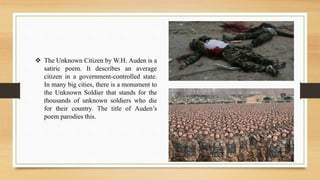
 The Unknown Citizen by W.H. Auden is a
satiric poem. It describes an average
citizen in a government-controlled state.
In many big cities, there is a monument to
the Unknown Soldier that stands for the
thousands of unknown soldiers who die
for their country. The title of Auden’s
poem parodies this.
 ‘The Unknown’ the word ‘unknown’ means
ordinary, obscure. So the whole phrase means
‘those ordinary, obscure soldiers as citizens of
the state who laid down their lives for
defending their motherland wanted name and
fame, but remained unknown.
 The citizen to whom the monument has been
built has been found to be without any fault.
He was a saint not because he searched for
God but because he served the government
perfectly. He did not get dismissed form his
job.
 Thus, this poem ‘The Unknown Citizen’ is a bitter
attack on modern society-its indifference towards
individuality and identity. The only way for an
individual to survive in a regimented society is to
conform, obey and live in perpetual mental slavery.
Such a creative is this ‘unknown citizen’ who is
utterly devoid of any urge for self-assertion. Such a
modern man is a slave to the routine, is incapable of
understanding such concepts as freedom and
happiness.
 The poem is implicitly the work of a government
agency at some point in the future, when
modern bureaucratizing trends have reached the point
where citizens are known by arbitrary numbers and
letters, not personal names.
“
”
Was he Was free? Was he happy? The question is
absurd:
Had anything been wrong, we should certainly have
heard.
‘The Unknown Citizen’- Lines 28-29.
 In the end of the poem, he asks two questions – “Was he free? Was he happy?”- he calls it
‘absurd.’
From the perspective of the state, it is much more important that people are not desperately
unhappy – so they don’t rock the boat and stop buying things – than is is that they experience
personal fulfillment.
Divya Dama TCAS-The Second Coming The Unknown Citizen

Divya Dama TCAS-The Second Coming The Unknown Citizen

  • 1.
    Critical Appreciation onpoems “The Second Coming” & “The Unknown Citizen” Made by: Divya Dama Roll no.:560 (TYBA Sem VI) Subject: History of English Literature Guided by: Dr. Yagnesh Dhoriya
  • 2.
    Critical Appreciation 1) TheSecond Coming By William Butler yeats 2) The Unknown Citizen By W.H.Auden
  • 3.
    The Second Coming ByWilliam Butler yeats Born:- 13th June, 1865, Sandy Mount, Ireland. Died:- 28th January,1939. He was an Irish poet and one of the famous figure of twentieth century literature. He was a symbolist poet. “But I, being a poor ,have only my dream; I have spread my dreams under your feet; thread softly because you treat on my dreams.” - William Butler Yeats
  • 4.
    The Second Coming •“ The second coming” is a poem composed by the Irish poet William Butler Yeats in 1919, first printed in The Dial in November 1920, and afterwards included in his 1921 collection of verses Michael Roberts and the dancer. • The poem uses Christian imagery regarding the apocalypse and second coming allegorically to describe the atmosphere of post-war Europe. • The 'second coming' refers back to the 'first' coming of the beastly aspect of the divine in the form of the swan.
  • 5.
  • 6.
     The secondcoming in this poem is the return of the beastly civilization, metaphorically and symbolically, as the poet could feel and envision in the face of the growing hostility worldwide after world war.
  • 7.
    • The secondcoming here is not really a second coming of Christ himself but of a new figure- in this case of a cruel, bestial, pitiless being which will represent the new era as Christ symbolized the old spiritual one. • The first image of the falcon loosing control of its master summarizes all this. Instead, Things are flying away, falling apart, our new civilization is disintegrating. • Human beings are becoming more like animals because of this losing of control by driver on the moving vehicle. • The body of lion with head of human beings seen coming out of some distant desert and advancing slowly with clumsy movement towards Bethlehem, the birth place of Christ.
  • 8.
    In “The SecondComing,” the end of the Christian era is thought to be at hand. The poem’s title is intended, first, to bring to mind the Second Coming of Christ. Yet this association, with its promises of salvation, gives way to the monstrous image of the “rough beast,” suggesting barbarism. In the New Testament, the Second Coming rescues the faithful from the dreadful conditions that accompany the end of the world. In the poem, the second coming means being condemned to those dreadful conditions. The fact that the “rough beast” is to be born in Bethlehem underlines the enormous changes that the poet believes to be on the way. At the same time,' The Second Coming ' is an illustration of Yeats' philosophy of history. Finally, in writing this poem, Yeats was able to choose words, which to an appreciable extent were the right ones to reveal, grieve emotions that was its purpose.
  • 9.
    The Unknown Citizen ByWystan Hugh Auden Born:- 21st February, 1907 ,York England. Died:- 29th September,1973, Vienna, Austria.  W.H Auden, was Anglo-American poet, born in England, later an American citizen, regarded by many critics as one of the greatest writers of twentieth century.  His work is noted for its stylistics and technical achievements, its engagement with moral political issues, and its variety of tone, form and content.
  • 10.
     The UnknownCitizen by W.H. Auden is a satiric poem. It describes an average citizen in a government-controlled state. In many big cities, there is a monument to the Unknown Soldier that stands for the thousands of unknown soldiers who die for their country. The title of Auden’s poem parodies this.
  • 11.
     ‘The Unknown’the word ‘unknown’ means ordinary, obscure. So the whole phrase means ‘those ordinary, obscure soldiers as citizens of the state who laid down their lives for defending their motherland wanted name and fame, but remained unknown.  The citizen to whom the monument has been built has been found to be without any fault. He was a saint not because he searched for God but because he served the government perfectly. He did not get dismissed form his job.
  • 12.
     Thus, thispoem ‘The Unknown Citizen’ is a bitter attack on modern society-its indifference towards individuality and identity. The only way for an individual to survive in a regimented society is to conform, obey and live in perpetual mental slavery. Such a creative is this ‘unknown citizen’ who is utterly devoid of any urge for self-assertion. Such a modern man is a slave to the routine, is incapable of understanding such concepts as freedom and happiness.  The poem is implicitly the work of a government agency at some point in the future, when modern bureaucratizing trends have reached the point where citizens are known by arbitrary numbers and letters, not personal names.
  • 13.
    “ ” Was he Wasfree? Was he happy? The question is absurd: Had anything been wrong, we should certainly have heard. ‘The Unknown Citizen’- Lines 28-29.  In the end of the poem, he asks two questions – “Was he free? Was he happy?”- he calls it ‘absurd.’ From the perspective of the state, it is much more important that people are not desperately unhappy – so they don’t rock the boat and stop buying things – than is is that they experience personal fulfillment.