Roll no 134
T.Y B.A
TOLANI COLLEGE OF ARTS AND SCIENCE
Tanvi sevak
SHAKESPEARE POETIC DRAMA
 The four great tragedies of poetic drama by
Shakespeare are
 Hamlet, Macbeth, Othello and King Lear
The revival of poetic drama
1. The concept of the poetic drama in the very beginning was adopted by
well known William Shakespeare
2. The English poetic drama had its day during the Elizabethan age
3. The university wits in general and Marlow and Shakespeare in
particular contributed their mite to the growth and development of
poetic drama
4. Shakespeare the master dramatist gave a touch of perfection to the
poetic drama especially through his tragedies and his tragi-comedies
5. Which includes Hamlet, Macbeth, Othello and king- Lear and the
tempest
6. Shakespeare took drama to such a height that none of this successor
could continue it with the same spirit
7. Nevertheless we may say that poetic drama died a natural death with
Shakespeare
The attempt of the poetic drama in 19 century
 No doubt both the romantic and the Victorian poets
attempted poetic drama during the 19 century
 Importantly Keats shelly and Tennyson made a
sincere attempt to revive Shakespeare's poetic drama
 As the readers tend to something which deals with
both the tragedy and comedy
 The aim was to overwhelm reader
 Though it was against the rules of early classics
 The rules regarding the three unities of time place and
action in drama as well as the verse form was strictly
banned
 The classics were staunch believer of rules the 19
century dramatist attempted a new concept apposed
by many criticism
Criticism on dramatic poetry
 Where Tennyson Keats and Shelly revived the
views and system of Shakespeare dramatic
poetry ,
 Mathew Arnold came with savior opposition .
 He rightly pointed out the lack of “Architectonics”
of drama
 Hence their failure of produce genuine poetic
drama which is at once poetic and dramatic
Arnold’s criticism and end of poetic
drama in nineteen century
 By Arnold's criticism regarding techniques the
poetic drama came to and end as it was latter not
accepted by critics
20th century revival of poetic drama
 Poetic drama was revived only at the beginning of the 20th century and
reached a sense of perfection in the hands of T.S Eliot and Christopher
Fry
 Eliot took the writing plays comparatively late in his career.
 He came to theater as a mature critic and poet he had a full
understanding of the nature of poetic drama
 Through his critical writings he tried to demolish many of the
misconceptions about verse drama emphasized its superiority over
prose drama
 And this way created a favorable atmosphere “a current of fresh ideas “
as Mathew Arnold would put it for the flourishing of poetic drama
 Through his practice he showed that verse drama is possible in the
modern age .
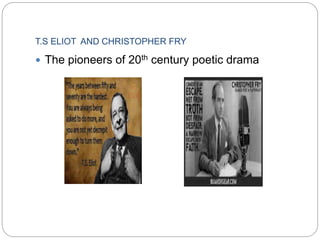
T.S ELIOT AND CHRISTOPHER FRY
 The pioneers of 20th century poetic drama
Eliot’s four views on dramatic poetry
 Eliot first talks about ,the dramatic adequacy then demands a poignant
theme ,involving symbolic characters with imagination atmosphere and
this means a fall back on the elemental emotional realities of life in
contradictions to the socio-economical issues which constitutes the
realm of the naturalistic prose drama
 Secondly T.S Eliot achieved success after a lot of experimentation. His
“murder in cathedral” marks the first conspicuous success of
experimentation with its neutral style and avoidance of the echoes of the
Shakespearean blank verse ,it had only a negative value in that
 The third important condition is that poetry must not be used as a mere
decoration but poetry is not an embellishment to look at but a medium
to be looked through
 The fourth and the last condition for the successful revival of poetic
drama according to Eliot is the re-orientation of the attitude of the
audience as poetic drama should overwhelm
The special feature of the age in writing
 Its special feature is the character in novel as in
every prose was regarded as suitable for comic or
low status character
 While verse was retained for those of high status
 This is banned in the 20th century revival moment
which took the reader to the aesthetic of emotions
and equality
Thank You!

Tanvi Sevak TCAS-poetic drama

  • 1.
    Roll no 134 T.YB.A TOLANI COLLEGE OF ARTS AND SCIENCE Tanvi sevak
  • 2.
    SHAKESPEARE POETIC DRAMA The four great tragedies of poetic drama by Shakespeare are  Hamlet, Macbeth, Othello and King Lear
  • 3.
    The revival ofpoetic drama 1. The concept of the poetic drama in the very beginning was adopted by well known William Shakespeare 2. The English poetic drama had its day during the Elizabethan age 3. The university wits in general and Marlow and Shakespeare in particular contributed their mite to the growth and development of poetic drama 4. Shakespeare the master dramatist gave a touch of perfection to the poetic drama especially through his tragedies and his tragi-comedies 5. Which includes Hamlet, Macbeth, Othello and king- Lear and the tempest 6. Shakespeare took drama to such a height that none of this successor could continue it with the same spirit 7. Nevertheless we may say that poetic drama died a natural death with Shakespeare
  • 4.
    The attempt ofthe poetic drama in 19 century  No doubt both the romantic and the Victorian poets attempted poetic drama during the 19 century  Importantly Keats shelly and Tennyson made a sincere attempt to revive Shakespeare's poetic drama  As the readers tend to something which deals with both the tragedy and comedy  The aim was to overwhelm reader  Though it was against the rules of early classics  The rules regarding the three unities of time place and action in drama as well as the verse form was strictly banned  The classics were staunch believer of rules the 19 century dramatist attempted a new concept apposed by many criticism
  • 5.
    Criticism on dramaticpoetry  Where Tennyson Keats and Shelly revived the views and system of Shakespeare dramatic poetry ,  Mathew Arnold came with savior opposition .  He rightly pointed out the lack of “Architectonics” of drama  Hence their failure of produce genuine poetic drama which is at once poetic and dramatic
  • 6.
    Arnold’s criticism andend of poetic drama in nineteen century  By Arnold's criticism regarding techniques the poetic drama came to and end as it was latter not accepted by critics
  • 7.
    20th century revivalof poetic drama  Poetic drama was revived only at the beginning of the 20th century and reached a sense of perfection in the hands of T.S Eliot and Christopher Fry  Eliot took the writing plays comparatively late in his career.  He came to theater as a mature critic and poet he had a full understanding of the nature of poetic drama  Through his critical writings he tried to demolish many of the misconceptions about verse drama emphasized its superiority over prose drama  And this way created a favorable atmosphere “a current of fresh ideas “ as Mathew Arnold would put it for the flourishing of poetic drama  Through his practice he showed that verse drama is possible in the modern age .
  • 8.
    T.S ELIOT ANDCHRISTOPHER FRY  The pioneers of 20th century poetic drama
  • 9.
    Eliot’s four viewson dramatic poetry  Eliot first talks about ,the dramatic adequacy then demands a poignant theme ,involving symbolic characters with imagination atmosphere and this means a fall back on the elemental emotional realities of life in contradictions to the socio-economical issues which constitutes the realm of the naturalistic prose drama  Secondly T.S Eliot achieved success after a lot of experimentation. His “murder in cathedral” marks the first conspicuous success of experimentation with its neutral style and avoidance of the echoes of the Shakespearean blank verse ,it had only a negative value in that  The third important condition is that poetry must not be used as a mere decoration but poetry is not an embellishment to look at but a medium to be looked through  The fourth and the last condition for the successful revival of poetic drama according to Eliot is the re-orientation of the attitude of the audience as poetic drama should overwhelm
  • 10.
    The special featureof the age in writing  Its special feature is the character in novel as in every prose was regarded as suitable for comic or low status character  While verse was retained for those of high status  This is banned in the 20th century revival moment which took the reader to the aesthetic of emotions and equality
  • 11.