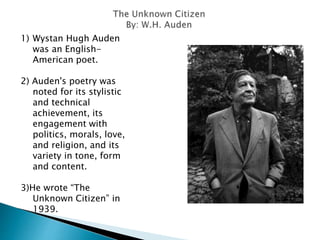
1) Wystan Hugh Auden
was an English-
American poet.
2) Auden's poetry was
noted for its stylistic
and technical
achievement, its
engagement with
politics, morals, love,
and religion, and its
variety in tone, form
and content.
3)He wrote “The
Unknown Citizen” in
1939.
 “The Unknown Citizen” (1940) is one of Auden’s most famous
poems.
 This poem is renowned for its wit and irony in complaining
about the stultifying and anonymous qualities of
bureaucratic, semi-socialist Western societies.
 It is satiric in structure.
 The poem is based on a boring, unremarkable and an
unknown citizen who is honoured with a poetic monument of
how little trouble he caused to anyone.
 This poem is created to resemble the soldiers who fought for
their country and were honoured for their brevity but whose
names have been lost to posterity.
 The rhyme scheme changes throughout the poem.
 The reader notices rhyme couplets in the poem.
 One must not confuse these couplets with heroic couplets.
 These patterns of the poem increase its dry humour.
 The “Citizen” described in this poem in a man of a perfect
life.
 There is nothing unusual in his life.
 He has a decent job, he has an insurance, a wife and just the
right amount of kids.
 His life is termed “normal” in the poem.
 He is praised as “unknown” because there was nothing
interesting to know about him.
 The closing couplet of this poem asks,
“Was he free? Was he happy? The question is absurd: / Had
anything been wrong, we should certainly have heard.”
 It becomes clear that the citizen is also “unknown” because,
in this statistical gathering of data, the man’s individuality
and identity are lost.
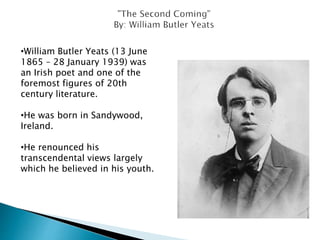
•William Butler Yeats (13 June
1865 – 28 January 1939) was
an Irish poet and one of the
foremost figures of 20th
century literature.
•He was born in Sandywood,
Ireland.
•He renounced his
transcendental views largely
which he believed in his youth.
 He wrote “The Second Coming” in 1919.
 He was awarded with Nobel Prize for Literature in 1923.
 The poem is considered a major work of Modernist poetry.
 “The Second Coming” was first printed in “The Dial”.
 The poem uses Christian imagery regarding
the Apocalypse and Second Coming allegorically to describe
the atmosphere of the poet’s contemporary times.
 This poem has been reprinted several times in various other
collections.
 The poem was written as an aftermath of the First World War.
 After the war, the poet, Yeats, predicted that it was the time
of the end of the world.
 In a letter to his friend, Yeats said that, the poem was
'written some 16 or 17 years ago and foretold what is
happening’,
that is, Yeats poetically predicted the rise of a rough beast
that manifested as chaos and upheaval in the form of Nazism
and Fascism, bringing Europe to its knees.
 His poem seems to suggest that world affairs and spirituality
undergo transformation from time to time.
 The Second Coming is a disturbing poem with memorable
lines.
 It's a highly visual two stanza creation, ending in a long, deep
question.
 There are two stanzas in this poem.
 This poem is written in free verse.
 It has loose iambic pentameter.
 The poem is full of exotic and unusual imagery.
 The first two lines take the reader off into the air on the
strong wings of a falcon, far away from the hand of the
falconer.
 One can feel the control being lost while reading the
beginning of the poem.
 The Second Coming relies heavily on certain words being
repeated, perhaps to emphasize the cyclic nature of things.
 In the second stanza, the reader meets another creature,
known to be a Sphinx.
 This Sphinx is said to be travelling an unstoppable journey to
Bethlehem.
 One can notice the biblical echoes in this poem.
 There is the birth of Jesus, disturbing vision of the
Apocalypse and the latter birth of the sinful world which is
being expected.
 The Second Coming” was intended by Yeats to describe the
current historical moment.
 “The Second Coming” is a magnificent statement about the
work in history, and about the conflict between the modern
world and the ancient world.
 The phrases and lines of this poem can be traced in many
movies and books today.
 One can notice the grave effect of the first world war on the
people of the contemporary times.
 Through the lines of this poem, the effect of the war on the
poet’s mind can also be traced and known with full clarity.
Tehzeeb Node TCAS-The Unknown Citizen and The Second Coming

Tehzeeb Node TCAS-The Unknown Citizen and The Second Coming

  • 2.
    1) Wystan HughAuden was an English- American poet. 2) Auden's poetry was noted for its stylistic and technical achievement, its engagement with politics, morals, love, and religion, and its variety in tone, form and content. 3)He wrote “The Unknown Citizen” in 1939.
  • 3.
     “The UnknownCitizen” (1940) is one of Auden’s most famous poems.  This poem is renowned for its wit and irony in complaining about the stultifying and anonymous qualities of bureaucratic, semi-socialist Western societies.  It is satiric in structure.
  • 4.
     The poemis based on a boring, unremarkable and an unknown citizen who is honoured with a poetic monument of how little trouble he caused to anyone.  This poem is created to resemble the soldiers who fought for their country and were honoured for their brevity but whose names have been lost to posterity.  The rhyme scheme changes throughout the poem.
  • 5.
     The readernotices rhyme couplets in the poem.  One must not confuse these couplets with heroic couplets.  These patterns of the poem increase its dry humour.  The “Citizen” described in this poem in a man of a perfect life.  There is nothing unusual in his life.  He has a decent job, he has an insurance, a wife and just the right amount of kids.
  • 6.
     His lifeis termed “normal” in the poem.  He is praised as “unknown” because there was nothing interesting to know about him.  The closing couplet of this poem asks, “Was he free? Was he happy? The question is absurd: / Had anything been wrong, we should certainly have heard.”  It becomes clear that the citizen is also “unknown” because, in this statistical gathering of data, the man’s individuality and identity are lost.
  • 7.
    •William Butler Yeats(13 June 1865 – 28 January 1939) was an Irish poet and one of the foremost figures of 20th century literature. •He was born in Sandywood, Ireland. •He renounced his transcendental views largely which he believed in his youth.
  • 8.
     He wrote“The Second Coming” in 1919.  He was awarded with Nobel Prize for Literature in 1923.  The poem is considered a major work of Modernist poetry.  “The Second Coming” was first printed in “The Dial”.
  • 9.
     The poemuses Christian imagery regarding the Apocalypse and Second Coming allegorically to describe the atmosphere of the poet’s contemporary times.  This poem has been reprinted several times in various other collections.  The poem was written as an aftermath of the First World War.  After the war, the poet, Yeats, predicted that it was the time of the end of the world.
  • 10.
     In aletter to his friend, Yeats said that, the poem was 'written some 16 or 17 years ago and foretold what is happening’, that is, Yeats poetically predicted the rise of a rough beast that manifested as chaos and upheaval in the form of Nazism and Fascism, bringing Europe to its knees.  His poem seems to suggest that world affairs and spirituality undergo transformation from time to time.  The Second Coming is a disturbing poem with memorable lines.  It's a highly visual two stanza creation, ending in a long, deep question.
  • 11.
     There aretwo stanzas in this poem.  This poem is written in free verse.  It has loose iambic pentameter.  The poem is full of exotic and unusual imagery.  The first two lines take the reader off into the air on the strong wings of a falcon, far away from the hand of the falconer.  One can feel the control being lost while reading the beginning of the poem.  The Second Coming relies heavily on certain words being repeated, perhaps to emphasize the cyclic nature of things.
  • 12.
     In thesecond stanza, the reader meets another creature, known to be a Sphinx.  This Sphinx is said to be travelling an unstoppable journey to Bethlehem.  One can notice the biblical echoes in this poem.  There is the birth of Jesus, disturbing vision of the Apocalypse and the latter birth of the sinful world which is being expected.  The Second Coming” was intended by Yeats to describe the current historical moment.
  • 13.
     “The SecondComing” is a magnificent statement about the work in history, and about the conflict between the modern world and the ancient world.  The phrases and lines of this poem can be traced in many movies and books today.  One can notice the grave effect of the first world war on the people of the contemporary times.  Through the lines of this poem, the effect of the war on the poet’s mind can also be traced and known with full clarity.