Michael A. Samara, MD, FACC
AdvancedHeartFailureTherapies
Cardiac Transplantation and Mechanical Circulatory Support
Advanced Heart Failure/Transplant/Mechanical Circulatory Support
Minneapolis Heart Institute at Abbott Northwestern Hospital
Part of Allina Health
Minneapolis, MN
Innovation Summit 2014
September 26, 2014
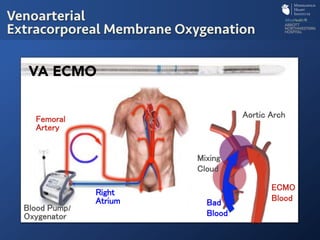
0
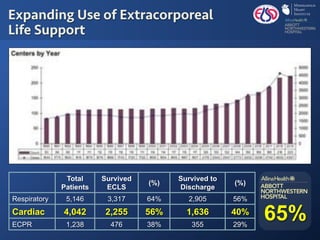
50
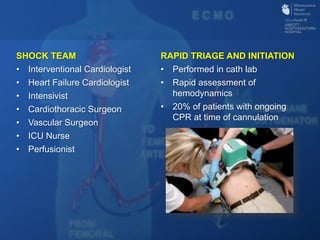
100
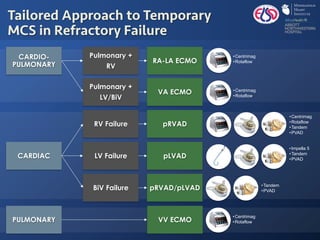
150
200
250
300
350
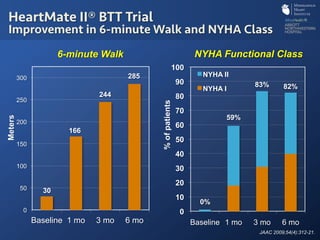
400
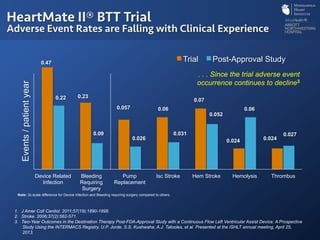
0
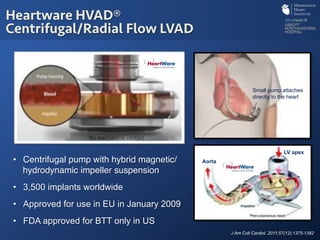
200
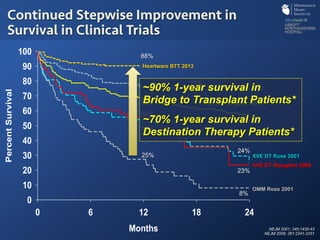
400
600
800
1000
1200
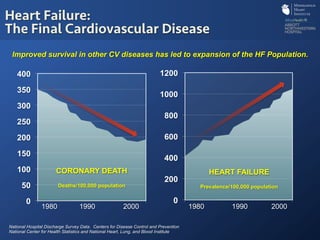
Heart Failure:
The Final Cardiovascular Disease
CORONARY DEATH
Deaths/100,000 population
HEART FAILURE
Prevalence/100,000 population
National Hospital Discharge Survey Data. Centers for Disease Control and Prevention
National Center for Health Statistics and National Heart, Lung, and Blood Institute
1980 1990 2000 1980 1990 2000
Improved survival in other CV diseases has led to expansion of the HF Population.
Survival(%)
100
80
60
40
20
0
0 6 12 18 24
Time (months)
J Heart Lung Transplant 2011;30:402–7
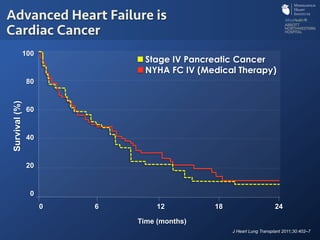
Advanced Heart Failure is
Cardiac Cancer
Stage IV Pancreatic Cancer
NYHA FC IV (Medical Therapy)
NOTE: This figure includes only the heart transplants that are
reported to the ISHLT Transplant Registry. As such, the
presented data may not mirror the changes in the number of
heart transplants performed worldwide
ISHLT
2011
J Heart Lung Transplant. 2011 Oct; 30 (10): 1071-1132
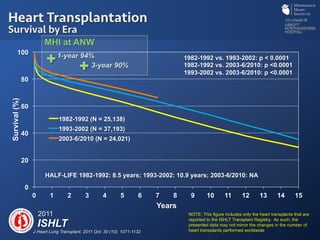
Heart Transplantation
Survival by Era
0
20
40
60
80
100
0 1 2 3 4 5 6 7 8 9 10 11 12 13 14 15
Survival(%)
Years
1982-1992 (N = 25,138)
1993-2002 (N = 37,193)
2003-6/2010 (N = 24,021)
HALF-LIFE 1982-1992: 8.5 years; 1993-2002: 10.9 years; 2003-6/2010: NA
1982-1992 vs. 1993-2002: p < 0.0001
1982-1992 vs. 2003-6/2010: p <0.0001
1993-2002 vs. 2003-6/2010: p <0.0001
1-year 94%
3-year 90%
MHI at ANW
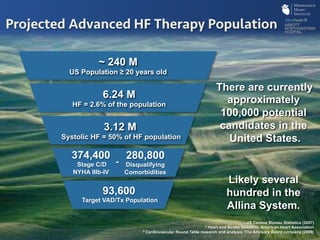
~ 240 M
US Population ≥ 20 years old
6.24 M
HF = 2.6% of the population
3.12 M
Systolic HF = 50% of HF population
374,400
Stage C/D
NYHA IIIb-IV
93,600
Target VAD/Tx Population
Projected Advanced HF Therapy Population
1 US Census Bureau Statistics (2007)
2 Heart and Stroke Statistics, American Heart Association
3 Cardiovascular Round Table research and analysis, The Advisory Board company (2009)
280,800
Disqualifying
Comorbidities
-
There are currently
approximately
100,000 potential
candidates in the
United States.
Likely several
hundred in the
Allina System.
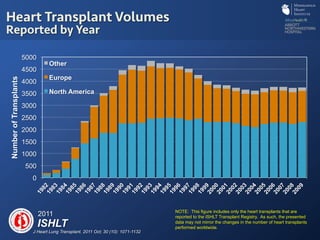
0
500
1000
1500
2000
2500
3000
3500
4000
4500
5000
NumberofTransplants
Other
Europe
North America
NOTE: This figure includes only the heart transplants that are
reported to the ISHLT Transplant Registry. As such, the presented
data may not mirror the changes in the number of heart transplants
performed worldwide.
Heart Transplant Volumes
Reported by Year
ISHLT
2011
J Heart Lung Transplant. 2011 Oct; 30 (10): 1071-1132
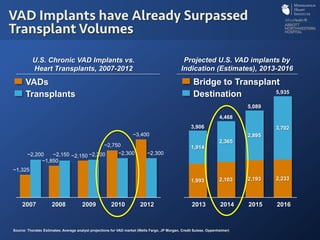
U.S. Chronic VAD Implants vs.
Heart Transplants, 2007-2012
Projected U.S. VAD implants by
Indication (Estimates), 2013-2016
~1,325
~1,850
~2,150
~2,750
~3,400
~2,200 ~2,150 ~2,200 ~2,300 ~2,300
20122010200920082007
2,233
3,702
2016
5,935
2013 2015
5,089
2,193
2,895
2014
4,468
2,103
2,365
3,906
1,993
1,914
Source: Thoratec Estimates; Average analyst projections for VAD market (Wells Fargo, JP Morgan, Credit Suisse, Oppenheimer)
VADs
Transplants
VAD Implants have Already Surpassed
Transplant Volumes
Bridge to Transplant
Destination
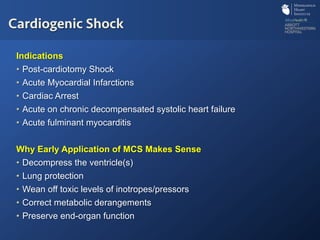
Indications
•  Post-cardiotomy Shock
•  Acute Myocardial Infarctions
•  Cardiac Arrest
•  Acute on chronic decompensated systolic heart failure
•  Acute fulminant myocarditis
Why Early Application of MCS Makes Sense
•  Decompress the ventricle(s)
•  Lung protection
•  Wean off toxic levels of inotropes/pressors
•  Correct metabolic derangements
•  Preserve end-organ function
Cardiogenic Shock
Venoarterial
Extracorporeal Membrane Oxygenation
!
!
/ !
!
!
!
!
/!
!
VA ECMO
!
!
!
!
!
!
!
Total
Patients
Survived
ECLS
(%)
Survived to
Discharge
(%)
Respiratory 5,146 3,317 64% 2,905 56%
Cardiac 4,042 2,255 56% 1,636 40%
ECPR 1,238 476 38% 355 29%
Expanding Use of Extracorporeal
Life Support
65%
SHOCK TEAM
•  Interventional Cardiologist
•  Heart Failure Cardiologist
•  Intensivist
•  Cardiothoracic Surgeon
•  Vascular Surgeon
•  ICU Nurse
•  Perfusionist
RAPID TRIAGE AND INITIATION
•  Performed in cath lab
•  Rapid assessment of
hemodynamics
•  20% of patients with ongoing
CPR at time of cannulation
CARDIO-
PULMONARY
Pulmonary +
RV
RA-LA ECMO
Pulmonary +
LV/BiV
VA ECMO
CARDIAC
RV Failure pRVAD
LV Failure pLVAD
BiV Failure pRVAD/pLVAD
PULMONARY VV ECMO
Tailored Approach to Temporary
MCS in Refractory Failure
• Centrimag
• Rotaflow
• Centrimag
• Rotaflow
• Centrimag
• Rotaflow
• Centrimag
• Rotaflow
• Tandem
• PVAD
• Impella 5
• Tandem
• PVAD
• Tandem
• PVAD
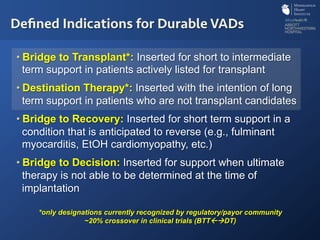
• Bridge to Transplant*: Inserted for short to intermediate
term support in patients actively listed for transplant
• Destination Therapy*: Inserted with the intention of long
term support in patients who are not transplant candidates
• Bridge to Recovery: Inserted for short term support in a
condition that is anticipated to reverse (e.g., fulminant
myocarditis, EtOH cardiomyopathy, etc.)
• Bridge to Decision: Inserted for support when ultimate
therapy is not able to be determined at the time of
implantation
Defined Indications for Durable VADs
*only designations currently recognized by regulatory/payor community
~20% crossover in clinical trials (BTT!"DT)
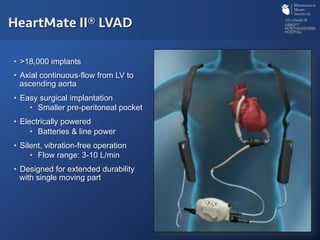
•  >18,000 implants
•  Axial continuous-flow from LV to
ascending aorta
•  Easy surgical implantation
•  Smaller pre-peritoneal pocket
•  Electrically powered
•  Batteries & line power
•  Silent, vibration-free operation
•  Flow range: 3-10 L/min
•  Designed for extended durability
with single moving part
HeartMate II® LVAD
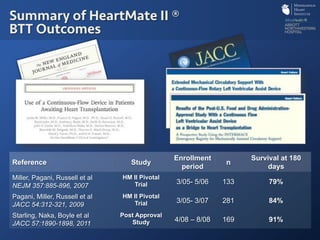
Summary of HeartMate II ®
BTT Outcomes
Reference Study
Enrollment
period
n
Survival at 180
days
Miller, Pagani, Russell et al
NEJM 357:885-896, 2007
HM II Pivotal
Trial 3/05- 5/06 133 79%
Pagani, Miller, Russell et al
JACC 54:312-321, 2009
HM II Pivotal
Trial 3/05- 3/07 281 84%
Starling, Naka, Boyle et al
JACC 57:1890-1898, 2011
Post Approval
Study 4/08 – 8/08 169 91%
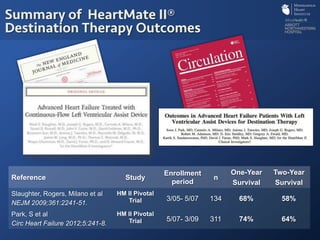
Summary of HeartMate II®
Destination Therapy Outcomes
Reference Study
Enrollment
period
n
One-Year
Survival
Two-Year
Survival
Slaughter, Rogers, Milano et al
NEJM 2009;361:2241-51.
HM II Pivotal
Trial 3/05- 5/07 134 68% 58%
Park, S et al
Circ Heart Failure 2012;5:241-8.
HM II Pivotal
Trial 5/07- 3/09 311 74% 64%
0
50
100
150
200
250
300
Baseline 1 mo 3 mo 6 mo
Meters
30
166
244
285
JAAC 2009;54(4):312-21.
HeartMate II® BTT Trial
Improvement in 6-minute Walk and NYHA Class
0
10
20
30
40
50
60
70
80
90
100
Baseline 1 mo 3 mo 6 mo
%ofpatients
NYHA II
NYHA I
59%
83% 82%
0%
NYHA Functional Class6-minute Walk
1.  J Amer Coll Cardiol. 2011;57(19):1890-1898.
2.  Stroke. 2006;37(2):562-571.
3.  Two-Year Outcomes in the Destination Therapy Post-FDA-Approval Study with a Continuous Flow Left Ventricular Assist Device: A Prospective
Study Using the INTERMACS Registry. U.P. Jorde, S.S. Kushwaha, A.J. Tatooles, et al. Presented at the ISHLT annual meeting, April 25,
2013.
Device Related
Infection
Bleeding
Requiring
Surgery
Pump
Replacement
Isc Stroke Hem Stroke Hemolysis Thrombus
Trial Post-Approval Study
0.06
0.031
0.47
0.22 0.07
0.052
0.024
0.06
0.024
0.027
0.23
0.09
0.057
0.026
Events/patientyear
Note: 3x scale difference for Device infection and Bleeding requiring surgery compared to others
. . . Since the trial adverse event
occurrence continues to decline3
HeartMate II® BTT Trial
Adverse Event Rates are Falling with Clinical Experience
Heartware HVAD®
Centrifugal/Radial Flow LVAD
J Am Coll Cardiol. 2011;57(12):1375-1382
Circulation. 2012;125:3191-3200
Aorta
LV apex
•  Centrifugal pump with hybrid magnetic/
hydrodynamic impeller suspension "
•  3,500 implants worldwide
•  Approved for use in EU in January 2009
•  FDA approved for BTT only in US
HeartWare® System
Small pump attaches
directly to the heart
Thin, flexible driveline
cable exits skin
A small controller &
batteries run the pump
CAUTION:  Federal  Law  (USA)  restricts  this  device  to  sale  by  or  on  the  order  of  a  physician.    Refer  to  the  “Instructions  For  Use” for
complete Indications for Use, Contraindications, Warnings, Precautions, Adverse Events and Instructions prior to using this device.
Months
0 6 12 18 24
PercentSurvival
0
10
20
30
40
50
60
70
80
90
100
68%
58%
55%
24%
8%
23%
25%
52%
NEJM 2001; 345:1435-43
NEJM 2009; 361:2241-2251
Continued Stepwise Improvement in
Survival in Clinical Trials
OMM Rose 2001
XVE DT Slaughter 2009
XVE DT Rose 2001
HMII DT Slaughter 2009
HMII BTT Pagani 2009
Heartware BTT 2013
88%
75%
~90% 1-year survival in
Bridge to Transplant Patients*
~70% 1-year survival in
Destination Therapy Patients*
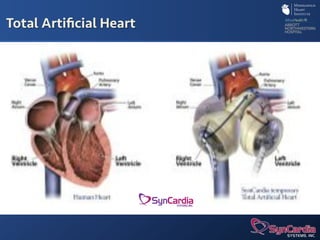
Total Artificial Heart
Inlet
Cannula in
Left Atrium
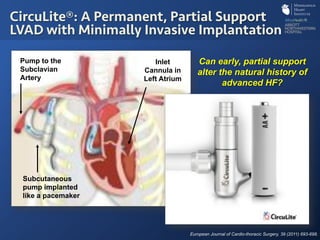
Pump to the
Subclavian
Artery
Subcutaneous
pump implanted
like a pacemaker
CircuLite®: A Permanent, Partial Support
LVAD with Minimally Invasive Implantation
European Journal of Cardio-thoracic Surgery, 39 (2011) 693-698.
Can early, partial support
alter the natural history of
advanced HF?

Advanced Heart Failure Therapies: Cardiac Transplantation and Mechanical Circulatory Support

  • 1.
    Michael A. Samara,MD, FACC AdvancedHeartFailureTherapies Cardiac Transplantation and Mechanical Circulatory Support Advanced Heart Failure/Transplant/Mechanical Circulatory Support Minneapolis Heart Institute at Abbott Northwestern Hospital Part of Allina Health Minneapolis, MN Innovation Summit 2014 September 26, 2014
  • 2.
    0 50 100 150 200 250 300 350 400 0 200 400 600 800 1000 1200 Heart Failure: The FinalCardiovascular Disease CORONARY DEATH Deaths/100,000 population HEART FAILURE Prevalence/100,000 population National Hospital Discharge Survey Data. Centers for Disease Control and Prevention National Center for Health Statistics and National Heart, Lung, and Blood Institute 1980 1990 2000 1980 1990 2000 Improved survival in other CV diseases has led to expansion of the HF Population.
  • 3.
    Survival(%) 100 80 60 40 20 0 0 6 1218 24 Time (months) J Heart Lung Transplant 2011;30:402–7 Advanced Heart Failure is Cardiac Cancer Stage IV Pancreatic Cancer NYHA FC IV (Medical Therapy)
  • 4.
    NOTE: This figureincludes only the heart transplants that are reported to the ISHLT Transplant Registry. As such, the presented data may not mirror the changes in the number of heart transplants performed worldwide ISHLT 2011 J Heart Lung Transplant. 2011 Oct; 30 (10): 1071-1132 Heart Transplantation Survival by Era 0 20 40 60 80 100 0 1 2 3 4 5 6 7 8 9 10 11 12 13 14 15 Survival(%) Years 1982-1992 (N = 25,138) 1993-2002 (N = 37,193) 2003-6/2010 (N = 24,021) HALF-LIFE 1982-1992: 8.5 years; 1993-2002: 10.9 years; 2003-6/2010: NA 1982-1992 vs. 1993-2002: p < 0.0001 1982-1992 vs. 2003-6/2010: p <0.0001 1993-2002 vs. 2003-6/2010: p <0.0001 1-year 94% 3-year 90% MHI at ANW
  • 5.
    ~ 240 M USPopulation ≥ 20 years old 6.24 M HF = 2.6% of the population 3.12 M Systolic HF = 50% of HF population 374,400 Stage C/D NYHA IIIb-IV 93,600 Target VAD/Tx Population Projected Advanced HF Therapy Population 1 US Census Bureau Statistics (2007) 2 Heart and Stroke Statistics, American Heart Association 3 Cardiovascular Round Table research and analysis, The Advisory Board company (2009) 280,800 Disqualifying Comorbidities - There are currently approximately 100,000 potential candidates in the United States. Likely several hundred in the Allina System.
  • 6.
    0 500 1000 1500 2000 2500 3000 3500 4000 4500 5000 NumberofTransplants Other Europe North America NOTE: Thisfigure includes only the heart transplants that are reported to the ISHLT Transplant Registry. As such, the presented data may not mirror the changes in the number of heart transplants performed worldwide. Heart Transplant Volumes Reported by Year ISHLT 2011 J Heart Lung Transplant. 2011 Oct; 30 (10): 1071-1132
  • 7.
    U.S. Chronic VADImplants vs. Heart Transplants, 2007-2012 Projected U.S. VAD implants by Indication (Estimates), 2013-2016 ~1,325 ~1,850 ~2,150 ~2,750 ~3,400 ~2,200 ~2,150 ~2,200 ~2,300 ~2,300 20122010200920082007 2,233 3,702 2016 5,935 2013 2015 5,089 2,193 2,895 2014 4,468 2,103 2,365 3,906 1,993 1,914 Source: Thoratec Estimates; Average analyst projections for VAD market (Wells Fargo, JP Morgan, Credit Suisse, Oppenheimer) VADs Transplants VAD Implants have Already Surpassed Transplant Volumes Bridge to Transplant Destination
  • 8.
    Indications •  Post-cardiotomy Shock • Acute Myocardial Infarctions •  Cardiac Arrest •  Acute on chronic decompensated systolic heart failure •  Acute fulminant myocarditis Why Early Application of MCS Makes Sense •  Decompress the ventricle(s) •  Lung protection •  Wean off toxic levels of inotropes/pressors •  Correct metabolic derangements •  Preserve end-organ function Cardiogenic Shock
  • 9.
    Venoarterial Extracorporeal Membrane Oxygenation ! ! /! ! ! ! ! /! ! VA ECMO ! ! ! ! ! ! !
  • 10.
    Total Patients Survived ECLS (%) Survived to Discharge (%) Respiratory 5,1463,317 64% 2,905 56% Cardiac 4,042 2,255 56% 1,636 40% ECPR 1,238 476 38% 355 29% Expanding Use of Extracorporeal Life Support 65%
  • 11.
    SHOCK TEAM •  InterventionalCardiologist •  Heart Failure Cardiologist •  Intensivist •  Cardiothoracic Surgeon •  Vascular Surgeon •  ICU Nurse •  Perfusionist RAPID TRIAGE AND INITIATION •  Performed in cath lab •  Rapid assessment of hemodynamics •  20% of patients with ongoing CPR at time of cannulation
  • 12.
    CARDIO- PULMONARY Pulmonary + RV RA-LA ECMO Pulmonary+ LV/BiV VA ECMO CARDIAC RV Failure pRVAD LV Failure pLVAD BiV Failure pRVAD/pLVAD PULMONARY VV ECMO Tailored Approach to Temporary MCS in Refractory Failure • Centrimag • Rotaflow • Centrimag • Rotaflow • Centrimag • Rotaflow • Centrimag • Rotaflow • Tandem • PVAD • Impella 5 • Tandem • PVAD • Tandem • PVAD
  • 13.
    • Bridge to Transplant*:Inserted for short to intermediate term support in patients actively listed for transplant • Destination Therapy*: Inserted with the intention of long term support in patients who are not transplant candidates • Bridge to Recovery: Inserted for short term support in a condition that is anticipated to reverse (e.g., fulminant myocarditis, EtOH cardiomyopathy, etc.) • Bridge to Decision: Inserted for support when ultimate therapy is not able to be determined at the time of implantation Defined Indications for Durable VADs *only designations currently recognized by regulatory/payor community ~20% crossover in clinical trials (BTT!"DT)
  • 14.
    •  >18,000 implants • Axial continuous-flow from LV to ascending aorta •  Easy surgical implantation •  Smaller pre-peritoneal pocket •  Electrically powered •  Batteries & line power •  Silent, vibration-free operation •  Flow range: 3-10 L/min •  Designed for extended durability with single moving part HeartMate II® LVAD
  • 15.
    Summary of HeartMateII ® BTT Outcomes Reference Study Enrollment period n Survival at 180 days Miller, Pagani, Russell et al NEJM 357:885-896, 2007 HM II Pivotal Trial 3/05- 5/06 133 79% Pagani, Miller, Russell et al JACC 54:312-321, 2009 HM II Pivotal Trial 3/05- 3/07 281 84% Starling, Naka, Boyle et al JACC 57:1890-1898, 2011 Post Approval Study 4/08 – 8/08 169 91%
  • 16.
    Summary of HeartMateII® Destination Therapy Outcomes Reference Study Enrollment period n One-Year Survival Two-Year Survival Slaughter, Rogers, Milano et al NEJM 2009;361:2241-51. HM II Pivotal Trial 3/05- 5/07 134 68% 58% Park, S et al Circ Heart Failure 2012;5:241-8. HM II Pivotal Trial 5/07- 3/09 311 74% 64%
  • 17.
    0 50 100 150 200 250 300 Baseline 1 mo3 mo 6 mo Meters 30 166 244 285 JAAC 2009;54(4):312-21. HeartMate II® BTT Trial Improvement in 6-minute Walk and NYHA Class 0 10 20 30 40 50 60 70 80 90 100 Baseline 1 mo 3 mo 6 mo %ofpatients NYHA II NYHA I 59% 83% 82% 0% NYHA Functional Class6-minute Walk
  • 18.
    1.  J AmerColl Cardiol. 2011;57(19):1890-1898. 2.  Stroke. 2006;37(2):562-571. 3.  Two-Year Outcomes in the Destination Therapy Post-FDA-Approval Study with a Continuous Flow Left Ventricular Assist Device: A Prospective Study Using the INTERMACS Registry. U.P. Jorde, S.S. Kushwaha, A.J. Tatooles, et al. Presented at the ISHLT annual meeting, April 25, 2013. Device Related Infection Bleeding Requiring Surgery Pump Replacement Isc Stroke Hem Stroke Hemolysis Thrombus Trial Post-Approval Study 0.06 0.031 0.47 0.22 0.07 0.052 0.024 0.06 0.024 0.027 0.23 0.09 0.057 0.026 Events/patientyear Note: 3x scale difference for Device infection and Bleeding requiring surgery compared to others . . . Since the trial adverse event occurrence continues to decline3 HeartMate II® BTT Trial Adverse Event Rates are Falling with Clinical Experience
  • 19.
    Heartware HVAD® Centrifugal/Radial FlowLVAD J Am Coll Cardiol. 2011;57(12):1375-1382 Circulation. 2012;125:3191-3200 Aorta LV apex •  Centrifugal pump with hybrid magnetic/ hydrodynamic impeller suspension " •  3,500 implants worldwide •  Approved for use in EU in January 2009 •  FDA approved for BTT only in US HeartWare® System Small pump attaches directly to the heart Thin, flexible driveline cable exits skin A small controller & batteries run the pump CAUTION:  Federal  Law  (USA)  restricts  this  device  to  sale  by  or  on  the  order  of  a  physician.    Refer  to  the  “Instructions  For  Use” for complete Indications for Use, Contraindications, Warnings, Precautions, Adverse Events and Instructions prior to using this device.
  • 20.
    Months 0 6 1218 24 PercentSurvival 0 10 20 30 40 50 60 70 80 90 100 68% 58% 55% 24% 8% 23% 25% 52% NEJM 2001; 345:1435-43 NEJM 2009; 361:2241-2251 Continued Stepwise Improvement in Survival in Clinical Trials OMM Rose 2001 XVE DT Slaughter 2009 XVE DT Rose 2001 HMII DT Slaughter 2009 HMII BTT Pagani 2009 Heartware BTT 2013 88% 75% ~90% 1-year survival in Bridge to Transplant Patients* ~70% 1-year survival in Destination Therapy Patients*
  • 21.
  • 22.
    Inlet Cannula in Left Atrium Pumpto the Subclavian Artery Subcutaneous pump implanted like a pacemaker CircuLite®: A Permanent, Partial Support LVAD with Minimally Invasive Implantation European Journal of Cardio-thoracic Surgery, 39 (2011) 693-698. Can early, partial support alter the natural history of advanced HF?