Dr. Osama El-Shahat 
Consultant Nephrologist 
Head of Nephrology Department 
New Mansoura General Hospital (international)(Egypt)
Agenda
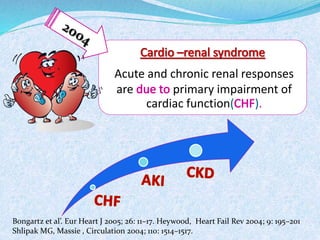
Acute and chronic renal responses 
are primary impairment of 
cardiac function( ). 
Bongartz et al’. Eur Heart J 2005; 26: 11–17. Heywood, Heart Fail Rev 2004; 9: 195–201 
Shlipak MG, Massie , Circulation 2004; 110: 1514–1517.
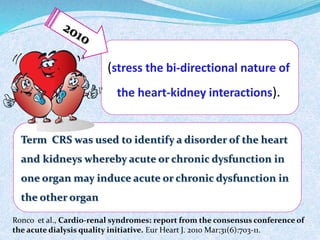
(stress the bi-directional nature of 
the heart-kidney interactions). 
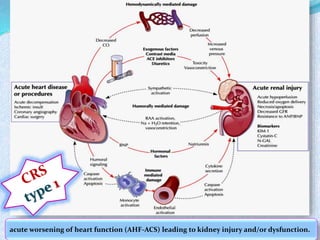
Term CRS was used to identify a disorder of the heart 
and kidneys whereby acute or chronic dysfunction in 
one organ may induce acute or chronic dysfunction in 
the other organ 
Ronco et al., Cardio-renal syndromes: report from the consensus conference of 
the acute dialysis quality initiative. Eur Heart J. 2010 Mar;31(6):703-11.
acute worsening of heart function (AHF-ACS) leading to kidney injury and/or dysfunction.
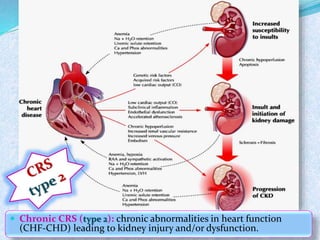
 Chronic CRS (type 2): chronic abnormalities in heart function 
(CHF-CHD) leading to kidney injury and/or dysfunction.
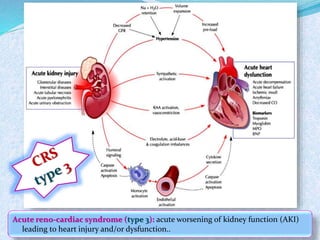
Acute reno-cardiac syndrome (type 3): acute worsening of kidney function (AKI) 
leading to heart injury and/or dysfunction..
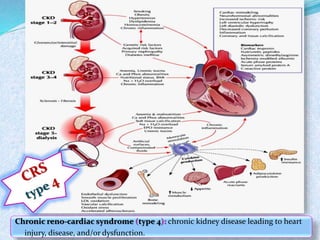
Chronic reno-cardiac syndrome (type 4): chronic kidney disease leading to heart 
injury, disease, and/or dysfunction.
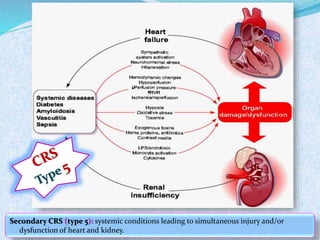
Secondary CRS (type 5): systemic conditions leading to simultaneous injury and/or 
dysfunction of heart and kidney.
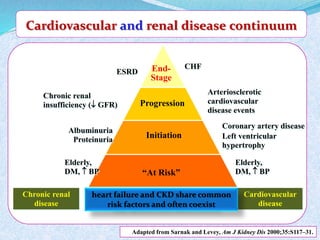
Cardiovascular and renal disease continuum 
End- 
Stage 
Progression 
Initiation 
“At Risk” 
Cardiovascular 
disease 
CHF 
Arteriosclerotic 
cardiovascular 
disease events 
Coronary artery disease 
Left ventricular 
hypertrophy 
Elderly, 
DM,  BP 
Chronic renal 
disease 
ESRD 
Chronic renal 
insufficiency ( GFR) 
Albuminuria 
Proteinuria 
Elderly, 
DM,  BP 
heart failure and CKD share common 
risk factors and often coexist 
Adapted from Sarnak and Levey, Am J Kidney Dis 2000;35:S117–31.
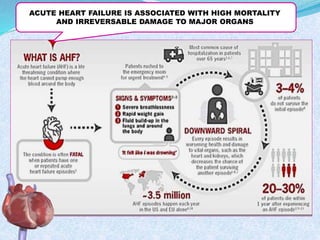
ACUTE HEART FAILURE IS ASSOCIATED WITH HIGH MORTALITY 
AND IRREVERSABLE DAMAGE TO MAJOR ORGANS
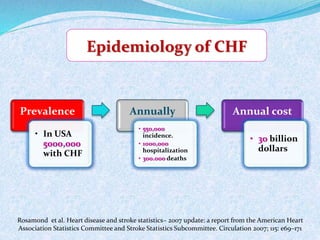
Epidemiology of CHF 
Prevalence 
• In USA 
5000,000 
with CHF 
Annually 
• 550,000 
incidence. 
• 1000,000 
hospitalization 
• 300.000 deaths 
Annual cost 
• 30 billion 
dollars 
Rosamond et al. Heart disease and stroke statistics– 2007 update: a report from the American Heart 
Association Statistics Committee and Stroke Statistics Subcommittee. Circulation 2007; 115: e69–171
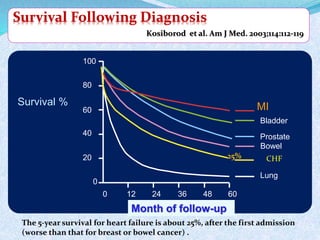
Kosiborod et al. Am J Med. 2003;114:112-119 
MI 
25% 
0 12 24 36 48 60 
100 
0 
80 
60 
40 
20 
Bladder 
Prostate 
Bowel 
Lung 
Month of follow-up 
Survival % 
CHF 
The 5-year survival for heart failure is about 25%, after the first admission 
(worse than that for breast or bowel cancer) .
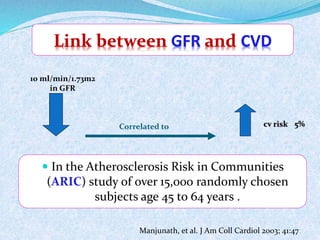
10 ml/min/1.73m2 
 In the Atherosclerosis Risk in Communities 
(ARIC) study of over 15,000 randomly chosen 
subjects age 45 to 64 years . 
in GFR 
Correlated to cv risk 5% 
Manjunath, et al. J Am Coll Cardiol 2003; 41:47.
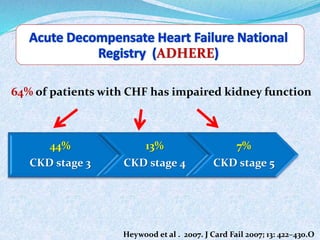
ADHERE 
64% of patients with CHF has impaired kidney function 
44% 
CKD stage 3 
13% 
CKD stage 4 
7% 
CKD stage 5 
Heywood et al . 2007. J Card Fail 2007; 13: 422–430.O
Link 
between 
CKD->CHF 
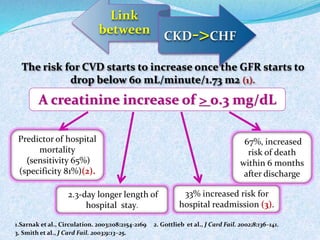
The risk for CVD starts to increase once the GFR starts to 
drop below 60 mL/minute/1.73 m2 (1). 
A creatinine increase of > 0.3 mg/dL 
Predictor of hospital 
mortality 
)sensitivity 65%) 
(specificity 81%)(2). 
2.3-day longer length of 
hospital stay. 
67%, increased 
risk of death 
within 6 months 
after discharge 
33% increased risk for 
hospital readmission (3). 
1.Sarnak et al., Circulation. 2003;108:2154-2169 2. Gottlieb et al., J Card Fail. 2002;8:136–141. 
3. Smith et al., J Card Fail. 2003;9:13–25.
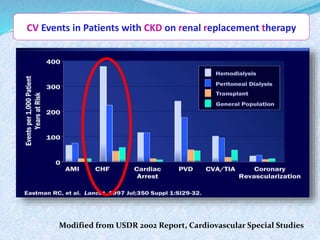
CV Events in Patients with CKD on renal replacement therapy 
Modified from USDR 2002 Report, Cardiovascular Special Studies
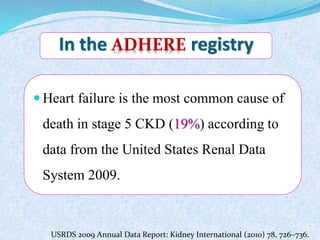
In the registry 
 Heart failure is the most common cause of 
death in stage 5 CKD (19%) according to 
data from the United States Renal Data 
System 2009. 
USRDS 2009 Annual Data Report: Kidney International (2010) 78, 726–736.
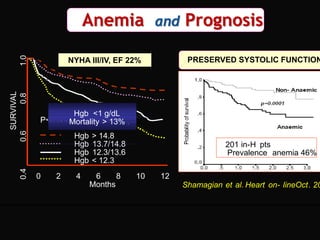
Anemia and Prognosis 
NYHA III/IV, EF 22% PRESERVED SYSTOLIC FUNCTION 
Hgb <1 g/dL 
Mortality > 13% 
0 2 4 6 8 10 12 
Months 
SURVIVAL 
0.4 0.6 0.8 1.0 
Hgb > 14.8 
Hgb 13.7/14.8 
Hgb 12.3/13.6 
Hgb < 12.3 
201 in-H pts 
Prevalence anemia 46% 
Shamagian et al. Heart on- lineOct. 2005 
P<0.00001
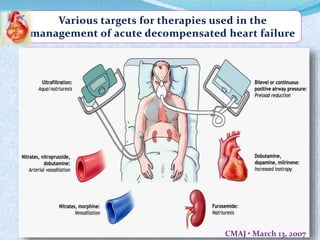
Various targets for therapies used in the 
management of acute decompensated heart failure 
CMAJ • March 13, 2007
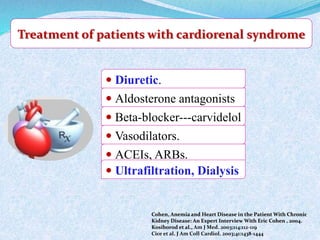
Treatment of patients with cardiorenal syndrome 
 Diuretic. 
 Aldosterone antagonists 
 Beta-blocker---carvidelol 
 .Vasodilators. 
 ACEIs, ARBs. 
 Ultrafiltration, Dialysis 
Cohen, Anemia and Heart Disease in the Patient With Chronic 
Kidney Disease: An Expert Interview With Eric Cohen , 2004. 
Kosiborod et al., Am J Med. 2003;114:112-119 
Cice et al. J Am Coll Cardiol. 2003;41:1438-1444
ACC/AHA guideline summary: Management of patients with 
current or prior symptoms of heart failure (HF) and a reduced left 
ventricular ejection fraction (LVEF) (HF stage C) 
Diuretics and salt restriction 
for fluid retention. 
Data from Hunt, SA, Abraham, WT, Chin, MH, et al. 2009 focused update incorporated into the ACC/AHA 2005 
Guidelines for the Diagnosis and Management of Heart Failure in Adults: a report of the American College of 
Cardiology Foundation/American Heart Association Task Force on Practice Guidelines: developed in 
collaboration with the International Society for Heart and Lung Transplantation. Circulation 2009; 119:e391.
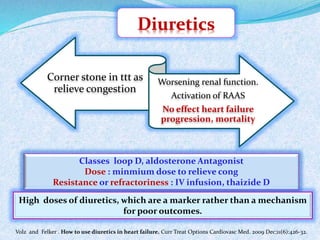
Corner stone in ttt as 
relieve congestion 
Worsening renal function. 
Activation of RAAS 
No effect heart failure 
progression, mortality 
Classes loop D, aldosterone Antagonist 
Dose : minmium dose to relieve cong 
Resistance or refractoriness : IV infusion, thaizide D 
High doses of diuretics, which are a marker rather than a mechanism 
for poor outcomes. 
Volz and Felker . How to use diuretics in heart failure. Curr Treat Options Cardiovasc Med. 2009 Dec;11(6):426-32.
Over 90%of All Hospitalizations for Acutely 
Decompensated Heart Failure (ADHF) Are Due 
to Fluid Overload 
Aronson. ACC. 2000. . 
The Majority of These Patients Have Failed 
Treatment With Oral Diuretics 
Adams et al. Am Heart J. 2005;149:209-216.
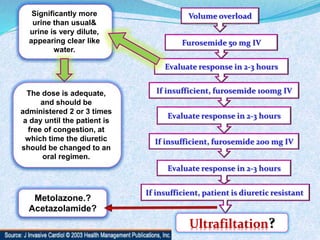
Significantly more 
urine than usual& 
urine is very dilute, 
appearing clear like 
water. 
The dose is adequate, 
and should be 
administered 2 or 3 times 
a day until the patient is 
free of congestion, at 
which time the diuretic 
should be changed to an 
oral regimen. 
Metolazone.? 
Acetazolamide? 
Volume overload 
Furosemide 50 mg IV 
Evaluate response in 2-3 hours 
If insufficient, furosemide 100mg IV 
Evaluate response in 2-3 hours 
If insufficient, furosemide 200 mg IV 
Evaluate response in 2-3 hours 
If insufficient, patient is diuretic resistant 
?
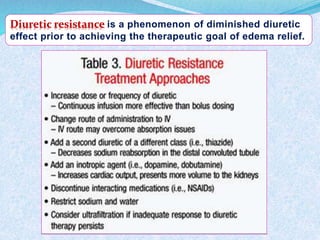
is a phenomenon of diminished diuretic 
effect prior to achieving the therapeutic goal of edema relief.
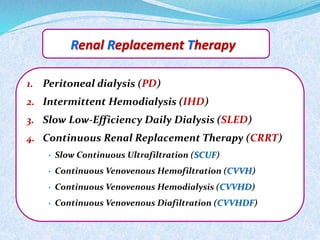
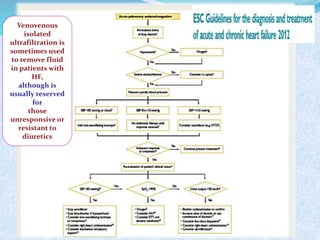
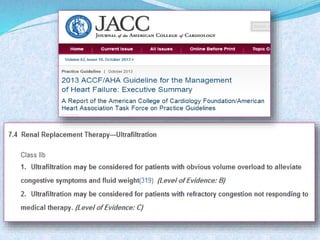
Renal Replacement Therapy 
1. Peritoneal dialysis (PD) 
2. Intermittent Hemodialysis (IHD) 
3. Slow Low-Efficiency Daily Dialysis (SLED) 
4. Continuous Renal Replacement Therapy (CRRT) 
• Slow Continuous Ultrafiltration (SCUF) 
• Continuous Venovenous Hemofiltration (CVVH) 
• Continuous Venovenous Hemodialysis (CVVHD) 
• Continuous Venovenous Diafiltration (CVVHDF)
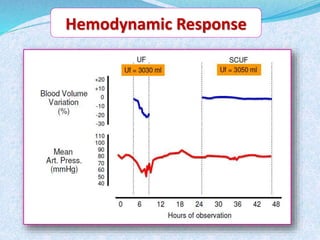
Hemodynamic Response
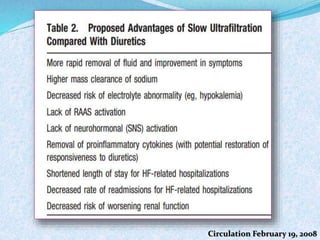
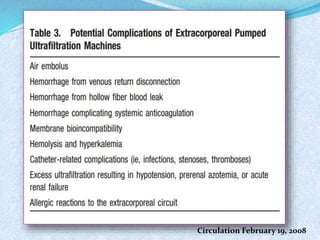
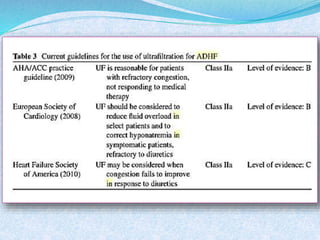
Circulation February 19, 2008
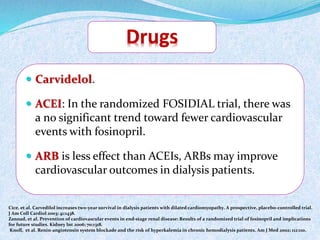
 Carvidelol. 
 ACEI: In the randomized FOSIDIAL trial, there was 
a no significant trend toward fewer cardiovascular 
events with fosinopril. 
 ARB is less effect than ACEIs, ARBs may improve 
cardiovascular outcomes in dialysis patients. 
Cice, et al. Carvedilol increases two-year survival in dialysis patients with dilated cardiomyopathy. A prospective, placebo-controlled trial. 
J Am Coll Cardiol 2003; 41:1438. 
Zannad, et al. Prevention of cardiovascular events in end-stage renal disease: Results of a randomized trial of fosinopril and implications 
for future studies. Kidney Int 2006; 70:1318. 
Knoll, et al. Renin-angiotensin system blockade and the risk of hyperkalemia in chronic hemodialysis patients. Am J Med 2002; 112:110.
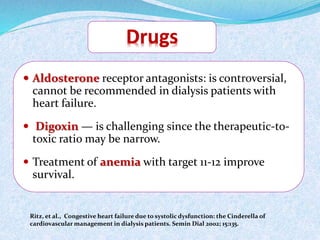
 Aldosterone receptor antagonists: is controversial, 
cannot be recommended in dialysis patients with 
heart failure. 
 Digoxin — is challenging since the therapeutic-to-toxic 
ratio may be narrow. 
 Treatment of anemia with target 11-12 improve 
survival. 
Ritz, et al., Congestive heart failure due to systolic dysfunction: the Cinderella of 
cardiovascular management in dialysis patients. Semin Dial 2002; 15:135.
 CRS is a common and has impacted on morbidity 
and mortality . 
 The management of the cardio renal syndrome 
remains a challenge in spite of the advances in 
medical therapy and novel agents. 
 Early management of CRS in multidisciplinary 
team approach will improve outcome .
 Treatment of CRS is more challenging in HD. 
 Individualizations should be considered. 
 Heart-kidney transplantation —most appropriate 
for selected dialysis patients with severe irreversible 
cardiac dysfunction. 
 It is hoped that new and effective therapies will be 
identified for the treatment and prevention of this 
challenging syndrome
Cardiorenal syndrome   DR Osama EL-Shahat

Cardiorenal syndrome DR Osama EL-Shahat

  • 1.
    Dr. Osama El-Shahat Consultant Nephrologist Head of Nephrology Department New Mansoura General Hospital (international)(Egypt)
  • 2.
  • 3.
    Acute and chronicrenal responses are primary impairment of cardiac function( ). Bongartz et al’. Eur Heart J 2005; 26: 11–17. Heywood, Heart Fail Rev 2004; 9: 195–201 Shlipak MG, Massie , Circulation 2004; 110: 1514–1517.
  • 4.
    (stress the bi-directionalnature of the heart-kidney interactions). Term CRS was used to identify a disorder of the heart and kidneys whereby acute or chronic dysfunction in one organ may induce acute or chronic dysfunction in the other organ Ronco et al., Cardio-renal syndromes: report from the consensus conference of the acute dialysis quality initiative. Eur Heart J. 2010 Mar;31(6):703-11.
  • 5.
    acute worsening ofheart function (AHF-ACS) leading to kidney injury and/or dysfunction.
  • 6.
     Chronic CRS(type 2): chronic abnormalities in heart function (CHF-CHD) leading to kidney injury and/or dysfunction.
  • 7.
    Acute reno-cardiac syndrome(type 3): acute worsening of kidney function (AKI) leading to heart injury and/or dysfunction..
  • 8.
    Chronic reno-cardiac syndrome(type 4): chronic kidney disease leading to heart injury, disease, and/or dysfunction.
  • 9.
    Secondary CRS (type5): systemic conditions leading to simultaneous injury and/or dysfunction of heart and kidney.
  • 10.
    Cardiovascular and renaldisease continuum End- Stage Progression Initiation “At Risk” Cardiovascular disease CHF Arteriosclerotic cardiovascular disease events Coronary artery disease Left ventricular hypertrophy Elderly, DM,  BP Chronic renal disease ESRD Chronic renal insufficiency ( GFR) Albuminuria Proteinuria Elderly, DM,  BP heart failure and CKD share common risk factors and often coexist Adapted from Sarnak and Levey, Am J Kidney Dis 2000;35:S117–31.
  • 11.
    ACUTE HEART FAILUREIS ASSOCIATED WITH HIGH MORTALITY AND IRREVERSABLE DAMAGE TO MAJOR ORGANS
  • 12.
    Epidemiology of CHF Prevalence • In USA 5000,000 with CHF Annually • 550,000 incidence. • 1000,000 hospitalization • 300.000 deaths Annual cost • 30 billion dollars Rosamond et al. Heart disease and stroke statistics– 2007 update: a report from the American Heart Association Statistics Committee and Stroke Statistics Subcommittee. Circulation 2007; 115: e69–171
  • 13.
    Kosiborod et al.Am J Med. 2003;114:112-119 MI 25% 0 12 24 36 48 60 100 0 80 60 40 20 Bladder Prostate Bowel Lung Month of follow-up Survival % CHF The 5-year survival for heart failure is about 25%, after the first admission (worse than that for breast or bowel cancer) .
  • 14.
    10 ml/min/1.73m2 In the Atherosclerosis Risk in Communities (ARIC) study of over 15,000 randomly chosen subjects age 45 to 64 years . in GFR Correlated to cv risk 5% Manjunath, et al. J Am Coll Cardiol 2003; 41:47.
  • 15.
    ADHERE 64% ofpatients with CHF has impaired kidney function 44% CKD stage 3 13% CKD stage 4 7% CKD stage 5 Heywood et al . 2007. J Card Fail 2007; 13: 422–430.O
  • 16.
    Link between CKD->CHF The risk for CVD starts to increase once the GFR starts to drop below 60 mL/minute/1.73 m2 (1). A creatinine increase of > 0.3 mg/dL Predictor of hospital mortality )sensitivity 65%) (specificity 81%)(2). 2.3-day longer length of hospital stay. 67%, increased risk of death within 6 months after discharge 33% increased risk for hospital readmission (3). 1.Sarnak et al., Circulation. 2003;108:2154-2169 2. Gottlieb et al., J Card Fail. 2002;8:136–141. 3. Smith et al., J Card Fail. 2003;9:13–25.
  • 17.
    CV Events inPatients with CKD on renal replacement therapy Modified from USDR 2002 Report, Cardiovascular Special Studies
  • 18.
    In the registry  Heart failure is the most common cause of death in stage 5 CKD (19%) according to data from the United States Renal Data System 2009. USRDS 2009 Annual Data Report: Kidney International (2010) 78, 726–736.
  • 19.
    Anemia and Prognosis NYHA III/IV, EF 22% PRESERVED SYSTOLIC FUNCTION Hgb <1 g/dL Mortality > 13% 0 2 4 6 8 10 12 Months SURVIVAL 0.4 0.6 0.8 1.0 Hgb > 14.8 Hgb 13.7/14.8 Hgb 12.3/13.6 Hgb < 12.3 201 in-H pts Prevalence anemia 46% Shamagian et al. Heart on- lineOct. 2005 P<0.00001
  • 21.
    Various targets fortherapies used in the management of acute decompensated heart failure CMAJ • March 13, 2007
  • 22.
    Treatment of patientswith cardiorenal syndrome  Diuretic.  Aldosterone antagonists  Beta-blocker---carvidelol  .Vasodilators.  ACEIs, ARBs.  Ultrafiltration, Dialysis Cohen, Anemia and Heart Disease in the Patient With Chronic Kidney Disease: An Expert Interview With Eric Cohen , 2004. Kosiborod et al., Am J Med. 2003;114:112-119 Cice et al. J Am Coll Cardiol. 2003;41:1438-1444
  • 23.
    ACC/AHA guideline summary:Management of patients with current or prior symptoms of heart failure (HF) and a reduced left ventricular ejection fraction (LVEF) (HF stage C) Diuretics and salt restriction for fluid retention. Data from Hunt, SA, Abraham, WT, Chin, MH, et al. 2009 focused update incorporated into the ACC/AHA 2005 Guidelines for the Diagnosis and Management of Heart Failure in Adults: a report of the American College of Cardiology Foundation/American Heart Association Task Force on Practice Guidelines: developed in collaboration with the International Society for Heart and Lung Transplantation. Circulation 2009; 119:e391.
  • 24.
    Corner stone inttt as relieve congestion Worsening renal function. Activation of RAAS No effect heart failure progression, mortality Classes loop D, aldosterone Antagonist Dose : minmium dose to relieve cong Resistance or refractoriness : IV infusion, thaizide D High doses of diuretics, which are a marker rather than a mechanism for poor outcomes. Volz and Felker . How to use diuretics in heart failure. Curr Treat Options Cardiovasc Med. 2009 Dec;11(6):426-32.
  • 25.
    Over 90%of AllHospitalizations for Acutely Decompensated Heart Failure (ADHF) Are Due to Fluid Overload Aronson. ACC. 2000. . The Majority of These Patients Have Failed Treatment With Oral Diuretics Adams et al. Am Heart J. 2005;149:209-216.
  • 26.
    Significantly more urinethan usual& urine is very dilute, appearing clear like water. The dose is adequate, and should be administered 2 or 3 times a day until the patient is free of congestion, at which time the diuretic should be changed to an oral regimen. Metolazone.? Acetazolamide? Volume overload Furosemide 50 mg IV Evaluate response in 2-3 hours If insufficient, furosemide 100mg IV Evaluate response in 2-3 hours If insufficient, furosemide 200 mg IV Evaluate response in 2-3 hours If insufficient, patient is diuretic resistant ?
  • 27.
    is a phenomenonof diminished diuretic effect prior to achieving the therapeutic goal of edema relief.
  • 28.
    Renal Replacement Therapy 1. Peritoneal dialysis (PD) 2. Intermittent Hemodialysis (IHD) 3. Slow Low-Efficiency Daily Dialysis (SLED) 4. Continuous Renal Replacement Therapy (CRRT) • Slow Continuous Ultrafiltration (SCUF) • Continuous Venovenous Hemofiltration (CVVH) • Continuous Venovenous Hemodialysis (CVVHD) • Continuous Venovenous Diafiltration (CVVHDF)
  • 29.
  • 30.
  • 31.
  • 36.
     Carvidelol. ACEI: In the randomized FOSIDIAL trial, there was a no significant trend toward fewer cardiovascular events with fosinopril.  ARB is less effect than ACEIs, ARBs may improve cardiovascular outcomes in dialysis patients. Cice, et al. Carvedilol increases two-year survival in dialysis patients with dilated cardiomyopathy. A prospective, placebo-controlled trial. J Am Coll Cardiol 2003; 41:1438. Zannad, et al. Prevention of cardiovascular events in end-stage renal disease: Results of a randomized trial of fosinopril and implications for future studies. Kidney Int 2006; 70:1318. Knoll, et al. Renin-angiotensin system blockade and the risk of hyperkalemia in chronic hemodialysis patients. Am J Med 2002; 112:110.
  • 37.
     Aldosterone receptorantagonists: is controversial, cannot be recommended in dialysis patients with heart failure.  Digoxin — is challenging since the therapeutic-to-toxic ratio may be narrow.  Treatment of anemia with target 11-12 improve survival. Ritz, et al., Congestive heart failure due to systolic dysfunction: the Cinderella of cardiovascular management in dialysis patients. Semin Dial 2002; 15:135.
  • 38.
     CRS isa common and has impacted on morbidity and mortality .  The management of the cardio renal syndrome remains a challenge in spite of the advances in medical therapy and novel agents.  Early management of CRS in multidisciplinary team approach will improve outcome .
  • 39.
     Treatment ofCRS is more challenging in HD.  Individualizations should be considered.  Heart-kidney transplantation —most appropriate for selected dialysis patients with severe irreversible cardiac dysfunction.  It is hoped that new and effective therapies will be identified for the treatment and prevention of this challenging syndrome