WISENET Wireless Sensor Network BY G.JANAREDDY 08Q61A0569 IV CSE
Overview Introduction Design Goals Design Methodology Subsystems Project Success Future Extensions / Projects Applications Conclusion
Introduction Wireless Sensor Networks One of MIT's 10 emerging technologies Low-power systems New applications: sensing, controls, automation WISENET: Wireless Sensor Network Office environment monitoring Temperature, humidity, light Quantitively evaluate heating & A/C systems Funding & support provided by Honeywell, Int'l.
HISTORY: The technological drive for smaller devices using  less power with greater functionality has created  new potential applications in the sensor and data acquisition  sectors. MIT even recognized wireless sensor networks and TinyOS as one of the ten emerging technologies that will change  the future (Technology Review, 1 February 2003).  “ Wireless Sensor Networks for Habitat Monitoring”
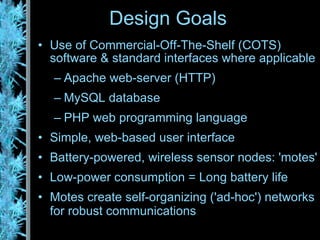
Design Goals Use of Commercial-Off-The-Shelf (COTS) software & standard interfaces where applicable Apache web-server (HTTP) MySQL database PHP web programming language Simple, web-based user interface Battery-powered, wireless sensor nodes: 'motes' Low-power consumption = Long battery life Motes create self-organizing ('ad-hoc') networks for robust communications
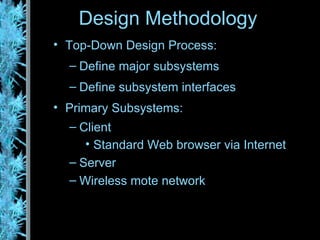
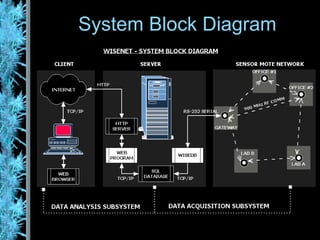
Design Methodology Top-Down Design Process: Define major subsystems Define subsystem interfaces Primary Subsystems: Client Standard Web browser via Internet Server Wireless mote network
System Block Diagram
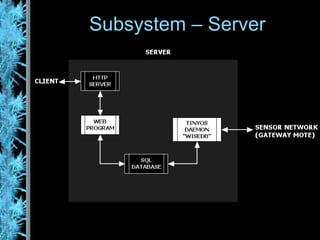
Subsystem – Server
WiseDB Written in C++ Utilizes open-source APIs Application Programming Interfaces (API) MySQL++ database API Serial API Relays information from mote network to database Sends commands to mote network
Written in PHP4 Utilizes Charting Software:  ChartDirector v3.0 Generates 3 Graphs (default) Passes Parameters via HTTP GET Use bookmarks for specific queries Retrieves Data for Specific Mote or All Motes Web Program
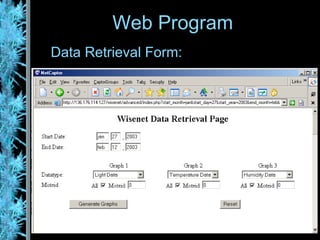
Data Retrieval Form: Web Program
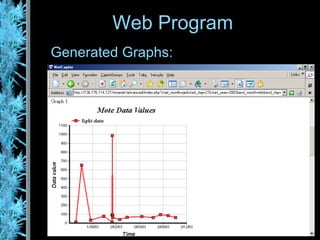
Generated Graphs: Web Program
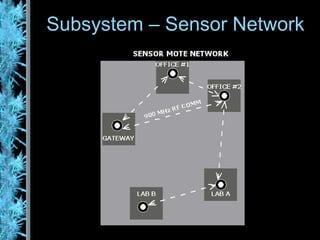
Subsystem – Sensor Network
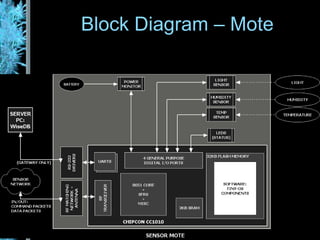
Block Diagram – Mote
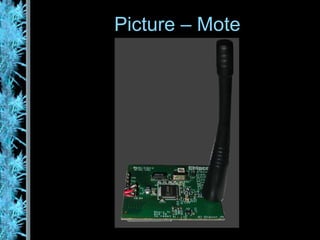
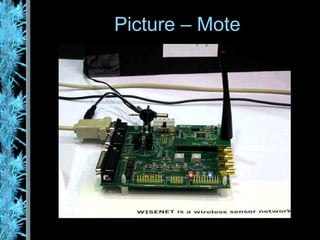
Picture – Mote
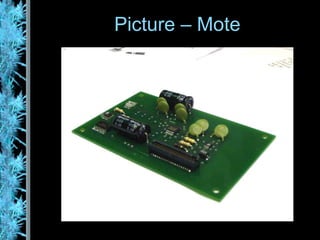
Picture – Mote
Picture – Mote
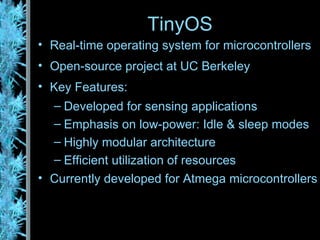
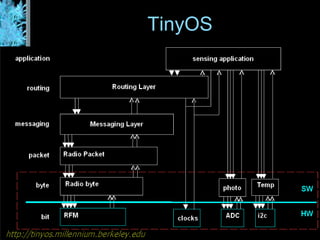
TinyOS Real-time operating system for microcontrollers Open-source project at UC Berkeley Key Features: Developed for sensing applications Emphasis on low-power: Idle & sleep modes Highly modular architecture Efficient utilization of resources Currently developed for Atmega microcontrollers
TinyOS
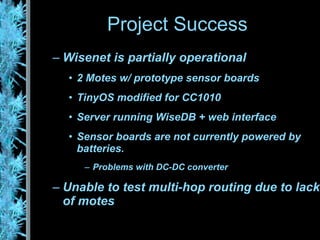
Wisenet is partially operational 2 Motes w/ prototype sensor boards  TinyOS modified for CC1010 Server running WiseDB + web interface  Sensor boards are not currently powered by batteries. Problems with DC-DC converter Unable to test multi-hop routing due to lack of motes Project Success
Expand network to develop & test  multi-hop routing Develop a single-board mote Create a expandable, plug-in sensor interface Research alternative energy sources  Solar cell, rechargeable batteries Continue development of TinyOS Improve tools Optimize performance / reduce power usage Improve web interface Data analysis Future Projects / Extensions
Lab / Office Monitoring Natural Habitat Monitoring Automation / Process Control Where wired sensors are impractical Security Systems Intrusion detection & occupancy sensors Extreme Weather Surveillance Think “Twister” Potential Biomedical Applications Critical fall alert for the elderly Military Reconnaissance Monitor battlefields, sensitive locations Potential Applications
ADVANTAGES: The following bullet-points show the benefits of using Wisenet  against traditional methods. Typically  ¾  the cost of a walkthrough. Can monitor offices over 24 hours. Captures true maximum and minimum occupancy figures. Installed at weekends  –  no staff disruption. Utilization figures viewable the very next day over portal.
Conclusion WISENET: Wireless Sensor Network Emerging technology that will change the world Many real-world applications Low-power Open-source software Modular mote application design (TinyOS) Flexible server implementation Simple user interface via the web WISENET is a step to the future of  wireless sensing technology.
REFERENCES: Atkinson.  MySQL++: A C++ API for MySQL, vers 1.7.9 ,  online posting . 12 Dec 2002. <http://www.mysql.com/downloads/api-mysql++.html>. 2. Gay, Levis, et al.  The  nesC  Language: A Holistic Approach to  Network Embedded Systems , online posting.  To appear in Proceedings of Programming Language Design and Implementation (PLDI <http://today.cs.berkeley.edu/tos/papers/nesc.pdf>.
Questions?
THANK YOU

569

  • 1.
    WISENET Wireless SensorNetwork BY G.JANAREDDY 08Q61A0569 IV CSE
  • 2.
    Overview Introduction DesignGoals Design Methodology Subsystems Project Success Future Extensions / Projects Applications Conclusion
  • 3.
    Introduction Wireless SensorNetworks One of MIT's 10 emerging technologies Low-power systems New applications: sensing, controls, automation WISENET: Wireless Sensor Network Office environment monitoring Temperature, humidity, light Quantitively evaluate heating & A/C systems Funding & support provided by Honeywell, Int'l.
  • 4.
    HISTORY: The technologicaldrive for smaller devices using less power with greater functionality has created new potential applications in the sensor and data acquisition sectors. MIT even recognized wireless sensor networks and TinyOS as one of the ten emerging technologies that will change the future (Technology Review, 1 February 2003). “ Wireless Sensor Networks for Habitat Monitoring”
  • 5.
    Design Goals Useof Commercial-Off-The-Shelf (COTS) software & standard interfaces where applicable Apache web-server (HTTP) MySQL database PHP web programming language Simple, web-based user interface Battery-powered, wireless sensor nodes: 'motes' Low-power consumption = Long battery life Motes create self-organizing ('ad-hoc') networks for robust communications
  • 6.
    Design Methodology Top-DownDesign Process: Define major subsystems Define subsystem interfaces Primary Subsystems: Client Standard Web browser via Internet Server Wireless mote network
  • 7.
  • 8.
  • 9.
    WiseDB Written inC++ Utilizes open-source APIs Application Programming Interfaces (API) MySQL++ database API Serial API Relays information from mote network to database Sends commands to mote network
  • 10.
    Written in PHP4Utilizes Charting Software: ChartDirector v3.0 Generates 3 Graphs (default) Passes Parameters via HTTP GET Use bookmarks for specific queries Retrieves Data for Specific Mote or All Motes Web Program
  • 11.
  • 12.
  • 13.
  • 14.
  • 15.
  • 16.
  • 17.
  • 18.
    TinyOS Real-time operatingsystem for microcontrollers Open-source project at UC Berkeley Key Features: Developed for sensing applications Emphasis on low-power: Idle & sleep modes Highly modular architecture Efficient utilization of resources Currently developed for Atmega microcontrollers
  • 19.
  • 20.
    Wisenet is partiallyoperational 2 Motes w/ prototype sensor boards TinyOS modified for CC1010 Server running WiseDB + web interface Sensor boards are not currently powered by batteries. Problems with DC-DC converter Unable to test multi-hop routing due to lack of motes Project Success
  • 21.
    Expand network todevelop & test multi-hop routing Develop a single-board mote Create a expandable, plug-in sensor interface Research alternative energy sources Solar cell, rechargeable batteries Continue development of TinyOS Improve tools Optimize performance / reduce power usage Improve web interface Data analysis Future Projects / Extensions
  • 22.
    Lab / OfficeMonitoring Natural Habitat Monitoring Automation / Process Control Where wired sensors are impractical Security Systems Intrusion detection & occupancy sensors Extreme Weather Surveillance Think “Twister” Potential Biomedical Applications Critical fall alert for the elderly Military Reconnaissance Monitor battlefields, sensitive locations Potential Applications
  • 23.
    ADVANTAGES: The followingbullet-points show the benefits of using Wisenet against traditional methods. Typically ¾ the cost of a walkthrough. Can monitor offices over 24 hours. Captures true maximum and minimum occupancy figures. Installed at weekends – no staff disruption. Utilization figures viewable the very next day over portal.
  • 24.
    Conclusion WISENET: WirelessSensor Network Emerging technology that will change the world Many real-world applications Low-power Open-source software Modular mote application design (TinyOS) Flexible server implementation Simple user interface via the web WISENET is a step to the future of wireless sensing technology.
  • 25.
    REFERENCES: Atkinson. MySQL++: A C++ API for MySQL, vers 1.7.9 , online posting . 12 Dec 2002. <http://www.mysql.com/downloads/api-mysql++.html>. 2. Gay, Levis, et al. The nesC Language: A Holistic Approach to Network Embedded Systems , online posting. To appear in Proceedings of Programming Language Design and Implementation (PLDI <http://today.cs.berkeley.edu/tos/papers/nesc.pdf>.
  • 26.
  • 27.