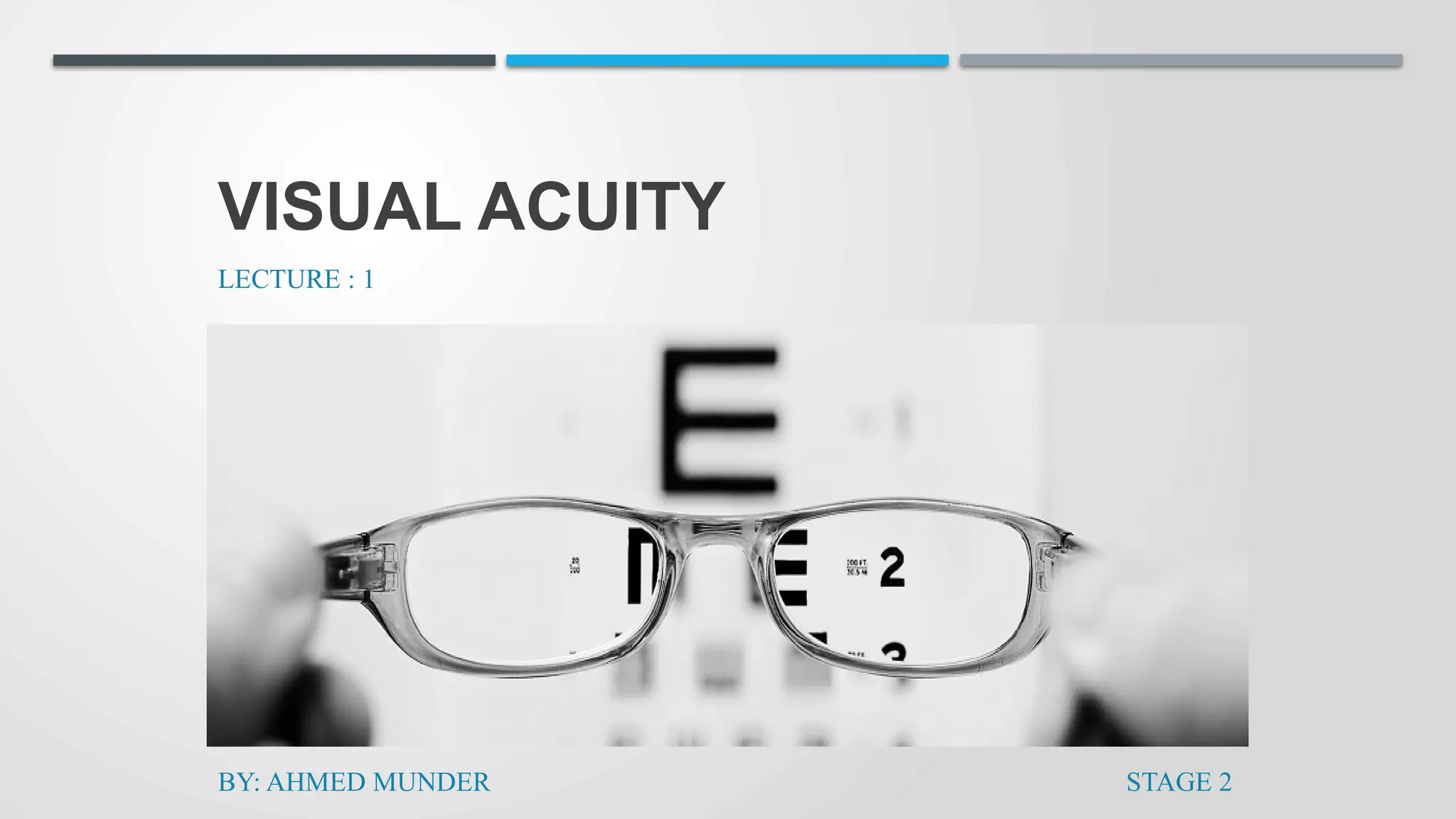
VISUAL ACUITY
LECTURE : 1
BY: AHMED MUNDER STAGE 2
DEFINITION
Acuity of vision is defined as the power of the eye to see a smallest object or letter
clearly and distinguishably at specified distances.
Visual acuity is the medical term for sharpness of vision. It deals with the sharpness or
discrimination of central vision, rather than the extent or clarity of peripheral vision.
FACTORS EFFECT ON VISUAL ACUITY
a) Diseases of eye
b) light sense
c) color sense
TYPES OF VISUAL ACUITY
1. Distant visual acuity
2. Near visual acuity
3. Pinhole visual acuity
DISTANT VISUAL ACUITY CHARTS
Distant visual acuity It is the ability of a person to distinguish an object or
letter whose rays are parallel and where no accommodation is required.
 In adults
a) Snellen’s chart
b) ETDRS chart (Log MAR chart)
 In illiterates
a) E - chart / pictures chart
b) Landolt’s broken rings chart
c) Multiple pictures chart
DISTANT VISUAL ACUITY CHARTS
 In children
a) Cake decorations
b) Teller acuity cards
c) Allen Picture cards
d) Sheridan Gardiner testing
e) Keeler’s preferential looking tests
f) Cardiff’s charts
DISTANT VISUAL ACUITY MAP
1) Snellen’s chart : six meters away
2) Count fingers ( CF ) : from three meters away to half meter
3) Hand movement ( HM ) : half meter
4) Perception of light ( PL) : PL+ or PL-
5) Projections of rays (PR) : accurate PR or inaccurate PR
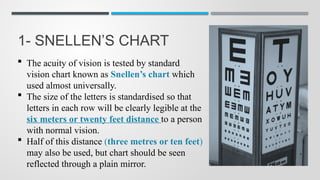
1- SNELLEN’S CHART
 The acuity of vision is tested by standard
vision chart known as Snellen’s chart which
used almost universally.
 The size of the letters is standardised so that
letters in each row will be clearly legible at the
six meters or twenty feet distance to a person
with normal vision.
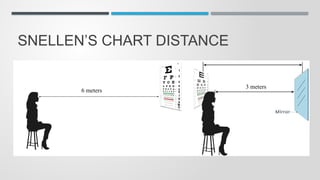
 Half of this distance (three metres or ten feet)
may also be used, but chart should be seen
reflected through a plain mirror.
SNELLEN’S CHART DISTANCE
6 meters
3 meters
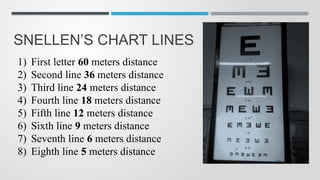
SNELLEN’S CHART LINES
1) First letter 60 meters distance
2) Second line 36 meters distance
3) Third line 24 meters distance
4) Fourth line 18 meters distance
5) Fifth line 12 meters distance
6) Sixth line 9 meters distance
7) Seventh line 6 meters distance
8) Eighth line 5 meters distance
GENERAL NOTES
 Each eye should be tested independently.
 The patient reads down the chart as far as he can and then this is repeated
with the other eye. Lastly both eyes are tested together.
 The right eye is tested conventionally first, except where the patient’s
complaint is particularly of defective left eye vision so it assessed first.
 If the visual acuities of the 2 eyes are about equal it is usually found that
they reinforce each other so that the binocular vision is slightly better
than the uniocular.
 Record the acuity value for each eye separately, with and without
correction (if patients wear glasses or contact lenses)
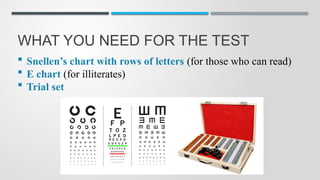
WHAT YOU NEED FOR THE TEST
 Snellen’s chart with rows of letters (for those who can read)
 E chart (for illiterates)
 Trial set
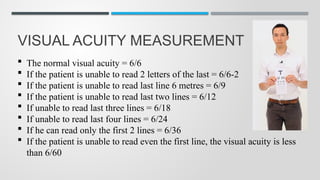
VISUAL ACUITY MEASUREMENT
 The normal visual acuity = 6/6
 If the patient is unable to read 2 letters of the last = 6/6-2
 If the patient is unable to read last line 6 metres = 6/9
 If the patient is unable to read last two lines = 6/12
 If unable to read last three lines = 6/18
 If unable to read last four lines = 6/24
 If he can read only the first 2 lines = 6/36
 If the patient is unable to read even the first line, the visual acuity is less
than 6/60
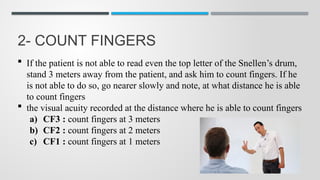
2- COUNT FINGERS
 If the patient is not able to read even the top letter of the Snellen’s drum,
stand 3 meters away from the patient, and ask him to count fingers. If he
is not able to do so, go nearer slowly and note, at what distance he is able
to count fingers
 the visual acuity recorded at the distance where he is able to count fingers
a) CF3 : count fingers at 3 meters
b) CF2 : count fingers at 2 meters
c) CF1 : count fingers at 1 meters
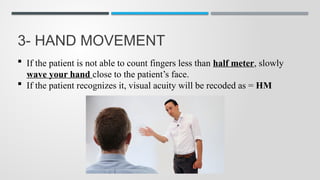
3- HAND MOVEMENT
 If the patient is not able to count fingers less than half meter, slowly
wave your hand close to the patient’s face.
 If the patient recognizes it, visual acuity will be recoded as = HM
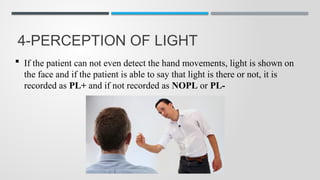
4-PERCEPTION OF LIGHT
 If the patient can not even detect the hand movements, light is shown on
the face and if the patient is able to say that light is there or not, it is
recorded as PL+ and if not recorded as NOPL or PL-
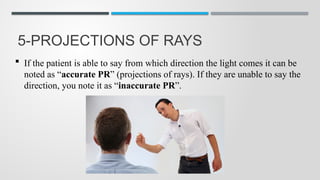
5-PROJECTIONS OF RAYS
 If the patient is able to say from which direction the light comes it can be
noted as “accurate PR” (projections of rays). If they are unable to say the
direction, you note it as “inaccurate PR”.
VISION ASSESSMENT FOR ILLITERATE
 Snellen’s chart is useful and most accurate in literate people above the
age of 6 years.
 For illiterates and children below 6 years of age other test charts based
on Snellen’s principles are useful.
 Test of Albini and Landlot’ broken ring test (C) is most useful in age
group above 4-6 years and in all illiterate people where patient is required
to show the direction in which the ring or legs of E are seen by them.
 It is important that the size of the symbols suitably corresponds to
Snellen’s letters and so the visual acuity is noted in the same manner.
VISION ASSESSMENT FOR CHILDREN
1) Allen picture card test
This test can be successfully used for the age group 3 to 4 years, it consists
of seven black and white line drawing of birth day cake, telephone,
horseman, teddy bear, automobile, house and tree, The child patient will be
shown at a closer distance so that he recognizes and identifies them.
Afterwards with the room fully illuminated these plates are then shown to
him from a distance of 6 metres.
2) New York light house flash card test
There are only 3 symbol flash cards with line drawings of open umbrella, an
apple and a house. These are printed on separate flash cards. The test is done
at a fixed distance of 3.60 metres
VISION ASSESSMENT FOR CHILDREN
3) Cake decoration
Small colored sweet balls of 1mm diameter are used to decorate cakes.This
is used to check the visual acuity of children. Twelve months old children
can pick up small objects and eat. Child is shown the cake decoration in
examiner’s or mother’s hand and encouraged to pick up and eat them. The
test is then repeated with only 1-2 sweet sugar balls after covering either eye
alternatively. Ability to see the sweet indicates the vision of 6/24 at the
testing distance.
VISION ASSESSMENT FOR CHILDREN
4) Keeler acuity test (preferential looking)
This test is based on the principle that a child prefers to look at pattern and
not plane surface.The child sits comfortably on the mother’s lap. The child is
shown a coarse grating card at 38cm. The examiner looking through a peep
hole, make the decision as to whether the child is looking at the grating. The
finest grating that the child prefers to look is taken as acuity limit
VISION ASSESSMENT FOR CHILDREN
5) Cardiff visual acuity test (vanishing Optotype)
The cards have six shapes which are easily recognisable (house, fish, dog,
duck, train) positioned either at the top or bottom half of a card . The cards
are caliberated to give visual acuity of equivalent of 20/20 to 20/200 at 1
metre viewing distance. When the child is comfortably seated the cards are
presented at eye level at a distance of 1 metre. The examiner watches the eye
movements towards the shape. If the child is looking at the shape, then the
next card is presented. This procedure is continued until no definite fixation
is observed. The test is performed at 1metre distance but altered to ½ metre
if the child is unable to see the first card.
VISION ASSESSMENT FOR CHILDREN
6) Sheridan gardiner test (matching test)
This test uses letters which children can recognize and copy at an early age.
The letters V T O H X A U are used and are shown to the child one at a time
on flip card. The child is given a key card showing all the letters and he has
to point the letter he sees. After explaining the procedure to the child the test
can be done at 6 metres or 3 metres. Sheriden Gardiner test is the most
accurate of the illiterate vision test in children.
QUIZ
 Define distant visual acuity ?
 Discuss meaning of (6/12-2) ?

Distant Visual acuity and Snellen chart Overview

  • 1.
    VISUAL ACUITY LECTURE :1 BY: AHMED MUNDER STAGE 2
  • 2.
    DEFINITION Acuity of visionis defined as the power of the eye to see a smallest object or letter clearly and distinguishably at specified distances. Visual acuity is the medical term for sharpness of vision. It deals with the sharpness or discrimination of central vision, rather than the extent or clarity of peripheral vision.
  • 3.
    FACTORS EFFECT ONVISUAL ACUITY a) Diseases of eye b) light sense c) color sense
  • 4.
    TYPES OF VISUALACUITY 1. Distant visual acuity 2. Near visual acuity 3. Pinhole visual acuity
  • 5.
    DISTANT VISUAL ACUITYCHARTS Distant visual acuity It is the ability of a person to distinguish an object or letter whose rays are parallel and where no accommodation is required.  In adults a) Snellen’s chart b) ETDRS chart (Log MAR chart)  In illiterates a) E - chart / pictures chart b) Landolt’s broken rings chart c) Multiple pictures chart
  • 6.
    DISTANT VISUAL ACUITYCHARTS  In children a) Cake decorations b) Teller acuity cards c) Allen Picture cards d) Sheridan Gardiner testing e) Keeler’s preferential looking tests f) Cardiff’s charts
  • 7.
    DISTANT VISUAL ACUITYMAP 1) Snellen’s chart : six meters away 2) Count fingers ( CF ) : from three meters away to half meter 3) Hand movement ( HM ) : half meter 4) Perception of light ( PL) : PL+ or PL- 5) Projections of rays (PR) : accurate PR or inaccurate PR
  • 8.
    1- SNELLEN’S CHART The acuity of vision is tested by standard vision chart known as Snellen’s chart which used almost universally.  The size of the letters is standardised so that letters in each row will be clearly legible at the six meters or twenty feet distance to a person with normal vision.  Half of this distance (three metres or ten feet) may also be used, but chart should be seen reflected through a plain mirror.
  • 9.
  • 10.
    SNELLEN’S CHART LINES 1)First letter 60 meters distance 2) Second line 36 meters distance 3) Third line 24 meters distance 4) Fourth line 18 meters distance 5) Fifth line 12 meters distance 6) Sixth line 9 meters distance 7) Seventh line 6 meters distance 8) Eighth line 5 meters distance
  • 11.
    GENERAL NOTES  Eacheye should be tested independently.  The patient reads down the chart as far as he can and then this is repeated with the other eye. Lastly both eyes are tested together.  The right eye is tested conventionally first, except where the patient’s complaint is particularly of defective left eye vision so it assessed first.  If the visual acuities of the 2 eyes are about equal it is usually found that they reinforce each other so that the binocular vision is slightly better than the uniocular.  Record the acuity value for each eye separately, with and without correction (if patients wear glasses or contact lenses)
  • 12.
    WHAT YOU NEEDFOR THE TEST  Snellen’s chart with rows of letters (for those who can read)  E chart (for illiterates)  Trial set
  • 13.
    VISUAL ACUITY MEASUREMENT The normal visual acuity = 6/6  If the patient is unable to read 2 letters of the last = 6/6-2  If the patient is unable to read last line 6 metres = 6/9  If the patient is unable to read last two lines = 6/12  If unable to read last three lines = 6/18  If unable to read last four lines = 6/24  If he can read only the first 2 lines = 6/36  If the patient is unable to read even the first line, the visual acuity is less than 6/60
  • 14.
    2- COUNT FINGERS If the patient is not able to read even the top letter of the Snellen’s drum, stand 3 meters away from the patient, and ask him to count fingers. If he is not able to do so, go nearer slowly and note, at what distance he is able to count fingers  the visual acuity recorded at the distance where he is able to count fingers a) CF3 : count fingers at 3 meters b) CF2 : count fingers at 2 meters c) CF1 : count fingers at 1 meters
  • 15.
    3- HAND MOVEMENT If the patient is not able to count fingers less than half meter, slowly wave your hand close to the patient’s face.  If the patient recognizes it, visual acuity will be recoded as = HM
  • 16.
    4-PERCEPTION OF LIGHT If the patient can not even detect the hand movements, light is shown on the face and if the patient is able to say that light is there or not, it is recorded as PL+ and if not recorded as NOPL or PL-
  • 17.
    5-PROJECTIONS OF RAYS If the patient is able to say from which direction the light comes it can be noted as “accurate PR” (projections of rays). If they are unable to say the direction, you note it as “inaccurate PR”.
  • 18.
    VISION ASSESSMENT FORILLITERATE  Snellen’s chart is useful and most accurate in literate people above the age of 6 years.  For illiterates and children below 6 years of age other test charts based on Snellen’s principles are useful.  Test of Albini and Landlot’ broken ring test (C) is most useful in age group above 4-6 years and in all illiterate people where patient is required to show the direction in which the ring or legs of E are seen by them.  It is important that the size of the symbols suitably corresponds to Snellen’s letters and so the visual acuity is noted in the same manner.
  • 19.
    VISION ASSESSMENT FORCHILDREN 1) Allen picture card test This test can be successfully used for the age group 3 to 4 years, it consists of seven black and white line drawing of birth day cake, telephone, horseman, teddy bear, automobile, house and tree, The child patient will be shown at a closer distance so that he recognizes and identifies them. Afterwards with the room fully illuminated these plates are then shown to him from a distance of 6 metres. 2) New York light house flash card test There are only 3 symbol flash cards with line drawings of open umbrella, an apple and a house. These are printed on separate flash cards. The test is done at a fixed distance of 3.60 metres
  • 20.
    VISION ASSESSMENT FORCHILDREN 3) Cake decoration Small colored sweet balls of 1mm diameter are used to decorate cakes.This is used to check the visual acuity of children. Twelve months old children can pick up small objects and eat. Child is shown the cake decoration in examiner’s or mother’s hand and encouraged to pick up and eat them. The test is then repeated with only 1-2 sweet sugar balls after covering either eye alternatively. Ability to see the sweet indicates the vision of 6/24 at the testing distance.
  • 21.
    VISION ASSESSMENT FORCHILDREN 4) Keeler acuity test (preferential looking) This test is based on the principle that a child prefers to look at pattern and not plane surface.The child sits comfortably on the mother’s lap. The child is shown a coarse grating card at 38cm. The examiner looking through a peep hole, make the decision as to whether the child is looking at the grating. The finest grating that the child prefers to look is taken as acuity limit
  • 22.
    VISION ASSESSMENT FORCHILDREN 5) Cardiff visual acuity test (vanishing Optotype) The cards have six shapes which are easily recognisable (house, fish, dog, duck, train) positioned either at the top or bottom half of a card . The cards are caliberated to give visual acuity of equivalent of 20/20 to 20/200 at 1 metre viewing distance. When the child is comfortably seated the cards are presented at eye level at a distance of 1 metre. The examiner watches the eye movements towards the shape. If the child is looking at the shape, then the next card is presented. This procedure is continued until no definite fixation is observed. The test is performed at 1metre distance but altered to ½ metre if the child is unable to see the first card.
  • 23.
    VISION ASSESSMENT FORCHILDREN 6) Sheridan gardiner test (matching test) This test uses letters which children can recognize and copy at an early age. The letters V T O H X A U are used and are shown to the child one at a time on flip card. The child is given a key card showing all the letters and he has to point the letter he sees. After explaining the procedure to the child the test can be done at 6 metres or 3 metres. Sheriden Gardiner test is the most accurate of the illiterate vision test in children.
  • 24.
    QUIZ  Define distantvisual acuity ?  Discuss meaning of (6/12-2) ?