Distance LearningTechnologies
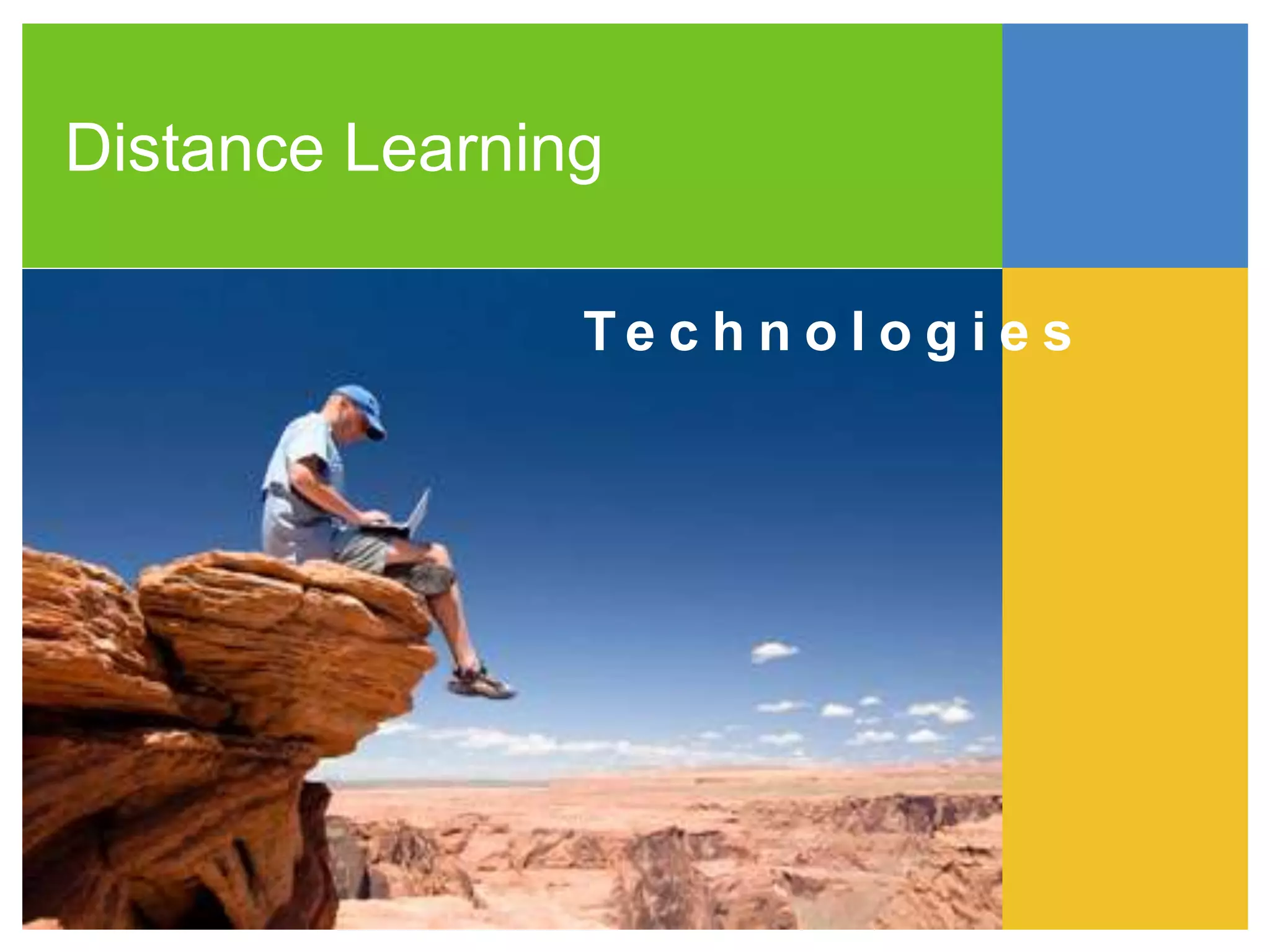
Learning AnywhereToday’s world is becoming more and more interconnected and mobile. One of the most attractive elements of distance learning is the ability to learn from anywhere. Mobile learning takes it the the highest level, allowing students to roam wherever their travels take them and still keep up with their education. This type of distance learning has really come to the forefront with the popularity of smartphones, netbooks, and tablet computers.
Learning AnywhereThis presentation will give you an overview of some of the major technologies available to you in your virtual classroom and their advantages and disadvantages.
Print TechnologiesThe original form of distance learning was correspondence courses, in which print materials were mailed to students and returned to the teachers through the postal system. Even though there are numerous new options for distance learning, print remains a significant component of most courses.Print materials may serve as the primary source of instruction, or they may be supplemental. As a primary source, distance students might use a textbook and read various units on a specific timetable. Other technologies, such as e-mail, could then be used to ask questions or send assignments back to the teacher.As a supplement to instruction, text materials may take the form of worksheets or study guides that are used in conjunction with video or voice technologies. It is important to note that the supplemental print materials may be disseminated via regular mail or over the Internet. In addition, fax machines are often used to transmit the print materials back and forth between the students and the teachers. There are many advantages and disadvantages to incorporating print materials.
Print TechnologiesMaterials are inexpensivePortableHigh comfort levelReadily accessibleAdvantages
Print TechnologiesNo interactionsLimited sensory involvementRequires reading skillsTime delayDisadvantages
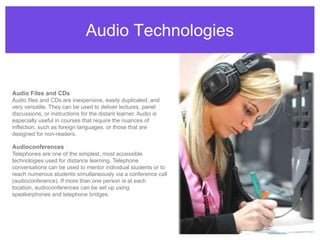
Audio TechnologiesAudio Files and CDsAudio files and CDs are inexpensive, easily duplicated, and very versatile. They can be used to deliver lectures, panel discussions, or instructions for the distant learner. Audio is especially useful in courses that require the nuances of inflection, such as foreign languages, or those that are designed for non-readers.AudioconferencesTelephones are one of the simplest, most accessible technologies used for distance learning. Telephone conversations can be used to mentor individual students or to reach numerous students simultaneously via a conference call (audioconference). If more than one person is at each location, audioconferences can be set up using speakerphones and telephone bridges.
Audio TechnologiesInexpensiveEasily accessibleEasily duplicatedEasy to useAdvantages
DisadvantagesNo visual cuesNo interactionScheduling issues planned in advanceRequires hardwareAudio Technologies
Online EducationOnline Collaboration: Internet Chat and ConferencingE-mail communications are asynchronous, meaning that they do not take place simultaneously. However, synchronous communications are possible through online chat, shared whiteboards, and videoconferences.Online chat refers to a two-way, interactive exchange on the Internet.Shared whiteboards are another form of collaboration of the Internet. If two or more people are connected to the Internet at the same time, they can communicate through graphic images on a shared whiteboard.Application sharing is an element of remote access, that enables two or more users to access a shared application or document from their respective computers simultaneously in real time. Generally, the shared application or document will be running on a host computer, and remote access to the shared content will be provided to other users by the host user.
Online EducationWeb-based coursesComputer mediated communication tools enable today’s distance learners to engage in collaborative problem-solving, threaded discussions, and peer tutoring through asynchronous distance learning environments. The authors suggest that these are best accomplished by establishing virtual learning communities, which break down traditional instructor-as-transmitter, learner-as-receiver roles and instead promote a more learner-driven environment. In virtual learning communities, members share mutual responsibility for each other’s learning.
Online EducationAdvantagesMay incorporate multimediaWorldwide accessInteractiveOffers synchronous and asynchronous learning
DisadvantagesOnline EducationRequires hardware and softwareMay be slowRequires web access
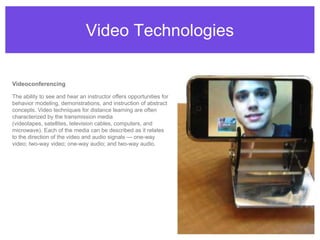
Video TechnologiesVideoconferencingThe ability to see and hear an instructor offers opportunities for behavior modeling, demonstrations, and instruction of abstract concepts. Video techniques for distance learning are often characterized by the transmission media (videotapes, satellites, television cables, computers, and microwave). Each of the media can be described as it relates to the direction of the video and audio signals — one-way video; two-way video; one-way audio; and two-way audio.
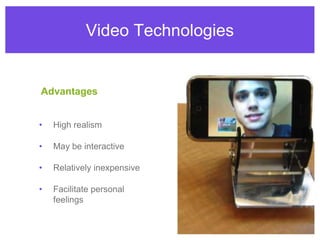
Video TechnologiesHigh realismMay be interactiveRelatively inexpensiveFacilitate personal feelingsAdvantages
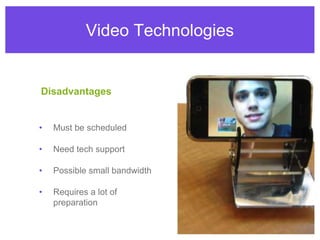
Must be scheduledNeed tech supportPossible small bandwidthRequires a lot of preparationDisadvantagesVideo Technologies
  Distance LearningTechnologies
Distance learningtechnologies

Distance learningtechnologies

  • 1.
    DistanceLearningTechnologies
  • 2.
    Learning AnywhereToday’s worldis becoming more and more interconnected and mobile. One of the most attractive elements of distance learning is the ability to learn from anywhere. Mobile learning takes it the the highest level, allowing students to roam wherever their travels take them and still keep up with their education. This type of distance learning has really come to the forefront with the popularity of smartphones, netbooks, and tablet computers.
  • 3.
    Learning AnywhereThis presentationwill give you an overview of some of the major technologies available to you in your virtual classroom and their advantages and disadvantages.
  • 4.
    Print TechnologiesThe originalform of distance learning was correspondence courses, in which print materials were mailed to students and returned to the teachers through the postal system. Even though there are numerous new options for distance learning, print remains a significant component of most courses.Print materials may serve as the primary source of instruction, or they may be supplemental. As a primary source, distance students might use a textbook and read various units on a specific timetable. Other technologies, such as e-mail, could then be used to ask questions or send assignments back to the teacher.As a supplement to instruction, text materials may take the form of worksheets or study guides that are used in conjunction with video or voice technologies. It is important to note that the supplemental print materials may be disseminated via regular mail or over the Internet. In addition, fax machines are often used to transmit the print materials back and forth between the students and the teachers. There are many advantages and disadvantages to incorporating print materials.
  • 5.
    Print TechnologiesMaterials areinexpensivePortableHigh comfort levelReadily accessibleAdvantages
  • 6.
    Print TechnologiesNo interactionsLimitedsensory involvementRequires reading skillsTime delayDisadvantages
  • 7.
    Audio TechnologiesAudio Filesand CDsAudio files and CDs are inexpensive, easily duplicated, and very versatile. They can be used to deliver lectures, panel discussions, or instructions for the distant learner. Audio is especially useful in courses that require the nuances of inflection, such as foreign languages, or those that are designed for non-readers.AudioconferencesTelephones are one of the simplest, most accessible technologies used for distance learning. Telephone conversations can be used to mentor individual students or to reach numerous students simultaneously via a conference call (audioconference). If more than one person is at each location, audioconferences can be set up using speakerphones and telephone bridges.
  • 8.
  • 9.
    DisadvantagesNo visual cuesNointeractionScheduling issues planned in advanceRequires hardwareAudio Technologies
  • 10.
    Online EducationOnline Collaboration:Internet Chat and ConferencingE-mail communications are asynchronous, meaning that they do not take place simultaneously. However, synchronous communications are possible through online chat, shared whiteboards, and videoconferences.Online chat refers to a two-way, interactive exchange on the Internet.Shared whiteboards are another form of collaboration of the Internet. If two or more people are connected to the Internet at the same time, they can communicate through graphic images on a shared whiteboard.Application sharing is an element of remote access, that enables two or more users to access a shared application or document from their respective computers simultaneously in real time. Generally, the shared application or document will be running on a host computer, and remote access to the shared content will be provided to other users by the host user.
  • 11.
    Online EducationWeb-based coursesComputermediated communication tools enable today’s distance learners to engage in collaborative problem-solving, threaded discussions, and peer tutoring through asynchronous distance learning environments. The authors suggest that these are best accomplished by establishing virtual learning communities, which break down traditional instructor-as-transmitter, learner-as-receiver roles and instead promote a more learner-driven environment. In virtual learning communities, members share mutual responsibility for each other’s learning.
  • 12.
    Online EducationAdvantagesMay incorporatemultimediaWorldwide accessInteractiveOffers synchronous and asynchronous learning
  • 13.
    DisadvantagesOnline EducationRequires hardwareand softwareMay be slowRequires web access
  • 14.
    Video TechnologiesVideoconferencingThe abilityto see and hear an instructor offers opportunities for behavior modeling, demonstrations, and instruction of abstract concepts. Video techniques for distance learning are often characterized by the transmission media (videotapes, satellites, television cables, computers, and microwave). Each of the media can be described as it relates to the direction of the video and audio signals — one-way video; two-way video; one-way audio; and two-way audio.
  • 15.
    Video TechnologiesHigh realismMaybe interactiveRelatively inexpensiveFacilitate personal feelingsAdvantages
  • 16.
    Must be scheduledNeedtech supportPossible small bandwidthRequires a lot of preparationDisadvantagesVideo Technologies
  • 17.
    DistanceLearningTechnologies